
Best Practices for Radiology Data Security: The 2026 Checklist
The average healthcare data breach now costs a staggering $6.64 million in 2026. For radiology practices, this isn’t just a financial metric; it’s a daily source of anxiety as you manage massive imaging files across complex networks. Implementing the best practices for radiology data security has shifted from a standard IT goal to a critical survival strategy. You know that your PACS and RIS integrations must be airtight, yet the technical complexity of modernizing these workflows often feels like a moving target.
We understand the pressure to eliminate vulnerabilities during remote image sharing while avoiding the massive HIPAA fines that follow a single oversight. It’s time to replace that uncertainty with a proactive, modern framework that protects both your patients and your practice. This article provides a clear, actionable checklist to master the technical and administrative safeguards required for 2026 regulatory standards. We’ll examine mandatory encryption, multi-factor authentication, and the specific audit steps needed to secure your modern imaging ecosystem.
Key Takeaways
- Implement the latest technical safeguards, including AES-256 encryption and mandatory Multi-Factor Authentication, to protect your clinical and administrative logins.
- Identify and close security loopholes created by physical media like CDs and USB drives by transitioning to secure, cloud-based sharing platforms like SMAART-SHARE.
- Master the best practices for radiology data security by integrating your RIS and PACS to minimize manual data entry errors and reduce exposure points.
- Ensure long-term HIPAA compliance by conducting annual Security Risk Assessments and testing formal Incident Response Plans to stay ahead of 2026 regulatory shifts.
- Future-proof your diagnostic workflow with scalable cloud storage that maintains data integrity while supporting seamless, secure teleradiology protocols.
Understanding the Radiology Data Security Landscape in 2026
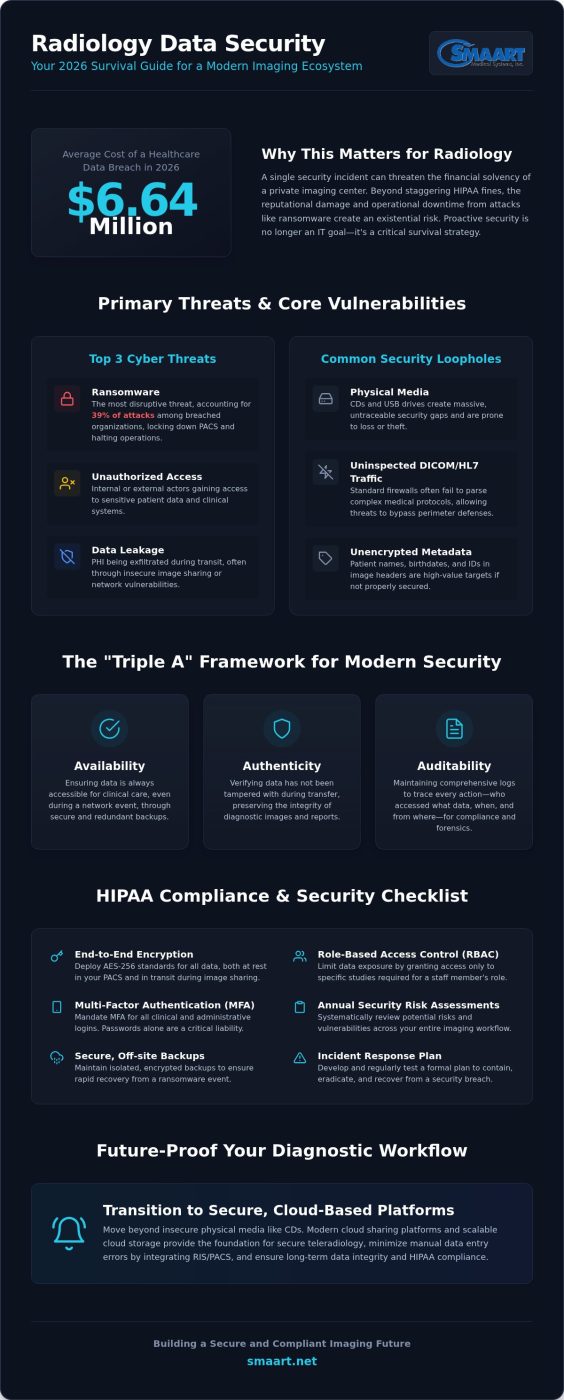
Radiology data security isn’t just about locking a digital door; it’s about protecting the sensitive Protected Health Information (PHI) housed within DICOM images and HL7 messages. As the field of Imaging informatics evolves, the complexity of managing these systems grows alongside the sophistication of cyber threats. In 2026, the primary risks facing your practice include ransomware, unauthorized access, and data leakage during transit. Cybercriminals target radiology departments specifically because of the high density of patient data stored in a single study. A single CT scan contains more valuable metadata than dozens of standard medical records, making it a high-value target for identity theft and extortion.
To secure your facility, you must achieve the “Triple A” of security: Availability, Authenticity, and Auditability. You need your data accessible when a patient is on the table, verified as untampered through every transfer, and fully traceable so you know exactly who accessed what and when. Balancing these three pillars is the foundation of modern best practices for radiology data security.
The Cost of Non-Compliance
Financial risks have reached a breaking point. With the average healthcare data breach cost hitting $6.64 million in 2026, a single incident can threaten the solvency of a private imaging center. HIPAA penalty tiers remain aggressive. Fines range from $100 to $50,000 per violation per day, depending on the level of negligence. Beyond the federal fines, the reputational damage is often permanent. Patients won’t return to a facility they don’t trust with their private images. Additionally, consider the operational cost of downtime. Ransomware accounts for 39% of attacks among breached organizations, and if your PACS is locked, your revenue stops immediately while your overhead continues to climb. Beyond healthcare, maintaining fiscal integrity requires specialized software for transaction simulation, and you can learn more about these technical systems.
DICOM and HL7: Unique Vulnerabilities
Standard firewalls often struggle to inspect DICOM traffic effectively. They recognize the connection but can’t always parse the complex data structures within the protocol, allowing threats to slip through undetected. This leaves unencrypted metadata in medical image headers vulnerable to scraping. These headers contain patient names, birthdates, and internal IDs that are often overlooked during basic security sweeps. Integration points between your PACS and EMR are also notorious weak links. If these systems don’t communicate through secure, encrypted channels, they create seams where data can be intercepted. Implementing best practices for radiology data security requires looking past the perimeter and securing the data at every integration point.
Technical Security Controls: A PACS and RIS Checklist
Implementing best practices for radiology data security requires a move from basic perimeter defense to deep technical safeguards. Your infrastructure must protect data at every stage of the imaging lifecycle. As emphasized in the UNC Radiology Security Guidelines, technical controls shouldn’t just exist; they must be actively managed to prevent unauthorized lateral movement within your network. Use this checklist to evaluate your current technical posture:
- End-to-End Encryption: Deploy AES-256 standards for all data at rest and in transit. This ensures that even if a packet is intercepted, the PHI remains unreadable.
- Multi-Factor Authentication (MFA): Enforce MFA for every clinical and administrative login. Relying on passwords alone is a liability in 2026.
- Role-Based Access Control (RBAC): Limit data exposure by granting access only to the specific studies or patient files required for a staff member’s role.
- Comprehensive Audit Logs: Track every action, including image views, edits, and exports. These logs are vital for both HIPAA compliance and post-incident forensics.
- Secure Backups: Maintain regular, encrypted backups stored off-site or in an isolated cloud environment to ensure rapid recovery after a ransomware event.
Securing the PACS Environment
When configuring SMAART-PACS, start by securing your DICOM nodes. You should only allow connections from known, verified IP addresses and AE titles. This prevents rogue devices from querying your database. We highly recommend using “Zero-Footprint” viewers. These web-based tools are essential because they don’t cache sensitive data on local diagnostic workstations, significantly reducing the risk of data theft if a physical device is lost. Don’t forget regular patch management. Keeping your workstation OS and diagnostic software updated is the simplest way to close known security gaps. For those seeking a more streamlined approach, integrated RIS/PACS platforms often handle these updates with less manual intervention.
RIS Data Integrity and Scheduling Security
Your RIS contains a goldmine of scheduling and demographic data that requires its own set of protections. In SMAART-RIS, you can set strict permissions to prevent unauthorized bulk exports of patient lists, which is a common vector for data leakage. Securing HL7 interfaces between your RIS and hospital billing systems is equally critical. These connections should be encrypted to prevent “man-in-the-middle” attacks during data exchange. SMAART-RIS ensures data consistency across the EMR interface by utilizing automated HL7 synchronization that updates patient records in real-time. This precision doesn’t just improve billing; it eliminates the security risks associated with manual data entry and mismatched patient identities.
Securing Image Sharing: Moving Beyond Radiology CDs
Moving data outside your facility is often the most vulnerable point in the imaging lifecycle. While internal servers are protected by firewalls, physical media like CDs and USB drives create a massive security loophole. These legacy methods fail to meet the ACR Technical Standard for Electronic Practice of Medical Imaging, which emphasizes the need for secure, traceable data transfer. Transitioning to digital sharing is no longer just a convenience; it’s one of the most effective best practices for radiology data security.
The Risks of Physical Media
Physical media lacks the fundamental security controls required in a modern clinical environment. Most CDs burned for patients are unencrypted, meaning any lost or stolen disc results in an immediate HIPAA violation. You can’t track who viewed the images or where the disc ended up once it left your front desk. Mailing records adds another layer of risk, introducing a multi-day security lag where sensitive PHI is completely outside your control. Without a digital audit trail, your practice remains blind to potential data leakage during transit.
Cloud-Based Sharing: SMAART-SHARE Security Features
SMAART-SHARE eliminates these vulnerabilities by centralizing external distribution through a secure cloud gateway. Instead of burning a disc, you generate time-limited access links protected by secure authentication. This ensures that only the intended recipient can view the study. One of the most powerful advantages is the ability to revoke access instantly. If a referring physician’s partnership ends or a link is accidentally sent to the wrong recipient, you can kill the connection with one click. This level of control is impossible with physical media.
Using a secure web portal for patients and physicians streamlines the workflow while maintaining high security standards. These portals should require Multi-Factor Authentication, ensuring that best practices for radiology data security extend to every external touchpoint. By moving beyond physical media, you gain total visibility over your data. You move from a “burn and forget” model to a fully auditable, encrypted ecosystem. This shift significantly reduces your liability and provides the relief of knowing your patient data is protected even after it leaves your local network.
Administrative and Operational Best Practices
Administrative protocols are the human firewall of your practice. While technical controls lock the data, operational best practices for radiology data security ensure that your team doesn’t accidentally hand over the keys. HIPAA mandates an annual Security Risk Assessment (SRA) to identify gaps before they become breaches. This isn’t just a box-ticking exercise. It’s a strategic review of how your data flows through your facility. You should also implement a rigorous vendor management program. In 2026, your software providers are your biggest allies or your greatest liabilities. Partnering with a provider like SMAART ensures your PACS and RIS are built on a foundation of compliance, reducing the burden on your internal IT staff.
Bring Your Own Device (BYOD) policies are another critical area. If radiologists use personal tablets or phones to view studies, those devices must be managed through secure containers and remote-wipe capabilities. Without clear policies, a single lost phone can trigger a reportable event. Establishing these boundaries early protects both the clinician and the organization.
Staff Training and Awareness
Phishing attacks have evolved rapidly. AI-driven social engineering is now 56% more common than it was just a year ago. Your staff needs regular phishing simulations to stay sharp. Training should also cover the specific security features of SMAART-PACS and SMAART-RIS. For instance, tech staff should know how to verify audit logs and manage user permissions effectively. Finally, enforce a “Clean Desk” policy. Leaving a workstation logged into a patient’s PET scan while grabbing coffee is a simple but dangerous oversight that leads to unauthorized access.
Incident Response: A 4-Step Framework
The mean time to identify and contain a breach is 247 days. A formal Incident Response Plan (IRP) shrinks this window and limits the damage. Follow this framework to maintain control during a security event:
- Step 1: Identification and Containment. Detect the event and isolate affected systems immediately to prevent lateral movement.
- Step 2: Eradication and Recovery. Remove the threat and restore radiology systems from secure, off-site backups.
- Step 3: Notification. Follow HIPAA protocols to notify patients and the HHS within the required legal timelines.
- Step 4: Post-Incident Analysis. Conduct a “lessons learned” session to identify how the breach occurred and strengthen the radiology workflow against future threats.
Ready to simplify your compliance journey? Explore how SMAART Medical Systems integrates these administrative safeguards into your daily workflow.
Future-Proofing Your Radiology Workflow with SMAART
Securing a radiology practice in 2026 demands more than just patching old holes. It requires a cohesive ecosystem where security isn’t an afterthought but a foundational element of the workflow. Moving from fragmented legacy systems to an integrated platform is one of the most effective best practices for radiology data security. When your RIS and PACS speak the same language, you eliminate the “seams” where data often leaks. SMAART Medical Systems designs these tools to provide elite security features without the bloated costs typically associated with industry giants. This approach offers immediate relief to administrators who are tired of managing complex, disconnected software stacks.
The Advantage of Integration
Managing a dozen different vendors creates a nightmare for security audits. Each new interface is a potential point of failure. By consolidating your workflow, you simplify your audit trail and ensure that user permissions remain consistent across the entire diagnostic chain. SMAART-PACS and SMAART-RIS work together to maintain total HL7 and DICOM consistency, ensuring that patient data isn’t just secure, but also accurate. SMAART-SHARE provides an affordable path to secure interoperability, and for organizations needing deeper custom connections, MEDITIL provides expert guidance on strategic data integration. This level of synchronization reduces the manual data entry that often leads to accidental PHI exposure. You gain a single point of accountability, which is vital when you need to respond quickly to a potential security event or regulatory inquiry.
As your volume increases, your security risks scale alongside your patient count. You need a platform that grows with you. Cloud-based storage and sharing reduce the local IT burden, shifting the heavy lifting of encryption and server maintenance to a secure, professionally managed environment. This allows your team to focus on clinical excellence rather than server patches. Transitioning from a legacy system to a modern platform is a significant step toward relief from the constant fear of a HIPAA breach. It’s about building a foundation that stays compliant even as regulations evolve.
We prioritize making full-featured security accessible to clinics of all sizes. You shouldn’t have to choose between financial health and data integrity. Our proprietary software is designed for modern diagnostic workflows, ensuring that every integration point is hardened against unauthorized access. If you’re ready to modernize your workflow and close the gaps in your current system, schedule a security-focused demo of our radiology management solutions. Our team will show you how integrated tools provide the confidence you need to manage patient data in a high-risk landscape.
Securing Your Practice for the Next Era of Imaging
The shift toward more stringent cybersecurity in 2026 isn’t just a regulatory hurdle; it’s an opportunity to modernize your entire diagnostic environment. By moving away from unencrypted physical media and embracing integrated, cloud-based workflows, you eliminate the most common points of failure in patient data management. Implementing best practices for radiology data security, from mandatory Multi-Factor Authentication to deep DICOM encryption, provides the operational relief your team needs to focus on patient outcomes rather than audit fears.
You don’t have to navigate these technical complexities alone. Our solutions feature a HIPAA-compliant architecture and seamless EMR/HIS integration to handle the heavy lifting of data protection. We offer an affordable, full-feature suite including PACS, RIS, and Cloud Sharing tools designed specifically for modern diagnostic demands. It’s time to replace legacy vulnerabilities with a platform that prioritizes both security and fiscal responsibility.
Explore Secure Radiology Management Solutions from SMAART Medical Systems and discover how we can help you future-proof your facility. Your path to a secure, efficient workflow starts with a partner who understands the specific pressures of today’s healthcare environment.
Frequently Asked Questions
Is cloud-based radiology image sharing more secure than using CDs?
Yes, cloud-based sharing is significantly more secure than physical media. CDs are rarely encrypted and easily lost, creating a massive HIPAA liability. Cloud platforms like SMAART-SHARE utilize end-to-end encryption and grant you the ability to revoke access instantly. This modern approach ensures that sensitive images are only viewed by authorized recipients, providing a level of control and visibility that physical discs simply cannot match.
What are the minimum HIPAA requirements for radiology data encryption?
Current 2026 standards move toward mandatory encryption for all ePHI. This includes AES-256 for data at rest on your servers and TLS 1.2 or higher for data in transit. Adopting best practices for radiology data security means treating encryption as a requirement rather than an addressable option. These safeguards ensure that even if data is intercepted, the underlying patient information remains unreadable and protected from unauthorized exploitation.
How does SMAART-PACS ensure DICOM data security?
SMAART-PACS secures DICOM traffic through a multi-layered approach. It restricts connections to verified IP addresses and AE titles, preventing rogue devices from querying your database. The system also utilizes zero-footprint viewers to prevent sensitive data from being cached on local workstations. These features, combined with built-in encryption, ensure that your diagnostic images remain protected from the moment they’re acquired until they are securely archived or shared.
Can MFA be implemented without slowing down the radiologist’s workflow?
Yes, MFA doesn’t have to hinder clinical speed. Modern implementations use biometrics or push notifications on mobile devices that take only seconds to complete. When integrated with Single Sign-On (SSO) within your SMAART environment, clinicians can move between applications seamlessly without repeatedly entering credentials. This balance of security and speed is essential for maintaining high diagnostic throughput while protecting your network from unauthorized access attempts.
What should I do if my radiology clinic is hit with ransomware?
If ransomware strikes, you must immediately isolate affected systems to prevent the malware from spreading. Notify your IT security team and activate your formal Incident Response Plan. You shouldn’t pay the ransom; instead, rely on your secure, off-site backups to restore your PACS and RIS data. Promptly identifying the breach and containing it is the most effective way to minimize downtime and protect your practice’s long-term reputation.
How often should a radiology practice perform a security audit?
You should perform a formal Security Risk Assessment (SRA) at least once a year to remain HIPAA compliant. However, best practices for radiology data security suggest conducting vulnerability scans every six months and penetration testing annually. Regular audits help you identify new technical gaps as your workflow evolves. Staying proactive ensures that your security posture remains resilient against the rapidly shifting threat landscape of the modern healthcare industry.
Does SMAART-SHARE provide an audit trail for shared medical images?
Yes, SMAART-SHARE provides a comprehensive audit trail for every shared study. The system logs exactly who generated an access link, who viewed the images, and when the data was accessed. This level of transparency is vital for compliance and forensic investigations. You can monitor external sharing activity in real-time, giving you the confidence that your patient data is being handled according to your facility’s strict privacy policies.
Is it possible to integrate SMAART software with my existing EMR securely?
Absolutely. SMAART software is designed to integrate seamlessly and securely with your existing EMR or HIS. We utilize encrypted HL7 interfaces to synchronize patient data and scheduling information without creating new vulnerabilities. This integration reduces manual data entry errors and ensures that patient records remain consistent across your entire organization. Our team focuses on creating a unified, secure ecosystem that supports your clinical goals without compromising data integrity.