
Enterprise PACS Solutions: The Shift to Cloud Based Medical Imaging Storage in 2026
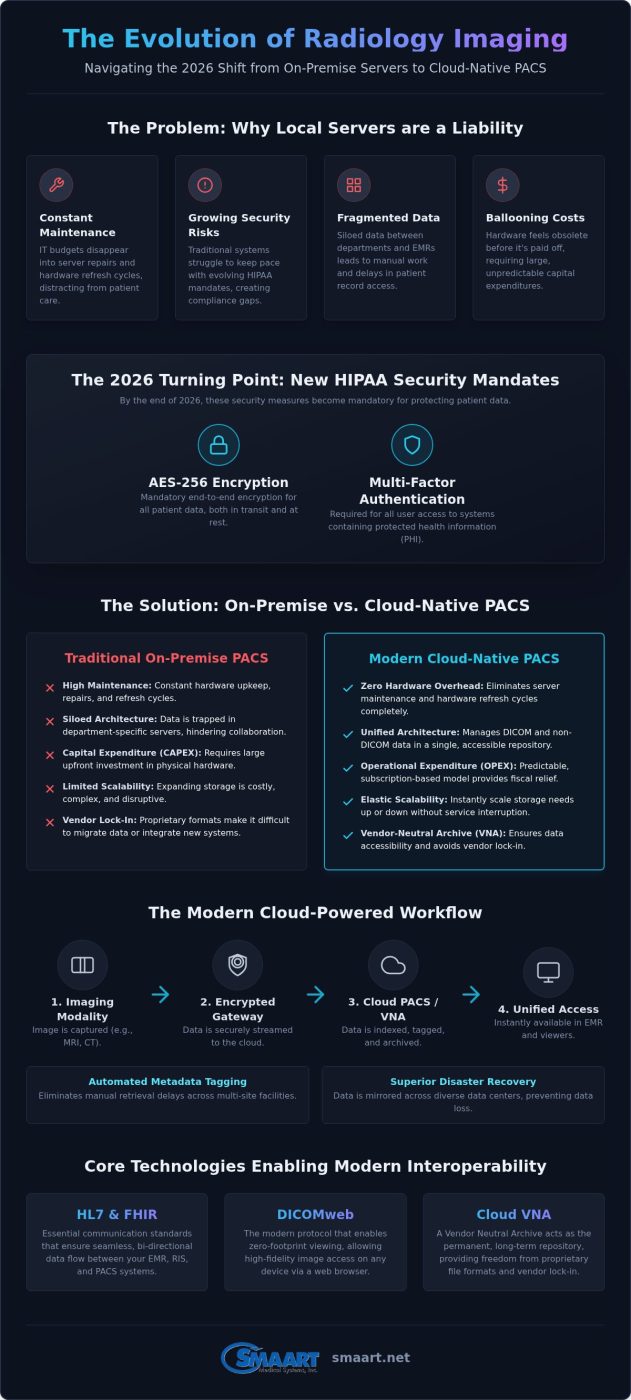
By the end of 2026, the local server humming in your basement won’t just be a maintenance headache; it will be a liability. As HIPAA mandates shift toward mandatory AES-256 encryption and multi-factor authentication, traditional enterprise PACS solutions are struggling to keep pace without ballooning costs. You’ve likely felt the strain of managing hardware that feels obsolete before it’s even paid off, all while trying to bridge the gap between siloed data and your EMR.
It’s frustrating to watch your IT budget disappear into server repairs when your primary focus is patient care. We understand that the transition to cloud-native imaging feels like a massive undertaking, but it’s actually the most direct path to operational relief. In this guide, you’ll learn how modern enterprise PACS and cloud storage transform radiology workflows by eliminating hardware overhead and ensuring seamless clinical interoperability. We’ll explore the move toward hardware-free distribution and how to stay ahead of the 2026 regulatory requirements without the usual complexity.
Key Takeaways
- Modern enterprise PACS solutions are shifting from siloed on-premise servers toward elastic cloud environments to manage both DICOM and non-DICOM data effectively.
- Learn how automated metadata tagging and streamlined data ingestion eliminate manual retrieval delays across multi-site facilities.
- Discover the fiscal relief of moving from high-maintenance hardware refresh cycles to predictable, subscription-based storage models.
- Understand the 2026 HIPAA security updates, including mandatory AES-256 encryption and multi-factor authentication requirements for protecting patient data.
- See how SMAART-PACS and SMAART-SHARE provide a scalable, hardware-free path to clinical interoperability and EMR integration.
What are Enterprise PACS Solutions in 2026?
The traditional Picture archiving and communication system (PACS) has undergone a radical transformation. By 2026, enterprise PACS solutions have evolved from simple storage repositories into centralized, cloud-native ecosystems. This shift represents a move away from the rigid, siloed on-premise servers that once tethered radiology departments to specific physical locations. Today’s elastic cloud environments allow facilities to scale their storage needs instantly, accommodating both DICOM and non-DICOM data within a single, unified architecture.
This evolution isn’t just about storage; it’s about clinical interoperability. The 2026 industry standards prioritize vendor-neutrality, ensuring that patient data remains accessible regardless of which modality or software generated the original image. A cloud-based Vendor Neutral Archive (VNA) now serves as the backbone of this modernization. It allows diverse medical data sets to be shared across entire health systems without the friction of proprietary file formats. This provides a level of technical freedom that helps administrators avoid the trap of vendor lock-in.
The Core Components: PACS vs. VNA in the Cloud
In a modern cloud ecosystem, the distinction between a PACS and a VNA is clearer than ever. While a PACS focuses on the immediate radiology workflow, including image interpretation and reporting, the VNA acts as the permanent, long-term repository. Hybrid cloud models have become the transition standard for hospitals in 2026, balancing the need for rapid local access with the security and scalability of the cloud. This dual approach provides the relief of reduced hardware maintenance while maintaining the high-speed performance clinicians require for daily diagnostic tasks. It’s a pragmatic way to modernize without a complete “rip and replace” of existing infrastructure.
Key Technologies Driving 2026 Imaging Storage
The technical engine behind these systems relies on advanced communication protocols. HL7 and FHIR are now essential standards that facilitate seamless communication between your EMR and PACS, ensuring that clinical data flows without interruption. DICOMweb is the protocol enabling zero-footprint viewing. With the release of the DICOM 2026c standard in July 2026, these protocols now offer even greater efficiency for streaming massive data sets across distributed networks. This ensures that a radiologist in a remote clinic sees the same high-fidelity image as a specialist in a major urban hospital, with zero latency issues.
The Technical Mechanism: How Cloud Storage Powers Radiology
Moving images from a modality to a secure cloud environment isn’t just a simple file transfer; it’s a sophisticated data ingestion pipeline. Modern enterprise PACS solutions use encrypted gateways to stream DICOM data directly into a vendor-neutral cloud PACS architecture. During this ingestion phase, the system performs automated metadata tagging. Every scan is indexed with specific patient demographics and study types. This allows for near-instant retrieval across multi-site facilities, regardless of where the original image was captured.
For facilities in remote areas, edge computing plays a critical role in reducing latency. By caching frequently accessed studies locally while the primary copy resides in the cloud, diagnostic viewing speeds remain consistently high. This architecture also provides a level of redundancy that legacy systems can’t match. Cloud environments offer superior disaster recovery compared to traditional tape-based backups. Your data is mirrored across geographically diverse data centers, ensuring that a local hardware failure never results in data loss. This shift provides the peace of mind that comes with knowing patient data is both accessible and immutable.
Seamless EMR and HIS Integration
SMAART-PACS interfaces directly with your Electronic Medical Records (EMR) to ensure that when a clinician opens a patient file, the relevant images are immediately available. We eliminate the “Image Silo” by creating a unified patient record that follows the individual across departments. Bi-directional data flow between your RIS and PACS means that scheduling updates, order status, and diagnostic reports sync instantly. This level of modern EMR integration provides immediate relief for busy administrative teams who are tired of manual data entry and fragmented workflows.
Zero-Footprint Viewing and Diagnostic Speed
Modern radiology workstations no longer require heavy, specialized local software installations. Zero-footprint viewers allow radiologists to manage high-resolution DICOM files through a standard web browser. These systems use advanced bandwidth optimization techniques, such as progressive loading and server-side rendering, to display diagnostic-quality images even on standard internet connections. It’s about maintaining diagnostic speed without the technical overhead of local app management. This flexibility allows your team to provide high-quality care from any location, effectively future-proofing your facility’s workflow for 2026 and beyond.
Cloud vs. Local Storage: The Fiscal and Efficiency Reality
Choosing between local and cloud storage is often framed as a technical debate, but it’s ultimately a financial decision. Traditional on-premise enterprise PACS solutions require significant capital expenditure (CapEx) for servers that begin depreciating the moment they’re installed. In contrast, cloud-native models shift these costs to a predictable operational expenditure (OpEx) subscription. This transition provides immediate fiscal relief by aligning your technology costs with your actual patient volume.
Local servers come with a long list of hidden expenses that quickly erode a facility’s budget. These costs are rarely just about the hardware itself. To maintain a reliable on-site environment, you must account for:
- 24/7 electricity and industrial-grade cooling systems.
- Dedicated physical space that could otherwise be used for clinical services.
- Routine hardware refresh cycles, typically every three to five years.
- Constant security patching and firmware updates to stay compliant.
Cloud environments eliminate the need to over-provision. Many facilities buy more server capacity than they need just to prepare for future growth, effectively paying for “empty” storage. Modern enterprise PACS solutions allow you to pay for actual consumption. This scalability ensures you aren’t penalized for growing your practice. It also reduces the burden on your internal IT staff. When you move to a SaaS model, the vendor handles the backend maintenance, allowing your team to focus on high-value clinical support rather than troubleshooting failed hard drives.
Reducing Radiology Overhead with Modern Software
The shift to cloud-native software like SMAART-SHARE removes the reliance on expensive proprietary hardware for image distribution. Instead of burning CDs or maintaining physical media stations, your staff can automate image distribution to referring physicians with a few clicks. This saves hours of administrative time every week and cuts the costs associated with physical mailing and hardware maintenance. While on-premise solutions incur escalating maintenance and refresh costs, the 5-year TCO for cloud storage remains significantly lower due to the elimination of physical infrastructure and reduced administrative labor.
Efficiency Gains in the Diagnostic Workflow
Centralized data access is the key to reducing time-to-report, especially in health systems with multiple locations. Remote radiologists no longer have to wait for massive files to download over a VPN. They can access diagnostic-quality images instantly through the cloud. SMAART-SHARE further enhances this workflow by facilitating collaborative viewing. Specialists can provide instant second opinions without needing to be in the same room or even the same city. For multi-site clinic management, this unified storage approach ensures that a patient’s entire imaging history is available at every touchpoint, creating a seamless experience for both the provider and the patient.
Security and Compliance: Protecting Patient Data in 2026
In 2026, security isn’t just a checkbox. It’s a survival mechanism. As the HIPAA Security Rule undergoes its most significant update in years, encryption of stored ePHI has moved from an “addressable” status to a strictly mandatory technical safeguard. Modern enterprise PACS solutions must now utilize AES-256 standards for all data at rest and end-to-end encryption for every transfer. This shift provides a much-needed layer of protection against the sophisticated cyber threats that target healthcare infrastructure. It’s about more than just avoiding fines; it’s about the relief of knowing your facility’s reputation is secure.
Access control has also become more rigorous. The 2026 mandate for multi-factor authentication (MFA) applies to every user accessing ePHI systems, regardless of their location. Combined with role-based access control (RBAC), this ensures that clinical data is only visible to those who truly need it for patient care. To maintain full regulatory protection, your system must generate comprehensive audit trails. These logs track every instance of image access, providing an immutable record that is essential for both legal defense and internal quality reviews. If you’re ready to modernize your security posture, request a compliance audit for your imaging workflow today.
Cybersecurity for Radiology: Beyond the Firewall
Ransomware protection is the primary concern for health system administrators in 2026. Cloud-native backups offer the ultimate defense because they provide isolated, immutable copies of your data that are unreachable from the local network. Under the newest HIPAA updates, Business Associate Agreements (BAAs) now require a 72-hour system recovery capability for critical operations. Partnering with a vendor that maintains SOC2 Type II certification ensures these recovery protocols are tested and verified annually.
The End of the Radiology CD: Secure Cloud Sharing
Physical media like CDs and USB drives are a security risk and a financial drain. They’re easily lost, frequently unreadable, and cost thousands of dollars in administrative labor every year. Transitioning to QR code-based sharing or secure portals represents a massive leap forward for patient privacy. The SMAART-SHARE model enables this hardware-free distribution, allowing patients and referring physicians to access images through secure, encrypted links. This eliminates the need for physical media while ensuring that every shared image remains within your facility’s secure compliance umbrella.
Modernizing Your Facility with SMAART Scalable Solutions
SMAART Medical Systems, Inc. bridges the gap between elite functionality and fiscal responsibility. Unlike legacy giants that push rigid, expensive suites, we offer enterprise PACS solutions tailored to your specific clinical volume. Whether you’re a specialized imaging center or a regional hospital system, our platform scales with you. By integrating SMAART-RIS and SMAART-PACS, your facility achieves a unified management ecosystem. This single-point-of-truth approach ensures that scheduling, diagnostic imaging, and reporting happen within a synchronized environment. It’s the most direct way to eliminate the friction that slows down patient care.
A successful modernization starts with assessing your current infrastructure. You need to know if your current network bandwidth and EMR protocols are ready for a cloud-native shift. We help you evaluate your readiness for cloud storage, focusing on how to replace aging local servers with elastic, secure alternatives. This assessment isn’t just about technology; it’s about identifying where your current workflow is costing you time and money. Moving to the cloud isn’t just an IT upgrade. It’s a strategic decision to prioritize clinical efficiency over hardware maintenance.
SMAART-SHARE: The Cloud Sharing Revolution
SMAART-SHARE represents the end of proprietary hardware and physical media. By moving to web-based image distribution, you eliminate the need for CDs and the staff time required to burn and mail them. This tool enables instant, secure collaboration between your clinics and referring physicians. In multi-site environments, centralized archives provide a single access point for every study. This reduces the overhead of managing fragmented data across different locations. Referring doctors get the images they need through a zero-footprint viewer, meaning they don’t have to install any software to view diagnostic-quality scans. It’s a faster, safer, and more professional way to handle image distribution in 2026.
Implementation and Partnership
We don’t just provide software. SMAART Medical Systems, Inc. acts as a reliable partner in your facility’s long-term success. Our migration process is designed to be seamless, with dedicated technical support to handle the data transfer and EMR handshake. We prioritize hands-on training and onboarding to ensure your clinical staff is ready for the cloud from day one. This supportive approach turns a complex technical transition into a period of genuine operational relief. We’re invested in making sure your team spends less time troubleshooting IT and more time focused on the patient. Discover how SMAART-PACS can modernize your imaging workflow.
Future-Proofing Your Health System
The landscape of medical imaging is moving rapidly toward a cloud-native future. By 2026, adopting modern enterprise PACS solutions is no longer just a technical upgrade; it’s a vital step for fiscal survival and clinical efficiency. You now understand how transitioning away from local hardware eliminates the drain of maintenance costs and cooling expenses while ensuring your facility meets the latest HIPAA encryption mandates. This evolution provides the relief of a streamlined workflow that finally bridges the gap between your imaging data and your EMR.
SMAART Medical Systems, Inc. stands as a pragmatic, affordable alternative to legacy enterprise vendors. We specialize in native EMR and HIS integration that simplifies your day-to-day operations. By utilizing SMAART-SHARE, you can embrace hardware-free image distribution and leave the security risks of physical media behind. It’s time to focus on patient outcomes instead of server downtime. Schedule a demo of SMAART-PACS and SMAART-SHARE today to start your journey toward a more efficient, secure, and integrated radiology department. Your team is ready for a partner that prioritizes their success.
Frequently Asked Questions
Is cloud based medical imaging storage as fast as local servers for diagnostic reading?
Modern cloud based storage is often faster than aging local servers due to advanced DICOMweb protocols and server-side rendering. Zero-footprint viewers stream images progressively, so radiologists don’t have to wait for an entire study to download before they start reading. Edge computing caches active cases locally, ensuring that diagnostic speed remains high even in areas with variable internet bandwidth.
How does cloud storage ensure HIPAA compliance for radiology images in 2026?
Cloud providers meet 2026 HIPAA standards by implementing mandatory AES-256 encryption for data at rest and end-to-end encryption for all transfers. These systems also enforce multi-factor authentication (MFA) for every user access point as required by the latest security rule updates. Moving to a cloud-native platform provides relief for administrators because the vendor handles these complex regulatory patches and security updates automatically.
Can enterprise PACS solutions integrate with my existing EMR and HIS platforms?
Yes, SMAART-PACS is designed for native integration with most EMR and HIS platforms using HL7 and FHIR standards. This bi-directional data flow ensures that patient records and imaging studies stay synchronized across your entire health system without manual intervention. It eliminates the “image silo” effect, allowing clinicians to launch diagnostic viewers directly from the patient’s electronic medical record.
What happens to my medical images if the internet connection goes down?
Hybrid enterprise PACS solutions use local caching and edge servers to ensure you can continue viewing active diagnostic studies even during an outage. These systems store recent images on a local gateway temporarily, providing a fail-safe for clinical operations. Once the connection is restored, the system automatically syncs any new data or diagnostic reports back to the primary cloud archive.
What is the cost difference between cloud and on-premise imaging storage?
Cloud storage typically offers a lower Total Cost of Ownership (TCO) by replacing high upfront hardware costs with a predictable subscription model. You avoid the hidden expenses of local servers, such as industrial cooling, electricity, and the need for hardware refresh cycles every few years. This shift from capital expenditure to operational expenditure provides significant financial relief for clinics that want to scale without massive IT overhead.
Is a Vendor Neutral Archive (VNA) necessary for a mid-sized radiology clinic?
A VNA is highly beneficial for mid-sized clinics that want to avoid proprietary vendor lock-in and manage both DICOM and non-DICOM data. It centralizes your imaging data in a standard format, making it easier to share studies with external partners and referring physicians. This architecture ensures that your imaging data remains portable and accessible even if you change modality hardware or reporting software in the future.
How do I migrate my existing DICOM data to a cloud-based enterprise PACS?
Migrating to the cloud involves using secure ingestion gateways that move your legacy DICOM data in a phased, methodical approach. During this process, automated metadata tagging ensures that every study is correctly indexed for rapid retrieval in the new system. Our team manages the technical handshake between your old archive and the cloud environment to ensure zero data loss and minimal disruption to your daily workflow.
Does cloud storage protect my facility against ransomware attacks?
Cloud storage provides a robust defense against ransomware through immutable backups and geographically distributed data centers that are isolated from your local network. Because the primary data resides off-site, a local infection can’t easily reach and encrypt your imaging archives. The 2026 HIPAA updates require a 72-hour system recovery capability, a standard that cloud-native enterprise PACS solutions meet through automated disaster recovery protocols.