Evidence-based radiology practice management: How EBR works
Evidence-based radiology practice management turns research into better-informed imaging decisions. It means choosing a test by weighing the clinical information, best available evidence, physician experience, and the patient’s expectations. The process has five steps: frame a question, search the literature, appraise the evidence, apply it to the case, and evaluate the result.
This approach can help radiology teams use imaging resources appropriately while grounding decisions in each patient’s clinical context. Evidence does not replace judgment: research has limitations, and findings need to be considered alongside clinical information and the likelihood of disease.
This article explains what evidence-based radiology means, how the five-step process works, and where its benefits and limitations lie. It also shows how thoughtful management can support consistent decisions, quality improvement, and efficient use of radiology resources.
Key Takeaways
- Use a focused clinical question to guide the evidence you search for and assess.
- Interpret imaging findings alongside the patient’s clinical picture and likelihood of disease.
- Balance the benefits of appropriate imaging with evidence limits and the needs of each patient.
- Connect quality-improvement goals with radiology workflows and information systems that support efficient practice.
Benefits and limitations of evidence-based radiology
Evidence-based radiology can help teams match imaging decisions to clinical need and use resources more deliberately. Its value depends on interpreting research in context, rather than treating a published result as a universal rule.
Staffing Model Evidence
Evidence on staffing models compares how teleradiology, in-house, and hybrid teams perform against a practice’s service needs. To assess which model fits, compare local measures such as access, reporting turnaround, continuity, workload, and error patterns. The most useful evidence is measured performance in the setting where the model will be used, not an assumption that one arrangement suits every department.
The scale of imaging use makes careful decisions consequential: in the United States, CT examinations rose from three million in 1985 to more than sixty million in 2005, an increase of more than 600% per decade. Appropriate imaging can reduce examinations involving ionizing radiation, ease professional overload, and help managers allocate resources efficiently. Those gains depend on selecting tests that address a clinical question, not simply increasing throughput.
Efficiency and Patient Outcomes
Efficiency and patient outcomes can improve when teams connect workload management with clinical quality measures. Review demand and workflow bottlenecks, use quality-improvement programs to track processes and outcomes, and interpret imaging results alongside clinical findings and pretest probability. To address burnout, errors, and patient-safety risks, monitor workload and process gaps, and use clinical findings to guide interpretation. This keeps attention on staff capacity as well as decisions that affect patients.
The American College of Radiology’s National Radiology Data Registry lets facilities benchmark outcomes and process-of-care measures, then develop quality-improvement programs. Performance measures also influence healthcare quality improvement and provider payment. Benchmarks can reveal variation, but teams still need to assess whether a measure reflects meaningful care for their patients and workflows.
Evidence has limits. Research findings may not transfer directly to every patient or department, and imaging value extends beyond detecting disease. Fryback and Thornbury’s tiered effectiveness model, developed in the 1990s, frames value across levels, from technical performance to effects on patient outcomes. That broader view helps teams avoid treating image quality alone as proof of clinical benefit.
Definition of evidence-based radiology
Evidence-based radiology combines clinical information, the best available research, physician experience, and patient expectations when selecting imaging. Each input informs a different part of the decision: clinical findings establish the problem, research informs the options, and physician judgment applies evidence to the situation. Patient expectations bring individual priorities into the discussion. A scan should not be selected simply because it is available or familiar.
Consider a patient whose symptoms and examination findings suggest several possible explanations. The radiologist and referring clinician can use the clinical picture to frame the imaging question, then assess which test best addresses it. Research helps clarify the test’s likely value and limitations, while the patient’s concerns and preferences also matter. This approach connects each examination to a clinical purpose rather than treating imaging as an isolated technical task.
Evidence-based practice also involves understanding how research was produced. Critical appraisal means examining a study’s methods, participants, outcomes, and relevance before applying its findings. The first articles on critical appraisal appeared in JAMA in 1993. David Sackett formally introduced the term evidence-based medicine in 1996. Those milestones reflect the importance of judging evidence quality, not merely collecting publications or following a result without context.
In healthcare, evidence-based radiology helps clinicians update their knowledge, understand research methods, and apply data to current patient care. A practical decision connects an evidence source to a specific clinical question, considers the clinician’s experience, and accounts for the patient’s expectations. Research informs judgment, but does not replace it. A finding that applies to a study group may not fit an individual whose symptoms, history, or priorities differ.
This distinction matters in radiology practice management because sound decisions depend on clinical reasoning and workable processes. Teams need access to relevant evidence, a clear way to discuss imaging choices, and feedback on how decisions perform in practice. The definition is not simply “use research.” It is the disciplined integration of research, clinical expertise, and patient values into imaging decisions.
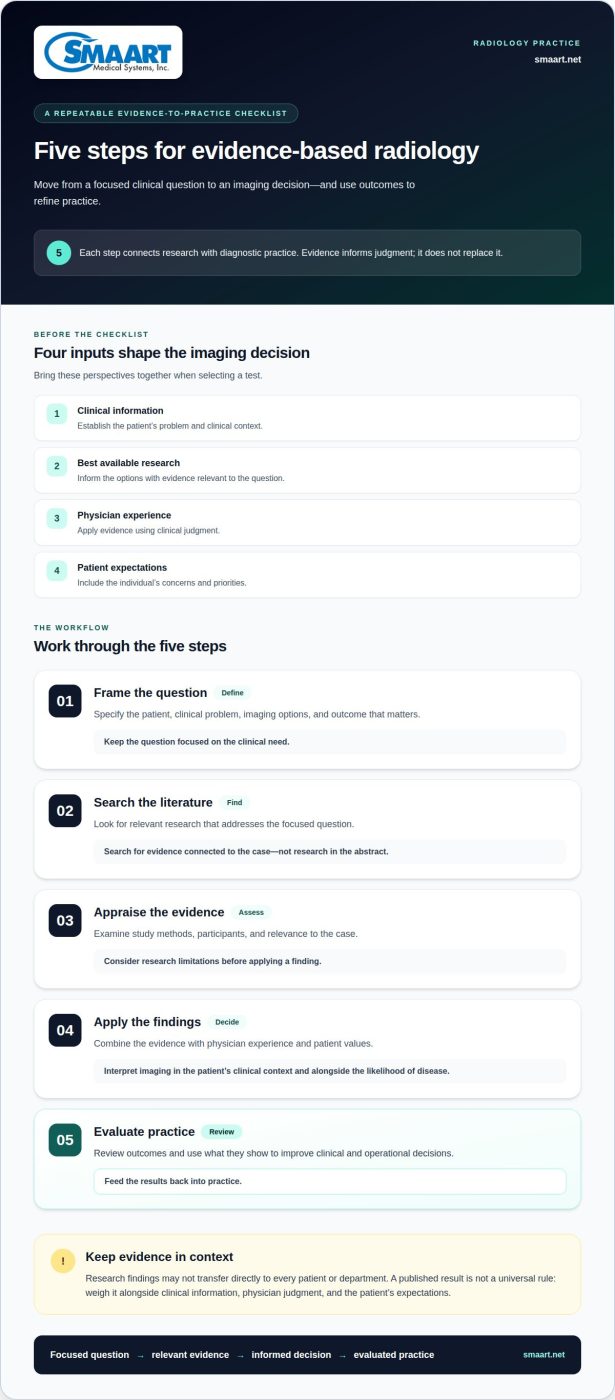
Five-step evidence-based radiology practice
Apply evidence through a repeatable sequence, then use outcomes to refine clinical and operational decisions. The five steps connect research with diagnostic practice.
- Frame the question: Define the patient, clinical problem, imaging options, and outcome that matters.
- Search the literature: Find relevant research that addresses that focused question.
- Appraise the evidence: Assess study methods, participants, and relevance to the case.
- Apply the findings: Combine evidence with physician experience and patient values.
- Evaluate practice: Review outcomes and use what they show to improve decisions.
Regulatory and Financial Requirements
U.S. regulatory and accreditation criteria depend on the practice setting and imaging services. Management should translate applicable criteria into documented protocols and workflows. Operating costs also vary with staffing, modality mix, imaging volume, facilities, equipment, and technology, so a single financial benchmark will not fit every practice. Budget reviews are more useful when they connect these factors with service demand and quality priorities.
Staffing and Workflow Decisions
Evidence-based staffing compares in-house, teleradiology, and hybrid models using local measures such as access, continuity, workload, and reporting quality. To address turnaround delays and backlogs, map where studies wait, align scheduling with demand, and prioritize work by clinical urgency. Just as service and wellness operations utilize specialized platforms like Milano Software to manage complex bookings and facility capacity, medical departments must configure their scheduling workflows to match real-time demand. Review resource use alongside these bottlenecks. This helps teams see whether workflow changes support timely interpretations without losing sight of patient-care needs.
Quality and Performance Measurement
Quality measurement combines diagnostic quality, productivity, and patient experience so managers can assess trade-offs rather than rely on a single target. The American College of Radiology’s National Radiology Data Registry enables facilities to benchmark outcomes and process-of-care measures and develop quality-improvement programs. Track relevant measures over time, then use patient feedback to identify friction. AI and automation may support operational tasks, but teams need human oversight to address errors, biased outputs, and workflow changes.
Repeating this cycle connects clinical questions, research, critical appraisal, application informed by physician experience and patient values, and evaluation of practice in evidence-based radiology decisions.
Which management strategies improve radiology department efficiency and patient outcomes?
Effective management links clinical priorities to workflow, staff capacity, and quality measures. In patient-centered care, radiology teams need infrastructure and skills that support both individual decisions and population health.
Start by mapping the imaging pathway from referral to final report. Identify, for example, where incomplete clinical information delays protocoling, where scheduling leaves capacity unused, and where reports wait for follow-up. Similar to how activity-focused organizations streamline session logistics and resource planning with Coordinate Sport, healthcare administrators must ensure their booking and scheduling systems prevent bottlenecks. Assign responsibility for each handoff, then review the workflow with the staff who carry it out. This turns a broad concern, such as backlogs, into specific steps managers can improve.
Next, align imaging use with clinical need. Appropriate resource use can benefit patients through fewer examinations involving ionizing radiation, professionals through reduced overload, and managers through more efficient use of resources. A useful management review asks whether each examination addresses a clinical question and whether the workflow supports timely interpretation. The goal is not simply to process more studies.
- Review referral and scheduling patterns to spot avoidable bottlenecks.
- Clarify handoffs between ordering clinicians, imaging staff, and interpreting radiologists.
- Compare workload with available staff and imaging resources.
- Use quality-improvement reviews to turn recurring delays into workflow changes.
Choose measures that connect operations with care. Performance measures drive healthcare quality improvement and influence provider payment, so teams should understand what each measure captures. Pair process measures, such as delays at a workflow handoff, with outcomes that reflect the care delivered. Review results with the people responsible for the process, then adjust protocols or resource allocation when the evidence points to a gap.
Evidence-based radiology practice management also involves investing in population health capabilities. As care shifts toward patient-centered models, providers need new skills and infrastructure to deliver high-quality care. Managers can connect this work to practical priorities: make relevant clinical information available, support consistent workflows, and use quality-review findings to guide improvements. Regular review keeps operational decisions tied to patient needs, not just volume.
SMAART Medical Systems: SMAART-PACS
SMAART-PACS from SMAART Medical Systems, Inc. supports hospitals and clinics aligning imaging operations with evidence-based practice. Its radiology software solutions are designed to integrate with existing EMR and HIS platforms, connecting radiology systems with the broader healthcare environment.
For teams reviewing technology alongside workflow and quality goals, SMAART-PACS is part of a product line that also includes SMAART-RIS and SMAART-SHARE, a cloud-based image-sharing platform. These products address different radiology management needs, helping practices consider the tools that fit their operations and information flow.
If you’re evaluating radiology management software for your practice, contact SMAART Medical Systems, Inc. to discuss your needs.
Turn your next improvement into a practical plan
Choose one operational decision your team wants to improve, then define what a better result would look like. Evidence-based radiology practice management becomes useful when teams translate priorities into clear ownership, a relevant measure, and a review point. Keep the first change focused so staff understand what is changing and why.
Use the review to learn, not just to score performance. If a measure shifts, examine the workflow and clinical context behind it before deciding what to adjust. This grounds improvement in the realities of your department and gives staff a clear role in shaping the next step.
Technology can support this work when it fits the way your practice manages imaging information and operations. To discuss a radiology software fit for your organization, contact SMAART Medical Systems, Inc.. A focused next step can help your team move from evidence to practical improvement with confidence.
Frequently Asked Questions
How is the EBR practiced?
EBR means applying research to a defined imaging decision, then reviewing how that decision works in clinical practice. For example, when discussing an imaging protocol, a team can assess whether the evidence fits the patient population and clinical question. Recording the rationale helps colleagues understand the choice and supports a focused review when later cases reveal different needs.
What is evidence based radiology (EBR)?
Evidence-based radiology is an approach to imaging decisions, not a particular scan or technology. It considers whether evidence applies to the patient in front of the clinician, rather than assuming a study result fits every case. The same research finding, for instance, may carry different weight when a patient’s presentation or preferences differ from those represented in the study.
What does evidence-based radiology practice management mean?
Evidence-based radiology practice management uses evidence-informed clinical decisions as a foundation for managing department operations. Managers can connect practice priorities with the workflows and information systems that support them, then use quality reviews to identify processes that need adjustment. For example, after changing how imaging referrals are handled, a department can assess whether the process supports clear clinical decisions and consistent follow-through.