
Getting Budget Approval for Radiology IT: A 2026 Guide
Getting budget approval for radiology IT is easier when the request starts with a specific workflow problem, not a longer list of software features. Decision-makers need to understand what is slowing operations, what the investment will cost, and how the organization will assess its value. A clear proposal connects those points and shows that the team has considered implementation as well as purchase.
A credible case links radiology’s operational needs to priorities leaders recognize, such as efficiency, continuity, integration, and responsible use of funds. It also makes assumptions visible, so executives can weigh the investment rather than defer it because the financial case is unclear.
This guide explains how to build an evidence-based proposal that links workflow challenges to relevant radiology IT capabilities and measurable outcomes. You’ll learn which costs, benefits, and risks to include, how to support claims with internal evidence, and how to outline a practical path from approval through implementation and evaluation. The result is a concise case that gives decision-makers a clear view of both the need and the plan.
Key Takeaways
- Start with a documented clinical or operational problem, then show why it matters to organizational priorities.
- Separate one-time and recurring costs, and present benefits as measurable hypotheses supported by transparent assumptions.
- Compare options against consistent clinical, integration, security, scalability, and support requirements.
- Make getting budget approval for radiology IT easier by clearly presenting the evidence, recommended scope, investment, risks, and evaluation measures.
- Turn approval conditions into an implementation plan with accountable owners, milestones, and stakeholder review checkpoints.
Getting budget approval for radiology IT starts with a clear operational case
Budget approval is a decision to fund a documented need, a defined scope, and the organizational value the investment is intended to support. Start with the work that needs attention, not a vendor or feature list. A committee can assess a specific operational problem more readily than a broad request to “modernize radiology.”
For example, staff may need to move between separate systems to coordinate exam scheduling and patient information. Describe who encounters that friction, where it occurs, and how it affects the workflow. Don’t claim it delays care or increases costs unless your internal evidence supports that conclusion.
Translate a radiology pain point into a decision-ready need
Build the case from observations your organization can validate, such as workflow reviews, staff feedback, process documentation, or available system records. Separate the root problem from the preferred fix. “Scheduling staff re-enter exam details across systems” describes a workflow issue. “We need a new RIS” jumps to a solution before the need is clear.
Then define the scope. Identify affected roles, processes, and departments, and specify what you want to evaluate. A Radiology Information System (RIS) can support functions such as scheduling and reporting, while PACS supports image storage and distribution. Connect each capability to a documented need rather than assuming a system will solve every workflow challenge.
Map the request to stakeholder priorities
Different decision-makers need different evidence. Clinical leaders may focus on whether the proposed workflow supports their teams. IT will assess integration with existing EMR or HIS platforms and technical requirements. Finance needs a clearly scoped request, accountable cost assumptions, and a way to review whether the intended value is being realized.
Before presenting, identify the budget owner, approval steps, and criteria the committee uses. Keep the summary consistent across audiences: one problem, one proposed scope, and one evaluation measure. For example: “Because staff currently re-enter scheduling details across systems, we propose evaluating a scheduling capability integrated with the existing workflow, measuring the frequency of re-entry before and after implementation.” Treat the measure as an evaluation plan, not a promise of improvement.
This framing gives the committee a clear question to decide: does the documented need justify the proposed scope, and can the organization evaluate its value? Getting budget approval for radiology IT is more practical when the request links validated operational evidence to stakeholder priorities without overstating impact.
Build a defensible radiology IT budget from costs, benefits, and assumptions
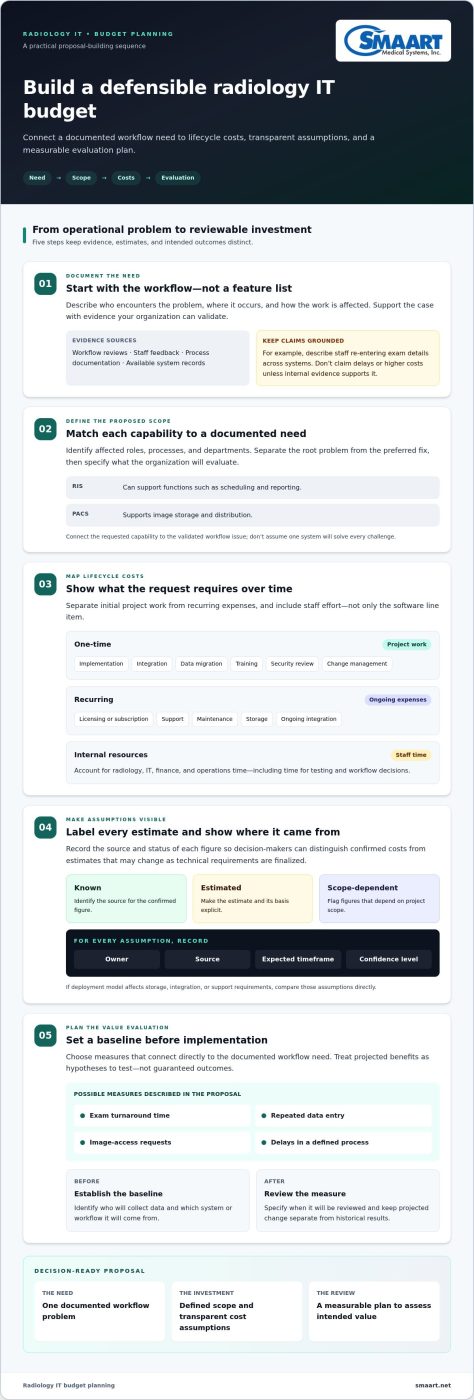
Once the need and scope are clear, show what the request will require over its full lifecycle. A defensible budget separates initial project work from recurring expenses and makes uncertainty visible. This helps finance distinguish confirmed figures from estimates that may change as technical requirements are finalized.
Account for lifecycle costs beyond the initial request
Include more than the software line item. Organize costs by timing and type, then record the source and status of each estimate:
- One-time: implementation, integration, data migration, training, security review, and change-management effort.
- Recurring: licensing or subscription, support, maintenance, storage, and any ongoing integration requirements.
- Internal resources: staff time from radiology, IT, finance, and operations, including time needed for testing and workflow decisions.
Mark each figure as known, estimated, or dependent on project scope. For every assumption, name an owner, source, expected timeframe, and confidence level. If the deployment model affects storage, integration, or support requirements, compare those assumptions directly. The existing cloud-versus-on-premise PACS cost guide provides a deeper cost-model analysis.
Make benefits measurable without overstating the case
Choose measures that connect directly to the documented workflow need. Depending on the request, these might include exam turnaround time, repeated data entry, image-access requests, or delays in a defined process. Establish a baseline before implementation and identify who will collect the data, which system or workflow it will come from, and when it will be reviewed.
Keep forecasts distinct from historical results. For example: “Historical records show the current baseline; the projected change is an assumption to test after implementation, not a verified saving.” This gives decision-makers a measurable evaluation plan without presenting hoped-for benefits as guaranteed outcomes.
For a practical comparison, use the same cost categories and measurement approach across deployment options. Tie estimates to their source, and revise them when scope changes instead of hiding uncertainty inside a single total. This makes getting budget approval for radiology IT a more transparent financial decision. To see how radiology software capabilities can map to operational needs, explore radiology software options.
Compare radiology IT options against clinical, technical, and financial requirements
A useful comparison makes trade-offs visible. Evaluate each option against the same requirements, not the length of its feature list or its initial price alone. Consistent criteria help clinical, IT, and finance reviewers understand where an option fits, what it depends on, and what still needs review.
Create a requirements matrix reviewers can scan
Separate must-haves from desirable capabilities and future considerations. For each requirement, record its importance, the evidence supporting the assessment, any dependencies, and the reviewer responsible for validating it. Keep the scoring simple and consistent, such as “meets,” “partially meets,” “does not meet,” or “needs review.”
Include criteria tied to the documented workflow need:
- Clinical fit: Does the option support the specific imaging workflow and users in scope?
- Integration: How does it fit with current EMR and HIS workflows, and what technical review is needed?
- Security and privacy: What information and safeguards must organizational reviewers assess?
- Scalability and support: Can the proposed scope accommodate identified needs, and what ongoing support requirements should be considered?
- Financial fit: How do initial and recurring cost assumptions compare over the same evaluation period?
Match capabilities to requirements rather than treating every function as a benefit. SMAART-PACS supports image storage and distribution, SMAART-RIS manages patient data and clinical scheduling, and SMAART-SHARE provides cloud-based image sharing and collaborative viewing. Include each product in the comparison only when it addresses a stated need.
Address integration, privacy, and implementation risk
Map the relevant touchpoints with existing EMR and HIS platforms. Identify which orders, patient details, images, or reports must move between systems, then assign technical reviewers to assess interfaces, dependencies, and testing needs. Evaluate a connected RIS and PACS workflow as a whole when the use case crosses scheduling, patient information, and image access.
Cloud, on-premise, and subscription models also affect the comparison. Consider how each model changes recurring obligations, infrastructure dependencies, storage planning, and internal responsibilities. Review the technical context for PACS and EMR integration as part of that assessment.
Include privacy, security, and HIPAA review in the approval process. Don’t treat a product comparison as proof of compliance. Document the organization’s review requirements, outstanding questions, and accountable owners. That clarity helps teams distinguish a viable option from one that still carries unresolved implementation risk. For getting budget approval for radiology IT, the strongest comparison is traceable from requirement to evidence, cost assumption, and decision.
Present the radiology IT proposal to answer approval committee concerns
A strong proposal makes the decision clear before the technical detail takes over. Open with the approval requested, the operational need it addresses, and what the organization may continue to experience if it delays action. Keep consequences tied to evidence already gathered. Don’t imply clinical harm, financial loss, or service disruption unless your internal data supports that claim.
Use a clear approval narrative and supporting evidence
Structure the presentation so reviewers can follow the reasoning from need to decision:
- Problem and evidence: State the workflow issue and the observations that document it.
- Options: Summarize alternatives against the same clinical, technical, and financial requirements.
- Recommended scope: Explain what the request includes and why that scope addresses the need.
- Investment and risks: Show the cost assumptions, dependencies, and planned mitigations.
- Measures: Identify how the organization will assess whether the intended value is being realized.
Make assumptions easy to inspect. A concise supporting table can list each estimate or forecast, its source, an accountable owner, and its confidence level. Keep the main presentation focused on findings that affect the decision. Place technical specifications, integration details, and supporting calculations in an appendix for reviewers who need them.
Answer the objections that can stall funding
Prepare direct responses to common concerns. For affordability, explain the scope and distinguish established figures from estimates. For disruption, describe dependencies, implementation responsibilities, and how operational changes will be governed. For integration, identify the systems and interfaces requiring review, along with the teams responsible for that work.
Uncertain returns need a measured answer, not a guarantee. Name the success measures, baseline, review point, and person accountable for follow-up. Separate mitigations the project team can control, such as assigning owners or planning workflow testing, from external dependencies or assumptions that remain unresolved.
Use a phased request only when the work can be divided without undermining technical dependencies or the intended workflow. If staging is appropriate, define what each phase delivers, what decision or evidence enables the next step, and how costs and outcomes will be reviewed. If the work needs a unified scope, explain why splitting it would not meet the documented need.
Getting budget approval for radiology IT is easier to support when the committee can see the decision, evidence, accountability, and evaluation plan at a glance. To explore software capabilities relevant to a radiology IT proposal, explore SMAART radiology software solutions.
Turn radiology IT budget approval into an accountable implementation plan
Approval is a starting point, not the finish line. Convert every condition attached to the funding decision into an implementation handoff: what’s in scope, who owns each decision, which milestones must be reached, and when progress will be reviewed. This keeps the approved proposal connected to the work that follows and makes changes easier to track.
Set up the project for a controlled start
Before implementation begins, document the approved scope, known dependencies, decision rights, and assumptions that still need validation. Assign accountable owners across radiology, IT, finance, and operations. For example, clinical stakeholders can confirm workflow requirements, IT can coordinate technical discovery and EMR or HIS integration review, and finance can monitor spending against approved assumptions.
Build milestones around meaningful readiness checks rather than dates alone. These could include confirming workflow requirements, completing integration planning, reviewing security and privacy considerations, preparing users, and agreeing that operational teams are ready for the next stage. Include training and staff communications in the handoff so readiness isn’t treated as a last-minute task.
Set baseline measures before changes begin. Choose indicators tied to the approved case, identify where the data will come from, and name the person responsible for collecting it. Agree on review checkpoints in advance, including who will attend and how issues or scope changes will be escalated.
Review outcomes and refine the investment case
After launch, compare observed results with the baseline and the criteria approved by leadership. Keep the review balanced: record what changed, what did not, and where data or workflow conditions limit conclusions. Avoid attributing every shift to the software when other factors may have contributed.
Use each checkpoint to capture lessons, emerging operational needs, and changes in recurring resource requirements. If a measure misses its target, document the cause and agree on a response, such as further workflow review or a revised evaluation period. This creates accountability without treating forecast benefits as guaranteed outcomes.
Radiology IT capabilities should match the approved use case. SMAART-PACS supports image storage and distribution, SMAART-RIS manages patient data and clinical scheduling, and SMAART-SHARE supports cloud-based image sharing and collaborative viewing. Consider these options according to the workflows in scope, without assuming a particular result. A disciplined handoff and evaluation plan help make getting budget approval for radiology IT part of a continuing process of responsible investment.
Explore SMAART radiology management software to review capabilities that align with your organization’s defined needs.
Move your radiology IT proposal from approval to action
Getting budget approval for radiology IT starts with a documented operational need, but a persuasive proposal also makes the investment accountable. Ground the request in internal evidence, separate confirmed costs from estimates, and compare options against consistent clinical, technical, and financial requirements.
Then carry that discipline into implementation. Assign owners, clarify dependencies, set baseline measures, and schedule reviews before work begins. This gives clinical, IT, finance, and operational teams a shared way to track progress and assess whether the approved investment is delivering its intended value.
Match software capabilities to the needs in scope. SMAART-PACS supports medical image storage and distribution, while SMAART-RIS manages patient data and clinical scheduling. SMAART software is designed to integrate with existing EMR and HIS platforms, helping organizations plan how radiology workflows fit within their broader systems.
Explore radiology software solutions from SMAART Medical Systems, Inc. to see how these capabilities can support your organization’s priorities. With a clear case, transparent assumptions, and a practical evaluation plan, you can take the next step with confidence.
Frequently Asked Questions
How do you get budget approval for radiology IT?
Build the request around a documented operational need, a defined scope, and a practical way to evaluate value. Use internal observations to show who experiences the problem and how it affects the workflow. Then present lifecycle costs, compare suitable options against consistent clinical and technical requirements, and identify risks, owners, and review measures. Getting budget approval for radiology IT is easier to support when leaders can trace the case from evidence to implementation.
What should a radiology IT budget proposal include?
Include the problem and supporting evidence, the proposed scope, options considered, and the reason for your recommendation. Separate one-time project expenses from recurring software, support, integration, and internal resource needs. Label each financial figure as known or estimated, and document its source and owner. Add implementation dependencies, integration and security review needs, approval responsibilities, baseline measures, and a plan for evaluating results after launch.
How much does radiology IT software cost?
There isn’t one standard price for radiology IT software. The investment depends on factors such as the capabilities in scope, deployment model, licensing or subscription structure, integration work, storage needs, training, and ongoing support. Build a project-specific cost model that separates initial and recurring requirements, and compare options over the same evaluation period. SMAART Medical Systems, Inc. provides SMAART-PACS, SMAART-RIS, and SMAART-SHARE for different radiology workflow needs.
How do you calculate ROI for a PACS or RIS investment?
Start with a baseline and define measurable outcomes related to the need, such as workflow delays, repeated data entry, or image-access requests. Estimate potential benefits using documented assumptions, then compare them with total project and recurring costs over a stated period. Keep forecasts separate from verified historical results. Assign an owner to track the measures after implementation, and report whether the results support, fall short of, or exceed the original assumptions.
What if finance rejects a radiology IT budget request?
Ask which part of the case needs clarification: affordability, scope, assumptions, timing, or evidence of organizational value. Revisit the proposal with finance’s feedback and distinguish necessary requirements from desirable features. You might refine the scope or phase the request if dependencies allow, but don’t split work in a way that undermines the intended workflow. Document what changed, update estimates and owners, then resubmit against the organization’s approval criteria.
Who should approve a radiology IT project?
The approval path depends on the organization’s budget authority and governance process. Typically, the proposal needs input from clinical leaders, IT, finance, and operational stakeholders, with final funding approval from the designated budget owner or committee. Clarify who recommends, reviews, and authorizes the project before presenting. After approval, assign owners for implementation decisions, integration and security review, budget tracking, and measurement of the outcomes tied to the proposal.
How can a radiology IT proposal address integration concerns?
Describe how the proposed system relates to existing EMR and HIS platforms, and identify the workflows and information that need to connect. Ask IT and relevant system owners to document interface requirements, dependencies, testing needs, and unresolved questions. Include integration work and internal review in the scope and cost assumptions. SMAART software is designed to integrate with existing EMR and HIS platforms, and project-specific requirements should be addressed during technical planning.
Explore SMAART Medical Systems, Inc. radiology management software to see how SMAART-PACS, SMAART-RIS, and SMAART-SHARE can support the workflows in your proposal.