
Getting physician buy-in for new PACS with physician partnership
Getting physician buy-in for new PACS starts with involving clinicians early, understanding their workflows, and explaining why the change is being considered. Physicians are more likely to support the process when they can shape the evaluation, not just approve decisions already made.
Physicians may reasonably ask whether a new system will fit their daily work and support patient care. Treat those concerns as useful input: they can help the team identify practical issues before implementation. This makes getting physician buy-in for new PACS a shared effort grounded in clinical priorities, rather than an administrative directive.
Build that partnership through physician input, administrative support, and clear leadership. Address common engagement barriers and prepare clinicians for adoption so your organization can compare options, make informed decisions, and move forward with clarity.
Key Takeaways
- Bring physicians into PACS planning early so their clinical priorities and workflow needs shape the decisions.
- Build trust by making room for concerns, responding with evidence, and providing practical administrative support.
- Identify engagement barriers before rollout, including workflow disruption, unclear benefits, and limited time for change.
- Give physician leaders a meaningful role and make training accessible, relevant, and available beyond implementation.
1. Physician partnership in decision-making
Start physician engagement before selecting a vendor. Form a group that includes radiologists, referring physicians, administrators, and IT staff. Ask members to map their imaging workflows, identify friction points, and prioritize patient-care needs. This gives physicians a meaningful role in evaluating options instead of asking them to approve a finished plan.
Compare PACS options against documented clinical workflows, integration needs, usability, training, and implementation support. During demonstrations, use representative cases and record physician feedback alongside unresolved concerns. Include administrative and technical stakeholders so the evaluation reflects how the system needs to work across the organization.
Ask radiologists and referring physicians whether image review and access fit their daily work and support clear collaboration. Their priorities will differ: have each group identify essential tasks and test them during the evaluation. Avoid assuming that one feature set or workflow will suit every role.
For U.S. privacy and security planning, include privacy policies, security protocols, backup, and disaster-recovery procedures in the review. The U.S. Department of Health and Human Services identifies the Health Insurance Portability and Accountability Act of 1996 as a healthcare law relevant to practice transactions. Include compliance stakeholders when assessing how the proposed system will handle health information.
Gather feedback through structured interviews and workflow tests, and keep a concern log. Track training participation, system usage, and recurring user issues against an agreed baseline, then review them after rollout. For interoperability, map how the PACS needs to exchange information with existing EMR and HIS platforms, and validate those workflows with IT and clinical users.
Partnership negotiations offer a useful parallel: associates commonly negotiate practice partnership after working with the practice for two to five years. A physician evaluating that opportunity should review voting rights, employment terms, and buy-in and buy-out calculations. Partners may receive a K-1 for income, deductions, and credits; the Qualified Business Income deduction can provide up to a 20% deduction on qualified business income. Define exit notice and payment terms in the agreement so both incoming and existing partners understand the arrangement.
2. Administrative support and trust-building
Administrative leaders build trust when they make adoption easier, rather than simply announcing a change. Assign a project contact to coordinate questions, training, and workflow issues. Give clinicians a reliable way to raise concerns, then record each issue, its owner, and the response. A concern log makes follow-through visible and keeps questions from being passed repeatedly between departments.
Make it practical for physicians to participate. Protect time for workflow reviews and training, and provide reporting that helps clinicians assess how the PACS affects daily work. Administrative teams can coordinate access, share implementation updates, and route technical issues to the appropriate staff. Clear responsibilities show clinicians who handles each task during the transition.
Answer feedback with evidence, not reassurance alone. If physicians worry that image access will disrupt a referral workflow, document the concern, test the workflow, and share the findings. If a change adds steps, explain what will be adjusted and when. Share examples of improved care or workflow when available, and recognize physicians who contribute time or champion the change.
Trust also depends on a credible business case. Present relevant operational data alongside clinical goals, and explain how the project supports the medical practice without reducing the discussion to revenue alone. Keep PACS decisions distinct from unrelated corporate matters, such as employment contracts, ownership agreements, or tax returns. That separation helps physician feedback stay focused on patient care and system performance. For a closer look at PACS workflow planning, connect technical decisions to the practical needs physicians raise.
Organizations can support physician-led improvement with administrative help, data analytics and reporting, and training. These resources give physicians practical ways to contribute and help project teams support adoption. Make support available throughout the initiative, not just at launch.
Project leaders can reinforce physician support by sharing evidence of positive effects on patient care or workflow and recognizing physicians’ efforts to adopt and champion the project. They should also provide a clear way to raise concerns, then address them with relevant information. Recording questions, reviewing evidence, and communicating responses keeps feedback connected to the improvement effort.
3. Physician engagement barriers
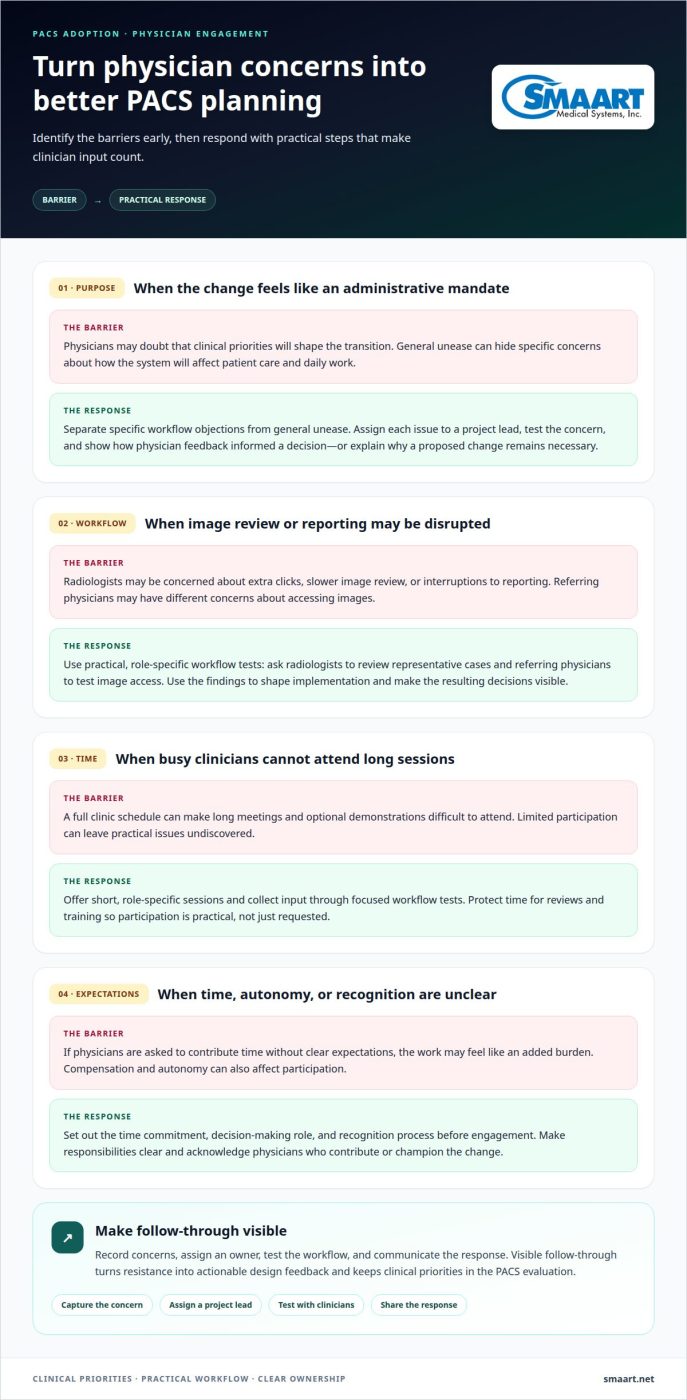
Physicians may resist a PACS transition when its clinical purpose seems secondary to an administrative mandate. A radiologist concerned about extra clicks, slower image review, or disrupted reporting needs to see that these issues will shape implementation. Separate specific workflow objections from general unease, then assign each issue to a project lead. This turns resistance into actionable design feedback.
Time pressure is another barrier. A physician with a full clinic schedule may not be able to attend long meetings or optional demonstrations. Offer short, role-specific sessions and collect feedback through practical workflow tests. For example, ask radiologists to review representative cases and referring physicians to test image access. Make the result visible: show how feedback informed a decision or workflow, or explain why a proposed change remains necessary.
Compensation and autonomy can also affect participation. When an organization asks physicians to contribute time without clarifying expectations, clinicians may see the work as an added burden. Set out the time commitment, decision-making role, and recognition process before engagement begins. Keep project participation separate from compensation agreements or employment terms so it does not feel tied to unrelated financial decisions.
Migration risks include incomplete image or report transfers, broken connections with existing systems, and interruptions to familiar workflows. Reduce these risks with a documented process: inventory data sources, test representative records, validate access and interfaces, and resolve defects before broader rollout. Have a named clinical lead and technical owner review each test result and communicate its status.
Uncertainty about organizational change can carry over from other decisions, including practice purchases, valuation, or goodwill discussions. Keep PACS evaluation focused on clinical workflows and operational needs. Route questions about separate corporate or employment agreements to the appropriate administrator or attorney, rather than mixing them with system feedback. Clear boundaries help physicians raise concerns openly and keep engagement focused.
4. Physician leadership and training
Give physician leaders defined responsibilities before implementation begins. A radiologist can represent image-review workflows, while a referring physician can represent clinical access needs. These leaders can help set priorities, review decisions, and identify issues affecting patient care. The Institute for Healthcare Improvement identifies a shared quality agenda as a framework for building physician buy-in. Use that agenda to connect PACS goals with the hospital’s improvement priorities.
A practical implementation sequence moves from workflow planning to system configuration, testing, physician onboarding, and ongoing support. At each stage, physician leaders can communicate decisions, gather feedback, and flag barriers for the project team. The timeline depends on the organization’s plan and readiness, so define milestones without promising a fixed duration. Schedule onboarding around when each clinical group will begin using the system.
Effective training is convenient, accessible, and tailored to different learning styles. Combine focused demonstrations with hands-on practice using relevant tasks, such as locating images or reviewing a study. Provide concise reference materials and a clear way to get help after training. Support remains important after launch, when day-to-day use may reveal new questions or workflow needs.
Leadership also means closing the feedback loop. Assign an owner to each issue, communicate the decision, and explain how it affects the workflow. Review adoption signals such as training participation, system usage, and repeated support requests; use them to identify where additional guidance may help. Keep PACS measures tied to clinical and operational goals, not unrelated returns, ownership, or growing revenue targets. This keeps physician leadership focused on system use and patient care, rather than a separate purchase or compensation discussion. For physician-centered PACS planning, explore PACS partnership options.
Physicians can also lead improvement planning and implementation teams, help develop the quality program, and prioritize improvement efforts. These roles give clinical staff a direct part in shaping and refining PACS changes, while keeping decisions connected to the practical needs of care teams.
Training for a new healthcare system or protocol should be convenient, accessible, and suited to different learning styles, with support continuing after implementation. Adapt that support as clinicians encounter the system in practice to help them use it effectively.
SMAART Medical Systems, Inc.: SMAART-PACS
SMAART Medical Systems, Inc. offers SMAART-PACS to hospitals and clinics evaluating a radiology management system. It interfaces with EMR, HIS, and practice-management systems, helping organizations consider PACS within their existing technology environment.
Use physician input to identify workflow and adoption priorities, then bring them into a discussion about SMAART-PACS and your imaging operations. SMAART-RIS provides scheduling, dictation with speech recognition, report distribution, modality worklist, and billing system integration. SMAART-SHARE supports QR-code-based exam sharing, CD/DVD/USB sharing, and report sharing.
If your organization is planning a PACS transition, contact SMAART Medical Systems, Inc. to discuss your needs.
Turn physician input into your next PACS decision
Getting physician buy-in for new PACS should continue beyond the initial rollout. Set a practical review point: decide who will assess feedback, how the team will address unresolved workflow issues, and when leaders will revisit project goals. This keeps physician participation connected to everyday use instead of treating adoption as a one-time milestone.
That checkpoint can also help your organization decide what it needs from its imaging systems as clinical workflows evolve. Bring your priorities and questions into a focused conversation about the right next step for your hospital or clinic. Contact SMAART Medical Systems, Inc. to discuss your PACS needs. A considered decision, shaped by the people who use the system, gives your team a clear path forward.
Frequently Asked Questions
What are the main reasons physicians resist adopting a new PACS?
Physicians may resist when a new PACS seems likely to disrupt established routines, add steps, or offer unclear clinical value. Limited time for training and uncertainty about how feedback will affect decisions can make resistance stronger. If physicians find a common task harder during a demonstration, explain whether the workflow can be adjusted and communicate the decision before rollout.
How can radiologists and referring physicians be involved in PACS selection?
Include radiologists and referring physicians in demonstrations, with each group assessing the system from its role. Radiologists can evaluate diagnostic tasks; referring physicians can assess how they receive and use imaging information. Gather comments separately and in joint discussions, then document shared priorities and role-specific needs. An evaluation matrix helps the selection team compare feedback consistently and explain how clinical input shaped its decision.