Hospital Imaging Workflow Optimization: A 2026 Strategy Guide
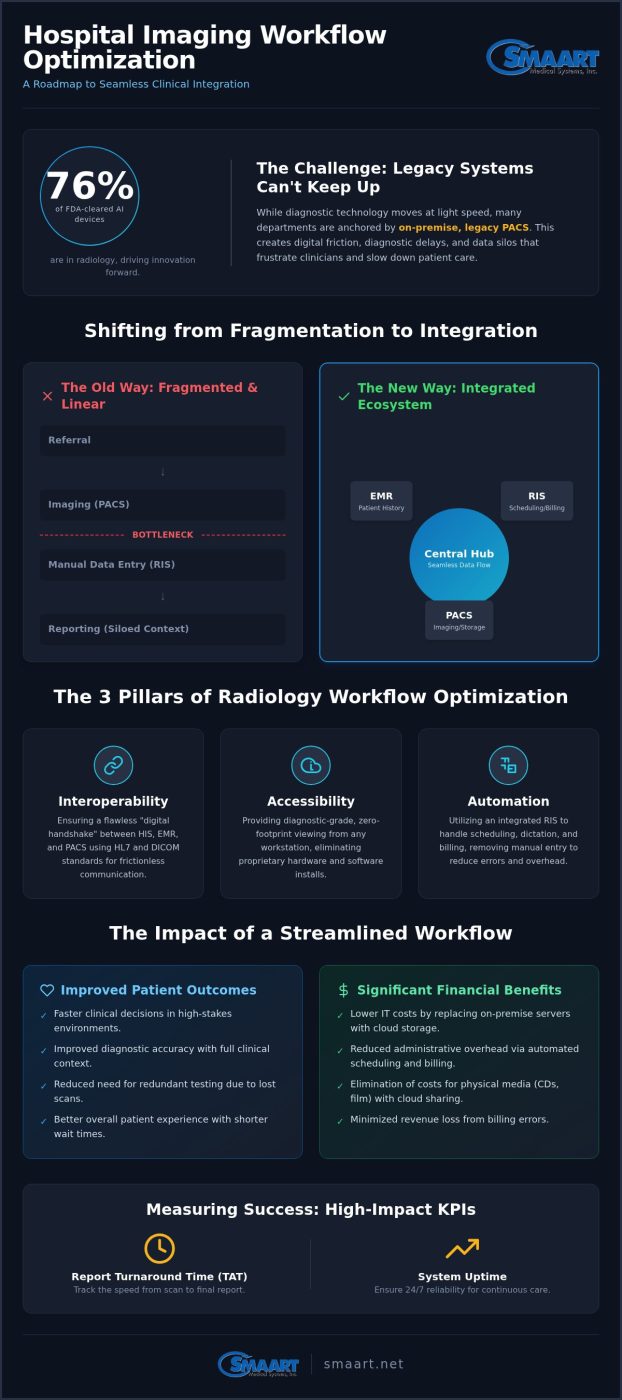
Did you know that radiology accounts for over 76% of all FDA-cleared AI medical devices as of 2026? While diagnostic technology moves at light speed, many departments remain anchored by on-premise legacy PACS that simply can’t keep up. You’ve likely experienced the frustration of diagnostic delays caused by siloed patient data or poor integration between your imaging software and the hospital EMR. Achieving true hospital imaging workflow optimization requires a shift in perspective. It’s not just about faster hardware; it’s about removing the digital friction that creates bottlenecks for your clinicians.
We understand the pressure to deliver faster results while managing rising operational costs. This guide provides a clear roadmap to eliminate those burdens through strategic software integration and modern workflow design. You’ll learn how to create a seamless data flow between your RIS, PACS, and EMR to slash report turnaround times. We’ll also explore how cloud-based sharing reduces overhead and replaces the need for expensive, proprietary hardware, giving your team the modern efficiency they deserve.
Key Takeaways
- Modernize your department by transitioning from fragmented, linear processes to an integrated digital ecosystem that eliminates diagnostic friction.
- Master the “digital handshake” between your EMR, HIS, and PACS to ensure clinical data flows seamlessly across the entire enterprise.
- Achieve hospital imaging workflow optimization by identifying and removing the data silos that cause costly diagnostic delays.
- Reduce operational overhead by leveraging SMAART-SHARE for cloud-based distribution, replacing the need for expensive proprietary hardware and CDs.
- Track high-impact KPIs like report turnaround times and system uptime to ensure your radiology department meets the demands of 24/7 care.
What is Hospital Imaging Workflow Optimization?
Hospital imaging workflow optimization isn’t just about buying faster scanners or increasing server capacity. It’s the systematic reduction of diagnostic friction and the elimination of data silos that slow down clinical teams. In many traditional settings, the workflow follows a rigid, linear path from referral to report. This outdated model often leads to “wait states” where clinicians stall because data is trapped in a different system. Modernizing this process means moving away from these bottlenecks and toward an integrated digital ecosystem where information moves as fast as the clinicians who need it.
As of 2026, the industry has shifted decisively toward cloud-native storage and zero-footprint diagnostic viewing. This ensures that a radiologist or referring physician can access high-resolution images from any workstation without installing heavy, proprietary software. Central to this evolution is the Picture Archiving and Communication System (PACS), which serves as the backbone for storing and distributing medical images. When these systems are siloed, they create digital speed bumps that delay care. True hospital imaging workflow optimization smooths those bumps by ensuring every piece of the diagnostic puzzle is visible from a single interface.
Imaging workflow optimization is the strategic alignment of RIS, PACS, and EMR to accelerate patient care.
The Impact of Optimized Imaging on Patient Outcomes
Speed saves lives. Reducing report turnaround times (TAT) allows for faster clinical decisions in high-stakes environments like the emergency department. When radiologists have full clinical context through seamless EMR integration, diagnostic accuracy improves. Patients also benefit from a better overall experience. They don’t have to wait days for results or undergo redundant testing because an earlier scan was lost in a siloed system or trapped on an unreadable disc.
Financial Benefits of Streamlining Radiology Operations
Optimization is as much a fiscal strategy as it is a clinical one. Migrating to cloud-based medical imaging storage lowers IT maintenance costs by removing the need for expensive on-premise server farms. Using SMAART-RIS automates scheduling and billing, which reduces administrative overhead and minimizes human error. Additionally, hospitals can eliminate the hidden costs of physical media. By leveraging SMAART-SHARE, teams stop wasting money on radiology CDs and film, moving instead to secure, instant digital sharing that costs a fraction of traditional methods.
The 3 Pillars of Radiology Workflow Optimization
Success in modern radiology isn’t accidental. It requires a deliberate architecture built on three core pillars: Interoperability, Accessibility, and Automation. These elements form the foundation for any scalable hospital imaging strategy. Without them, even the most advanced diagnostic equipment remains underutilized. By focusing on these pillars, departments can move away from reactive troubleshooting and toward a proactive, high-efficiency model that supports both clinicians and patients.
- Interoperability: Ensuring a flawless “digital handshake” between the HIS, EMR, and PACS.
- Accessibility: Providing diagnostic-grade viewing from any workstation without the need for heavy, proprietary hardware.
- Automation: Utilizing an integrated RIS to handle scheduling, dictation, and billing, effectively removing manual entry from the equation.
When these pillars are strong, the entire diagnostic chain accelerates. You don’t just see faster results; you see a more resilient department. This structural approach is essential for achieving long-term hospital imaging workflow optimization, especially as data volumes continue to grow.
Seamless Interoperability and HL7 Standards
Standardized protocols are the silent engine of modern healthcare. HL7 and DICOM standards serve as the backbone of imaging integration, allowing disparate systems to communicate without friction. An academic analysis of imaging workflow confirms that the tighter the integration between these standards, the lower the rate of manual data entry errors. SMAART-PACS plays a critical role here by bridging the gap between clinical patient data and the imaging suite. When your EMR and PACS share bidirectional communication, the radiologist receives the full clinical context automatically, leading to more informed interpretations and fewer requested clarifications.
Transitioning to Cloud-Based Exam Sharing
The days of burning radiology CDs should be behind us. Physical media is slow, expensive, and notoriously insecure. Transitioning to cloud-based sharing platforms represents one of the most significant “quick wins” for reducing operational overhead. SMAART-SHARE enables secure, collaborative viewing for referring physicians, allowing them to access studies instantly from any location. This shift provides a massive relief to administrative staff who no longer have to manage the logistics of physical discs. From a security standpoint, HIPAA-compliant cloud storage offers far greater protection than a CD that can be easily lost or damaged. If you’re ready to modernize your department, exploring an integrated imaging suite can provide the relief and efficiency your team needs.
Overcoming Integration Bottlenecks: PACS, RIS, and EMR
The “Silo Effect” is the most persistent barrier to true hospital imaging workflow optimization. When imaging data is trapped in a standalone system, it remains isolated from the patient’s broader clinical record. This disconnection forces clinicians to toggle between screens, manually cross-reference patient IDs, and piece together a history from fragmented sources. It’s a drain on productivity and a risk to patient safety. Effective integration ensures that images and clinical data exist in a unified environment, providing immediate relief to overworked staff.
A recent radiology workflow efficiency study highlights that moving toward filmless, integrated operations isn’t just a modern trend; it’s a necessity for survival in a high-volume landscape. Integrated RIS-PACS solutions eliminate the friction of redundant log-ins and manual patient searches. By creating a single point of entry, these systems allow the clinical team to focus on diagnosis rather than data management. While some administrators worry that deep integration is too complex, SMAART Medical Systems, Inc. proves otherwise. Our solutions are designed for seamless EMR/HIS compatibility, offering a high-performance alternative to the overly complex industry giants. Facilities evaluating their options can also benefit from reviewing Carestream PACS alternatives and enterprise imaging comparisons to understand the full range of modern solutions available.
Eliminating Data Silos with Integrated RIS-PACS
True efficiency starts when patient scheduling in SMAART-RIS synchronizes perfectly with image acquisition in the PACS. This alignment automates the flow of diagnostic reports back into the primary EMR, ensuring the referring physician sees results instantly. By streamlining the workstation environment, you significantly reduce radiologist fatigue. They no longer need to manage multiple passwords just to view one study. Instead, the data follows the patient, creating a smoother experience for everyone involved in the care cycle.
The Role of Zero-Footprint Diagnostic Viewing
Accessibility shouldn’t depend on where a clinician is sitting. Web-based, zero-footprint viewers are essential for remote reading and multi-site clinics. These viewers eliminate the need for expensive, dedicated diagnostic hardware at every terminal. You can provide high-speed image access on any standard workstation while maintaining strict HIPAA compliance. This flexibility ensures that critical images are available enterprise-wide, whether in the surgical suite or a satellite clinic, without compromising on performance or security. This approach allows your facility to scale its imaging capabilities without a massive hardware overhaul.
Measuring Success: KPIs for Hospital Imaging Efficiency
Data drives decisions. You cannot achieve true hospital imaging workflow optimization without a clear understanding of your current performance metrics. Measuring success isn’t just about feeling faster; it’s about quantifying the relief your new systems provide to both staff and patients. By tracking specific Key Performance Indicators (KPIs), administrators move from anecdotal evidence to actionable insights. These metrics serve as the heartbeat of your radiology department, signaling where the system is thriving and where friction remains.
- Report Turnaround Time (TAT): This measures the exact minutes from the moment an exam is completed to the second the verified report is available. It’s the ultimate metric for clinical speed.
- System Uptime: For emergency departments, every second counts. Ensuring 24/7 availability of SMAART-PACS is non-negotiable for high-acuity environments.
- Referrer Satisfaction: Track how easily outside physicians access shared images via SMAART-SHARE. If they’re calling your help desk, the workflow isn’t fully optimized yet.
- Operational Cost per Study: Calculate your total IT and administrative spend divided by your exam volume to see the real fiscal impact of your software choices.
When you monitor these figures, you gain the power to justify future investments. You aren’t just asking for a budget; you’re proving a return on investment. High-performance software makes this tracking effortless by providing the raw data needed for deep analysis. It’s about moving from guesswork to a precision-managed department.
Establishing an Efficiency Audit
Start with a digital audit of your current radiology workflow management software. Look for “dead time” in the patient journey. This is the period where a patient has been scanned, but the study hasn’t been opened by a radiologist. Using SMAART-RIS reporting tools, you can pinpoint exactly where scheduling bottlenecks occur. Are exams piling up at mid-morning? Is there a lag in transcription? Identifying these gaps is the first step toward closing them. If you’re ready to see how your current metrics compare, explore our workflow reporting tools today.
Benchmarking Against National Standards
Compare your facility’s TAT with industry averages for different modalities like CT, MRI, and X-ray. National standards provide a yardstick for your performance. However, periodic checks aren’t enough. The most successful departments engage in continuous workflow monitoring. This real-time visibility allows you to resolve issues before they become systemic failures. When it’s time to speak with the hospital board, use this data to demonstrate how software upgrades will lower costs and improve patient outcomes across the entire enterprise.
Strategic Optimization with SMAART Medical Systems, Inc.
Choosing the right technology partner is the final, most critical step in your modernization journey. True hospital imaging workflow optimization shouldn’t require a blank check or a decade-long implementation phase. It requires a solution that respects your budget while delivering the high-performance features your clinical team demands. SMAART-PACS and SMAART-RIS offer a refreshing alternative to the overly complex legacy giants. We provide a streamlined, integrated suite that removes the technical barriers between your clinicians and the patients they serve.
Integration is the core of our philosophy. Your strategy for hospital imaging workflow optimization is only as strong as the software that powers it. Our systems are designed for seamless compatibility with your existing HIS and EMR infrastructures. We don’t believe in forcing a total hardware overhaul. Instead, we focus on software-driven improvements that provide immediate relief to your staff. From zero-footprint viewing to automated reporting, every feature is built to accelerate your diagnostic timeline and reduce operational strain.
Scalability is equally important for growing hospital networks. As your facility expands, SMAART-SHARE allows you to distribute images across multiple sites without the need for expensive, proprietary hardware or outdated CDs. This cloud-native approach ensures that your data is always accessible, secure, and ready for collaborative review. We position ourselves as a dedicated partner in your modernization, offering elite technical expertise with a service-oriented approach that prioritizes your facility’s unique needs over a one-size-fits-all sales model.
Why Hospitals are Switching to SMAART
The primary driver for many facilities is the relief of reducing financial strain without sacrificing essential diagnostic features. You get a full-feature imaging suite that rivals industry giants but at a fraction of the traditional cost. Beyond the finances, hospitals value the personalized support and responsive partnership SMAART Medical Systems, Inc. provides. You aren’t just another account number; you’re a clinical partner. Our focus remains on practical utility. We build tools for the realities of modern healthcare, ensuring your team has everything they need to work efficiently without the fluff of unnecessary, complex sub-menus.
Next Steps for Your Workflow Overhaul
Modernizing your department starts with a single step. Identify the most significant friction point in your current process. Is it a delay in report turnaround times? Is it the high cost of maintaining on-premise servers? Once you’ve pinpointed the bottleneck, you can begin to apply the strategies outlined in this guide. We invite you to see our technology in action and discover how it fits your specific clinical environment. Your team deserves a workflow that supports their expertise rather than hindering it. When you’re ready to move forward, optimize your imaging workflow with SMAART Medical Systems, Inc. and experience the relief of a truly streamlined operation.
Modernize Your Radiology Department for 2026 and Beyond
The transition to a high-efficiency imaging department isn’t a luxury; it’s a clinical necessity. By focusing on the core pillars of interoperability and accessibility, you can dismantle the data silos that currently cause diagnostic delays. We’ve explored how tracking the right KPIs allows you to move from reactive troubleshooting to precision management. Achieving sustainable hospital imaging workflow optimization requires a shift toward integrated digital ecosystems that prioritize the clinician’s time and the patient’s experience.
SMAART Medical Systems, Inc. is here to bridge the gap between complex technical requirements and your high-level administrative goals. Our trusted SMAART-PACS and SMAART-RIS solutions provide the seamless EMR/HIS integration you need to eliminate redundant tasks. With secure, zero-footprint cloud sharing through SMAART-SHARE, your team can collaborate from any location without the burden of proprietary hardware. It’s time to experience the relief of a streamlined, cost-effective workflow designed for the realities of modern healthcare.
Ready to eliminate the bottlenecks in your facility? Request a SMAART Workflow Consultation to see our solutions in action. We’re committed to your long-term success and look forward to helping you build a more resilient department.
Frequently Asked Questions
What are the most common bottlenecks in hospital imaging workflows?
Data silos and manual entry are the most frequent causes of diagnostic delays. When imaging data is trapped away from the patient’s clinical record, it forces staff to toggle between systems and cross-reference IDs manually. Legacy on-premise PACS often lack the interoperability needed for modern speeds. These friction points lead to high maintenance costs and frustrated clinicians who can’t access the full clinical context they need for accurate interpretations.
How does a zero-footprint PACS viewer improve hospital efficiency?
A zero-footprint viewer allows clinicians to access diagnostic-grade images from any web-enabled workstation without installing proprietary software. This setup removes the need for expensive, dedicated hardware at every terminal. It significantly improves hospital imaging workflow optimization by enabling remote reading and multi-site access. Clinicians get the information they need instantly, whether they’re in the surgical suite, a satellite clinic, or working from home.
Is cloud-based medical image sharing as secure as on-premise storage?
Yes, modern cloud-based sharing is often more secure than physical media or traditional on-premise servers. Platforms like SMAART-SHARE utilize HIPAA-compliant encryption and rigorous access controls to protect patient data. Unlike a radiology CD that can be lost or damaged, cloud storage provides a secure, auditable trail of who accessed each study. It eliminates the risks associated with physical distribution while ensuring images are available 24/7.
Can SMAART-PACS integrate with our existing EMR system?
SMAART-PACS is built for seamless integration with all major EMR and HIS platforms. It uses standard HL7 and DICOM protocols to ensure a smooth “digital handshake” between your clinical records and imaging suite. This bidirectional communication allows diagnostic reports to flow automatically back into the primary patient record. You won’t have to worry about redundant log-ins or manual data entry errors that slow down your team.
How long does it typically take to implement a new RIS-PACS solution?
Implementation timelines vary based on the size of your facility and the complexity of your current data, but SMAART focuses on rapid deployment. Our service-oriented approach ensures that technical integrations are handled efficiently to minimize clinical downtime. Because our solutions are designed for compatibility with existing infrastructures, we can often move faster than industry giants who require extensive hardware overhauls. We prioritize a smooth transition that provides immediate relief.
What is the difference between a RIS and a PACS in an optimized workflow?
The RIS (Radiology Information System) handles the administrative side of the department, such as scheduling, billing, and report generation. The PACS (Picture Archiving and Communication System) focuses on the storage, retrieval, and distribution of the actual medical images. In a truly optimized environment, these two systems work in perfect synchronization. SMAART-RIS and SMAART-PACS communicate seamlessly to ensure the right images are always paired with the correct patient clinical context.
How can we reduce the costs of distributing radiology results to patients?
Replacing physical media with digital sharing is the most effective way to lower distribution costs. Physical radiology CDs and film are expensive to produce and even more costly to manage and mail. By using SMAART-SHARE, you can provide secure, instant access to images and reports via the cloud. This shift reduces administrative overhead and eliminates the material costs of proprietary hardware used for burning discs.
Does optimizing imaging workflow require replacing our existing imaging hardware?
No, achieving hospital imaging workflow optimization is primarily a software-driven strategy. You don’t need to purchase new scanners or expensive server farms to see significant efficiency gains. By integrating SMAART-PACS and SMAART-RIS with your current modalities, you can remove data friction and improve turnaround times. Our solutions are designed to enhance your existing infrastructure, allowing you to modernize your department without the financial strain of a total hardware replacement.