
What Can You Negotiate in a Radiology Software Contract?
Price is only one part of a radiology software agreement. The terms with the greatest operational impact often cover the system’s scope, connections with existing EMR and HIS platforms, implementation responsibilities, support, renewal, termination, and data handling. To know how to negotiate a radiology software contract, assess these commitments alongside the commercial terms and put every agreed detail in writing.
It’s reasonable to focus on cost, but a contract also shapes how software fits daily operations and what support your organization can rely on. This guide explains which terms to raise, how to rank priorities, and how your experience with radiology systems can inform negotiations. Clear responsibilities and practical expectations help you assess the agreement as a whole.
Key Takeaways
- Review notice periods, termination triggers, and written commitments so you understand the consequences of ending an agreement.
- Assess restrictive clauses by their practical effect on where you can work and whom you can solicit.
- Set priorities before negotiating, including work expectations, site assignments, call processes, and the PACS support your workflow depends on.
- Use your experience to make focused requests, while preparing for some organizations to resist changes to standardized terms.
1. Negotiating notice periods and termination terms
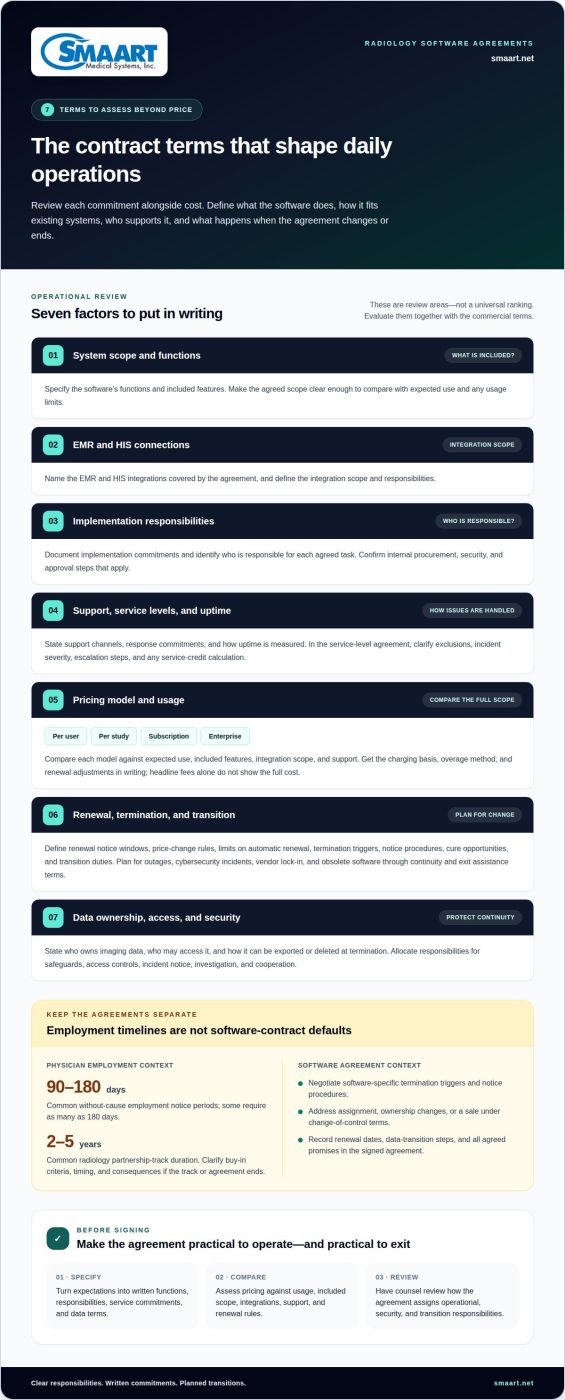
Separate the radiology software agreement from physician employment terms. Employment contracts commonly set without-cause notice periods of 90 to 180 days, and some require as many as 180 days. For software, negotiate termination triggers, notice procedures, cure opportunities, and transition duties. Check for acceleration clauses that let an employer shorten notice. A radiology partnership track commonly lasts 2-5 years; spell out buy-in criteria, timing, and consequences if the track or agreement ends. Address change of control by defining whether assignment, ownership changes, or a sale triggers notice or termination rights.
Put every negotiated promise in the signed agreement, including renewal dates, data transition steps, and any partnership or buy-in terms. For software pricing, compare per-user, per-study, subscription, and enterprise models against expected use, included features, integration scope, and support. Ask for the charging basis, overage method, and renewal adjustments in writing. Costs depend on the selected model and contract scope; avoid comparing headline fees without accounting for usage limits and included services.
Specify the software’s functions, EMR and HIS integrations, support channels, response commitments, and uptime measurement. For HIPAA and security, assign responsibilities for safeguards, access controls, incident notice, investigation, and cooperation. State who owns imaging data, who can access it, and how it can be exported or deleted at termination. Identify applicable U.S. healthcare and privacy requirements, along with internal procurement, security, and approval steps. Have counsel review how the agreement allocates these responsibilities.
Negotiate renewal notice windows, price-change rules, termination rights, and clear limits on automatic renewal. Address outages, cybersecurity incidents, vendor lock-in, and obsolete software through continuity plans, data portability, support obligations, and exit assistance. For employment agreements, review state-specific terms with a licensed, experienced attorney before signing. The same careful review helps keep software commitments, hospital operations, and career plans aligned.
2. Non-compete and non-solicitation clauses
Separate physician employment restrictions from the radiology software agreement. An employment non-compete may limit where a radiologist can work after leaving, while non-solicitation terms may restrict contact with patients, staff, or referral relationships. Review the covered people, locations, activities, and duration. Common radiology non-competes last 1-2 years after employment and may cover 10-50 miles from facilities. Narrow the radius to the primary work site and shorten the restriction where possible.
Legal developments matter, but don’t assume a nationwide rule settles an individual contract. In 2024, the U.S. Federal Trade Commission proposed a nationwide ban on most non-compete clauses. State law and the agreement’s wording affect the practical analysis, so obtain legal assistance before accepting restrictions that could shape a physician’s next job or private practice.
Compensation terms also deserve close attention. Ask for the productivity plan in writing, including its threshold, measurement method, duties counted, and adjustments for ramp-up periods or partial FTE. If pay depends on productivity, request the employer’s compensation plan and a plain-language explanation. Compare the complete package and practice conditions, including expected work, call, leave, and support, rather than treating base salary as the whole offer.
To benchmark a software proposal, compare its billing basis, included scope, usage assumptions, and renewal terms with comparable proposals. Negotiate discounts only where they reflect documented volume, term length, or bundled scope, and ask how each concession affects future renewals. In the service-level agreement, define uptime measurement, exclusions, incident severity, support response targets, escalation steps, and any service-credit calculation.
Keep employment clauses separate from software procurement. Map each restriction to the agreement it belongs in, identify who bears each obligation, and record negotiated changes in the signed version. This makes the software commitment easier to assess alongside a separate career decision.
3. Defining negotiation goals and issues before negotiations begin
Planning how to negotiate a radiology software contract starts with a clear agenda. Separate essential terms from preferences, then identify who can approve each change. Radiology fellows are advised to begin interviewing and reviewing contracts about 12-18 months before graduation. For an existing imaging center, discussions may involve a Radiology Service Agreement or a custom partner relationship. First define which agreement is under review and who must approve revisions.
Turn broad concerns into precise terms. For employment discussions, request written rules for site assignments, the percentage of subspecialty reads, and call assignment methodology. These details can shape a radiologist’s daily work as much as salary. Include PACS and reading-room support in the discussion, since workflow inefficiencies can affect productivity and the practical value of an offer. Tie each request to a specific operational need, such as predictable coverage or a defined subspecialty mix.
Rank the full employment package, not just its headline compensation. Academic radiology generally offers lower salaries than private practice, while private practice typically offers higher salaries and more vacation time. Weigh those tradeoffs alongside work hours, duties, leave, and retirement benefits. Mark which terms are essential, which are flexible, and what alternative wording could address the same concern. This keeps discussions focused when priorities compete.
Before discussions, prepare a concise reason for each requested change. A hospital or radiology group can assess a proposal more easily when it explains the operational need and offers workable wording. For example, request a stated call-assignment method and a process for resolving scheduling disputes. When negotiating software terms, connect each request to workflow, integration, or responsibility. Keep notes, then email a summary of agreed points after discussions.
4. Experience and negotiating leverage
Experience can strengthen a radiologist’s position, but it doesn’t guarantee changes. Large hospitals may resist revising standard agreements, especially for physicians just out of residency or fellowship. Still, radiologists can request specific edits even when an employer says its contract is standardized. Tie each request to clinical duties, workflow, or career goals, and explain why the wording matters before signing.
Use evidence to support a proposal. In a hypothetical negotiation, an applicant presents records showing productivity and accuracy in the 90th percentile. Rather than demand an immediate bonus formula, the applicant proposes tracking performance for the first half-year, then setting a productivity bonus. The applicant also offers to reduce the requested bonus by 10 percent in exchange for flexibility. The example shows how a reasoned proposal can give both sides room to negotiate.
Knowing your priorities helps you respond when an employer pushes back. Explain why a change is reasonable, then identify an alternative you could accept. For a software agreement, connect each requested term to a practical need, such as integration with existing EMR or HIS platforms. Focus on measurable scope, responsibilities, and workflow impact, not broad assurances without clear meaning.
Before signing, compare the proposed wording with your documented priorities and summarize any verbal agreement in writing. If the organization rejects a change, ask for its rationale and consider whether another clause addresses the underlying concern. Radiology groups and hospitals can also use a neutral third party to support productive negotiation. To connect software discussions with your imaging workflow, explore radiology software options.
Large hospitals may be unwilling to negotiate much of their standard contracts, particularly for physicians just out of residency or fellowship. Before responding, identify which terms are essential and which are preferences. Ask what disputed wording means in practice and whether a narrower edit could address the concern. If no revision is available, compare the agreement with your priorities and decide whether its overall terms remain acceptable. Keep any proposed alternative tied to the work it governs.
SMAART Medical Systems
SMAART Medical Systems, Inc. provides radiology software solutions for hospitals and clinics. Its offerings include SMAART-PACS, SMAART-RIS, and SMAART-SHARE, designed to integrate with existing EMR and HIS platforms. Consider these systems when assessing how imaging workflows, integrations, and software scope fit the terms under negotiation. Clear priorities help focus contract discussions on practical requirements.
As you compare agreements, connect proposed capabilities and responsibilities to your radiology team’s workflow. This supports focused discussions about fit, integration, and expectations. Contact SMAART Medical Systems, Inc. to discuss your radiology software needs.
Turn Your Priorities Into a Clear Next Step
Before the next vendor conversation, turn your priorities into a short decision record. Note who can approve each change, its operational rationale, and the fallback your team can accept. This keeps procurement, IT, finance, and radiology aligned as discussions move from broad goals to contract language.
Negotiating a radiology software contract also means knowing when to pause. If a clause changes responsibilities, workflow, or exit options, compare the revised language with your decision record before accepting it. Treat each version as a decision point, not just another document in an email thread.
Keep the agreement grounded in your organization’s clinical and operational needs. For a next step, contact SMAART Medical Systems, Inc. to discuss radiology software for your organization. A clear plan gives your team a steadier foundation for productive discussions and confident decisions.
Frequently Asked Questions
What Can Be Negotiated?
You can negotiate the agreement’s scope, billing structure, included functions, integration responsibilities, support process, renewal terms, and exit provisions. If your clinic expects changes in imaging volume, ask how the contract handles usage changes and whether charges adjust. Clarify which services are included, what triggers extra work, and how amendments are approved. This makes the negotiated terms easier to assess against actual operating needs.
What contract terms should be negotiated for implementation, training, and data migration?
Define each party’s implementation tasks, dependencies, acceptance criteria, training format, and responsibility for resolving problems. For data migration, specify which records and images are included, the transfer format, validation process, and how discrepancies are handled. For example, document who confirms that migrated studies are accessible in the new workflow. Explain how schedule changes or incomplete inputs affect the project plan, so responsibilities stay clear.
What U.S. healthcare regulations and procurement requirements affect radiology software contracts?
Identify applicable U.S. healthcare and privacy requirements, and document internal procurement, security, and approval steps. For HIPAA and security, assign responsibility for safeguards, access controls, incident notice, investigation, and cooperation.
What pricing models and typical costs apply to radiology software contracts in the United States?
Common models include per-user, per-study, subscription, and enterprise pricing. Compare the charging basis, overage method, included features, integration scope, support, usage limits, and renewal adjustments; costs depend on the model and contract scope.
How should uptime, support response times, and service credits be defined in a radiology software SLA?
Define how uptime is measured and which exclusions apply. Set incident severity levels, support response targets, escalation steps, and how any service credit is calculated.