How Integrated RIS/PACS Can Improve Workflow and Control Costs
A radiology department can lose time long before a scan is read. A radiology information system (RIS) manages tasks such as patient registration, scheduling, tracking, reporting and billing, while PACS stores and provides access to digital images. When the systems work together, they can reduce repeated data entry, processing delays and reliance on physical film, creating practical financial benefits of integrated RIS/PACS.
Imaging teams often focus on faster reporting and lower operating costs. But disconnected workflows can slow routine tasks and increase the risk of errors. Integrating radiology information system (RIS) and picture archiving and communication system (PACS) workflows connects administrative information with image management, reducing avoidable handoffs.
This article explains how RIS and PACS work together, where efficiency gains can emerge, and how automation may reduce processing time and data-entry errors. It also explores how digital image management can cut film storage needs, so you can assess the operational value alongside the costs of changing systems.
Key Takeaways
- See how connecting imaging and radiology administration can help teams improve turnaround times and use staff and equipment more efficiently.
- Learn which workflow steps can be streamlined, from scheduling and tracking to reporting and billing.
- Identify where shared information can reduce repeated data entry and lower the chance of avoidable errors.
- Understand how digital image access can reduce reliance on film processing, physical storage, and transport.
Radiology department efficiency and turnaround times
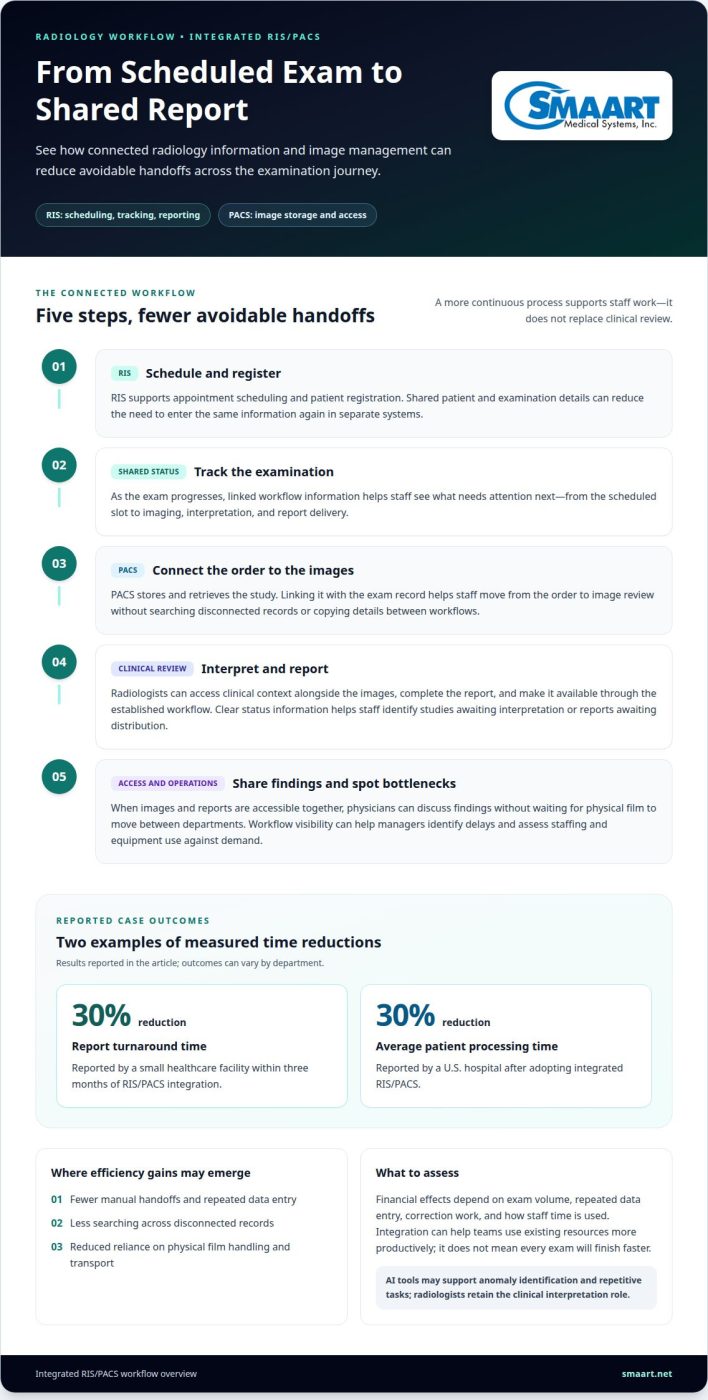
In a hospital radiology department, delays can build between registration, imaging, interpretation, and report delivery. An integrated workflow links the RIS worklist with the PACS study, helping staff connect an exam order to the correct medical images. Radiologists can access clinical context alongside the images instead of searching separate records. Operations teams can also see where examinations are waiting. That visibility helps identify handoffs that slow image review and report completion.
Consider a routine imaging appointment. RIS supports scheduling and patient tracking, while PACS stores and retrieves the resulting study. When the systems share information, staff can follow the examination from its scheduled slot through image review and reporting. They can spot bottlenecks, such as a study awaiting interpretation or a report not yet distributed. Managers can use this workflow view to assess staffing and equipment use, then adjust assignments to demand. In much the same way that automated utility and energy monitoring through smartmitaz.com gives organizations clear visibility into facility consumption, integrated radiology data provides administrators with real-time insight into asset utilization. The financial benefit comes from reducing avoidable delays and using existing resources more productively, not from assuming every exam will finish faster.
Communication matters after interpretation, too. When images and reports are accessible together, radiologists can share findings with other physicians without waiting for physical film to move between departments. Faster access supports timely clinical discussions and reduces courier-dependent handoffs. Clear connections between images, reports, and patient records also help care teams find the right information when coordinating care.
Artificial intelligence tools can support radiology workflows by helping identify anomalies, reduce repetitive tasks, and organize information for radiologist review. They complement, rather than replace, clinical interpretation. A department can assess whether AI addresses a specific pressure, such as repetitive image review, and how its outputs fit existing reporting processes. Combined with RIS/PACS workflow visibility, carefully applied AI can help teams manage workload and direct attention. The financial benefits of integrated RIS/PACS can therefore extend beyond reduced film handling to better use of staff time and equipment.
Workflow automation and reduced patient processing time
Automation connects routine radiology tasks, from registration through reporting, into a coordinated process. Its practical value is fewer manual handoffs and less waiting between steps.
Automating Radiology Workflows
Workflow automation uses connected systems to move patient and examination information between tasks. For example, scheduling details can support patient tracking, while an exam’s status helps staff see what needs attention next. A small healthcare facility case study reported a 30% reduction in report turnaround time within three months of RIS/PACS integration. That result shows how removing process friction can help reports reach care teams sooner.
Image Management and Reporting
Image management and reporting connect a patient’s examination with its images, interpretation, and final report. PACS stores and retrieves medical images, while RIS supports reporting and tracks the examination’s progress. A radiologist can open the relevant study, complete a report, and make it available through the established workflow. A U.S. hospital reported a 30% reduction in average patient processing time after adopting integrated RIS/PACS. Clear status information also helps staff identify delayed studies and route work appropriately.
Integrated RIS/PACS Operation
An integrated RIS/PACS links radiology scheduling and tracking with image storage and access. As an examination progresses, the systems exchange relevant information so staff can associate the study with its workflow and report. This can reduce repeated handoffs between screens or processes. Staff can follow a patient’s progress from registration to imaging and interpretation through linked records, rather than coordinating each step manually. The result is a more continuous process, not a replacement for clinical review.
AI tools can support reporting and diagnostic workflows by helping identify anomalies and reduce repetitive tasks; radiologists retain the clinical interpretation role. Staff training makes the change usable: teams need practice with worklists, image retrieval, report completion, and exception handling. Start by mapping one common examination from scheduling to report delivery, then train each role on its part. Facilities evaluating connected radiology workflows can explore integrated radiology software as a potential next step.
Reducing duplicate data entry and human error
No single cost reduction applies to every radiology department. The financial effect depends on exam volume, repeated data entry, correction work, and how staff time is used.
Reducing Duplicate Data Entry
RIS/PACS integration can share patient and examination information instead of requiring staff to re-enter it in separate systems. For example, registration details associated with an imaging order can follow the exam into the image workflow. This reduces repetitive typing and opportunities for inconsistent records. Departments can identify where information is entered more than once, then focus integration on those handoffs.
Fewer Examination Steps and Errors
Connected systems can make related patient data and images accessible through a coordinated workflow, reducing examination handoffs. Staff can move from an exam order to image review without manually searching disconnected records. Each removed handoff is one less point where a study may be delayed or details copied incorrectly. Linking the exam record with its image study, for example, helps staff work from the same examination context.
Less Manual Work and Fewer Data Errors
Digital image archiving and connected access can reduce manual work. When correcting a report, for example, staff can refer to the linked patient exam and study instead of searching separate paper records. Fewer manual transfers can reduce the chance of transcription mistakes and misplaced information. Across document-heavy operations, platforms such as saturn.gd demonstrate how AI-driven workflow automation can streamline processing and minimize recurring data errors. The practical gain is smoother operations, with less time spent reconciling data and more time supporting accurate clinical workflows.
Administrative and Staffing Costs
Administrative and staffing costs are affected by the time teams spend on data entry, corrections, and coordination. Integrated systems can reduce these tasks, but the financial impact depends on exam volume and existing processes. Compare time spent on duplicate entry and error correction before and after workflow changes. Then assess whether released staff capacity reduces overtime, supports other work, or improves operations, without assuming staffing reductions.
What is an integrated RIS/PACS and how does it work?
An integrated RIS/PACS connects radiology administration with medical image storage and access. A radiology information system, or RIS, manages radiology-specific records, including registration, appointments, tracking, and reports. A picture archiving and communication system, or PACS, stores digital images and makes them available for review. For example, a patient’s appointment and examination record can be associated with the corresponding imaging study.
The systems support different parts of the same clinical process. RIS follows the patient’s radiology journey, from booking through reporting. PACS stores images from modalities such as X-ray, CT, MRI, and ultrasound for retrieval and archiving. Linking these functions helps staff and radiologists access a study alongside relevant patient information, rather than treating images and administrative records as separate tasks.
Information exchange connects the workflow. Shared standards can help imaging systems exchange studies. A completed scan can be stored in PACS and associated with the patient’s RIS record. A radiologist can retrieve and review the images, then create a report within the radiology workflow. The report and study can then be made accessible to the relevant care team.
This connection can also extend across departments and locations, supporting access to images and clinical reports when needed. For instance, a physician reviewing a patient’s record can locate the relevant study without arranging physical film transport. Integrating RIS and PACS with electronic health records can streamline radiology workflows and reduce administrative burdens. The operational value depends on how well the systems connect with existing records and how staff use the shared workflow. To explore connected imaging workflows, review radiology software solutions that bring image management and radiology operations together.
SMAART Medical Systems: SMAART-PACS
SMAART Medical Systems, Inc. offers SMAART-PACS, SMAART-RIS, and SMAART-SHARE for hospitals and clinics. SMAART-PACS provides image storage and distribution, while SMAART-RIS manages patient data and clinical scheduling. SMAART-SHARE is a cloud-based platform for secure image sharing and collaborative viewing. The systems are designed to integrate with existing EMR and HIS platforms.
To assess the operational and financial benefits of integrated RIS/PACS, match system capabilities to your imaging, reporting, and information-sharing needs. SMAART-PACS and SMAART-RIS support complementary radiology workflows, while SMAART-SHARE provides cloud-based image sharing. Contact SMAART Medical Systems, Inc. to discuss your radiology software needs.
Make Your Next Radiology Investment Count
Before changing systems, define what a better operating model would mean for your facility. Establish a baseline using measures your team already tracks, such as time spent correcting records, report completion, and film-related work. After implementation, compare those measures with the resources needed to maintain the new workflow. This provides a practical way to assess whether the expected financial benefits of integrated RIS/PACS align with operational priorities.
Include radiology, clinical, and administrative perspectives in the evaluation. Each group sees different friction points, and their input can clarify which workflows need attention first. A focused assessment also helps frame discussions about system fit, integration needs, and the outcomes your facility wants to measure.
For a conversation about radiology software options, contact SMAART Medical Systems, Inc. A considered next step can help your team move toward a workflow that supports its priorities with greater confidence.
Frequently Asked Questions
What is the return on investment and payback period for integrated RIS/PACS?
ROI and payback depend on implementation costs and measurable operational changes. Estimate expenses for software, integration, migration, training, and ongoing operations, then compare them with potential savings from reduced film handling, less repeated administrative work, and improved staff capacity. Track these measures before and after rollout. The payback period is the time required for accumulated savings to offset the investment, not a fixed timeline for every facility.
How does integrated RIS/PACS affect radiology throughput, report turnaround time, and revenue?
Connected workflows can help departments move studies through scheduling, image review, reporting, and billing with fewer interruptions. Staff can monitor pending exams and identify where work is waiting. Faster processing may support greater capacity, but added revenue depends on demand, staffing, payer arrangements, and the facility’s ability to perform additional billable work. Measure completed exams, report timing, and billing outcomes together to understand the operational effects.
What hidden costs and financial risks are associated with RIS/PACS integration?
Costs can extend beyond the software. Budget for data migration, connections with existing systems, staff training, workflow adjustments, storage, and ongoing technical operations. Transition-related disruption may also require extra staff time or slow routine work. Map these needs before implementation, assign responsibility for each task, and include them in the financial model. This helps decision-makers compare the full cost of ownership with expected operational gains.
How do integrated RIS/PACS systems reduce duplicate imaging, billing errors, and claim denials?
Linked patient records and imaging histories can help clinicians review relevant prior studies before ordering another exam, supporting informed decisions about repeat imaging. Shared examination details can also reduce retyping between radiology and billing workflows. More consistent records may help prevent errors that interfere with claims, although integration alone cannot eliminate denials. Clear documentation, accurate coding, and payer-specific requirements still matter for each claim.
How do cloud-based and on-premises RIS/PACS costs compare?
Cloud PACS can reduce an organization’s IT workload by transferring system management to cloud providers. Traditional on-premises PACS uses in-house IT to archive images on local hardware and maintain two copies; no direct cost comparison is provided.