
How to Create a Business Case for a New RIS and Weigh Its Costs and Value
A feature list won’t make the case for a new radiology information system. Creating a business case for a new RIS means showing decision-makers the operational problem, supporting it with evidence, and comparing costs, benefits, risks, and alternatives. It should also explain what may happen if the organization keeps its current approach.
A new system must do more than look promising: its value needs to make sense to clinical, IT, and financial stakeholders. A clear business case brings those priorities together with current metrics and realistic projections, rather than broad claims.
This guide explains what a business case is, how it differs from a business plan, executive summary, and project charter, and which components help stakeholders assess an RIS investment. You’ll learn how to compare projected costs with tangible and operational benefits, address risks, and present a recommendation that supports an informed decision.
Key Takeaways
- Build the case around a clearly evidenced operational problem, its organizational impact, and the consequences of maintaining the status quo.
- Keep the business case focused on one proposed investment, distinct from broader planning documents and project authorization records.
- Compare upfront and ongoing costs with projected financial and operational benefits over a defined time frame.
- Bring Finance, IT, clinical, and executive stakeholders into the process early to strengthen estimates and align the recommendation with organizational priorities.
- Use a structured case covering options, implementation, finances, risks, and responsibilities to make the decision easier to assess.
What is a business case?
A business case helps decision-makers judge whether a specific investment addresses a real organizational need. For a radiology information system (RIS), it connects workflow problems to evidence, options, costs, benefits, risks, and strategic priorities.
1. Define the Current Problem
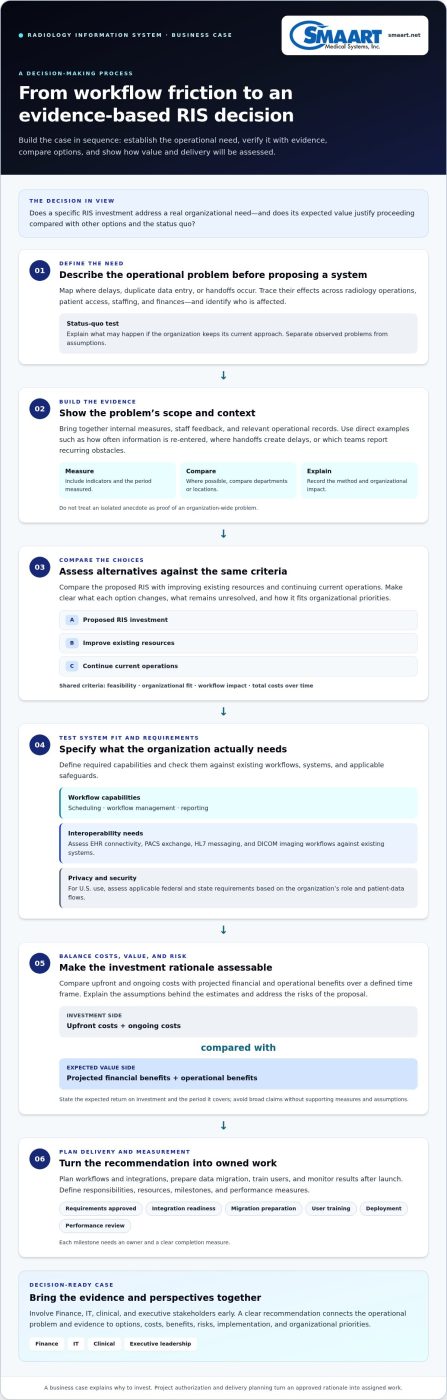
Describe the problem and trace its effects across radiology operations, patient access, staffing, and finances. A RIS manages radiology workflows, including scheduling, patient and examination information, and related administrative processes. It may help address fragmented workflows or manual coordination, but define the actual issue before proposing a system.
Answer the question: what happens if the organization keeps its current approach? Map where delays, duplicate data entry, or handoffs occur, then identify who is affected. For example, a scheduling bottleneck can increase staff workload and affect appointment access. Separate observed problems from assumptions, and connect each finding to an organizational consequence.
2. Gather Problem Evidence
Support the problem statement with internal measures, staff feedback, and relevant operational records. Where possible, compare performance across departments or locations, and describe the period and method behind each measure. Specific evidence makes the problem compelling; broad claims such as “the workflow is inefficient” don’t show decision-makers what needs to change.
Include measurable indicators and direct examples. Document how often staff re-enter information, where handoffs create delays, or which teams report recurring workflow obstacles. Explain how each finding affects clinical, operational, or financial priorities. Don’t present an isolated anecdote as proof of an organization-wide problem; show its scope and context.
3. Explain the Business Case Purpose
Define the business case as the evidence-based rationale for approving a project. It presents the problem, compares possible solutions, and explains the proposed solution’s expected benefits, costs, risks, and return on investment over a defined time frame. Include the option of improving existing resources, as well as the consequences of doing nothing.
Compare alternatives against shared criteria: feasibility, organizational fit, workflow impact, and total costs over time. A RIS should meet the organization’s requirements, not simply add features. For U.S. use, assess the federal and state privacy and security requirements that apply to the organization’s handling of patient information. The relevant requirements depend on its role and data flows.
For selection and implementation, define requirements, compare options, plan workflows and integrations, prepare data migration, train users, and monitor results after launch. Specify the capabilities the organization needs, such as scheduling, workflow management, and reporting. Document interoperability needs too: assess EHR connectivity, PACS exchange, HL7 messaging, and DICOM imaging workflows against the organization’s existing systems.
Business case compared with a business plan, executive summary, and project charter
Use each document for a distinct decision. The business case tests whether a specific RIS investment merits approval; related documents provide broader context, a concise overview, or authorization to proceed.
- Separate the business case from the business plan. A business plan covers the organization’s wider strategy, operations, and long-term direction. A business case focuses on one proposed project and the reasons to fund it. Connect the RIS proposal to priorities already in the plan, such as improving radiology workflow, using resources effectively, or supporting organizational growth.
Present the investment as a decision, not a product description. Compare the proposed option with improving existing resources and continuing current operations. This helps executives see what would change, what would remain unresolved, and how each option supports the organization’s strategy.
- Use the executive summary to make the decision easy to scan. It condenses the business case’s recommendation, core evidence, projected value, and main risks. It doesn’t replace the detailed analysis. Summarize the operational issue and expected outcome upfront, then point to the supporting assumptions and financial assessment in the main document.
Keep claims consistent. If the summary presents improved resource utilization as a benefit, the full case should explain the metric, baseline, and measurement approach. A concise executive overview orients leaders, while the complete business case gives Finance, IT, and clinical reviewers enough detail to assess the proposal.
- Distinguish the project charter from the investment rationale. The charter authorizes project work and clarifies its scope, sponsor, responsibilities, and governance. The business case explains why the organization should proceed. Once the case is approved, use the charter and implementation plan to translate the recommendation into assigned work, resources, timelines, milestones, and performance measures.
Set milestones around meaningful project outcomes, such as approved requirements, integration readiness, migration preparation, user training, deployment, and performance review. IT or technical teams can assess feasibility, resource needs, and sequencing. A target date is not a useful milestone unless it has an owner and a clear completion measure.
- Connect value metrics, team input, and decision tools. Estimate hard ROI using measures such as cost savings, resource utilization, revenue, staffing, time allocation, productivity, or space utilization. Add less tangible impacts, including staff morale, patient satisfaction, data quality, and staff education. Explain how each metric relates to the project, and distinguish measurable estimates from qualitative benefits.
Ask Finance to validate cost assumptions, cash flow, net present value, and ROI over a defined period. The project sponsor can coordinate input from Finance, IT, HR, and clinical subject matter experts. An RFP can help a buying committee compare solution options and total cost of ownership. Together, these inputs create a decision-ready case for the RIS investment.
Business case example with projected costs and benefits
Build a decision model that lets leaders compare investment choices, not just software features. For a radiology workflow project, connect each projected cost, benefit, and risk to an operational challenge and a clear measurement method.
Estimate Project Costs
List one-time and ongoing costs, then assign each to a project phase. For a RIS implementation, consider configuration, integration work, data migration, staff training, and internal project time. Include recurring licensing, maintenance, support, and future upgrades in the operating forecast. Separate delivery costs from ongoing costs so Finance can see when each affects cash flow.
Ask Finance and IT to validate assumptions against the organization’s systems, scope, and staffing plan. Don’t treat the purchase price as the full investment. Migration, for example, may require staff time to map records and test data. Document the reason for each estimate and identify the team responsible for it.
Project Quantifiable Benefits
Choose measurable outcomes that relate directly to the problem. A radiology team might track scheduling turnaround, duplicate data entry, staff time spent coordinating examinations, or resource utilization. Record the current baseline, intended direction of change, data source, and review period. This gives leaders a practical way to evaluate projected benefits after implementation.
Work with Finance to translate eligible operational improvements into financial impact. Estimate how reduced manual work could change staff time allocation, then show the calculation and assumptions. Project revenue effects only when the organization can explain the connection. Keep benefits distinct, and don’t count the same saved time as both added capacity and cost reduction.
Describe Qualitative Benefits
Capture outcomes that matter but don’t translate cleanly into dollars. A RIS proposal may discuss staff experience, data quality, patient satisfaction, or smoother coordination between radiology teams. Tie each benefit to a specific workflow change. For instance, explain how fewer repeated information handoffs could make scheduling responsibilities clearer for staff.
Give each qualitative benefit a way to assess progress. Staff feedback, patient feedback, and data-quality reviews can show whether the intended change is taking hold. Don’t present these outcomes as guaranteed financial returns. Explain instead how they support clinical, operational, or strategic priorities alongside measurable results.
Analyze Costs, Benefits, and Risks
Compare the proposed investment with alternatives, including optimizing existing resources and making no change. Show expected cash flows over a defined time frame, then ask Finance to assess ROI and net present value. A useful business case makes assumptions visible, helping decision-makers understand how different cost or benefit estimates affect the recommendation.
Assess risks for every option, not only the preferred one. Implementation risks may involve resources, skills, funding, scope, or quality. Operational risks concern the effects on routine work during and after deployment. Pair each risk with a mitigation action, an owner, and a measure for review. This turns analysis into action and gives leaders a clearer basis for deciding.
Engaging leadership and relevant stakeholders
Involve stakeholders while shaping the proposal, not only when seeking approval. Early input helps align the RIS project with clinical, technical, and financial priorities.
1. Map Decision-Makers and Stakeholders
Identify the executive sponsor, final decision-makers, budget owners, and teams affected by radiology workflows. Include Finance, IT, Informatics, and Clinical representatives, then record each person’s role in the decision. Complex B2B deals involve an average of 13 stakeholders, so map influence and approval responsibilities rather than relying on one contact.
Ask the sponsor to clarify who approves funding, technical feasibility, workflow changes, and project scope. A stakeholder map can show who recommends, reviews, approves, or uses the system. Include frontline schedulers and radiology staff, whose daily work can reveal practical requirements executives may not see.
For each group, note its priorities and likely concerns. Finance may focus on cash flow and value; IT may assess integration and resource demands. Clinical leaders may prioritize workflow continuity. This map helps tailor the proposal without changing its evidence or expected outcomes for different audiences.
2. Engage Relevant Stakeholders
Schedule focused discussions before finalizing the proposal. Ask radiology staff to describe workflow friction, IT to identify technical dependencies, and Finance to review cost assumptions. Use a shared requirements document to capture each issue, its operational effect, and the team responsible for evaluating it.
Involve stakeholders at relevant decision points. Invite IT and Informatics to review integration needs, then ask Clinical leaders to assess workflow implications. This sequence can surface conflicts early, such as a desired process change that depends on a technical resource or training plan.
Keep meetings purposeful. Circulate a short agenda, define the decision needed, and record owners and follow-up actions. The executive sponsor should connect proposed outcomes to organizational priorities and help resolve competing needs. Don’t treat attendance as buy-in; confirm whether participants support the assumptions and what evidence they still need.
3. Gather Feedback and Approvals
Share the draft business case with relevant stakeholders before presenting it to final decision-makers. Invite specific comments on scope, assumptions, risks, projected outcomes, and responsibilities. Consolidate feedback in one revision log, noting which changes you made and why. This creates a clear record instead of scattered edits across separate documents.
Resolve material disagreements with evidence. If Finance challenges a benefit estimate, revisit its calculation and data source. If IT flags a feasibility concern, update the technical assessment, timeline, or mitigation plan. Then ask the executive sponsor to confirm strategic alignment before submitting the proposal through the organization’s approval process.
Prepare the final presentation around the decision leaders must make: proceed, revise, or decline. Summarize the recommendation, evidence, key trade-offs, and requested approval. After the meeting, document the decision, conditions, accountable owners, and next steps so stakeholders share an understanding of what happens next.
Business case components
Build the document as a connected decision tool, not a collection of disconnected claims. These six steps organize the core components leaders need to assess a radiology information system investment.
- Write an executive summary. Present the recommendation, operational issue, expected outcomes, and decision required. Keep it brief enough for an executive to grasp the case quickly, then point to sections containing supporting evidence. For example, summarize a scheduling problem and the proposed change without introducing benefits the financial analysis doesn’t examine.
- Define the problem and strategic fit. Document the current workflow issue, its organizational impact, and the evidence supporting it. Connect the initiative to a stated priority, such as improving resource use or supporting consistent radiology operations. Clearly show what happens if the organization takes no action, rather than treating replacement as the only option.
- Compare options and recommend a solution. Assess the proposed approach alongside alternatives, including optimizing existing resources and maintaining current operations. Use consistent criteria for each option, such as feasibility, cost, workflow impact, and alignment with organizational goals. Explain why the recommendation best addresses the defined problem, and identify trade-offs leaders should understand before approving it.
- Develop the implementation plan. Outline the major activities, responsibilities, required resources, and milestones. For a RIS project, include requirements, integration planning, data migration, staff preparation, deployment, and performance review. Assign an owner to each milestone and describe how progress will be tracked. This plan connects the approved proposal to practical delivery and makes dependencies visible.
- Include financial analysis and risk assessment. Show upfront and ongoing costs, projected benefits, and ROI over a defined time frame. Explain assumptions and how Finance can validate them. Identify delivery risks, such as resource or scope constraints, and operational effects on routine work. Pair each material risk with a mitigation action and responsible owner.
- Close with stakeholder roles and a clear decision. Name the sponsor, decision-makers, and teams responsible for review or delivery. Explain who validates financial estimates, technical feasibility, and clinical workflow needs. Finish with the approval requested and the next action after a decision. A conclusion should bring the analysis together, not introduce a new benefit or unresolved assumption.
SMAART Medical Systems: SMAART-PACS
SMAART Medical Systems, Inc. offers SMAART-PACS, SMAART-RIS, and SMAART-SHARE for radiology management and imaging workflows. If your business case focuses on radiology information management, assess SMAART-RIS against your team’s requirements and intended outcomes. SMAART-PACS may fit needs centered on PACS, while SMAART-SHARE is a cloud-based sharing platform. The solutions are designed to integrate with existing EMR and HIS platforms, a factor to include in your technical and operational assessment. Compare the relevant offering with your documented workflows and integration needs rather than assuming every option solves the same problem. For a next step, contact SMAART Medical Systems, Inc. to discuss how its radiology software offerings relate to your project.
Turn approval into a decision you can learn from
Creating a business case for a new RIS also gives your organization a chance to establish how it will judge the decision over time. Before work begins, assign an owner to preserve the assumptions behind the approval and track whether the project’s intended outcomes remain relevant as workflows change.
Keep the case useful beyond the funding meeting. As implementation progresses, record decisions that alter scope, priorities, or expected results. After launch, compare actual performance with the organization’s chosen measures, then use the findings to guide future investments. This connects planning with operational learning, rather than treating approval as the finish line.
If you’re considering how radiology software fits your organization’s needs, contact SMAART Medical Systems, Inc. to discuss your next step. A clear decision process can help your team move forward with purpose.
Frequently Asked Questions
How much does a new RIS cost, including implementation, licensing, and ongoing support?
RIS costs depend on the project scope and are provided after a quote request. Budget for licensing, implementation, integrations, data migration, training, and ongoing support, then separate one-time expenses from recurring charges. Deployment model, existing systems, migration complexity, and required workflow changes shape the total. Ask Finance to record each category separately so decision-makers can see how costs fall across the project and its operating life.
What financial benefits and ROI can a RIS deliver for a radiology department?
A RIS may support financial value when it reduces avoidable administrative work, improves resource utilization, or helps the department manage appointment capacity. Calculate ROI using benefits and costs measured over the same period: subtract total costs from quantified benefits, then divide by total costs. For example, estimate the value of staff time redirected from manual coordination, but don’t count that time again as both a cost reduction and added capacity.
How do you calculate the total cost of ownership and build a RIS business case?
Include all project and operating costs across the period leaders will use to assess the investment. When creating a business case for a new RIS, compare those costs with expected benefits and a do-nothing scenario. Include implementation, licensing, integration, migration, training, support, and ongoing operation. Finance can model cash flows and net present value while documenting assumptions, so leaders can see which estimates most affect the recommendation.
How does a RIS compare with cloud-based, on-premises, and integrated RIS/PACS options?
Cloud-based and on-premises options differ in where systems are hosted and which infrastructure responsibilities the organization manages. An integrated RIS/PACS option combines information-management and image-management capabilities in a coordinated offering. Compare each approach against your infrastructure, workflows, integration requirements, staffing capacity, and cost model. For example, SMAART-RIS is fully integrated with SMAART-PACS, so assess whether that pairing aligns with your radiology operations and project requirements.
What are the main risks of replacing a RIS, and how can they be mitigated?
Common risks include incomplete data migration, integration problems, workflow disruption, unclear ownership, and low user adoption. Reduce migration risk by mapping important data fields and reconciling sample records before transition. Have technical and clinical teams test key workflows, such as scheduling and information exchange, and document defects with assigned owners. Prepare staff with role-specific training, then monitor issues after launch so the team can prioritize fixes based on operational impact.
What metrics should be used to evaluate RIS performance and business-case success?
Choose measures that correspond to the problem the project is meant to address. A radiology department could track scheduling turnaround, staff time spent on manual coordination, duplicate data entry, examination throughput, or resource utilization. Pair operational measures with financial indicators such as realized cost savings or changes in revenue. Define each metric’s data source, owner, and review cadence before launch, then compare results with the established baseline.