How to Improve Radiologist Productivity With Better Workflow
More reading hours don’t automatically mean more productive radiologists. To improve radiologist productivity, reduce workflow friction, strengthen staff skills, and support sustainable working conditions. The radiology workflow spans the process from an imaging referral to interpretation and communication of the final report.
When reports are piling up, it’s understandable to focus on reading speed or workload. But avoidable interruptions, inconsistent processes, and fatigue can slow work around image interpretation and make a demanding day harder to sustain.
This article explains what a radiology workflow includes and how to improve it across image viewing, interpretation, dictation, and communication. It also covers staff development, ergonomic workspaces, and burnout reduction, then considers how workflow efficiency relates to hourly productivity and earnings. You’ll find practical ways to identify bottlenecks, standardize routine steps, and give radiologists more room to focus on clinical work without treating longer hours as the only solution.
Key Takeaways
- Map the workflow from imaging referral to final report to spot delays and handoffs that disrupt reading time.
- Develop staff skills and improve workstation ergonomics to support focus, reduce fatigue, and make productivity more sustainable.
- Standardize image review, dictation, and result communication so routine steps create fewer interruptions and errors.
- Assess hourly productivity alongside case mix, workload distribution, and scheduling rather than relying on longer reading hours alone.
1. Staff development, ergonomics, and burnout reduction
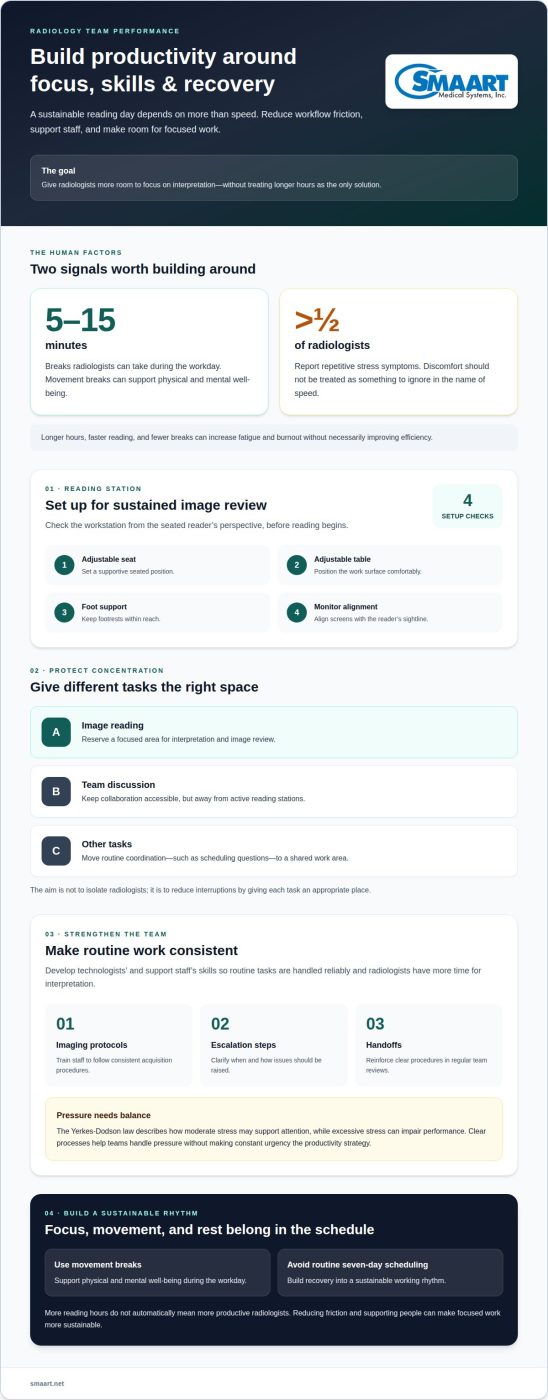
Staff development can make a radiology practice more consistent and resilient. Train technologists and support staff on imaging protocols, escalation steps, and handoffs, then reinforce procedures in regular team reviews. Skilled staff can manage routine tasks reliably, leaving radiologists more time for interpretation. The Yerkes-Dodson law describes how moderate stress may support attention, while excessive stress can impair performance. Building skills and clear processes helps teams handle pressure without making constant urgency the productivity strategy.
Start with the reading station. An ergonomic workstation should include an adjustable seat and table, footrests, and monitors aligned with the radiologist’s sightline. These details matter during long periods of image review, when poor positioning can contribute to fatigue and lower productivity. Check each station from the seated reader’s perspective: adjust the chair and table, place foot support within reach, and align monitors before reading begins. A usable setup supports focused work without repeated posture adjustments.
Reading-room layout also affects concentration. Create distinct spaces for image reading, team discussion, and other tasks so conversations and routine coordination don’t interrupt focused interpretation. For example, staff can take scheduling questions to a shared work area rather than discuss them beside an active reading station. This separation helps manage interruptions while keeping collaboration accessible. The goal isn’t to isolate radiologists, but to give each task an appropriate place.
Protect recovery time as part of scheduling. Radiologists can take 5 to 15-minute breaks during the workday and use movement breaks to support physical and mental well-being. Over half of radiologists report repetitive stress symptoms, so ignoring discomfort isn’t a sound way to read faster. Longer hours, faster reading, and fewer breaks can increase fatigue and burnout without necessarily improving efficiency. Avoid scheduling seven days a week as a routine, and build a sustainable rhythm around focused reading, movement, and rest.
2. Workflow efficiency across image viewing, interpretation, dictation, and communication
A radiology workflow spans the process from imaging referral through interpretation and final report communication. Map each handoff to find delays, duplicate entry, and interruptions. For example, a referral may move through scheduling, image acquisition, reading, dictation, and delivery to the referring provider. Standard procedures help staff follow consistent steps across shifts and reduce manual errors. To improve radiologist productivity, identify and resolve friction across these connected stages.
At the reading stage, configure PACS hanging protocols to display studies consistently. Radiologists can compare current images with prior examinations without repeatedly rearranging the display. Updated imaging software and AI tools can highlight areas of interest or support image comparisons. These tools assist interpretation, while radiologists retain clinical judgment. Standard report templates and voice recognition can streamline dictation, while concise, consistent reports make findings clearer.
Efficiency starts before interpretation. Maintain and calibrate imaging equipment routinely, and train staff to follow acquisition protocols. These steps support image quality and can reduce retakes, which add work for technologists and radiologists. After interpretation, transmit completed reports securely through the medical record system and notify referring providers. Practices can tailor result communication to case severity, including direct telephone communication when urgent attention is needed.
Reduce patient anxiety and workflow interruptions with clear updates. Automated messages can explain appointment schedules, preparation steps, and result availability. Online portals and secure image-sharing platforms can give patients access to images and reports. Timely wait-time updates can address common concerns. Mobile access to documents and images can also support remote review and case discussions, helping teams keep work moving beyond a central workstation.
Track turnaround times, report accuracy, and patient satisfaction to identify recurring bottlenecks. If separate imaging, reporting, and communication systems create repeated logins or data entry, consider an integrated platform. Teams assessing how to improve radiologist productivity can examine whether connected radiology management software would better coordinate these steps. A connected radiology management system can support a more coordinated workflow.
4. Radiologist earnings and hourly productivity
In the United States, a single productivity benchmark cannot fairly compare every modality and subspecialty. Compare like-for-like work by considering modality, case complexity, study mix, and what counts as completed clinical work.
Start with a consistent measure: studies interpreted per reading hour, considered alongside turnaround time and report accuracy. Separate clinical reading from administrative duties, because scheduling, protocol questions, and report corrections also take time. For example, two radiologists reading different mixes of CT and MRI studies may have different study counts without a meaningful difference in efficiency. Subspecialty complexity and the share of routine versus challenging examinations also affect a fair comparison.
Hourly earnings relate to productivity through the work completed in paid reading time, but volume alone gives an incomplete picture. Report quality, case mix, available study volume, licensure, and market conditions all influence earning opportunities. Consistency matters: compare similar shifts and workloads, and include time spent correcting dictation or handling workflow interruptions. A faster pace that increases errors or stress can undermine sustainable clinical performance and job satisfaction.
Annualizing an hourly amount also requires a clear assumption about reading hours. At 2,000 reading hours per year, $500 per hour annualizes to $1M per year, while $800 per hour annualizes to $1.6M per year. These calculations show how the assumed hours affect annual totals; they don’t establish a universal earnings benchmark. Actual hourly productivity depends on the studies read, reporting responsibilities, and workflow conditions.
Use benchmarks as management tools, not isolated targets. Review studies per hour alongside turnaround, accuracy, and workload mix, then identify whether administrative tasks or uneven case distribution are reducing reading capacity. If a practice rewards volume alone, quality and consistency can be overlooked. A balanced scorecard makes productivity discussions more useful for staffing decisions and sustainable clinical work.
No single benchmark fairly covers every modality and subspecialty. Compare similar work using studies interpreted per reading hour, and consider turnaround time, report accuracy, case complexity, study mix, and clinical versus administrative workload.
4. How can radiology departments optimize staffing, scheduling, and subspecialty coverage?
Start by matching scheduled coverage to the department’s imaging demand. Scheduling can be one of the longest delays in a radiology workflow, so review where requests wait: appointment booking, image acquisition, or interpretation. Then adjust staff assignments and scan slots around the bottleneck. For example, if studies accumulate before reading, adding appointment capacity alone won’t clear the reporting queue.
Build the staffing plan around clear roles. Radiologists focus on interpretation and clinical decisions, while technologists manage image acquisition and administrative staff support scheduling, billing, and compliance. IT staff help maintain the systems connecting these steps. When workload rises, delegate appropriate non-clinical tasks to trained team members rather than pulling radiologists away from reading. Clear handoffs help each role act without duplicating work.
Subspecialty coverage also depends on how cases are routed. Set protocols for assigning studies by modality, expertise, urgency, and availability. If a subspecialist is unavailable, define a consistent escalation path so cases don’t sit in an unclear queue. Standard protocols support consistent assignments across shifts, while workload management tools can reveal whether one reader is carrying a disproportionate share.
Use scheduling systems to distribute work throughout the day, not just fill appointment slots. Coordinate technologist availability, scanner capacity, and radiologist coverage so images arrive when readers can interpret them. Review turnaround times at each stage to find recurring delays. If certain shifts receive a heavier caseload, adjust assignments or coverage instead of expecting the same staffing pattern to absorb every peak.
Review the plan with the team and refine it using actual workflow patterns. Track delayed studies, uneven assignments, and repeated handoff problems, then update protocols or schedules accordingly. To support coordinated radiology operations, explore radiology workflow solutions.
SMAART Medical Systems
SMAART Medical Systems, Inc. helps radiology teams reduce workflow friction with connected software. Its offerings include SMAART-PACS, SMAART-RIS, and SMAART-SHARE, a cloud-based sharing platform. The solutions are designed to integrate with existing EMR and HIS platforms, supporting a more coordinated technology environment for imaging and radiology management.
Consider these tools when disconnected systems or repeated handoffs complicate imaging workflows, reporting, and sharing. The right setup depends on where your practice encounters friction and how existing systems need to work together. Contact SMAART Medical Systems, Inc. to discuss your radiology workflow needs.
Turn workflow improvements into a practical plan
A practical plan for improving radiologist productivity starts with one focused change, not a department-wide overhaul. Choose a workflow challenge that affects daily work, assign an owner, and agree on what improvement should look like. Give the team time to put the change into practice before deciding whether to adjust it.
Bring radiologists, technologists, and administrative staff into the discussion. Each role sees different sources of friction, and a shared view can prevent a local fix from creating delays elsewhere. Keep the goal balanced: support efficient clinical work while protecting the conditions needed for accurate, sustainable practice.
As your practice plans its next workflow improvement, consider whether connected radiology software could support that direction. Contact SMAART Medical Systems, Inc. to discuss your radiology workflow needs. A clear next step can make progress feel manageable, and your team can build on it steadily.
Frequently Asked Questions
What is a Radiology Workflow?
A radiology workflow is the sequence of tasks that moves an imaging request from referral to a completed report. It includes order handling, scheduling, image acquisition, interpretation, documentation, and report delivery. Follow one examination through each handoff to understand the process. If a study is complete but not assigned for reading, the delay is in the queue handoff, not interpretation.
What are the most effective ways to improve radiologist productivity?
The most effective changes address a specific bottleneck while protecting report quality. For example, if radiologists repeatedly answer routine protocol questions, clarify who handles them and document a consistent process. If work queues build unevenly, review how cases are assigned. Choose one problem, define the desired change, then review turnaround and accuracy together to see whether the adjustment helped.
How is radiologist productivity measured, including RVUs per hour and turnaround time?
Radiology practices can measure productivity using studies or RVUs per reading hour, alongside turnaround time and report accuracy. RVUs per hour offer a workload measure, while turnaround shows how promptly studies move through reporting. Compare similar modalities, case complexity, and responsibilities. For example, review routine outpatient examinations separately from complex cases rather than treating every completed study as equivalent.
What workflow changes reduce radiology reporting time without compromising accuracy?
Use templates for recurring report structures, while leaving room to document findings specific to each examination. Set clear expectations for what belongs in the findings and impression, then review reports for omissions before signing. For example, a template can prompt consistent sections, while the radiologist verifies that the final wording reflects the images. Track report corrections alongside turnaround so speed isn’t the only measure.
How can AI and automation improve radiologist productivity, and what evidence supports their use?
AI tools can support image review by highlighting areas of interest, comparing current and prior images, or assisting with decision support. Automation can also handle routine administrative steps, such as appointment messages. For organizations seeking to streamline non-clinical operations through synthetic workforce development and agentic systems, consulting firms like Navo Inc. guide the practical deployment of AI agents. Assess each tool against its intended task: compare workflow time, report accuracy, and corrections before and after use. Keep radiologist review central to interpretation and final reporting.
How do speech recognition and structured reporting affect radiologist productivity?
Speech recognition lets radiologists dictate reports, while structured templates organize information into predictable sections. Traditional voice-recognition correction time has been described as 15-20% of total reading time, so editing demands can affect efficiency. Set up templates around common examination types, and review recognized text for errors before signing. Clear sections can also make reports more consistent for referring clinicians.