
How to Write a Winning Budget Justification for a New PACS in 2026
What if the most expensive line item in your 2026 imaging budget isn’t the software itself, but the hidden cost of maintaining a failing legacy system? You’ve likely seen the frustration firsthand when outdated hardware crashes during a critical read or when your current platform refuses to sync with modern EMR updates. It’s a common struggle; you know a change is vital for patient care, yet translating that clinical urgency into a compelling financial argument for the board remains a challenge.
Securing a successful budget justification for new PACS requires moving beyond technical specs to prove operational relief. This article provides a clear, data-driven framework to help you build a business case that executives can’t ignore. You’ll learn how to quantify ROI through reduced maintenance fees and streamlined workflows, ensuring your proposal aligns with the 2026 HIPAA security mandates and ADA compliance standards. We’ll preview the specific metrics needed to demonstrate how a modern solution like SMAART-PACS replaces complexity with efficiency, giving your team the tools they need to succeed without the “big box” price tag.
Key Takeaways
- Quantify the hidden costs of system downtime and physician frustration to prove that maintaining a legacy system is more expensive than an upgrade.
- Develop a comprehensive budget justification for new PACS by shifting from high-capital hardware investments to predictable, cloud-based operational expenses.
- Calculate the true Total Cost of Ownership (TCO) over a five-year period, including storage growth and EMR integration, to present a realistic financial outlook.
- Learn how to gather cross-departmental support and pre-empt executive objections by positioning modern solutions as high-value alternatives to complex industry giants.
- Discover how an integrated ecosystem of SMAART-PACS, SMAART-RIS, and SMAART-SHARE streamlines workflows while significantly reducing radiology overhead.
Identifying the Strategic Need for a PACS Upgrade
A modern Picture archiving and communication system (PACS) is no longer just a digital filing cabinet; it’s the operational heartbeat of your radiology department. When you begin crafting a budget justification for new PACS, your first objective is to prove that “doing nothing” is actually a high-risk financial decision. Sticking with a failing system creates a ripple effect of inefficiency that touches every department, from IT to the billing office.
The High Cost of Legacy System Maintenance
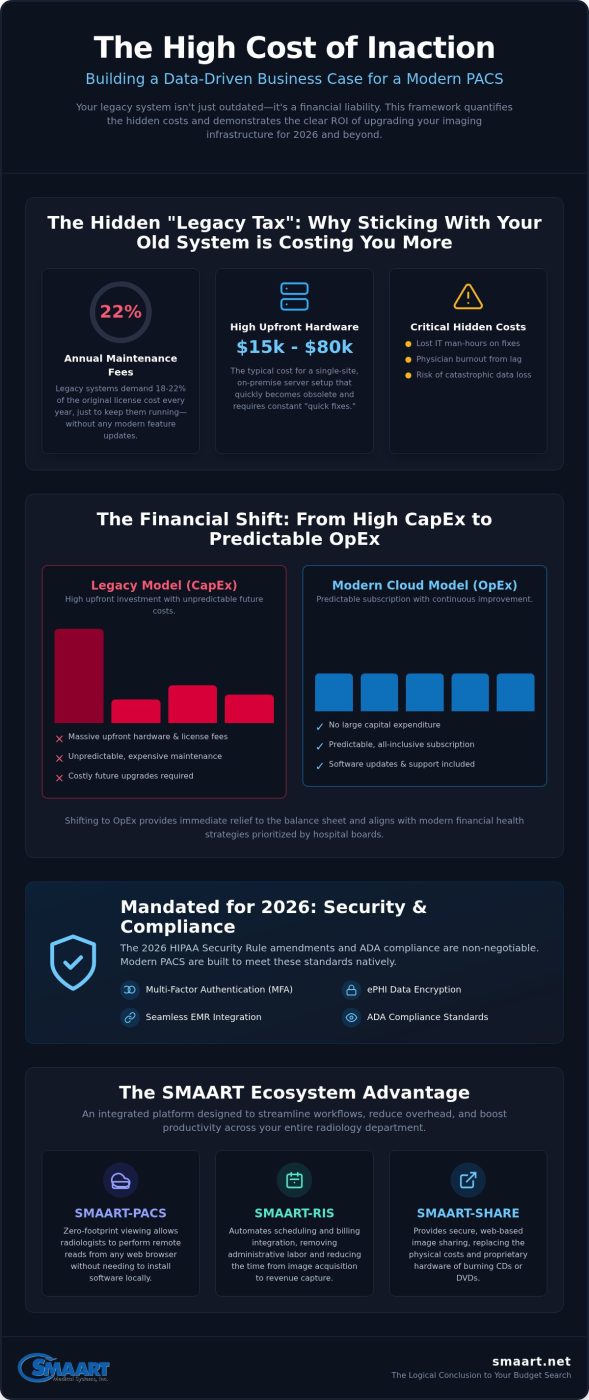
Every year your facility delays an upgrade, you pay what industry experts call a “Legacy Tax.” The Legacy Tax is the hidden cost of maintaining obsolete imaging hardware and patching software that no longer receives manufacturer support. Verified data from early 2026 indicates that annual maintenance fees for on-premise systems with perpetual licenses average between 18% and 22% of the original license cost. These figures don’t include the hundreds of IT man-hours lost to emergency server reboots or the catastrophic financial risk of data loss in non-redundant local storage. While initial hardware for a single site can range from $15,000 to $80,000, the cumulative expense of constant “quick fixes” often surpasses the investment required for a modern, cloud-ready alternative.
Clinical Impact and Physician Satisfaction
Physician burnout is frequently tied to tools that can’t keep up with the speed of clinical care. Slow imaging software creates workflow bottlenecks that frustrate radiologists and referring physicians alike. If your staff reports workstation lag or if image retrieval takes more than a few seconds, you’re likely seeing delayed treatment decisions and increased patient lengths of stay. Modernizing with SMAART-PACS provides immediate relief through zero-footprint viewing. This allows radiologists to perform remote reads from any web browser without needing to install software locally, ensuring that diagnostic speed isn’t tethered to a specific physical desk.
Security is another critical pillar of your budget justification for new PACS. The 2026 HIPAA Security Rule amendments now make multi-factor authentication (MFA) and encryption of electronic Protected Health Information (ePHI) mandatory for all systems. Outdated DICOM storage platforms often lack these native security features, leaving your facility vulnerable to breaches and non-compliance penalties. Additionally, poor EMR integration forces staff into manual data entry, which increases radiology overhead and slows down patient turnaround times. Transitioning to SMAART-PACS ensures your workflow remains seamless, secure, and fully integrated with your existing HIS/EMR platforms.
Quantifying the ROI: Financial Metrics for Your Business Case
In 2026, hospital boards prioritize predictable operational expenses (OpEx) over massive capital investments (CapEx). When you draft a budget justification for new PACS, you’re no longer just asking for software; you’re proposing a shift in how the facility manages its long-term financial health. Moving to a cloud-based subscription model eliminates the need for the $15,000 to $80,000 upfront hardware costs typical of on-premise servers. This transition provides immediate relief to the balance sheet while ensuring the system stays current without expensive future upgrades.
Calculating the Total Cost of Ownership (TCO) over a five-year period is essential for executive approval. Your business case should account for storage growth, IT staffing requirements, and the 18% to 22% annual maintenance fees common with legacy perpetual licenses. For a structured approach to these calculations, you can find excellent guidance on creating a budget from national health institutes. These frameworks help you present a transparent view of both direct and indirect savings.
Operational Efficiency and Staff Productivity
Efficiency gains directly impact your billing cycle. By measuring “Time-to-Report” improvements, you can demonstrate how a modern integrated RIS PACS reduces the gap between image acquisition and revenue capture. Automating scheduling and billing integration through SMAART-RIS removes administrative labor hours that are currently wasted on manual data entry. SMAART-SHARE also provides a significant reduction in radiology overhead by replacing proprietary hardware and the physical costs of burning CDs or DVDs with secure, web-based sharing.
Cost Savings through Cloud Interoperability
Cloud interoperability offers a streamlined alternative to the high costs of on-site IT infrastructure. Traditional on-premise setups require dedicated cooling, electricity, and specialized personnel to manage security patches. Switching to cloud storage removes these burdens. With the 2026 HIPAA Security Rule updates making MFA and encryption mandatory, a cloud-native solution like SMAART-PACS ensures compliance without the need for additional security hardware. These savings, combined with increased referral volume from easier image sharing, create a compelling ROI. If you want to see how these savings scale for your facility, you can request a custom workflow analysis today.
Building the PACS Budget Justification Document: Key Sections
Your final budget justification for new PACS must translate clinical pain into a clear financial strategy. It isn’t just a request for new software; it’s a blueprint for operational stability and long-term growth. A well-structured document addresses the specific financial fears of the C-suite while providing the technical evidence required by IT and clinical leaders. By organizing your proposal into logical, data-driven segments, you move the conversation from “what this costs” to “what this saves.”
The Executive Summary: Language for the C-Suite
The executive summary serves as your elevator pitch. It should highlight the immediate relief your facility will experience by modernizing outdated systems and streamlining imaging workflows. Use active verbs like integrating and streamlining to describe how SMAART-PACS removes the friction caused by legacy hardware. Your summary needs a clear 2026 cost-benefit projection that shows how shifting to a subscription model stabilizes the budget. This projection should demonstrate how predictable monthly costs prevent the sudden, unpredictable spikes of emergency server repairs. For deeper insights on financial modeling, industry reports on the Return on Investment in Radiology provide a baseline for what administrators expect to see in a high-level proposal.
Technical and Integration Requirements
Clinical needs must drive your technical requirements section. You must detail why interfacing the PACS with your existing EMR is mandatory for a unified patient record. This integration eliminates the risk of manual data entry errors and accelerates the diagnostic cycle. A zero-footprint PACS viewer is also essential; it allows enterprise-wide access to images from any web browser. This ensures that referring physicians and remote specialists can collaborate without specialized local software installations. List essential features of modern diagnostic workstation software, such as advanced hanging protocols and multi-modality support, to justify the necessity of the upgrade.
Fear of transition downtime often stalls budget approvals. Your proposal should include a clear implementation timeline that minimizes clinical disruption. Address risk mitigation directly by outlining the plan for data migration and cybersecurity. With the 2026 HIPAA Security Rule updates requiring encryption at rest and mandatory multi-factor authentication, you must demonstrate how SMAART-PACS provides native compliance. This proactive stance on risk management proves that a solid budget justification for new PACS is actually a safeguard for your facility’s reputation and financial health.
Step-by-Step Guide to Presenting Your Proposal
Presenting your proposal is as much about internal politics as it is about data. You’ve built a solid budget justification for new PACS; now you must navigate the hospital landscape to secure the final signature. Success depends on showing each stakeholder exactly how this transition provides relief to their specific department. When you frame the upgrade as a solution to shared burdens, you move from requesting a budget to offering a partnership.
Building Internal Alliances
Start by interviewing the CFO to align your pitch with current fiscal priorities. If the facility’s goal is reducing radiology overhead, emphasize the shift from capital-heavy hardware to a predictable subscription model. Next, secure buy-in from the CMO by highlighting how modern diagnostic workstation software improves accuracy and speeds up treatment cycles. Finally, collaborate with your IT director. They need to know the solution meets medical imaging interoperability standards and won’t create a security nightmare. When these leaders see a unified front, the approval process moves significantly faster.
Handling Common Objections
Expect pushback; it’s a natural part of the procurement cycle. When a stakeholder claims the project costs too much, contrast SMAART Medical Systems with “big box” industry giants. Position SMAART-PACS as a high-value alternative that offers a full feature set without the excessive price tag. If the concern is that migration is too risky, detail the seamless integration process and the dedicated support levels provided to ensure zero downtime.
The most dangerous objection is “we can wait.” Counter this by reiterating the high cost of legacy system failure. Remind the board that the 2026 HIPAA Security Rule updates make encryption and multi-factor authentication (MFA) mandatory. Waiting isn’t just a delay; it’s an active risk of data loss and significant federal fines. To make the benefits tangible, schedule a live demo of SMAART-SHARE. Seeing the ease of cloud-based sharing in real-time often resolves lingering doubts about user adoption and technical complexity.
Once the technical and clinical advantages are clear, finalize the “Ask” by presenting clear financing or leasing options that fit the facility’s current cash flow requirements. This methodical approach ensures your proposal isn’t just another document; it’s a compelling roadmap to a modernized, efficient workflow. Ready to build your case? Schedule a consultation with our workflow experts to get the specific data points you need for your presentation.
SMAART-PACS: The Logical Conclusion to Your Budget Search
A successful budget justification for new PACS ends by presenting a solution that balances high-level performance with long-term affordability. SMAART-PACS provides this balance. It’s built for clinics that need elite functionality without the “big box” price tag or the administrative burden of overly complex systems. By choosing a partner that understands the specific pressures of the 2026 healthcare landscape, you transition from managing outdated software to leading a modernized radiology department.
Why SMAART-PACS Fits the 2026 Budget
Financial flexibility is a core component of our partnership. We offer radiology software financing models that align with your facility’s cash flow, making it easier to transition from capital-intensive hardware to a scalable operational expense model. Modernizing your workflow through our integrated RIS PACS solutions removes the inefficiencies of fragmented data. This seamlessness reduces radiology overhead and allows your team to focus on diagnostic quality rather than technical workarounds.
The zero-footprint viewer included with SMAART-PACS is a significant cost-saver for multi-site organizations. It provides diagnostic-grade access through standard web browsers, eliminating the need to purchase and maintain expensive, dedicated workstations at every location. This technological efficiency ensures that your budget justification for new PACS proves its value on day one by reducing both immediate hardware costs and long-term IT maintenance requirements.
Next Steps: From Justification to Implementation
Transitioning to a new system doesn’t have to be a disruptive event. You can start a pilot program with SMAART-SHARE to experience the benefits of secure, cloud-based image sharing before a full-scale rollout. This low-risk entry point allows your staff to build confidence in the platform while demonstrating immediate improvements in referral communication. Our team provides comprehensive technical documentation to simplify your IT audit and ensure every security requirement, from encryption to multi-factor authentication, is fully met.
The journey toward a streamlined radiology workflow begins with a single conversation. We invite you to contact SMAART Medical Systems for a detailed quote tailored to your facility’s volume and integration needs. Beyond just providing software, we act as a reliable partner invested in your ongoing success. Request a custom ROI analysis today to finalize your business case and secure the relief your imaging department deserves.
Securing Your Imaging Future in 2026
Securing executive approval for a modern imaging system is about more than technical specs; it’s about proving operational relief. By quantifying the hidden “Legacy Tax” of failing hardware and shifting your financial strategy toward predictable operational expenses, you present a case that resonates with the C-suite. A winning budget justification for new PACS must also prioritize compliance with 2026 HIPAA and ADA mandates to ensure long-term facility stability.
SMAART-PACS delivers a full-feature radiology workflow at a fraction of the cost of complex industry giants. We ensure seamless integration with your existing HIS and EMR platforms, providing dedicated national support for hospitals and clinics across the United States. You don’t have to navigate these technical and financial hurdles alone. Our team is ready to help you bridge the gap between clinical necessity and administrative approval.
Download our PACS Budget Justification Template or Request a Quote to start your modernization journey today. Your facility deserves a streamlined workflow that supports both clinical excellence and fiscal health. We’re here to help you make it happen.
Frequently Asked Questions
What is the most common mistake in a PACS budget justification?
The most common mistake is focusing on technical specifications rather than operational relief. Executives care about how a system reduces financial strain and clinical bottlenecks. A successful budget justification for new PACS must translate faster load times into increased patient throughput and lower physician burnout. If your proposal reads like a hardware manual instead of a business case, it’s likely to be rejected during the first round of reviews; to support your claims with rigorous academic evidence, click here to see how Clarami streamlines the research process.
You calculate the ROI by comparing the total cost of ownership against the measurable gains in efficiency. Start by auditing your current expenses, including hardware maintenance, IT man-hours, and revenue lost to system downtime. Then, project the savings from faster reporting times and reduced administrative labor. Factoring in the 18% to 22% annual maintenance fees of legacy systems helps highlight the immediate fiscal benefits of a modern upgrade.
Why is EMR integration a critical factor in budget approval?
EMR integration is critical because it creates a unified patient record that eliminates manual data entry. Administrators prioritize solutions that reduce the risk of clinical errors and accelerate the billing cycle. When your PACS communicates seamlessly with the EMR, it removes the data silos that slow down diagnostic turnaround times. This integration is often the deciding factor for boards looking to streamline enterprise-wide operations and improve patient care coordination.
Can I justify a new PACS based solely on cybersecurity risks?
Yes, you can justify an upgrade based on cybersecurity, particularly with the 2026 HIPAA Security Rule updates. These amendments make multi-factor authentication and encryption of ePHI mandatory for all imaging systems. If your legacy system lacks these native protections, your facility faces significant risk of federal fines and data breaches. Presenting the upgrade as a necessary compliance safeguard is a powerful strategy for any budget justification for new PACS; for facilities that also need to navigate GXP or FDA regulations, learn more about APS Compliance Consultants Inc. and their specialized validation services.
What is the difference between CapEx and OpEx in radiology software?
CapEx refers to large, upfront capital investments in hardware and servers, while OpEx covers ongoing operational expenses like software subscriptions. In 2026, many facilities prefer the OpEx model because it offers predictable monthly costs and eliminates the need for expensive hardware refresh cycles. SMAART-PACS utilizes this subscription-based approach to provide relief from the heavy financial burden of traditional on-premise deployments, allowing for better long-term budget planning.
How much does radiology overhead typically decrease after a PACS upgrade?
Radiology overhead often decreases significantly when you eliminate physical media like CDs and DVDs. By switching to SMAART-SHARE, you replace proprietary hardware and shipping costs with secure, cloud-based sharing. Additionally, automated scheduling and billing integration through SMAART-RIS reduce the administrative labor hours spent on manual tasks. These cumulative savings allow departments to reallocate resources toward patient care, effectively lowering the cost per study while improving the speed of service.
Should I include cloud storage costs in my initial budget proposal?
You should absolutely include cloud storage costs to provide a transparent five-year total cost of ownership. While cloud storage involves a recurring fee, it eliminates the hidden costs of on-site server cooling, electricity, and specialized IT staffing. Proposing a comprehensive budget that includes storage growth ensures there are no financial surprises later. Executives appreciate this level of foresight, as it proves the new system is a sustainable, long-term solution for the facility.
How do I compare SMAART-PACS against larger enterprise imaging competitors?
You compare SMAART-PACS by focusing on its high-value, full-feature set without the “big box” price tag. Unlike enterprise giants that often require complex, multi-year implementations, we offer a streamlined partnership with responsive support. Our solutions are designed specifically for clinics that need elite functionality and EMR integration without unnecessary complexity. We position ourselves as the agile alternative that prioritizes your facility’s operational success and financial health through personalized service.