
Secure Medical Image Exchange for Healthcare Facilities
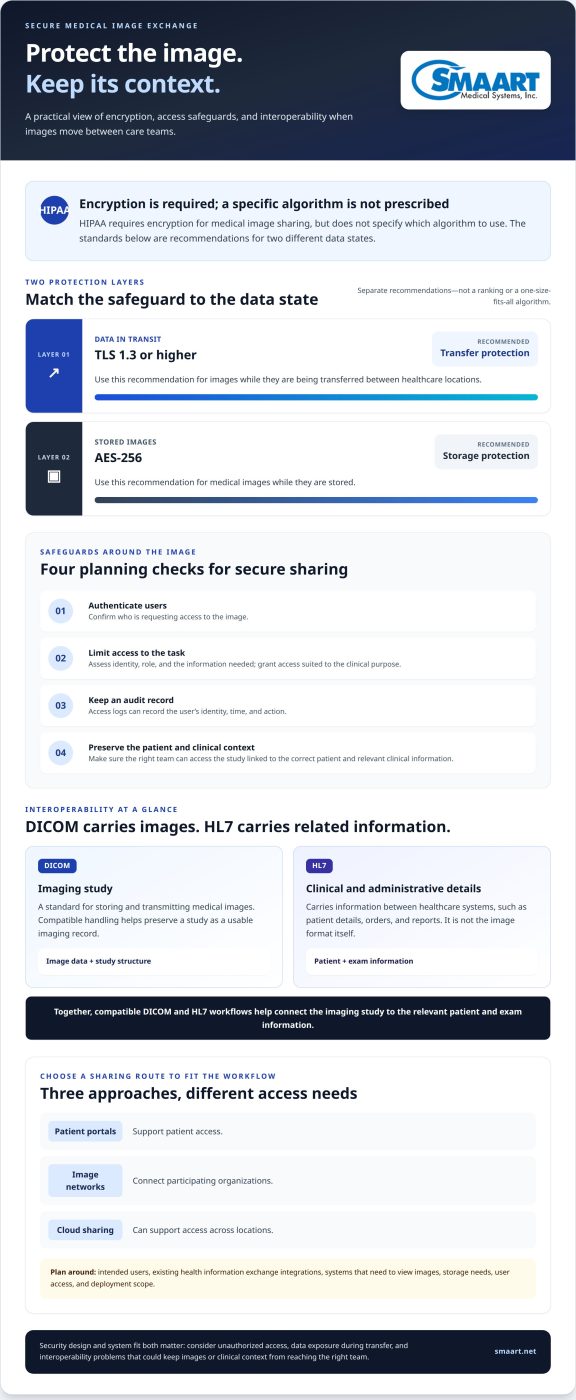
The most secure image exchange isn’t defined by a single mandated encryption algorithm. HIPAA requires encryption for medical image sharing but doesn’t specify which algorithm to use. For data in transit, TLS 1.3 or higher is recommended; for stored images, AES-256 is recommended. That distinction helps healthcare facilities assess security without confusing recommended standards with a specific HIPAA-prescribed algorithm.
Image exchange and PACS are related, but they do different jobs. PACS stores and manages imaging, while exchange helps move images between facilities and care teams. Both should fit clinical workflows and keep images connected to the right patient and context.
This guide explains the role of encryption, how DICOM and HL7 support interoperability, and how secure medical image exchange compares with PACS. You’ll also see what to consider when planning cross-facility sharing, including how existing systems and clinical workflows affect the setup. The goal is a clearer path to sharing images securely without adding avoidable complexity for staff.
Key Takeaways
- Replacing physical media can simplify access to prior imaging and support smoother coordination between care teams.
- Security planning should account for how images are protected during transfer and while stored, alongside access controls.
- DICOM and HL7 address different parts of interoperability, helping imaging data and related clinical information work across systems.
- Use PACS to manage imaging and image exchange to share it across facilities; the right approach depends on your workflows and existing systems.
Benefits of replacing CDs with secure online access
Replacing CDs with online access can make imaging easier to share across facilities. A specialist can review a prior study without waiting for a disc to arrive.
Secure Online Imaging Access
Online access replaces the physical handoff with a controlled digital route to medical imaging. For example, an authorized care team member can retrieve a study through a secure platform rather than loading a CD. When evaluating this approach, focus on how users are authenticated, how access is limited, and whether activity is recorded. These controls help keep imaging available to clinical teams while protecting patient information.
Access to Prior Imaging Studies
Previous imaging gives clinicians a reference point for a new examination. Comparing a current scan with an earlier study may help guide treatment decisions and reduce unnecessary repeat exams, radiation exposure, or duplicate procedures. Cross-facility sharing can also support faster specialist consultations, reported as up to 30% faster. The practical benefit depends on whether the relevant study and its clinical context are accessible when care teams need them.
Zero-Trust Access Controls
A zero-trust approach evaluates each access request instead of assuming a user is safe because they are inside a healthcare network. Requests can be assessed against identity, role, and the information needed for a task. For example, a clinician reviewing a patient’s scan should receive access suited to that clinical purpose. Access logs can record the user’s identity, time, and action, creating a record of how imaging data was used.
Sharing Images with Doctors
How can providers let patients securely share medical images with doctors? They can offer an approved digital sharing route, authenticate access, and make the relevant study available to the intended care team. The U.S. Department of Health and Human Services says patients have the right to access medical records, including images. With secure medical image exchange, patients can share imaging without carrying a CD, while providers manage access and keep the study linked to its clinical context.
What encryption standards are required for medical image sharing?
HIPAA requires encryption for medical image sharing, but it doesn’t mandate a specific algorithm. TLS 1.3 or higher is recommended for data in transit, while AES-256 is recommended for stored images. Facilities planning secure medical image exchange should consider both, alongside user authentication, access permissions, and secure transfer between healthcare locations.
When assessing a sharing platform, consider encryption during transfer and storage, access controls, audit records, and fit with clinical workflows. For care coordination, determine whether a referring location and specialist can access the same study without a separate download or manual handoff. The image should stay linked to the correct patient and relevant clinical context.
Choose between patient portals, image exchange networks, and cloud sharing based on the workflow. Portals support patient access, networks connect participating organizations, and cloud sharing can support access across locations. Consider the intended users, existing health information exchange integrations, and the systems that need to view the images.
The cost of a medical image exchange platform depends on the solution and its deployment model. SMAART Medical Systems offers purchase, lease, rental, and cloud-based options, with no prices listed here. When planning, consider storage needs, integrations, user access, and deployment scope. Risks include unauthorized access, exposed data during transfer, and interoperability problems that prevent images or clinical context from reaching the right team. Security and system fit are therefore central to secure medical image exchange planning.
Validation can provide another useful input. The RSNA Image Share Validation Testing Program launched in 2016 to test health care IT vendor systems against medical image exchange standards. Products that pass receive the RSNA Image Share Validation seal. Consider validation alongside the platform’s security design and integration fit, rather than as a substitute for evaluating those needs.
For facilities aligning image access across existing systems, cloud-based sharing may support that workflow. Explore cloud-based image-sharing options as part of planning how teams will access and share studies.
DICOM and HL7 interoperability
DICOM is a standard for storing and transmitting medical images. It supports sharing studies between imaging systems, but interoperability also depends on how each system handles patient and exam information. For example, a CT study may arrive in DICOM format but still need to match the correct patient record and clinical order at the receiving facility.
A DICOM study contains image data and information that helps systems organize and interpret it. This structure lets a receiving application identify elements such as the study and its images. During image sharing, compatible DICOM handling helps preserve the study as a usable imaging record, rather than a collection of unrelated picture files. A JPEG export, for example, may be viewable but does not provide the same DICOM workflow context.
HL7 supports a different part of the exchange. It carries clinical and administrative information between healthcare systems, such as patient details, orders, and reports. In a cross-facility workflow, DICOM can carry the imaging study while HL7 messages help connect it with the relevant patient and exam information. That coordination supports clinical collaboration without making HL7 the image format itself.
Effective interoperability requires both standards to work together across the sending and receiving systems. A practical workflow traces one example, such as a referring clinic sending a chest X-ray to a hospital. The DICOM study must arrive intact, and associated information must identify the right patient and examination. Mismatched identifiers, incomplete messages, or incompatible system configurations can interrupt that handoff. Reviewing how DICOM images and HL7 information move through each connection helps facilities spot gaps before routine sharing depends on them.
Medical image exchange compared with PACS
PACS and image exchange solve related but different problems. PACS stores, organizes, and supports viewing imaging studies within an organization. Exchange moves studies between organizations, such as when a community clinic sends a scan to a hospital specialist. One manages imaging locally; the other enables access across organizational boundaries.
Consider a patient referred from a clinic to a hospital. The clinic’s PACS may hold the original CT study, while an exchange capability makes it available to the receiving care team. The specialist can review the existing images instead of relying only on a report or waiting for physical media. Exchange can complement PACS, not replace its role in local imaging management.
The capabilities to assess depend on the workflow. PACS should support staff as they store, retrieve, and review studies during imaging operations. Exchange should route studies or provide access across locations, connect with receiving systems, and preserve relevant patient and study context. For example, a facility serving multiple referral partners may need exchange workflows that extend beyond its own PACS environment.
Map where images originate, who needs access, and which systems must receive them. If clinicians mainly review studies within one facility, PACS may meet the primary need. If referrals regularly cross facility boundaries, exchange can address that gap. A combined approach may make sense when teams need both local image management and external collaboration. The deciding factor is the workflow, not one label for every imaging task.
Use that distinction to frame system planning: identify the local imaging functions, then define the cross-facility sharing needs. For a setup that needs both capabilities, explore integrated imaging and sharing options as a next step.
SMAART Medical Systems
SMAART Medical Systems, Inc. helps healthcare facilities manage and share imaging with radiology software designed to integrate with existing EMR and HIS platforms. Its products include SMAART-PACS, SMAART-RIS, and SMAART-SHARE, a cloud-based image-sharing platform.
Consider these solutions when planning how imaging moves between internal systems and external care teams. The right fit depends on whether your facility needs imaging management, radiology workflow support, image sharing across locations, or a combination that works with existing systems. Defining these workflows can focus technology planning and help reduce operational complexity.
Contact SMAART Medical Systems, Inc. to discuss your facility’s medical imaging workflow.
Turn your sharing goals into a practical plan
Base the next decision on workflow, not software labels. Identify where image sharing should begin, who needs access, and how the receiving team will use each study. A clear scenario, such as a referral between a clinic and hospital, gives planning conversations a practical starting point. It also helps align clinical, operational, and technical priorities before implementation choices take shape.
For secure medical image exchange to support everyday care, it needs to fit the people and systems already involved. Consider which handoffs create delays, where teams need more consistent access, and what information must accompany an image. These priorities can shape a focused discussion about the right imaging workflow for your facility. Contact SMAART Medical Systems to discuss your healthcare facility’s imaging needs. A well-defined starting point can make the path forward clearer for your teams.
Frequently Asked Questions
How do facilities verify the identity of requesting providers?
Facilities can verify a provider through an authenticated account associated with an authorized organization and role. For example, a radiologist requesting a referral study should be identifiable as part of the receiving care team, not merely someone with a link. Access should match the clinical task and patient relationship. Recording the user, access time, and action creates a useful audit trail for reviewing image access.
What happens if a receiving facility cannot view the images?
The exchange workflow should route a problem for technical review rather than treating delivery as complete. The team can assess whether the study arrived intact, whether the receiving viewer supports its format, and whether it is associated with the correct patient and exam. If a series opens incompletely, the sending facility can retransmit it through an approved channel before clinical review continues.
What is secure medical image exchange?
Secure medical image exchange is a controlled process for making diagnostic images available to authorized patients, clinicians, or healthcare organizations. A sound workflow connects the study to the correct patient and intended recipient while limiting access to appropriate users. For instance, a referring clinic can share a patient’s imaging digitally with a hospital care team, avoiding the need to hand over a physical disc.
What standards and protocols support medical image sharing, including DICOM and FHIR?
DICOM is the standard for storing and transmitting medical images. HL7 can carry related clinical and administrative information between systems, helping connect a study with patient or exam details. FHIR is another framework used to exchange structured health information. These standards serve different roles, so facilities need compatible workflows that correctly associate the image with the relevant patient record.
How does HIPAA apply to sharing medical images in the United States?
HIPAA applies to healthcare organizations’ handling of protected health information, including medical images. It requires encryption for image sharing but does not prescribe a specific encryption algorithm. Facilities also need safeguards that limit access to appropriate users and support review of image access. A practical assessment considers how the organization protects patient information throughout its sharing workflow.
How can healthcare providers securely send medical images from one hospital to another?
Providers use an approved workflow to identify the receiving hospital, associate the study with the correct patient, and make it available to the intended care team. Secure medical image exchange should also include a way to address delivery or viewing problems. The receiving team can confirm that the study opens and matches the patient record before relying on it for clinical review.