Improving Radiology Report Turnaround for Patient Flow
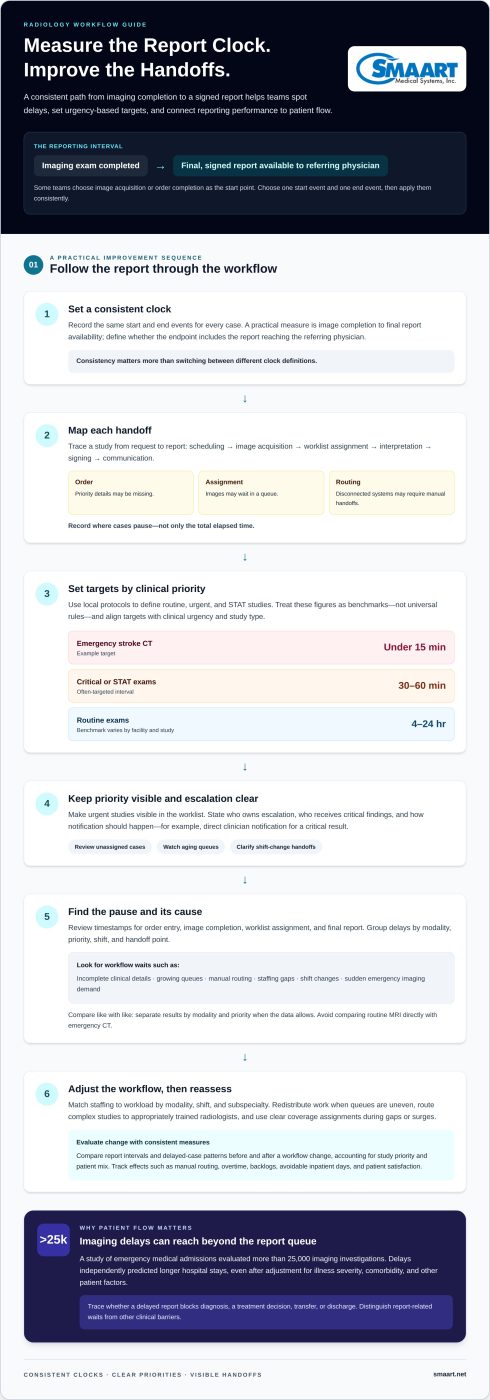
A report delay can become a patient-flow delay. Radiology turnaround time is the interval from completing an imaging exam to making the final, signed report available to the referring physician, so improving radiology report turnaround time starts with measuring that interval consistently. Critical or STAT exams often have targets of 30-60 minutes, while routine exam benchmarks can range from 4-24 hours, depending on the facility and study.
It’s understandable to focus on how long an exam takes. But waiting for its report can also delay treatment decisions and contribute to longer hospital stays. Set expectations that reflect clinical urgency, then track whether reports meet them.
This article explains how to define turnaround time, measure reporting consistency, and find workflow bottlenecks. It also covers how imaging delays can affect length of stay and practical ways to improve patient flow, from clearer priority protocols to better-connected reporting workflows.
Key Takeaways
- Define when the reporting clock starts and stops so turnaround performance is measured consistently.
- Track how imaging delays can hold up care decisions and contribute to longer hospital stays.
- Set reporting targets by clinical priority, then review performance to spot recurring workflow bottlenecks.
- Explore how connected radiology management software can support smoother reporting workflows and patient flow.
What Is Radiology Turnaround Time?
- Define the reporting clock. Radiology turnaround time usually measures the interval from completing an imaging exam to the final, signed report reaching the referring physician. Some teams start at image acquisition or order completion instead. Choose one start point and one end point, then use them consistently across the workflow.
- Map each handoff from order to report. Follow a routine chest X-ray and an urgent CT through scheduling, image acquisition, worklist assignment, interpretation, signing, and communication. Delays can occur when orders lack priority details, images wait for assignment, or disconnected systems require manual routing. Record where cases pause, not just total elapsed time.
- Set clear priority and communication rules. Define which studies are routine, urgent, or STAT, and document who receives critical findings and how. A vague priority label can leave a case in the wrong queue. Specify the escalation path and the expected communication method, such as direct clinician notification for a critical result.
- Match staffing to workload and patient needs. Review case volumes by modality, shift, and subspecialty to identify pressure points. Redistribute work when one queue grows while another has capacity, and route complex studies to appropriately trained radiologists. Include patient preferences and communication needs in scheduling and handoffs, supporting culturally responsive patient care without disrupting clinical priorities.
- Plan for staffing gaps and volume surges. Track when backlogs build, such as during shift changes, staff absences, or sudden emergency imaging demand. Cross-train staff on worklist and escalation procedures, and use clear coverage assignments so cases don’t sit unclaimed. Review unusual delays with the team, then update training and workflow instructions to address the cause.
Effects of imaging delays on hospital length of stay
Imaging delays can hold up diagnosis, treatment decisions, and discharge planning. A study of emergency medical admissions evaluated more than 25,000 imaging investigations and found delays independently predicted longer hospital stays, even after adjustment for illness severity, comorbidity, and other patient factors.
Costs and return on investment depend on implementation scope and are provided after a quote request. To assess ROI, compare the investment with measurable changes such as reduced manual routing, overtime, backlogs, and avoidable inpatient days.
- Trace the patient’s path after imaging. Follow an emergency admission from the scan request through image acquisition, interpretation, clinician notification, and the next care decision. Mark where a delayed report blocks treatment, transfer, or discharge. This timeline connects reporting performance with hospital flow instead of treating turnaround as an isolated metric.
- Separate clinical waits from workflow waits. Review timestamps for order entry, image completion, worklist assignment, and final report. A case may wait because of incomplete clinical details, a growing queue, manual routing, or a staffing gap. Identifying the specific pause helps teams target the cause rather than add capacity indiscriminately.
- Check downstream resource effects. When a report delays a decision, a patient may remain in a bed while the care team waits for imaging results. That can constrain bed availability and extend staff coordination. Track these effects alongside patient satisfaction, but distinguish cases where the report caused the delay from cases with other clinical barriers.
- Use a consistent root-cause review. Group delayed cases by modality, priority, shift, and handoff point. Then review examples with radiology and emergency teams. If CT reports stall during a shift change, clarify coverage and escalation ownership. If incomplete orders recur, improve the information captured when requests enter the workflow.
- Evaluate workflow changes with operational measures. Compare report intervals and delayed-case patterns before and after a change, while accounting for study priority and patient mix. Reducing manual handoffs may address one bottleneck, while staffing adjustments may address another. Explore connected radiology workflow options when disconnected systems contribute to delays.
Practical turnaround-time measurement and improvement steps
Use consistent timestamps and priority definitions to identify operational bottlenecks. A reliable baseline for improving radiology report turnaround time helps teams target changes and assess whether they work.
Compare Turnaround Benchmarks
Set local targets by clinical urgency, then compare performance within each priority group. Critical or STAT exam targets are often 30-60 minutes; routine exam benchmarks can range from 4-24 hours, depending on facility and study type. Emergency stroke CT may have a target under 15 minutes. Treat these as benchmarks, not universal rules, and align targets with local clinical protocols.
Use the same start and end events for every measure, such as image completion and final report availability. Where the data allows, separate results by modality and priority. Avoid comparing routine MRI directly with emergency CT, because urgency affects the expected response.
Prioritize Urgent Studies and Worklists
Assign each order a clear routine, urgent, or STAT priority under site-specific protocols. Make escalation ownership explicit so staff know who acts when a critical case is waiting. Keep urgent studies visible in the worklist, and review unassigned cases, aging queues, and handoffs at shift changes.
Measure turnaround by priority level, then review cases that miss targets. Manual routing or disconnected systems can delay assignment, so streamline handoffs where bottlenecks occur. Set reporting targets in structured service-level agreements and review performance against them instead of relying on a single overall average.
Apply Reporting and Automation Tools
Evaluate voice recognition, structured reporting, or AI tools against a defined workflow problem. Voice recognition captures dictated findings, while structured templates guide consistent report sections. AI may support parts of image or workflow review, but its impact on turnaround depends on implementation and clinical oversight.
Before wider adoption, compare timestamps and correction needs for the affected workflow. Track whether a tool reduces manual steps without adding review delays or making worklist ownership less clear. Use the findings to guide efforts to improve radiology report turnaround time, including staff training or clearer escalation coverage where needed.
Effects of inconsistent radiology report turnaround
Use site-specific protocols and service-level targets to set expectations by priority. These provide measurable standards without assuming one turnaround target suits every study.
- Track variation, not only averages. Compare report times by modality, priority, shift, and department. A stable average can hide a routine queue that moves predictably and an urgent queue with repeated spikes. Review cases that miss their targets, then identify whether the delay occurred during assignment, interpretation, signing, or clinician notification.
- Connect variation to patient care. Delayed reports can increase patient anxiety and postpone critical treatment decisions. For example, if a clinician is waiting for an imaging result before choosing the next step, inconsistent reporting makes planning harder. Follow the case from completed scan to decision, and note where uncertainty or waiting affects care coordination.
- Protect quality while addressing speed. Faster reporting should not mean removing appropriate interpretation or review. Check whether a workflow change creates more corrections, unclear findings, or missed communication. Compare those quality signals with turnaround performance. The goal is a dependable process that supports timely decisions, not a shorter clock at the expense of a clear, complete report.
- Make expectations visible across healthcare teams. Document priority definitions, escalation paths, and responsibility for communicating critical findings. A consistent protocol helps radiology and referring departments understand what happens when an urgent case waits. Review exceptions with the teams involved, then adjust the workflow or training where the same handoff problem recurs.
- Use guidelines as operational guardrails. Apply facility protocols and service-level targets when setting reporting expectations; do not assume one deadline fits every study or clinical context. Accreditation, regulatory, and professional requirements should guide local policy where applicable. Keep the reporting process transparent, and assess both timing and communication so improvement efforts remain focused on patient care.
SMAART Medical Systems
SMAART Medical Systems, Inc. offers radiology management software for hospitals and clinics working to streamline imaging workflows. When reporting delays stem from disconnected systems or manual coordination, its solutions may be relevant to your operational review. SMAART-PACS and SMAART-RIS are designed to integrate with existing EMR and HIS platforms, while SMAART-SHARE provides a cloud-based sharing platform. Together, these offerings can support a more connected imaging environment, helping teams examine how information moves through their current processes. The right fit depends on your workflow priorities, such as system integration, image management, or sharing needs. Contact SMAART Medical Systems, Inc. to discuss how its radiology software offerings could fit your organization’s workflow.
Make Reporting Consistency Part of Your Next Improvement
Make reporting consistency an ongoing operational priority, not a one-time project. Choose a workflow issue your team can observe, agree on how to measure it, and assign clear ownership for reviewing results. This gives you a practical starting point for improving radiology report turnaround time while keeping clinical quality and communication in view.
As processes change, keep feedback flowing between radiology, referring departments, and operational leaders. A recurring delay may need a different response than a one-off backlog. Use the data to guide the next adjustment, whether that means clarifying a handoff, refining a priority rule, or improving how information moves through existing systems.
For support with radiology workflow technology, contact SMAART Medical Systems, Inc.. A focused conversation can help you explore a practical next step for your organization. Steady, evidence-led improvements can make reporting more predictable and help teams keep patient flow moving.
Frequently Asked Questions
What factors cause delays in radiology report turnaround time?
Delays often occur when a case cannot move smoothly from one workflow stage to the next. An order missing relevant clinical details may need clarification before interpretation, while unavailable comparison images can slow review. Unclear ownership matters too: if staff don’t know who should act on an unassigned or escalated case, it can sit idle. Categorize delays by cause to identify a targeted fix.
Which workflow changes reduce radiology report turnaround time?
Remove avoidable steps that don’t support interpretation or clinical communication. For example, standardize order fields so radiologists receive necessary context, and reduce duplicate data entry between connected systems. Test one workflow change at a time, then compare similar case groups before and after implementation. Include report corrections and communication issues in the review so faster processing doesn’t shift extra work downstream.
What staffing and scheduling strategies improve radiologist productivity and coverage?
Align assignments with the department’s study mix, radiologist expertise, and periods of higher demand. For example, assign complex neuroradiology cases to appropriate subspecialty expertise while distributing routine work among available readers. Review workloads to identify uneven queues, and define coverage responsibilities during shift changes and absences. Training on shared worklist and escalation procedures can help staff maintain continuity when assignments change.
How can emergency and critical findings be communicated quickly and reliably?
Use a written escalation protocol that identifies the responsible recipient, communication channel, and required follow-up when a critical result is found. For example, pair a direct call with documentation of who received the message and when. Define what happens if the first recipient is unavailable, and review communication exceptions with the teams involved. This creates a traceable handoff rather than relying on an informal message alone.
What metrics should radiology departments track to measure turnaround time?
Track elapsed reporting time alongside timestamps that show where delays occur, such as order receipt, image availability, interpretation, finalization, and communication. Segment results by modality, urgency, and shift so faster cases don’t mask a slower subgroup. Review median performance and unusually delayed cases together: the median shows a typical pattern, while outliers can reveal workflow failures that need specific action.
What are the costs and return on investment of radiology workflow improvement tools?
Costs and return on investment depend on implementation scope; pricing is provided after a quote request. Assess ROI by comparing the investment with measurable changes such as reduced manual routing, overtime, backlogs, and avoidable inpatient days.