
Key Features of a Modern Radiology Information System: A 2026 Guide
How many hours a week does your clinical team lose to the “swivel-chair” shuffle between disconnected software screens? It’s an exhausting reality for many practices where fragmented data silos and manual entry still reign. Understanding the key features of a modern Radiology Information System is no longer just about moving to a digital database; it’s about reclaiming that lost time and energy. In 2026, a truly high-performing RIS acts as a clinical productivity multiplier that finally bridges the gap between complex medical imaging and lean administrative efficiency.
You likely already feel the weight of manual billing errors and software friction driving up revenue leakage and staff burnout. It’s frustrating to watch operational overhead climb while your team struggles with tools that don’t talk to each other. This guide promises to show you the essential capabilities of a modern RIS that unify clinical workflows and maximize facility profitability. We will preview how seamless EMR integration, FHIR R4 compliance, and AI-powered scheduling can transform your practice from a collection of silos into a unified, high-throughput operation that delivers measurable ROI and long-term relief.
Key Takeaways
- Understand how the RIS has evolved from a simple database into a dynamic platform for workflow orchestration and administrative relief.
- Identify the key features of a modern Radiology Information System that eliminate manual scheduling friction and reduce no-show rates through automated patient reminders.
- Learn how integrating SMAART-RIS with SMAART-PACS creates a unified interface that speeds up diagnostic turnaround times and reduces software fatigue.
- Discover how to capture lost revenue by leveraging automated billing support and data-driven analytics to identify operational bottlenecks.
- See why a modern, affordable ecosystem is the pragmatic choice for clinics looking to challenge the complexity and cost of legacy industry giants.
Defining the Modern Radiology Information System (RIS) in 2026
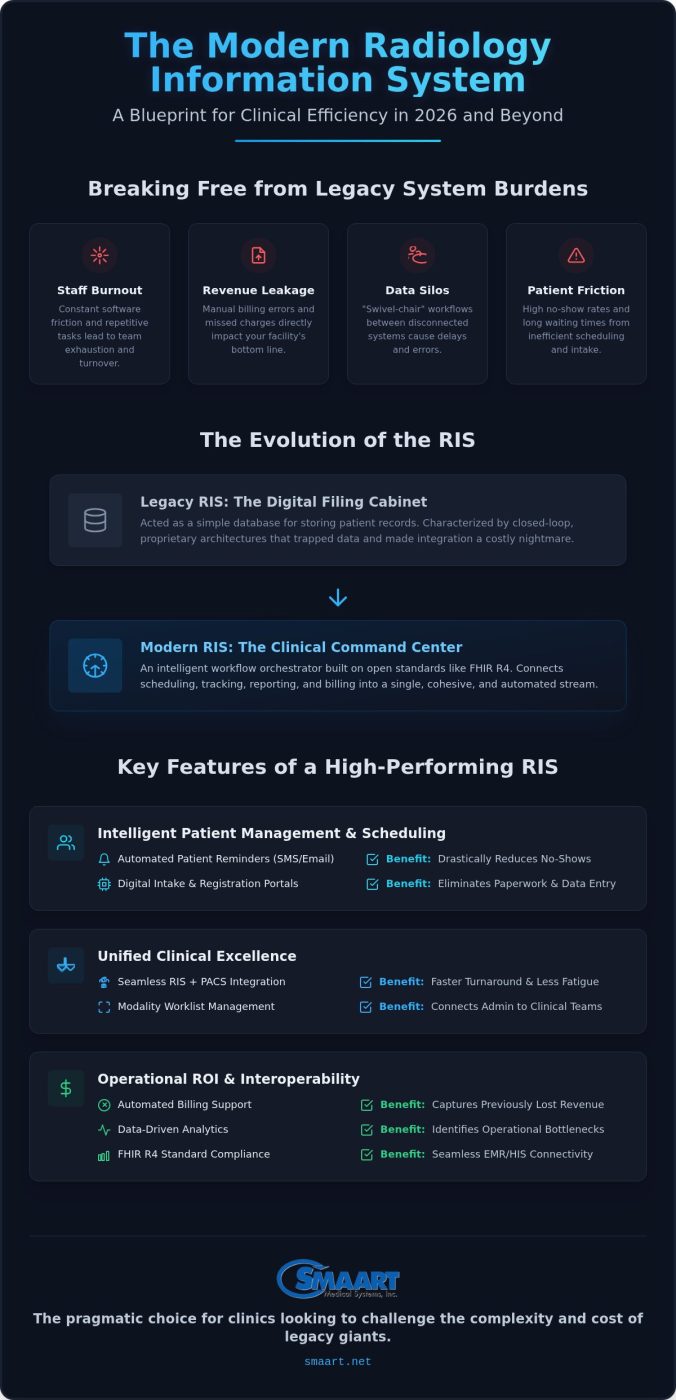
A modern Radiology Information System (RIS) acts as the central nervous system for imaging facilities. It isn’t merely a place to store patient data; it’s a specialized platform designed to manage the non-clinical side of radiology workflows. In 2026, the industry has moved beyond digital filing. We’ve entered an era of true workflow orchestration. This shift means your software must do more than record information. It must actively drive efficiency by connecting scheduling, patient tracking, and results distribution into a single, cohesive stream. Understanding the key features of a modern Radiology Information System is essential for any practice looking to survive the transition from volume-based to value-based care.
Interoperability is now a regulatory and operational necessity. With the federal mandate of FHIR R4 standards, systems that can’t talk to other platforms are becoming obsolete. A modern RIS ensures that data flows effortlessly between your facility and external EMR or HIS platforms. This connectivity reduces the manual burden on your staff and eliminates the data silos that lead to costly errors. It’s about creating a seamless environment where information is always where it needs to be, exactly when it’s needed.
The Shift from Legacy to Modern Architectures
Legacy systems were often closed-loop proprietary islands. They trapped data and made integration a nightmare. Modern architectures favor open-standard hubs that prioritize flexibility. Scalability is another critical factor. Cloud-native systems, built specifically for the web, offer superior performance over older cloud-hosted models that just “lift and shift” desktop software to a remote server. A Modern RIS is a unified platform for scheduling, tracking, and results distribution that scales with your growth without requiring massive hardware investments. Providers like One Health Connect demonstrate how these cloud-based radiology software and integrated health solutions can provide the scalability and flexibility modern clinics require.
Why Feature-Rich Doesn’t Have to Mean Over-Complex
Many administrators fear that adding advanced tools will overwhelm their staff. We challenge the enterprise giant status quo by proving that high-performance software can remain intuitive. The key features of a modern Radiology Information System should provide operational relief, not more training sessions. By focusing on a pragmatic design, SMAART-RIS balances high-end functionality with a user interface that feels familiar from day one. You don’t need an enterprise-level budget to access full-feature systems. We focus on fiscal responsibility, ensuring that your software investment translates directly into measurable ROI through improved throughput and reduced administrative burnout.
Intelligent Patient Management and Scheduling Features
High-volume clinics live or die by their front-end efficiency. If the entry point of the patient journey is cluttered with manual tasks, the entire clinical workflow slows down. Intelligent patient management transforms the front desk from a bottleneck into a streamlined gateway. By leveraging the key features of a modern Radiology Information System, facilities can move away from reactive scheduling and toward a proactive, data-driven approach that respects both staff time and patient convenience.
Automated scheduling tools do the heavy lifting of reducing no-show rates. By sending intelligent patient reminders via SMS or email, the system ensures slots don’t go to waste. These aren’t just generic pings. They’re interactive notifications that allow patients to confirm or reschedule, feeding that data directly back into the master calendar. This automation allows your team to focus on patient care rather than playing phone tag with a daily call list.
Digital intake portals eliminate the stacks of paper that traditionally clutter the waiting room. Patients can complete registration and upload insurance information from home. This ensures data integrity and reduces the time spent in the waiting area. When you integrate these portals with your core software, you eliminate the “swivel-chair” data entry that leads to human error. You can explore how SMAART-RIS simplifies these administrative logistics for facilities of all sizes.
Modality worklist management is the vital bridge between the administrative and clinical worlds. It pushes patient demographics directly to the imaging equipment, ensuring that the technologist has the correct information before the first scan is even taken. This is one of the most critical key features of a modern Radiology Information System because it prevents patient safety risks associated with manual data entry. Resource optimization further enhances this by tracking equipment availability and staff licensing in real-time, preventing double-bookings and ensuring specialized suites are always utilized at peak capacity.
Streamlining the Front-End Workflow
Integrated registration reduces manual entry errors by pulling data from existing patient records or referring physician portals. This creates a single source of truth that follows the patient throughout their visit. Real-time tracking allows managers to see exactly where a patient is in the facility flow, from check-in to the changing room to the imaging suite. SMAART-RIS is specifically engineered to reduce this administrative burden, allowing high-volume clinics to maintain higher throughput without adding more headcount.
Patient Portals and Modern Communication
In 2026, patients expect the same digital convenience in healthcare that they get in banking. Secure portals allow patients to access their own reports and images without needing to request physical media. Automated notifications improve clinical compliance by reminding patients of necessary prep instructions or follow-up appointments. By connecting patients to their results through cloud platforms like SMAART-SHARE, you provide a level of transparency and relief that builds long-term loyalty and trust.
Clinical Excellence: Integrated Reporting and PACS Connectivity
A radiologist’s productivity depends on the harmony between their reading environment and their reporting tools. In many legacy setups, these are two separate worlds that require constant, manual synchronization. One of the key features of a modern Radiology Information System is the deep, native integration with imaging archives. Seamless SMAART-PACS integration allows radiologists to access diagnostic images directly from within the RIS report editor. This eliminates the need to toggle between different software windows, which is a primary driver of fatigue and error in high-volume environments.
Speed matters in diagnosis, but accuracy remains paramount. Voice recognition and structured reporting tools are essential for accelerating the diagnostic turnaround time (TAT). By 2026, these systems have evolved to understand complex medical terminology with near-perfect accuracy. Automating the communication of urgent findings through critical results notification ensures that referring physicians are alerted immediately. This closes the loop on patient safety without requiring manual follow-up calls from the radiology staff, providing much-needed operational relief.
The Radiologist’s Integrated Workspace
A “single pane of glass” experience is the gold standard for modern diagnostic workstations. Radiologists need patient history, previous reports, and current images to coexist in one view. SMAART-RIS provides critical clinical context by pulling relevant EMR data directly into the diagnostic workflow. This holistic view improves diagnostic accuracy by giving the reader the full clinical story. Zero-footprint viewers offer the remote reading flexibility that modern practices demand, allowing for collaborative viewing via SMAART-SHARE without the need for proprietary hardware or complex installations.
Advanced Reporting Tools
Consistency is the bedrock of quality in medical documentation. Structured templates ensure that every report meets regulatory compliance and provides clear, actionable data for referring providers. Speech recognition integration removes the burden of manual typing and the high costs of third-party transcription services. Integrated reporting reduces the “navigation tax” for radiologists by keeping their focus on the images and their hands off the mouse. This streamlined approach is one of the key features of a modern Radiology Information System that delivers measurable ROI through improved throughput and faster results delivery.
Operational ROI: Billing, Analytics, and Interoperability
Financial viability in 2026 requires more than just high patient volume; it demands a system that captures every dollar earned without increasing administrative strain. One of the key features of a modern Radiology Information System is its ability to function as an interoperability hub rather than a standalone silo. This means speaking the same digital language as the rest of the hospital through standards like HL7, DICOM, and the federally mandated FHIR R4. When your RIS integrates seamlessly with the facility’s EMR or HIS, you eliminate the manual data re-entry that leads to billing errors and staff burnout.
Automated billing and coding support acts as a guardrail for your revenue cycle. By suggesting appropriate codes based on the procedure performed, the system reduces the likelihood of claim denials. This acceleration of the revenue cycle provides the fiscal relief many clinics desperately need. You can request a demo of SMAART-RIS to see how these integrated tools protect your bottom line and simplify complex financial workflows.
Maximizing Revenue through Billing Integration
Capturing charges at the point of care prevents “lost” procedures that often slip through the cracks of manual systems. Real-time insurance verification within the RIS workflow ensures that eligibility is confirmed before the patient even enters the imaging suite. This proactive approach ensures you’re not performing uncompensated work. SMAART-RIS is engineered to bridge the gap between clinical IT requirements and high-level administrative goals, providing a clear path to fiscal responsibility and operational transparency. To complete this cycle, partnering with Integrity Statements for professional billing and statement distribution ensures that critical patient communications are delivered with precision and reliability.
Data-driven decision making is no longer a luxury reserved for large hospital groups. Custom dashboards allow you to monitor facility performance and modality utilization in real-time. You can identify exactly where bottlenecks occur, whether it’s a specific imaging suite or a lag in reporting turnaround. These insights are vital when budgeting for technology upgrades or staff expansion. Moving from disconnected legacy systems to a unified SMAART solution provides a measurable ROI by streamlining throughput and reducing the operational overhead that plagues traditional practices.
The key features of a modern Radiology Information System must include robust business intelligence tools. These tools allow you to spot growth opportunities by analyzing referral patterns and patient demographics. Instead of guessing where to invest, you use hard data to drive your facility’s expansion. This pragmatic approach to management ensures that every decision you make is backed by the reality of your clinical operations.
The SMAART Advantage: Affordable, Full-Feature RIS for 2026
Challenging the industry status quo requires a bold approach to both technology and pricing. For years, radiology departments were trapped between underpowered, entry-level software and the bloated, over-priced platforms of enterprise giants. We’ve changed that narrative. The key features of a modern Radiology Information System are now available in a high-performance package that respects your facility’s budget. Our focus on fiscal responsibility ensures you get elite-level tools without the unnecessary complexity or hidden costs common in traditional models.
The SMAART ecosystem is a unified force. SMAART-RIS, SMAART-PACS, and SMAART-SHARE work in concert to create a comprehensive imaging environment. This integrated suite manages everything from the initial patient reminder to the final diagnostic report and cloud-based image distribution. By choosing a single-vendor ecosystem, you eliminate the integration headaches that often plague multi-platform setups. This synergy is designed to provide immediate relief from the operational friction that slows down your clinical throughput.
Seamless Integration, Simplified Workflow
A unified SMAART workflow delivers a level of efficiency that legacy systems simply can’t match. It reduces the administrative burdens that lead to staff burnout and the financial strain of maintaining outdated, on-premise hardware. Our commitment to your success extends beyond the software itself. We act as a reliable partner, providing dedicated support for seamless EMR and HIS transitions. SMAART-SHARE simplifies the process of collaborative viewing, allowing you to distribute results securely across the care continuum without requiring proprietary hardware.
Ready to Modernize Your Radiology Workflow?
Take a moment to evaluate your current system against the 2026 standard. If you still encounter software navigation friction or manual billing errors, your technology is likely costing you more than you realize. The key features of a modern Radiology Information System should provide a clear path to scalability and cloud-readiness. Our expert team is highly responsive and deeply knowledgeable about the specific pressures of the modern healthcare environment.
We invite you to experience the difference that a pragmatic, modern system can make. Request a personalized demo of SMAART-RIS today to see how we can help you unify your workflow and maximize your facility’s profitability.
Empowering Your Practice for the Future of Imaging
Modernizing your radiology workflow isn’t just a technical upgrade; it’s a strategic move toward long-term sustainability. We’ve explored how unified platforms eliminate data silos and how automated billing protects your revenue cycle from preventable leakage. By prioritizing interoperability and intuitive design, you can finally reduce the software friction that leads to clinician burnout. Identifying the key features of a modern Radiology Information System is the first step toward operational freedom and measurable profitability.
SMAART Medical Systems, Inc. provides a pragmatic alternative to the complexity of legacy giants. Our ecosystem is built on the promise of seamless EMR/HIS interoperability and transparent licensing that fits your clinic’s budget. With cloud-based tools like SMAART-SHARE, collaborative imaging distribution becomes a standard part of your daily routine rather than a technical hurdle. This full-feature RIS is engineered to scale with you, ensuring your facility remains cloud-ready and efficient.
Streamline your facility with SMAART-RIS radiology management software and reclaim the efficiency your team deserves. You don’t have to navigate these changes alone. We’re here to be your reliable partner in building a faster, more responsive diagnostic environment.
Frequently Asked Questions
What are the core differences between a RIS and a PACS?
A Radiology Information System (RIS) acts as the operational brain of the department, managing patient scheduling, tracking, and billing. In contrast, a Picture Archiving and Communication System (PACS) functions as the digital archive for storing and retrieving medical images. While the RIS handles the administrative lifecycle of an order, the PACS focuses on the diagnostic viewing experience. Modern facilities often integrate SMAART-RIS with SMAART-PACS to ensure a seamless flow from the front desk to the radiologist’s workstation.
How does a modern RIS improve patient safety?
Modern systems improve safety by eliminating manual data entry through modality worklist management. This ensures that accurate patient demographics are pushed directly to imaging equipment; it reduces the risk of misidentification. Additionally, automated critical results notification ensures that urgent findings are communicated to referring physicians without delay. These automated safeguards provide a layer of clinical relief by minimizing human error and ensuring that life-saving information reaches the right hands immediately without requiring manual follow-up calls.
Why is HL7 and FHIR integration important for my facility?
HL7 and FHIR R4 are the essential languages that allow different healthcare platforms to communicate. As of 2026, FHIR R4 is the federally mandated standard for interoperability in the United States. These protocols allow your RIS to exchange data with EMRs and HIS platforms seamlessly. Without this integration, your facility remains a data silo; this forces staff into redundant manual entry and increases the likelihood of operational bottlenecks and revenue leakage that can strain your practice.
Can a modern RIS help reduce radiologist burnout?
Yes, reducing “navigation tax” is one of the key features of a modern Radiology Information System. By providing a “single pane of glass” experience, radiologists can access patient history and diagnostic images in a unified interface. This eliminates the exhausting “swivel-chair” navigation between disconnected software. Integrated voice recognition and structured reporting further streamline the workflow; this allows clinicians to focus on diagnosis rather than fighting with cumbersome administrative tools that contribute to daily fatigue and frustration.
What billing features should be included in a radiology information system?
An effective system must include real-time insurance verification and automated coding support. These features help capture charges at the point of care; this prevents lost revenue from unbilled procedures. By identifying potential claim denials before they are submitted, the software accelerates the revenue cycle and provides measurable ROI. Look for a platform that bridges the gap between clinical documentation and administrative invoicing to ensure long-term fiscal responsibility and much-needed operational relief for your billing team.
How long does it typically take to implement a new RIS?
Implementation timelines vary based on the size of the facility and the complexity of existing data migrations. However, modern cloud-native systems typically offer a faster deployment than legacy on-premise hardware. A standard transition for a mid-sized clinic often takes several weeks to a few months. Choosing a reliable partner like SMAART ensures that your team receives dedicated support during the EMR and HIS transition to minimize operational downtime and ensure a smooth, efficient go-live experience.
Is a cloud-based RIS as secure as an on-premise system?
Cloud-based systems are often more secure than local servers due to enterprise-grade encryption and mandatory multi-factor authentication. The 2026 HIPAA Security Rule updates require universal encryption for data at rest and in transit; cloud providers automate these requirements more effectively. These platforms also offer robust disaster recovery and contingency plans, ensuring data restoration within 72 hours of an incident. This provides peace of mind and relief from the burden of managing complex, vulnerable local IT security.
How does RIS integration with EMR affect facility ROI?
Integration directly impacts ROI by increasing patient throughput and reducing administrative overhead. One of the key features of a modern Radiology Information System is its ability to speak the same language as the EMR, eliminating redundant data entry. This efficiency allows your facility to see more patients without increasing headcount. Seamless data exchange also improves referral management; it ensures that reports reach physicians promptly, which encourages long-term partnership and steady patient volume through improved clinical trust.