
Radiology Workflow Management Software: A Digital Audit & Checklist for 2026
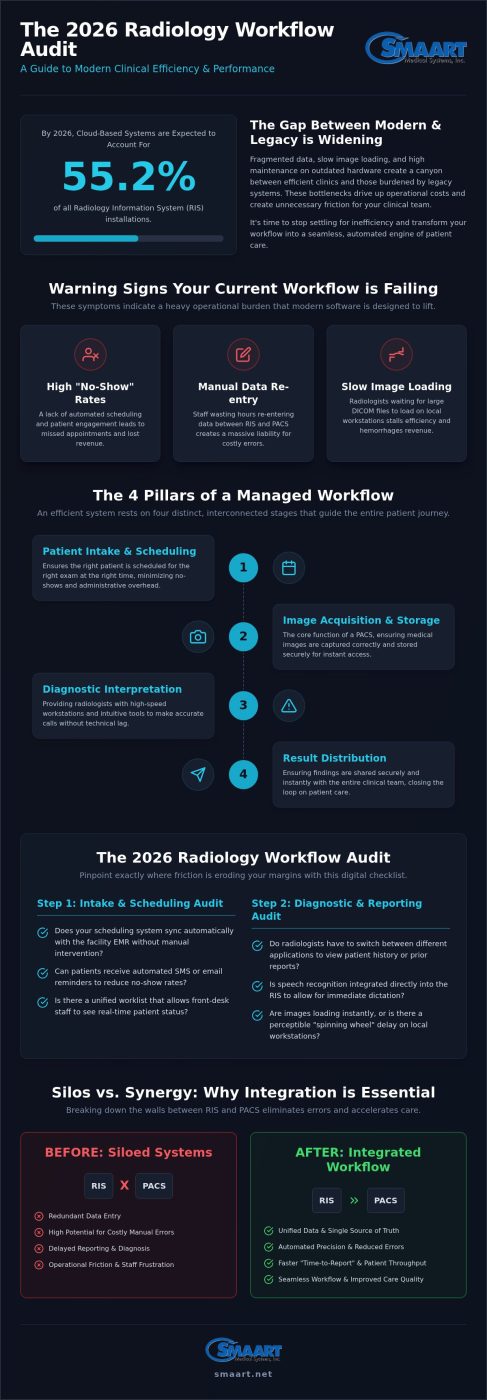
With cloud-based systems expected to account for over 55% of all RIS installations by 2026, the gap between modern clinics and legacy-burdened practices is no longer a crack; it’s a canyon. You likely know the frustration of waiting for a high-resolution image to load while a patient sits in the waiting room, or the headache of manually re-entering data because your radiology workflow management software isn’t communicating with your PACS. These bottlenecks do more than just slow you down. They drive up operational costs and create unnecessary friction for your clinical team. It’s time to stop settling for fragmented data and high maintenance fees on hardware that belongs in the past.
This guide provides a comprehensive digital audit to help you evaluate your current clinical efficiency and identify exactly where your systems might be failing you. We will walk through a modern checklist designed for 2026 standards, focusing on faster reporting cycles and lower overhead. You will learn how to bridge the gap between patient data and diagnostic images, ensuring your practice operates with the precision and speed that the current medical environment demands. By identifying these friction points now, you can transform your workflow into a seamless, automated engine of patient care.
Key Takeaways
- Run a targeted digital audit to pinpoint exactly where scheduling friction and workstation lag are slowing down your clinical output.
- Identify why modern radiology workflow management software is the essential digital backbone for reducing “time-to-report” without compromising diagnostic accuracy.
- Learn how breaking down the silos between RIS and PACS eliminates redundant data entry and prevents costly manual errors.
- Discover the operational relief of zero-footprint viewing and cloud-based sharing, effectively ending the era of proprietary hardware and physical CDs.
- Explore how SMAART Medical Systems, Inc. offers a pragmatic, high-performance alternative to complex industry giants through affordable, enterprise-grade integration.
What is Radiology Workflow Management Software?
Think of your clinic as a high-performance engine. If the fuel lines are clogged, the horsepower doesn’t matter. In medical imaging, radiology workflow management software acts as those fuel lines. It’s the digital backbone that manages a patient’s entire journey, starting the moment they book an appointment and ending only when the final diagnostic report reaches the referring physician. It’s the invisible infrastructure that keeps data moving, ensuring that radiologists and administrators aren’t bogged down by technical friction.
The core goal is simple but vital: reducing “time-to-report” while maintaining absolute diagnostic accuracy. Every minute saved in the reporting cycle is a minute gained for patient care and facility throughput. By 2026, simply having a place to store images isn’t enough. Cloud-based systems are expected to account for 55.2% of all RIS installations this year, proving that the industry is moving away from heavy, localized hardware. Modern workflows demand an integrated architecture that moves data at the speed of the cloud, replacing manual hurdles with automated precision.
The 4 Pillars of a Managed Workflow
A truly efficient system rests on four distinct stages. First is patient intake and scheduling, the primary domain of a Radiological Information System (RIS). This pillar ensures that the right patient is in the right chair at the right time. Second is image acquisition and storage, which is handled by the PACS. Third is diagnostic interpretation, where the radiologist needs high-speed workstations and intuitive tools to make accurate calls without technical lag. Finally, result distribution ensures that findings are shared securely and instantly with the entire clinical team, closing the loop on patient care.
Signs Your Current Workflow is Failing
You don’t need a consultant to tell you if your system is broken; the symptoms are usually obvious. High “no-show” rates often point to a lack of automated scheduling and patient engagement. If your staff spends hours manually re-entering patient names or insurance details between the RIS and the PACS, you’re looking at a massive liability for data errors. Perhaps most frustrating is the “spinning wheel” of death. When radiologists have to wait for large DICOM files to load on local workstations, your clinical efficiency isn’t just stalled; it’s hemorrhaging revenue. These silos between data and imaging create a heavy operational burden that modern, integrated software is designed to lift. Transitioning to a unified platform is no longer about staying ahead. It’s about not being left behind.
The 2026 Radiology Workflow Audit: A Digital Checklist
Identifying bottlenecks in your facility shouldn’t be a guessing game. A structured audit allows you to pinpoint exactly where manual friction is eroding your margins. By evaluating your radiology workflow management software through a modern lens, you can move from reactive firefighting to proactive optimization. This checklist focuses on the practical touchpoints where clinical efficiency is either won or lost.
Step 1: Intake and Scheduling Audit
The front-of-house experience sets the tone for the entire patient journey. If your staff is stuck in a cycle of phone calls and manual data entry, your throughput is already compromised. Research highlights that optimizing process efficiency in medical imaging is a primary driver for improving patient safety and reducing administrative waste. Consider these questions:
- Does your scheduling system sync automatically with the facility EMR without manual intervention?
- Can patients receive automated SMS or email reminders to reduce no-show rates?
- Is there a unified worklist that allows front-desk staff to see real-time patient status?
Step 2: Diagnostic and Reporting Audit
Radiologists are your most valuable resource. Forcing them to jump through technical hoops is a recipe for burnout and delayed results. Diagnostic workstation software is a tool for high-resolution DICOM interpretation. It should be fast, intuitive, and deeply integrated. Audit your current interpretative cycle:
- Do radiologists have to switch between different applications to view patient history or prior reports?
- Is speech recognition integrated directly into the RIS to allow for immediate dictation?
- Are images loading instantly, or is there a perceptible delay on local workstations?
Step 3: Analyze Reporting and Dictation Integration
The transition from “image captured” to “report signed” is where many facilities lose hours. If your dictation system isn’t talking to your radiology workflow management software, you’re creating a data silo. Integration ensures that patient demographics and exam details are pre-populated, leaving the radiologist to focus solely on the clinical findings. This reduces manual re-entry errors and slashes the time-to-report.
Step 4: Check Result Delivery and Image Sharing
The final step is getting the data where it needs to go. If you’re still burning CDs or relying on fax machines, your workflow is stuck in the last decade. Evaluate how easily referring physicians and patients can access results. Seamless sharing shouldn’t require proprietary hardware. If your audit reveals these gaps, exploring a more integrated radiology workflow can provide the operational relief your team deserves.
Integrated RIS vs. PACS: Why Silos Kill Efficiency
Efficiency dies in the gaps between disconnected software. When your scheduling data lives in a different world than your imaging data, your staff spends more time bridging that gap than treating patients. This is the “silo problem.” It’s a recurring hurdle for mid-sized clinics using legacy systems that weren’t built to communicate. In a siloed environment, the front desk confirms an appointment in the RIS, but the technologist has to manually type that same data into the modality. This disconnect creates a massive drag on daily operations.
Modern radiology workflow management software relies on the seamless handshake of HL7 and DICOM standards. HL7 manages the administrative “who and when,” while DICOM handles the “what and where” of the medical images. When these standards work together within an integrated platform, redundant data entry disappears. Without this integration, the financial impact of manual administrative errors can be staggering. Misspelled names or incorrect patient IDs lead to billing denials and lost revenue. More importantly, they create a risk of mismatched studies that compromise patient safety. Breaking down these silos isn’t just a technical upgrade; it’s a fiscal necessity.
The SMAART-RIS and SMAART-PACS Synergy
Patient data should flow like water from the initial scheduling call to the final diagnostic view. SMAART-RIS and SMAART-PACS work in tandem to ensure that every team member sees the same clinical truth. When front-desk staff update a patient’s status, the radiologist sees it instantly in their worklist. This real-time visibility eliminates the “Where is this study?” phone calls that plague fragmented offices. By managing a single, unified platform, you also slash IT overhead. You don’t have to juggle multiple vendor support contracts or worry about conflicting update cycles that break your integrations. It’s about the relief of a system that just works.
Impact on Radiologist Productivity
Radiologists shouldn’t have to act as data detectives. “Search and click” fatigue happens when a physician has to hunt through separate systems to find a patient’s clinical history or previous scans. High-performing radiology workflow management software ensures that prior studies are automatically available and positioned for comparison. SMAART-PACS is a full-feature tool designed specifically to prevent these workflow interruptions. By providing a single-pane view of the patient’s imaging journey, it allows the radiologist to focus on interpretation rather than navigation. When the software handles the data retrieval, the physician can spend more time on the diagnosis, accelerating the entire reporting cycle.
Essential Features for Modern Clinical Interoperability
Interoperability is the heartbeat of a modern medical facility. In 2026, simply being “connected” isn’t enough. You need systems that actually talk to each other without manual intervention. This is where radiology workflow management software transitions from a simple utility to a strategic asset. If your data is trapped behind proprietary walls, your clinical efficiency will always hit a ceiling. True interoperability means data moves where it’s needed, when it’s needed, without technical friction.
One of the most significant shifts is the move toward zero-footprint viewing. Gone are the days of installing heavy, specialized software on every single workstation. Modern systems allow you to access full-fidelity DICOM images through any standard web browser. This reduces IT maintenance burdens and allows for immediate interpretation. Whether the radiologist is on-site or working remotely, the experience is identical. It’s about removing the tether to a specific desk or hardware set.
Similarly, the era of burning CDs is over. It’s a slow, expensive, and insecure method of transporting medical data. Cloud-based image sharing allows you to send studies to referring physicians or patients with a secure, encrypted link. This isn’t just about convenience; it’s about speed. When a specialist can view an image the moment it’s captured, patient outcomes improve and the reporting cycle accelerates. To see how these tools can transform your practice, explore the SMAART clinical solutions designed for modern interoperability.
The Move to SMAART-SHARE Cloud Platform
Replacing expensive, proprietary hardware with the SMAART-SHARE platform provides immediate financial relief. It enables secure, collaborative viewing for referring physicians without the need for complex VPNs or local software installs. For smaller clinics and rural hospitals, this lowers the barrier to entry for enterprise-grade tools. You get the same power as a major university hospital without the massive upfront capital expenditure or the maintenance costs of legacy servers.
Interfacing PACS with EMR
Achieving deep data integration between your PACS and the facility EMR is the “Holy Grail” of radiology workflow. A simple web link within the patient record isn’t enough. You need a bidirectional flow where patient demographics and clinical orders move seamlessly between systems. This deep integration streamlines the billing cycle by ensuring that RIS data is captured and coded correctly from the start. It prevents the “lost charge” syndrome that often drains clinic revenue. By future-proofing your facility with integrated radiology workflow management software, you prepare for enterprise-wide imaging goals where every department has access to the data they need, exactly when they need it.
In this cloud-first world, security remains the top priority. As of January 1, 2026, Texas requires that electronic health records containing state patient data be physically stored within the United States. Modern platforms must adhere to these localization rules while maintaining strict HIPAA compliance. It’s about protecting patient trust while leveraging the speed and flexibility of a modern, automated workflow.
Streamlining Your Facility with SMAART Solutions
The results of a digital audit are only as valuable as the actions you take afterward. Identifying bottlenecks is the first step, but true operational relief comes from implementing tools that solve those problems at the root. SMAART Medical Systems provides a pragmatic, high-performance alternative to the overly complex industry giants that often dominate the market. We believe that top-tier radiology workflow management software shouldn’t come with a prohibitive price tag or a steep learning curve. It should simply work, allowing your team to focus on patient outcomes instead of troubleshooting hardware.
By integrating SMAART-PACS and SMAART-RIS into your daily operations, you replace fragmented silos with a unified clinical engine. SMAART-PACS provides enterprise-level power for clinics and hospitals, ensuring that high-resolution diagnostic images are available instantly, anywhere. When paired with SMAART-RIS, the entire patient journey, from initial scheduling to final reporting, becomes a single, automated stream of data. This synergy eliminates the manual re-entry errors identified in your audit and slashes your time-to-report, providing immediate relief to both your administrative staff and your radiologists.
Affordability Meets Innovation
Modernizing your workspace doesn’t require an “enterprise” budget. We design our solutions to reduce both operational and financial strain, offering full-feature functionality that rivals much more expensive platforms. Our partnership model goes beyond a simple software license. We view ourselves as a reliable partner in your ongoing success, providing the technical authority and responsive support you need to navigate a changing healthcare landscape. This approach allows smaller clinics and rural hospitals to access the same advanced radiology workflow management software used by major urban centers, leveling the playing field for better patient care.
- Pragmatic Design: Software built for speed and clarity, not unnecessary ornamentation.
- Seamless Integration: SMAART-PACS integrates with your existing hospital infrastructure to protect your current investments.
- Cloud-First Sharing: SMAART-SHARE removes the need for proprietary hardware and physical CDs, enabling secure, browser-based collaboration.
Request a Workflow Consultation
Moving from a manual audit to an automated workflow is a journey you don’t have to take alone. Our experts are ready to help you analyze your audit findings and execute a transition plan that minimizes downtime and maximizes efficiency. Whether you need to customize SMAART-SHARE for a specific referring physician network or deeply interface your PACS with a local EMR, we provide the elite expertise required for a seamless rollout. Efficiency isn’t just a goal; it’s a requirement for modern medicine. Contact SMAART Medical Systems to modernize your workflow today.
Future-Proofing Your Clinical Operations
The digital audit you’ve just completed is the first step toward a more efficient, relief-driven practice. By identifying specific friction points in your scheduling, interpretation, and sharing cycles, you’ve laid the groundwork for significant operational improvement. Modernizing your radiology workflow management software is the most direct way to eliminate the data silos that drive up costs and cause administrative burnout. Replacing manual data re-entry with automated, integrated systems ensures that your radiologists can focus on what they do best: providing accurate, timely diagnoses.
You don’t have to settle for the complexity and high overhead of legacy systems. Seamless interoperability and cloud-based sharing are now accessible to facilities of every size. It’s time to move beyond the spinning wheels and manual errors of the past. Discover how SMAART-PACS can streamline your facility workflow with full EMR/HIS integration and affordable cloud-based sharing designed for hospitals and clinics. Taking the leap toward an automated, unified platform will bring immediate relief to your team and superior care to your patients. Your path to a faster, more accurate reporting cycle starts today.
Frequently Asked Questions
What is the difference between RIS and PACS in a radiology workflow?
RIS handles the administrative patient data, scheduling, and tracking of clinical orders. PACS manages the storage, retrieval, and viewing of the actual medical images. While they perform different roles, modern radiology workflow management software bridges the two to ensure data flows seamlessly from the front desk to the radiologist’s workstation. This integration prevents the “silo” problem where patient info doesn’t match the diagnostic images.
Can radiology workflow management software integrate with our existing EMR?
Yes, integration with existing EMR or HIS platforms is a primary function of modern workflow solutions. SMAART-RIS and SMAART-PACS use standard HL7 and DICOM protocols to ensure that patient demographics and orders sync automatically across your entire facility. This deep integration eliminates the need for manual data re-entry. It significantly reduces the risk of administrative errors and billing delays that often plague fragmented systems.
How does cloud-based image sharing improve clinic efficiency?
Cloud-based sharing replaces the outdated and expensive practice of burning CDs and mailing physical media. By using SMAART-SHARE, your facility can send encrypted links to referring physicians or patients for instant access to diagnostic images. This acceleration in data delivery leads to faster consultations and improved patient satisfaction. It also provides a noticeable reduction in physical storage costs and the heavy burden of hardware maintenance.
What is a zero-footprint PACS viewer and why is it important?
A zero-footprint viewer is a browser-based tool that allows clinicians to view high-resolution DICOM images without installing any software on their local computer. This technology is critical because it allows radiologists to work securely from any location. It also reduces the IT burden of managing local software updates. It ensures that the diagnostic experience is consistent and fast across different hardware configurations without local installation friction.
How much does it cost to implement modern radiology workflow software?
The cost of implementation varies based on the size of your facility, the volume of studies, and specific integration requirements. The focus is on providing a pragmatic and affordable alternative to overly complex industry giants. Transitioning to a modern, integrated system often results in lower long-term operational overhead. It achieves this by eliminating legacy hardware maintenance and reducing administrative waste through automated radiology workflow management software.
Is SMAART-SHARE HIPAA compliant for medical image distribution?
Yes, SMAART-SHARE is designed to meet and exceed current HIPAA compliance standards for 2026. All data is encrypted during transmission and at rest, ensuring that patient privacy is maintained throughout the sharing process. Additionally, the platform supports required data localization standards. This keeps sensitive patient information secure and within authorized jurisdictions as mandated by specific state and federal laws regarding electronic health records.
How does speech recognition integration speed up the reporting process?
Integrating speech recognition directly into the RIS allows radiologists to dictate findings immediately while viewing images in the PACS. This eliminates the delay of traditional transcription services and allows for real-time report generation. By prepopulating patient data from the workflow software, the system reduces the time spent on administrative headers. The physician can focus entirely on the clinical diagnosis, which slashes the overall time-to-report.
What are the hardware requirements for SMAART-PACS?
SMAART-PACS is designed to integrate with existing hospital infrastructure, often reducing the need for expensive new hardware. Because it leverages cloud-ready architectures and zero-footprint viewing, the requirements for local workstations are significantly lower than traditional systems. Our team conducts a thorough technical assessment during your consultation to ensure your current network and workstations can support peak diagnostic performance without unnecessary capital expenditure.




A Client
Recently left us a 5-star review
Amy Campbell
Director of Radiology
Arkansas
"We adore SMAART’s service. They answer the phone quickly, usually immediately answer our questions since they build SMAART PACS."
Lisa Kroening
Director of Radiology
County Hospital, Arkansas
"Working with SMAART Medical Systems for the past few years has been great. We purchased our first PACS system from them and have been very pleased. Their technical support is the best and I would recommend a SMAART-PACS to anyone."
Veronica
Practice Manager
Radiology Clinic, Texas
"We’ve run our business for 18 years on the SMAART-PCS. Their support is very cost-effective and they even help us with our IT questions."
Jeremy
IT Manager
Health System, Wisconsin
"I have been in IT for many years and worked with many different vendors. I can honestly say that SMAART has the best customer support of anyone I have ever worked with. This is one vendor you can rest assured you need not worry about. You’re in good hands with SMAART."
Contact Us
Contact Information
Ready to transform your radiology workflow and costs? Contact us today for personalized guidance and see how SMAART-PACS can elevate your practice to new heights of efficiency and patient care.