
Reducing Radiology Reporting Turnaround Time: 2026 Workflow Optimization Guide
The bottleneck in your imaging workflow isn’t a lack of clinical expertise. It’s the invisible friction created by disconnected systems that force your team to hunt for data instead of interpreting images. When your RIS and PACS don’t talk, you aren’t just losing minutes; you’re losing the trust of referring physicians who need answers now. Mastering the art of reducing radiology reporting turnaround time in 2026 requires more than just working harder. It demands a shift toward seamless, AI-driven automation that clears the path for your specialists.
We understand the mounting pressure of high volumes and the exhaustion that comes with navigating data silos. You deserve a workflow that supports your speed rather than hindering it. This guide outlines how to eliminate operational bottlenecks and leverage integrated AI to slash report times without sacrificing diagnostic precision. We’ll examine how cloud-native tools like SMAART-PACS and SMAART-RIS can help you achieve sub-30-minute STAT reporting, boost referral loyalty, and lower your overhead through smarter, automated delivery.
Key Takeaways
- Define RTAT as the interval from exam completion to finalization and understand why it’s the top KPI for referral satisfaction.
- Identify manual “dead zones” in your current workflow and use AI-driven prioritization to ensure urgent cases move to the top automatically.
- Eliminate data friction by ensuring seamless HL7 and DICOM handshakes between your RIS and PACS to avoid reporting delays.
- Implement a five-step strategy for reducing radiology reporting turnaround time, including digital audits and a shift to web-based viewing.
- Leverage integrated tools like SMAART-PACS and SMAART-SHARE to automate report distribution and provide instant access to referring physicians.
Understanding the Impact of Radiology Report Turnaround Time (RTAT) in 2026
Radiology Report Turnaround Time, or RTAT, is the definitive clock of any diagnostic facility. It measures the precise interval from the moment a technician completes an imaging exam to the second the final report is signed and available to the clinician. In 2026, this metric has evolved from a simple operational goal into the primary KPI for outpatient referral satisfaction and inpatient discharge planning. If the report isn’t there, the care stops. It’s that simple.
Analyzing the landscape of TAT metrics reveals a stark divide between modern facilities and those struggling with legacy tech. We can categorize this into the good, the bad, and the ugly:
- The Good: Seamless, automated workflows where radiologists spend their time interpreting rather than clicking through menus, resulting in sub-hour reads for critical cases.
- The Bad: Lagging systems that create 24-hour delays for routine exams, leaving patients in a state of high anxiety and doctors without answers.
- The Ugly: Data silos where critical findings sit trapped in a PACS because the RIS didn’t trigger an alert, causing missed deadlines and significant patient safety risks.
Reducing radiology reporting turnaround time isn’t just about clicking faster; it’s about eliminating these dangerous gaps. The financial implications are equally significant. For hospitals, faster reporting directly reduces the average length of stay (LOS). When a diagnostic result arrives hours earlier, clinicians can finalize discharge orders or pivot to necessary surgeries sooner. This efficiency maximizes bed turnover and optimizes the entire revenue cycle, turning the radiology department from a potential bottleneck into a high-speed engine of facility throughput.
The Stakeholders of Speed: Who Benefits from Lower TAT?
Referring physicians rely on timely data to build immediate treatment plans. They don’t have the time to chase down missing results or navigate complex portals. For patients, a shorter wait means relief from anxiety and a faster path to recovery. Administrators also see a clear win. Streamlined reporting translates to higher volume capacity and a healthier bottom line, ensuring the facility remains a preferred partner in a competitive local medical community.
Routine vs. STAT: Setting Realistic Benchmarks
Success requires distinguishing between different levels of urgency. Current industry standards for emergency department interpretations often target sub-30-minute or sub-60-minute windows. For routine outpatient exams, staying competitive means delivering results within 24 hours, though many leading clinics now aim for same-day finalization. However, speed must never compromise diagnostic quality. True optimization balances rapid interpretation with robust quality assurance, ensuring that every fast report is also an accurate one.
Leveraging AI in Radiology Workflow Automation to Eliminate Bottlenecks
Efficiency in 2026 isn’t just about how fast a radiologist can read. It’s about reclaiming the minutes lost in manual “dead zones” where data sits idle. Traditional workflows often stall during the transition from image acquisition to interpretation. These gaps usually occur while waiting for EMR synchronization, hunting for relevant prior studies, or manually triaging the worklist. By identifying and automating these stagnant periods, facilities can make massive strides in reducing radiology reporting turnaround time.
AI pre-processing acts as a digital assistant that works in the background before a radiologist even opens a study. Modern algorithms can now scan pixel data for critical findings, such as intracranial hemorrhages or pulmonary emboli, and flag them immediately. This ensures that the most urgent cases don’t sit at the bottom of a chronological pile. Simultaneously, automated clinical history fetching pulls relevant patient data from the EMR and presents it alongside the images. This eliminates the need for the radiologist to play detective; they have the context they need the moment they click “open.”
Smart Worklists and Triage
Moving beyond a “first-in, first-out” model is essential for modern care. SMAART-RIS leverages patient data and AI flags to create acuity-based reading queues. This system automatically pushes STAT orders and flagged studies to the top of the SMAART-PACS viewer. It reduces “search and click” fatigue by grouping similar studies together, allowing the radiologist to maintain a steady diagnostic rhythm. Integrating these automated tools into a unified platform from SMAART Medical Systems, Inc. ensures that every second saved in the worklist translates directly into faster patient care.
Automated Reporting and Speech Recognition
The dictation process has evolved into a streamlined, structured experience. Advanced speech recognition tools in 2026 understand medical context better than ever, significantly reducing the time spent on corrections. Structured reporting templates allow radiologists to quickly document normal findings with a single command, leaving more mental energy for complex pathologies. When these dictation tools are deeply integrated with the PACS, finalization happens with a single click. This seamless handshake between the report and the image archive is the final hurdle in reducing radiology reporting turnaround time and ensuring that referring physicians get the answers they need without delay.
Interfacing PACS and RIS: The Infrastructure of Speed
Infrastructure is the often-overlooked foundation of a high-performance radiology department. Even the most talented diagnostic team can’t overcome a system where data doesn’t flow. Siloed RIS and PACS platforms are the primary culprits behind reporting delays. When these systems operate as isolated islands, staff must manually bridge the gap. This leads to redundant work, fractured communication, and a higher risk of clerical errors. True progress in reducing radiology reporting turnaround time starts with a seamless digital handshake between your imaging and information systems.
Modern interoperability relies on robust HL7 and DICOM standards. These protocols ensure that patient data, order details, and images move instantly across the network without human intervention. When a tech completes a study, the PACS should immediately notify the RIS. This automated handshake triggers the next step in the workflow without a single second of “dead time.” Furthermore, using a zero-footprint viewer like SMAART-PACS eliminates the workstation lag common in legacy systems. By streaming images directly to a web browser, radiologists can start interpreting studies instantly on any device, bypassing the frustration of heavy software installations and slow loading bars.
The Power of Seamless EMR and HIS Integration
Speed begins at the point of entry. SMAART-RIS communicates directly with the hospital’s EMR to eliminate redundant patient registration. This integration ensures that clinical context follows the order automatically. When the radiologist opens a case, the patient’s history is already there. Once the report is signed, it doesn’t sit in a queue. It’s pushed instantly back to the primary record, ensuring the referring physician has the data they need for immediate treatment decisions.
Cloud-Based Sharing vs. Legacy Media
The era of burning radiology CDs is over. Physical media is a massive TAT killer that creates unnecessary friction for both staff and patients. SMAART-SHARE replaces outdated discs with secure, cloud-based links. This allows for instant collaborative viewing and rapid second opinions without the logistical nightmare of courier services or lost mail. We help you maintain strict HIPAA compliance while significantly increasing the speed of report distribution. By moving your sharing workflow to the cloud, you ensure that the final diagnostic answer reaches its destination the moment it’s finalized, closing the loop on the patient care cycle with modern efficiency.
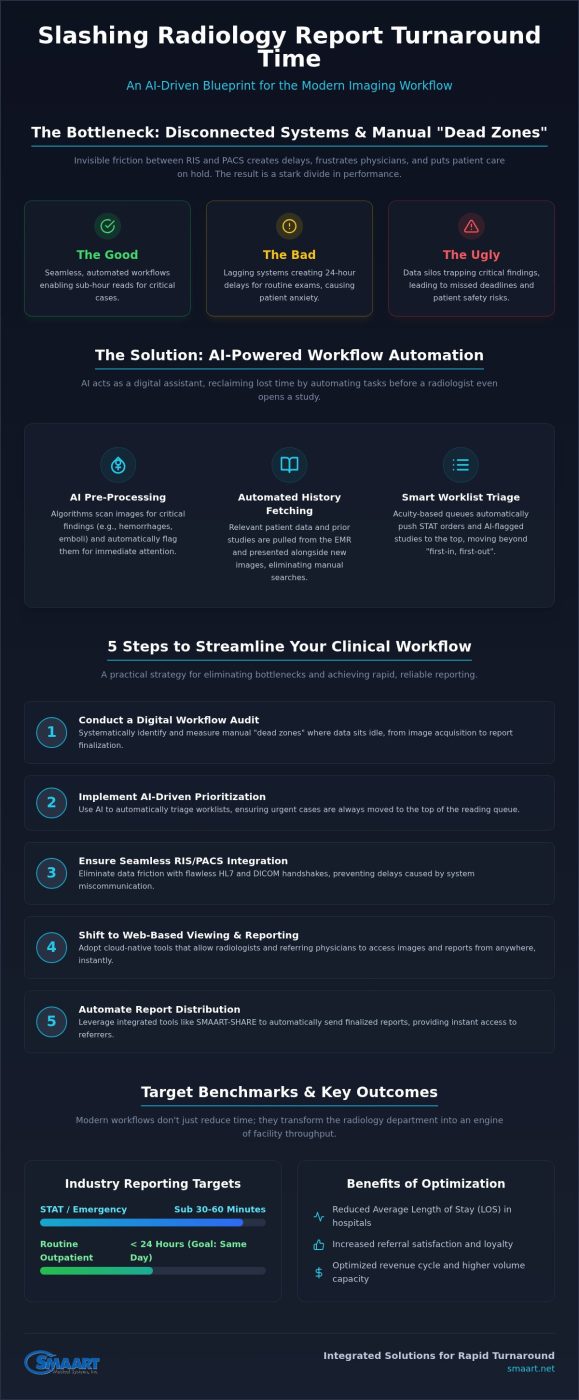
5 Practical Steps to Streamline Your Clinical Imaging Workflow
Transitioning from a sluggish workflow to a high-speed diagnostic engine requires a deliberate roadmap. You don’t need a massive headcount to see results. You need better coordination. Efficiency is a choice. By focusing on the right digital tools, you can start reducing radiology reporting turnaround time immediately. These five steps provide a clear path to modernization.
- Step 1: Conduct a digital audit. Map your “Order-to-Report” timeline. Use your system logs to identify exactly where studies sit idle. You must measure the journey from order entry to technologist completion, and finally to radiologist assignment.
- Step 2: Upgrade to a web-based PACS. Legacy software often requires local installations that lag. A zero-footprint viewer like SMAART-PACS allows for remote reading flexibility, enabling your team to work from any secure location without workstation delays.
- Step 3: Implement automated notifications. Critical results cannot wait for a manual phone call. Use system-driven alerts to notify referring physicians the moment a critical finding is flagged.
- Step 4: Standardize reporting templates. Minimize dictation variance by using structured templates. This reduces the cognitive load on radiologists and speeds up the finalization of routine normal studies.
- Step 5: Utilize cloud-based sharing. Physical media like CDs are TAT killers. Deploy SMAART-SHARE to distribute results instantly via secure links.
Identifying the “Hidden” Delays
The time between a technologist finishing an exam and a radiologist opening the study is often the biggest source of waste. These “dead zones” are where minutes turn into hours. Use SMAART-RIS analytics to find specific modality bottlenecks. You might discover that certain imaging centers have longer assignment delays, or that peer-review cycles are creating backlogs during peak hours. Tracking these specific intervals allows you to apply targeted solutions rather than guessing where the friction lies. Data doesn’t lie; it shows you exactly where your workflow is bleeding time.
Optimizing the Radiologist Environment
Interruptions are the enemy of speed. Integrated communication tools within your PACS allow radiologists to consult with technologists without leaving their diagnostic cockpit. This keeps them in the “flow state” longer. High-speed, ergonomic software reduces physical strain and keeps the focus on the images. Enabling secure home-reading options also helps your facility manage after-hours surges, ensuring that volume spikes don’t derail your TAT targets. To see how these tools work in a live environment, explore the SMAART workflow suite and discover how we support your team’s success.
Modernizing with SMAART: Integrated Solutions for Rapid Turnaround
SMAART Medical Systems, Inc. provides more than just software. We offer a unified environment where SMAART-PACS and SMAART-RIS act as a combined speed engine for your facility. While industry giants often focus on massive, complex installations that can overwhelm smaller teams, our focus remains on reducing radiology reporting turnaround time through streamlined, pragmatic integration. We believe that small-to-midsize clinics shouldn’t have to choose between high-end diagnostic features and financial sustainability. Our platforms deliver the same AI-driven prioritization and seamless EMR handshakes found in major medical centers but at a footprint that makes sense for your specific volume.
The final mile of any diagnostic journey is report distribution. This is where many workflows fail. SMAART-SHARE serves as the ultimate tool for rapid result delivery. It ensures that once a radiologist clicks “finalize,” the data is already on its way to the referring physician’s portal. By focusing on the technical handshake between SMAART-RIS and your existing EMR, we make reducing radiology reporting turnaround time a predictable, repeatable outcome rather than a constant struggle. Our commitment to partnership means we don’t just install a system; we work with you to continuously refine your clinical workflow as your facility grows.
Why SMAART is the Efficient Alternative to Industry Giants
Legacy enterprise systems are often bloated with features your facility might never use, leading to slow performance and high maintenance costs. SMAART Medical Systems, Inc. offers a refreshing, agile alternative. Our zero-footprint SMAART-PACS viewer provides immediate access to images on any device, ensuring that radiologists can start interpreting studies from any location without the lag of heavy software. We’ve designed our suite to be intuitive and fast, prioritizing the tools your team actually needs for daily success. SMAART-SHARE eliminates the logistical nightmare of physical media by providing secure, instant digital access to images and reports, effectively ending CD-related delays by 2026.
Getting Started with a Workflow Digital Audit
Modernizing your facility doesn’t have to be an overnight upheaval. We specialize in helping clinics transition from aging on-premise hardware to flexible SMAART cloud-hybrid models. This approach allows you to maintain control over your data while gaining the speed and reliability of modern cloud infrastructure. The process begins with a simple consultation. We’ll perform a digital audit of your current “Order-to-Report” timeline to identify exactly where your system is losing time. From there, we map out a tailored integration plan that fits your budget and your timeline. It’s time to stop fighting your software and start letting it work for you.
Optimize your workflow with SMAART Medical Systems, Inc. today
Future-Proofing Your Diagnostic Workflow
The path to a more efficient radiology department doesn’t require complex, over-engineered enterprise software. It starts with identifying manual friction points and replacing them with automated, intelligent handshakes. By prioritizing acuity-based triage and bridging the gap between your RIS and EMR, you can transform your facility into a high-speed diagnostic hub. We’ve explored how reducing radiology reporting turnaround time is achievable through digital audits, standardized reporting, and the elimination of physical media like CDs.
SMAART Medical Systems, Inc. is here to help you navigate this transition with ease. Our zero-footprint diagnostic viewer reduces workstation lag, while our seamless EMR/RIS integration removes the burden of manual data entry. You can achieve faster results and lower operational overhead without sacrificing the quality of care your patients deserve. Experience the relief of a streamlined workflow that supports your team instead of slowing them down. Our affordable cloud-based medical image sharing ensures your results reach their destination instantly.
Request a SMAART Workflow Audit and PACS Demo
Take the first step toward a faster, more responsive future for your clinic today.
Frequently Asked Questions
What is the average radiology report turnaround time in 2026?
Current industry benchmarks for 2026 prioritize urgency over a single flat average. Leading facilities often target sub-60-minute windows for STAT orders from the emergency department, while routine outpatient results are increasingly expected within 24 hours. Achieving these speeds requires a fully integrated digital ecosystem that removes manual data entry and provides instant image access across the network.
How does AI actually speed up the radiology reporting process?
AI accelerates interpretation by automatically flagging critical findings and pre-populating relevant clinical history into the radiologist’s worklist. This intelligent prioritization ensures that life-threatening cases move to the top of the queue immediately, bypassing a traditional chronological order. It eliminates the time radiologists spend hunting for data, allowing them to focus entirely on the diagnostic images.
Can cloud-based PACS really improve turnaround times for remote clinics?
Cloud-native solutions provide remote clinics with the same high-speed image access as major urban centers without the need for expensive on-site server maintenance. By using a zero-footprint viewer like SMAART-PACS, radiologists can interpret studies from any secure location. This flexibility significantly reduces the lag caused by local workstation limitations and heavy software installations.
What are the main causes of delays in radiology reporting?
Most delays stem from “data friction” between siloed systems and manual administrative steps like burning CDs or chasing down patient history. These bottlenecks create idle periods where a study is finished but hasn’t yet reached a radiologist’s eyes. Inefficient communication between the RIS and PACS often keeps critical data trapped, slowing down the entire care cycle.
Is it possible to reduce TAT without hiring more radiologists?
Yes, you can achieve your goals by optimizing your existing workflow and removing the administrative burdens that slow down your current staff. Reducing radiology reporting turnaround time is often more about improving system interoperability and automation than increasing your headcount. Smarter tools allow your team to handle higher volumes with less fatigue and fewer interruptions.
How does RIS-PACS integration impact clinical efficiency?
Deep integration ensures a seamless handshake between patient data and imaging studies, which eliminates redundant data entry. When SMAART-RIS and SMAART-PACS work together, the system automatically triggers the next step in the workflow the moment an exam is completed. This automation keeps the diagnostic process moving forward without requiring manual intervention from technologists or administrative staff.
What is the role of SMAART-SHARE in reducing distribution time?
SMAART-SHARE eliminates the need for physical media by providing secure, instant digital links to imaging results and reports. This platform ensures that referring physicians receive diagnostic answers as soon as they’re signed, cutting days out of the traditional distribution cycle. It removes the logistical nightmare of lost discs and courier delays, closing the loop on patient care instantly.
Are there HIPAA risks when trying to speed up report delivery?
Speed doesn’t have to compromise security if you use modern, encrypted cloud platforms specifically designed for medical data. SMAART solutions maintain strict HIPAA compliance by using secure access protocols and encrypted data transmission. This ensures that patient privacy remains protected while you accelerate the delivery of reports to the referring clinical team.