RIS Software with Speech Recognition: Maximizing Radiology Reporting Efficiency
What if the biggest drain on your clinic’s bottom line isn’t your imaging hardware, but the time spent waiting for a report to be typed? Many radiology practices still struggle with the high costs of third-party transcription and the mental burnout that comes from heavy manual data entry. It’s frustrating to watch diagnostic turnaround times stretch longer while referring physicians grow impatient for results. You shouldn’t have to choose between clinical accuracy and operational speed.
In this article, you’ll discover how integrated speech recognition in RIS software eliminates transcription bottlenecks and accelerates diagnostic turnaround times. We’ll examine how modern radiology information system reporting features like those found in SMAART-RIS provide the relief your team needs by automating the documentation process. By bridging the gap between clinical excellence and fiscal responsibility, you can achieve faster report generation and lower administrative overhead. We’ll also preview how a seamless connection between your RIS and SMAART-PACS creates a modern, scannable workflow that respects your time and your budget.
Key Takeaways
- Eliminate transcription bottlenecks by transitioning from manual entry to real-time, automated reporting workflows.
- Understand how advanced Natural Language Processing interprets complex medical terminology to maintain clinical accuracy without the wait.
- Identify the specific radiology information system reporting features that reduce diagnostic turnaround times and lower administrative overhead.
- Evaluate essential reporting tools using our checklist, focusing on medical vocabulary depth and template customization.
- Explore how a unified SMAART-RIS and SMAART-PACS ecosystem provides enterprise-level efficiency at a clinic-friendly price point.
The Evolution of Radiology Reporting: Beyond Manual Transcription
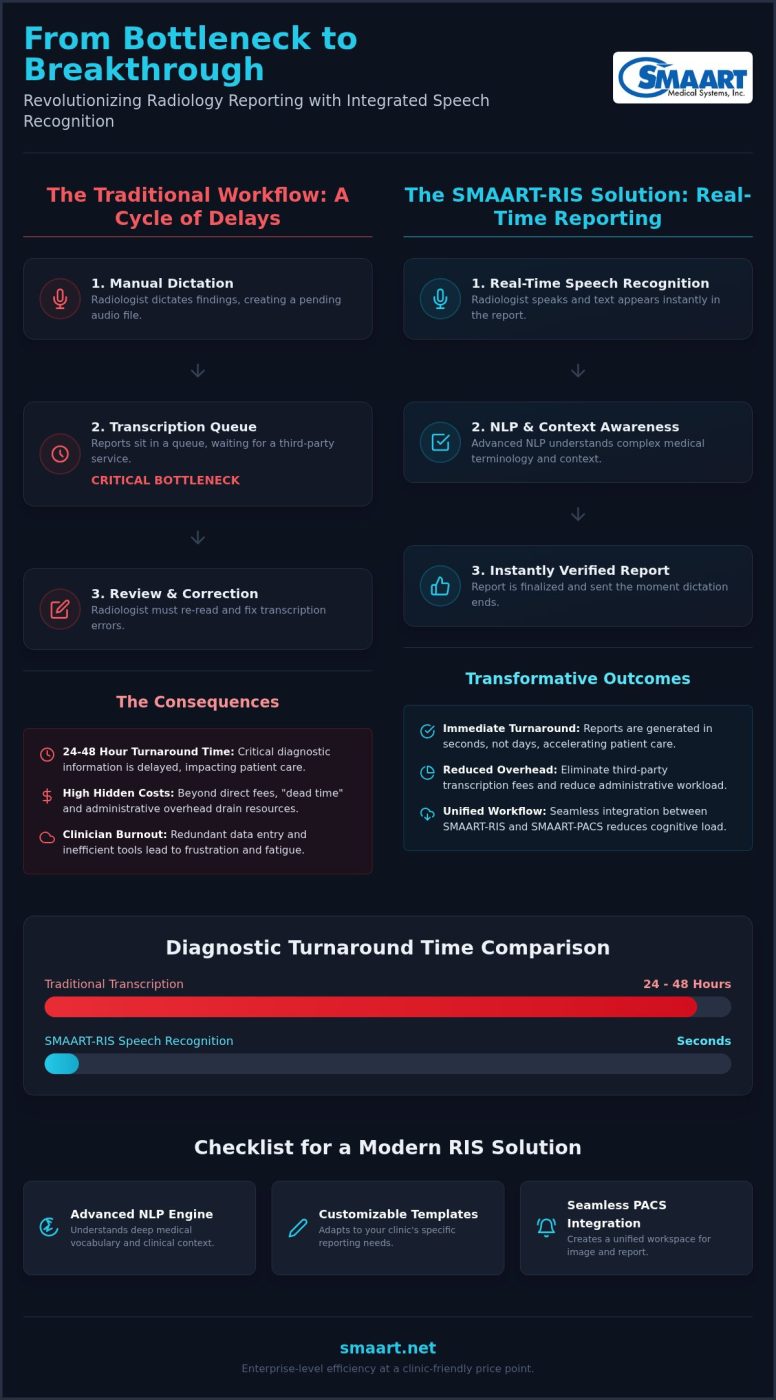
Clinical communication relies entirely on the speed and clarity of the final report. In a busy imaging center, the radiology information system reporting features act as the engine driving the entire diagnostic cycle. For decades, this engine was stalled by the slow, manual process of dictation followed by third-party transcription. This traditional model was functional when patient volumes were lower, but it has become a significant liability in 2026. The modern healthcare environment demands immediate results; delays are no longer just administrative hurdles; they are obstacles to effective patient care.
When reports sit in a queue for 24 or 48 hours, the relationship between the imaging center and the referring physician begins to erode. Doctors need answers to make treatment decisions. Patients feel the anxiety of the wait. Transitioning toward real-time diagnostic documentation isn’t just about adopting new tech; it’s about restoring trust and ensuring that your clinic remains the preferred partner for local providers. Moving beyond manual typing allows your radiologists to finalize findings the moment they see them on the screen.
The True Cost of Transcription Services
External transcription services often hide their true impact behind seemingly low per-line costs. While the direct fees are easy to track, the hidden expenses lie in the “dead time” that occurs while a report is out for typing. This period of administrative latency creates a significant bottleneck. The turnaround time gap is the critical period of clinical silence that exists between a radiologist completing an exam and the referring physician receiving the final diagnostic report. This gap represents lost revenue and increased overhead, as staff must spend time tracking down pending files and answering status inquiries from frustrated clinics.
Why Traditional RIS Features Aren’t Enough
Basic radiology information system reporting features often rely on rigid, static templates. These legacy tools require radiologists to jump between different software windows, manually copying patient data or exam details. This siloed approach is a recipe for redundant data entry and avoidable errors. It’s exhausting for the clinician and inefficient for the business. True efficiency requires a unified environment where SMAART-RIS and SMAART-PACS work in total harmony. A modern diagnostic workstation should pull data automatically into the report, allowing the radiologist to focus on the image rather than the interface. Without this level of integration, your team is simply working harder to overcome the limitations of their own software.
How RIS Software with Speech Recognition Transforms Workflows
The synergy between speech-to-text technology and RIS databases turns a standard dictation tool into a clinical powerhouse. It’s no longer just about recording sounds; it’s about deep integration. Natural Language Processing (NLP) acts as the bridge, allowing the system to understand the context of complex medical terminology. When a radiologist speaks, the software recognizes anatomical nuances and pathological terms with high precision, placing the text exactly where it belongs. This deep integration ensures that radiology information system reporting features are no longer passive data fields but active participants in the diagnostic process.
Total synchronization between SMAART-PACS and your RIS creates a unified workspace. As the radiologist moves through a study, the report stays pinned to the correct patient and exam context. There’s no more switching between screens or losing your place. This seamless flow reduces the cognitive load on the clinician, allowing them to focus entirely on the images. If you’re ready to modernize your workflow, you can explore the full capabilities of SMAART-RIS to see these features in action.
From Voice to Verified Report in Seconds
The mechanics of real-time cursor tracking change everything. Voice commands allow radiologists to navigate the report, sign off on findings, and even pull in previous study data without touching a keyboard. This eliminates the need for a secondary review cycle. In traditional setups, a report might wait hours for a transcriptionist to finish and a radiologist to re-read it. With SMAART-RIS, the report is verified and available to the referring physician the moment the radiologist stops speaking. It’s an immediate boost to your clinic’s responsiveness.
Structured vs. Unstructured Data in Reporting
Smart templates are the foundation of effective speech recognition. While unstructured dictation is flexible, structured reporting ensures data integrity. By using predefined templates, the RIS captures discrete data points that are vital for clinical analytics and quality tracking. This doesn’t mean the radiologist is restricted; it means their insights are organized for better long-term use. Security remains a top priority throughout this process. Every syllable of voice data is encrypted and handled within a secure environment, ensuring full HIPAA compliance while your team works at peak efficiency.
Key Benefits of Integrated Speech Recognition for Clinics
Achieving clinical efficiency requires more than just faster software; it requires a fundamental shift in how results are delivered. When you eliminate the wait for external transcription, the Diagnostic Turnaround Time (TAT) plummets. Reports that once took days to finalize are now completed in minutes. This speed directly impacts your reputation with local providers. Referring physicians receive instant results, which translates to higher satisfaction and more frequent referrals. This responsiveness is a competitive advantage that sets your clinic apart from larger, slower institutions.
Accuracy also sees a measurable boost. Because radiologists review their text in real time as it appears on the screen, they can catch and correct errors immediately. This self-correction loop removes the risk of “lost in translation” moments that occur when a third-party transcriptionist misinterprets a complex anatomical term. Modern radiology information system reporting features ensure that the final document is a precise reflection of the radiologist’s intent, finalized while the images are still fresh in their mind.
Operational Relief and Burnout Prevention
The mental toll of manual reporting is a primary driver of radiologist burnout. Every extra click and every sentence typed by hand consumes cognitive energy that should be reserved for diagnosis. Integrated speech recognition provides immediate operational relief by reducing these repetitive tasks. There is a significant psychological benefit to “closing the folder” on a case immediately after viewing the images. It allows your team to maintain a steady, energetic pace throughout the day without the looming shadow of a growing dictation queue. By empowering your staff to focus on diagnosis rather than documentation, you create a more sustainable and supportive workplace.
Financial ROI: Comparing Manual vs. Speech-Enabled RIS
The financial argument for upgrading your RIS is just as compelling as the clinical one. Monthly transcription fees are a recurring drain on resources that never provides a long-term asset. In contrast, an integrated system like SMAART-RIS replaces these variable costs with a predictable, affordable software subscription. Beyond direct savings, there are substantial indirect gains in throughput. Some industry professionals report that integrated speech recognition can help radiologists increase their daily study volume by up to 20% compared to traditional manual entry methods. This increased capacity allows your clinic to handle more patients without adding headcount, significantly improving your overall bottom line.
Choosing the Right RIS Reporting Features: A Checklist
Selecting a new platform is more than a technical upgrade; it’s a strategic decision that affects every member of your team. You need a system that doesn’t just record data but actively simplifies the reporting process. Not all platforms are built with the same level of clinical depth. When evaluating your options, prioritize these radiology information system reporting features to ensure long-term clinical and financial success for your practice.
- Medical Vocabulary Depth: Verify that the speech engine is pre-loaded with specialized terminology for your specific sub-specialties. Whether you focus on musculoskeletal imaging or complex neuroradiology, the system should recognize anatomical nuances without constant manual corrections.
- Customization and Macros: Assess how easily your radiologists can create their own templates and voice-activated macros. This flexibility is what turns a generic tool into a personalized efficiency driver that adapts to individual dictation styles.
- Seamless PACS/EMR Sync: Ensure the RIS pulls patient demographics and history automatically. This prevents the redundant data entry that leads to errors and clinician fatigue.
- Cloud-Based Access: In a modern clinic, reporting shouldn’t be tied to a specific physical desk. Cloud flexibility allows for secure, remote finalization of studies, which is essential for maintaining turnaround times during off-hours.
Integration and Interoperability Requirements
Data silos are the enemy of efficiency. To prevent them, your system must adhere to industry-standard HL7 and FHIR protocols. These standards ensure that your reports move instantly from the RIS back to the hospital information system (HIS) or electronic medical record (EMR). SMAART-RIS bridges the gap between your HIS and SMAART-PACS, creating a “single sign-on” experience. This means your team spends less time authenticating and more time diagnosing. By ensuring your data flows freely between platforms, you protect the integrity of the patient record and speed up the billing cycle.
User Experience and Training Support
Adoption is the ultimate measure of success for any new software. If the user interface is cluttered or counter-intuitive, your radiologists will struggle to embrace the new workflow. You should evaluate the vendor’s training program and implementation roadmap before making a commitment. A reliable partner doesn’t just install the software; they provide ongoing 24/7 technical support to ensure your clinical workflows never stall. The goal is to feel supported by a partner that understands the high-pressure nature of modern medical imaging. When the software is easy to use, the relief for your staff is immediate.
Ready to see how these features work in a live environment? Schedule a demo of SMAART-RIS today and see the difference a modern system makes.
Optimizing Clinic Efficiency with SMAART-RIS Solutions
SMAART-RIS isn’t just another software package; it’s a commitment to your clinic’s operational health. We understand that hospitals and private practices face immense pressure to modernize without breaking the bank. By delivering high-end radiology information system reporting features at a price that respects your budget, we provide the relief you’ve been looking for. You get the tools of an industry giant with the personal support of a dedicated partner. It’s about making your daily life easier while keeping your finances in check.
The real power lies in the unified ecosystem. When your reporting tools live within the same environment as SMAART-PACS, the friction of daily work simply disappears. You aren’t just buying a reporting tool; you’re investing in a seamless diagnostic engine. For those looking toward the future, SMAART-SHARE adds cloud-ready flexibility. This allows your team to share images and reports securely. It ensures your practice stays agile in an increasingly mobile healthcare landscape. You’ll be ready for whatever the industry demands next.
Why SMAART-RIS is the Pragmatic Choice
We focus on reducing operational burdens and financial strain. Many platforms are overly complex, requiring weeks of training and specialized IT staff. SMAART-RIS is different. It’s designed for hospitals and clinics that value efficiency over complexity. Our “reliable partner” approach means we’re with you during every step of implementation and beyond. We don’t just hand over a license; we ensure your team feels confident and supported. This approach eliminates the cold, clinical detachment often found in medical software, replacing it with a partnership built on your success.
Get Started with a Streamlined Reporting Audit
The first step toward modernization is identifying your current reporting bottlenecks. Look at your “dead time” between dictation and finalization. Check your monthly transcription invoices. These numbers often reveal a significant opportunity for savings. We can help you analyze these workflows to find where automation will have the biggest impact. Requesting a tailored demo allows you to see exactly how our radiology information system reporting features fit into your unique environment. Don’t let legacy processes hold your clinic back any longer.
Modernize your reporting workflow with SMAART-RIS today and experience the relief of a truly streamlined practice.
Modernize Your Diagnostic Workflow
Transitioning to an integrated reporting model is about more than just speed; it’s about reclaiming your team’s time and energy. By moving away from manual transcription, you eliminate the administrative latency that stalls patient care and inflates overhead. Modern radiology information system reporting features provide the automation needed to finalize results in real time, ensuring your clinic remains a high-performance partner for referring physicians. You’ve seen how reducing documentation friction directly prevents radiologist burnout and creates a more sustainable clinical environment.
SMAART-RIS offers a full-feature solution designed for seamless EMR integration and expert support. It’s an affordable path to enterprise-level efficiency without the complexity of traditional industry giants. You don’t have to navigate these technical shifts alone. Our team is ready to act as your dedicated medical technology partner, helping you build a more responsive and profitable practice. It’s time to replace operational strain with the relief of a modern, unified ecosystem.
Streamline your radiology workflow with SMAART-RIS reporting features. Your journey toward a more efficient, stress-free imaging center starts today.
Frequently Asked Questions
How accurate is speech recognition in radiology information systems today?
Modern systems achieve accuracy levels exceeding 99% when properly calibrated to the user’s voice. Advanced Natural Language Processing allows the software to understand the specific context of medical dictation, which significantly reduces the need for manual corrections. This high level of precision ensures that clinical documentation remains reliable while moving at the speed of your practice.
Can RIS speech recognition handle complex medical terminology and different accents?
Yes, modern engines come pre-loaded with comprehensive medical dictionaries covering various sub-specialties. These radiology information system reporting features use deep learning to adapt to different accents and speech patterns over time. The system learns from your individual dictation style, becoming more precise and responsive with every diagnostic study you finalize.
Does integrated speech recognition require special hardware?
You don’t need specialized computer hardware, though a high-quality noise-canceling microphone is essential for the best results. Most modern platforms run efficiently on standard diagnostic workstations. As long as your system meets the basic RAM requirements and has a stable internet connection for cloud-based processing, you can begin reporting immediately without a massive hardware investment.
How does speech recognition in RIS improve diagnostic turnaround time?
It eliminates the administrative latency caused by waiting for third-party transcriptionists to type and return reports. Radiologists can speak, self-edit, and sign off on findings in one continuous session. This “instant finalization” means referring physicians receive results in seconds rather than days, which dramatically accelerates the entire patient care cycle.
Is it difficult to integrate speech-enabled RIS with my existing EMR?
Integration is a smooth process when the software uses industry-standard protocols like HL7 and FHIR. SMAART-RIS is built for seamless connectivity with existing EMR and HIS platforms. This ensures that your finalized reports flow automatically into the patient’s permanent record, removing the need for manual data entry or risky copy-paste workflows.
What is the difference between front-end and back-end speech recognition?
Front-end recognition displays your text on the screen in real time as you speak, allowing for immediate verification. Back-end recognition processes the recording after you’ve finished, often requiring a separate review later. Front-end is the preferred choice for modern clinics because it allows radiologists to “close the folder” on a case the moment they stop talking.
How much can a clinic save by switching from transcription to speech recognition?
Clinics save money by eliminating variable per-line transcription fees and reducing the administrative overhead of managing pending reports. While direct savings are immediate, the indirect gains from increased throughput are even more significant. Some industry professionals report that radiologists can increase their daily study volume by up to 20% by utilizing efficient radiology information system reporting features.
Is speech recognition in radiology HIPAA compliant?
Professional-grade systems use end-to-end encryption for all voice data and text transmissions to ensure full compliance. SMAART-RIS handles all dictation within a secure, encrypted environment that meets or exceeds HIPAA standards. This protects sensitive patient information while allowing your team to work with the speed and flexibility of a modern cloud-ready system.