
Secure Medical Image Sharing Platform: A 2026 Guide to Standards and Safeguards
What happens to a medical image’s privacy after it leaves the originating PACS? Sharing a study can help clinicians collaborate and give patients easier access, but every transfer creates another point where data handling matters. A secure medical image sharing platform should be assessed across the full lifecycle, not judged by a compliance label or a single security feature.
Teams need to protect sensitive imaging data without adding avoidable steps for clinicians or patients. Broad claims can make it difficult to distinguish meaningful safeguards from general assurances. This guide explains how to evaluate security from upload and access through sharing and retention, and how to assess governance, interoperability, and everyday workflows.
It also explains where standards such as HIPAA, NIST Cybersecurity Framework 2.0, DICOM, and FHIR fit into an assessment. For clinics considering cloud-based distribution and collaborative viewing, SMAART-SHARE provides an option without proprietary hardware. Use this guide to compare platform capabilities, understand responsibilities, and support efficient image exchange while keeping privacy in view.
Key Takeaways
- Assess a secure medical image sharing platform by how it manages images throughout the sharing lifecycle, not by a compliance label alone.
- Separate interoperability standards, which support data exchange, from privacy and security frameworks that guide protection and governance.
- Compare portal, cloud, and removable-media workflows by recipient access, traceability, and ease of use.
- Use a pre-share review to clarify the purpose, recipient, information shared, access period, and follow-up responsibilities.
- Consider how SMAART-SHARE’s cloud-based image sharing and collaborative viewing can fit into a clinic’s image distribution workflow.
What Makes a Medical Image Sharing Platform Secure?
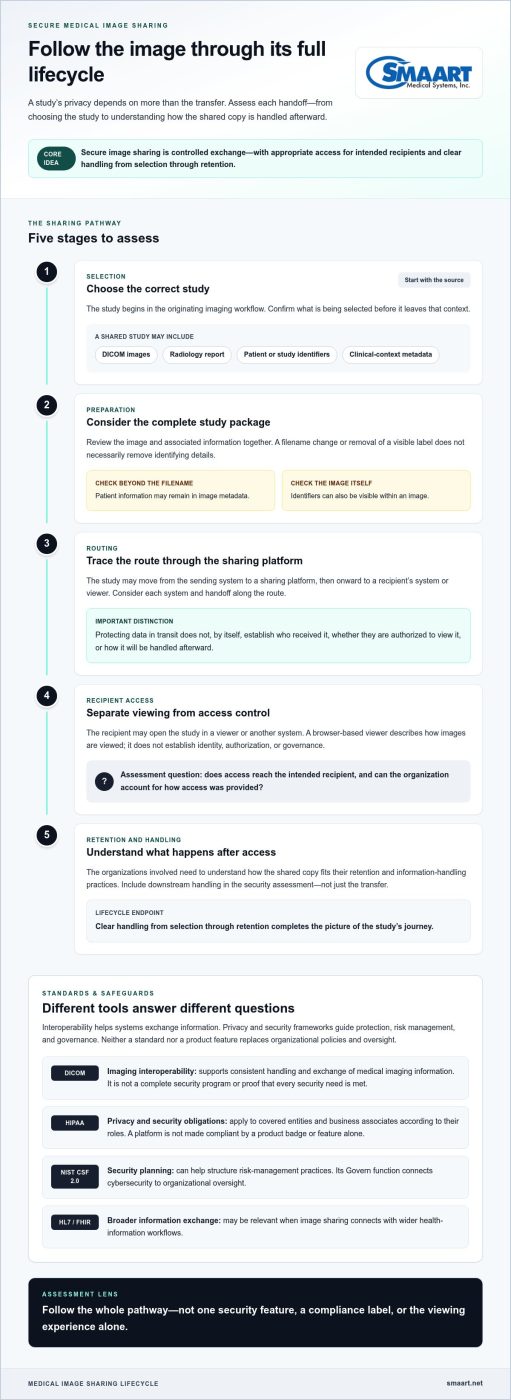
A medical image remains sensitive after it leaves the originating PACS. It passes through systems, people, and viewing tools, each of which can affect who sees the study and what happens next. A secure medical image sharing platform supports controlled exchange, viewing, and management of images and related information throughout that journey.
Secure image sharing is the controlled exchange of medical images and associated information, with appropriate access for intended recipients and clear handling from selection through retention. That involves more than delivering a file. Protecting data in transit does not, by itself, establish who received it, whether they are authorized to view it, or how the study will be handled afterward.
Think of sharing as a lifecycle rather than a single send action. A team selects the correct study, prepares it for exchange, routes it through a sharing platform, and makes it available to a recipient. The recipient accesses it through a viewer or another system. The organizations involved then need to understand how the shared copy fits their retention and information-handling practices. Each handoff belongs in the security assessment.
This end-to-end view leads to more useful questions than “Is the connection secure?” Does access reach the intended recipient? Is the content appropriate for the purpose? Can the organization account for how the recipient got access and what happens to the study afterward? Security depends on the entire pathway, not one technical feature.
Which data moves when a medical image is shared?
A shared study can include DICOM images, a radiology report, patient or study identifiers, and metadata that provides clinical context. That information may move from the sending system to a sharing platform, then to a recipient’s system or viewer. Consider each component: the image alone may not provide the full clinical picture, while associated details can reveal sensitive information.
Renaming a file or removing a visible label does not necessarily remove identifying details. Patient information may appear in image metadata, and identifiers can also be visible within an image itself. Consider the complete study package and its route, not just the filename. The Medical Image Sharing Overview provides background on sharing approaches and related standards.
How does image sharing differ from storage or viewing?
PACS primarily supports storing and managing imaging studies within an organization’s imaging workflow. Sharing adds another step: making a study available to someone outside that original context. The recipient may use a different system, role, or workflow, so the organization needs to consider access and downstream handling as well as the transfer itself.
A browser-based viewer describes how someone views images, not whether access is appropriately controlled. A smooth viewing experience can reduce workflow friction, but using a browser does not establish identity, authorization, or governance. For more on viewing architecture, see this zero-footprint PACS viewer guide. Treat storage, sharing, and viewing as distinct stages when evaluating safeguards.
Which Standards and Safeguards Guide Secure Medical Image Sharing?
Standards answer different questions. Interoperability standards define how systems represent and exchange information. Privacy and security frameworks help organizations decide how to protect that information, manage risk, and govern access. A secure medical image sharing platform needs to work within both: compatible data exchange matters, but it does not replace organizational policies or safeguards.
DICOM supports medical imaging interoperability; it is not a complete security program. A format or exchange standard can help systems handle imaging information consistently, but it does not determine who may access a study, whether a disclosure is appropriate, or how an organization manages risk. Those decisions require policies, technical controls, and oversight suited to the organization’s workflow.
What roles do HIPAA and NIST guidance play?
In the United States, HIPAA establishes privacy and security obligations for covered entities and business associates according to their roles. It is not a product badge. A platform’s use of a standard or security feature does not automatically make an organization compliant. Organizations must consider how their own practices and relationships meet applicable requirements.
The HHS Office for Civil Rights (OCR) is a source for current HIPAA guidance. For security planning, NIST guidance can help teams structure risk-management practices. NIST Cybersecurity Framework 2.0, for example, includes a Govern function that connects cybersecurity to organizational oversight. Use these resources to inform risk analysis and policy, and consult authoritative sources for current regulatory interpretations.
How do DICOM and health data exchange standards fit?
DICOM supports the packaging and exchange of medical imaging information, helping imaging systems interpret and work with studies. The official DICOM Standard for Security and Privacy describes mechanisms addressed within the standard. Assess how those mechanisms relate to the organization’s architecture and operational policies rather than treating DICOM support as proof that every security need is met.
HL7 and FHIR may also be relevant when image sharing connects to broader health-information workflows. An organization may need systems to exchange information about a study alongside related clinical context. The relevant standards depend on the systems and exchange process involved. Identify what each standard enables, then determine what the organization must address separately, including appropriate disclosure, identity, access, and governance.
Turn standards into practical safeguards: document how information moves, assess risks along that pathway, assign responsibility, and establish policies for appropriate access and handling. Revisit those decisions when systems or workflows change. For clinics reviewing imaging workflows, SMAART’s PACS and RIS software is designed to integrate with existing EMR and HIS platforms.
How Do Medical Image Sharing Methods Compare on Security and Workflow?
Portal-based sharing, cloud image exchange, and removable media solve different workflow problems. None is automatically safest. The outcome depends on how identity is established, access is scoped, activity can be traced, and the process fits the organization’s policies. A secure medical image sharing platform should balance convenience with control: recipients need to reach the right study without unnecessary exposure or manual work.
Compare each method using the same questions. Who receives the study? What can they access? Can the organization understand how it was shared? How easily can the recipient view it in their normal workflow? For patient-facing workflows, the patient portal for medical images overview explains the role portals can play in exam sharing.
How do common sharing methods compare?
- Portal-based sharing: A portal can provide a familiar route for patients or other authorized users. Evaluate how it verifies identity, limits access to the intended information, and fits the recipient’s ability to log in and view the study.
- Cloud image exchange: Remote access can make collaboration and distribution more convenient, while centralized administration can help organizations manage the exchange process. That convenience depends on sound configuration, clear governance, and defined responsibility for access.
- Removable media: Physical media can be straightforward in some settings, but handling and delivery add steps. Teams also need to account for possible loss, uncertainty about who has the media, and confusion over whether a copy is current.
For every method, assess traceability and access scope alongside the transfer itself. A process that records who shared a study and with whom may be easier to oversee than one that relies on informal handoffs. The appropriate method still depends on the organization’s workflow, policies, and technical environment.
What trade-offs matter between cloud exchange and legacy sharing?
Cloud exchange can support remote access without a physical handoff, but it brings configuration and governance responsibilities. Teams need to align access with the sharing purpose and define how the process is managed. Removable media shifts the work: instead of configuring an online exchange, staff must handle delivery, track physical copies, and reduce confusion when studies are updated or resent.
Consider the recipient’s experience from start to finish. A process that seems simple for the sender may add steps for a clinician reviewing images during routine work. A quick handoff is also of little use if the recipient cannot confidently access the correct study.
How should teams judge convenience without weakening safeguards?
Evaluate the workflow with clinicians, administrators, and IT stakeholders together. Walk through a typical exchange and note where identity is checked, how much information the recipient can access, and whether the study can be viewed without avoidable delays. Confirm that the stated purpose and recipient match the access provided.
Patient access also raises questions about appropriate disclosure and organizational policy. HHS provides HIPAA Privacy Rule Guidelines as a reference for understanding privacy obligations. For clinics considering cloud-based distribution, SMAART-SHARE supports image sharing and collaborative viewing without proprietary hardware.
What Should a Healthcare Team Check Before Sharing Images?
A short pre-share review can make image exchange more consistent without turning every request into a lengthy approval process. Adapt the steps below to your organization’s policies, user roles, and clinical workflow. Keep two questions distinct: what the organization requires, and what the platform can do to support that process.
Use this pre-share review for each request
- Confirm the purpose. Identify why the study is being shared and whether that purpose fits organizational policy. A treatment-related request, for example, may follow a different review path than a request for another activity.
- Verify the recipient. Confirm who needs the images and their role in the workflow. Follow the organization’s process for establishing recipient identity and authorizing release. Do not rely on a familiar name or email address alone.
- Limit the information. Select the study and related material needed for the stated purpose. Consider whether reports, identifiers, or additional studies should be included instead of sending a broader set by default.
- Set the access period. Decide how long access is appropriate under organizational policies and how the team will handle a change in need. Avoid leaving the duration undefined just because a request is time-sensitive.
- Assign follow-up. Name who is responsible for confirming the recipient can use the study, addressing problems, and following organizational retention or incident-escalation processes.
A reliable pre-share check connects an authorized purpose, the right recipient, appropriately scoped access, and documented governance. Record decisions through the organization’s established process so staff can apply the same approach to routine requests.
What governance decisions should be made first?
Before teams rely on a checklist, define permitted sharing purposes and roles in organizational policy. Establish who can authorize release, how recipient identity is handled, and who owns retention, access reviews, and incident escalation. Assign clear owners: policies are harder to apply when staff do not know who makes a decision or follows up when something goes wrong.
How can teams assess platform fit without assuming compliance?
Document the workflows, systems, users, and data types involved before evaluating a platform. Review available security documentation against organizational risks and procurement requirements. Then distinguish evidence of a technical capability from the organization’s responsibility to set policy and oversee its use. A product does not establish compliance by itself.
Map integration needs across PACS, EMR, and HIS workflows, and assess each relevant interface in context. Systems may handle information differently, so include clinicians, administrators, and IT stakeholders in workflow testing. A secure medical image sharing platform should fit the intended process and support defined safeguards, rather than push staff toward workarounds that bypass them.
For clinics assessing cloud-based image distribution and collaborative viewing, SMAART-SHARE is one option to evaluate against workflow and governance requirements.
How Can SMAART-SHARE Support Secure Medical Image Sharing?
Once your team has mapped its workflow, governance requirements, and integration needs, it can assess whether a sharing platform fits. SMAART-SHARE is a cloud-based platform for medical image sharing and collaborative viewing. It gives clinics an option for distributing radiology results without proprietary hardware and offers an affordable approach to image distribution.
These capabilities describe the platform’s role, not a complete security assessment. Consider a secure medical image sharing platform alongside the organization’s policies and risk-management practices. Evaluate how the proposed workflow supports your requirements, and distinguish platform capabilities from safeguards the organization is responsible for establishing.
Where does SMAART-SHARE fit in a radiology workflow?
A clinic can use SMAART-SHARE in the workflow for distributing radiology results for review. Its collaborative viewing capability supports participants reviewing shared studies together. This can suit workflows where a study needs to be shared beyond its original imaging environment, while keeping the focus on software for image distribution and viewing.
Before adopting a sharing process, define who may participate, what information is appropriate to share, and how the organization governs access and follow-up. Then consider how cloud-based distribution fits with existing PACS and other radiology workflows. SMAART also offers PACS and RIS software designed to integrate with existing EMR and HIS platforms. Each organization’s systems and workflow requirements should guide its integration assessment.
Cloud delivery changes how a study is distributed, but it does not replace organizational decisions about appropriate sharing. Make those decisions explicit. For example, the team should understand the intended use of the shared study and how the workflow aligns with internal policies. Assess the platform against those needs rather than assuming a deployment or product category automatically fulfills them.
What is a practical next step for evaluating image sharing?
Start with a short requirements summary before reviewing a platform. Include:
- Workflow: How the clinic selects and distributes studies, and who needs to review them.
- Governance: The organization’s rules for purpose, recipient, access, retention, and follow-up.
- Systems: The PACS, EMR, HIS, and other relevant systems involved in the exchange.
- Evaluation: The security documentation and workflow fit the organization needs to assess.
With those needs defined, clinics can assess whether SMAART-SHARE’s cloud-based sharing and collaborative viewing fit their radiology-result distribution workflow, including the option to share without proprietary hardware. Keep the evaluation grounded in practical fit rather than broad claims. Consider product capabilities and organizational safeguards separately, so teams can make informed decisions without treating a platform as an automatic compliance solution.
To explore how cloud-based image sharing may fit your clinic’s workflow, explore SMAART-SHARE.
Turn Your Sharing Policy Into a Practical Workflow
Turn security expectations into a workflow people can follow consistently. Choose a routine image-sharing scenario and map each step from the clinic’s perspective. Note where staff need clearer guidance, where handoffs slow down, and which organizational decisions should be documented. This practical view helps your team assess a secure medical image sharing platform against real needs rather than broad promises.
As workflows evolve, revisit the process with the people who use and manage it. Regular, focused reviews can help keep privacy, governance, and clinical efficiency aligned without adding unnecessary friction.
For clinics exploring cloud-based distribution, SMAART-SHARE offers image sharing with collaborative viewing as an affordable option that does not require proprietary hardware. Explore SMAART-SHARE for cloud-based medical image sharing and consider how it could fit your clinic’s workflow.
Frequently Asked Questions
What is a secure medical image sharing platform?
A secure medical image sharing platform helps healthcare organizations make imaging studies available to intended users through a managed digital workflow. It can support the exchange and viewing of images alongside related information, such as reports. For example, a clinic might share a study with another care participant for review rather than send an image file without context. Security also depends on the organization’s policies and how the platform is used.
Is cloud-based medical image sharing secure?
Cloud use alone does not establish that a sharing process is secure. Organizations should assess the platform and the responsibilities around its use, including how access aligns with policy, how data is handled, and how the workflow is governed. Review relevant security documentation as part of risk assessment, then test the intended sharing process with the people who will use it.
Is HIPAA compliance the same as having a secure image sharing platform?
No. HIPAA sets privacy and security obligations for covered entities and business associates according to their roles; it is not a product certification. A platform feature or compliance statement does not replace an organization’s own risk analysis, policies, and oversight. For example, a clinic still needs to define who can authorize an image release and how staff should respond if a study is sent to the wrong recipient.
How can healthcare providers share DICOM images securely?
Use an approved workflow that preserves the study’s clinical context and follows organizational policy. Before sending, staff can confirm they selected the intended examination, include only the information needed for the purpose, and use the organization’s established method for directing it to the recipient. For instance, distinguish a requested follow-up study from unrelated prior exams rather than sharing a broader imaging history by default.
Can medical images be shared without using physical media?
Yes. Digital sharing workflows can distribute studies without handing off a disc or other removable media. This can reduce physical delivery and handling steps, though the organization still needs to govern the exchange and fit it into its clinical workflow. SMAART-SHARE is a cloud-based option for clinics to distribute radiology results and support collaborative viewing without proprietary hardware.
What standards should a medical image sharing platform support?
The relevant standards depend on the systems and information involved. DICOM is central to medical imaging data, while HL7 and FHIR may support exchange with broader health-information workflows. These standards serve interoperability needs; they do not establish privacy, identity verification, or appropriate disclosure by themselves. Consider which systems must exchange information and whether the proposed workflow handles those exchanges in a way that fits organizational policies.
How do clinics evaluate security when selecting an image sharing platform?
Start with a specific use case, such as sending a study for a specialist’s review, and map the systems, users, and information involved. Include clinical, administrative, and IT perspectives. Review the platform’s available security documentation against the clinic’s risk and procurement requirements, then assess workflow fit and integration needs. Record open questions and assign owners before making a decision instead of relying on a general compliance claim.