
The 2026 Guide to Referring Physician Image Portals: Streamlining Specialist Care
In 2026, relying on physical media instead of a modern referring physician image portal is a clinical and compliance liability. You’ve likely felt the frustration when a specialist review is delayed because a disc was cracked, lost, or trapped behind an obsolete Java-based viewer. These bottlenecks don’t just drain your staff’s time. They create genuine anxiety regarding the security of unencrypted data and the potential for HIPAA violations during manual transfers.
We believe that sharing life-saving data should be as fast as it is secure. This guide explains how modern portals eliminate the risks of physical media while ensuring diagnostic-quality image sharing. You’ll learn how cloud-based tools like SMAART-SHARE provide instant, zero-footprint viewing without the need for software installs. We also detail the 2026 HIPAA updates that make multi-factor authentication and encryption at rest mandatory for all providers. This is your roadmap to replacing outdated workflows with a streamlined, compliant, and highly efficient imaging ecosystem.
Key Takeaways
- Transitioning to a modern referring physician image portal eliminates the clinical delays and mechanical failures associated with outdated physical media like CDs and DVDs.
- Prepare for the 2026 HIPAA Security Rule updates by implementing mandatory multi-factor authentication and data encryption for all shared imaging studies at rest and in transit.
- Streamline your specialist workflow with SMAART-RIS integrations that automate notifications and provide instant access to diagnostic-quality images.
- Lower your facility’s operational costs by moving from expensive, hardware-heavy distribution to the cloud-based efficiency of SMAART-SHARE.
- Improve patient outcomes with zero-footprint viewing, allowing specialists to review critical scans immediately in any web browser without cumbersome software installs.
What is a Referring Physician Image Portal?
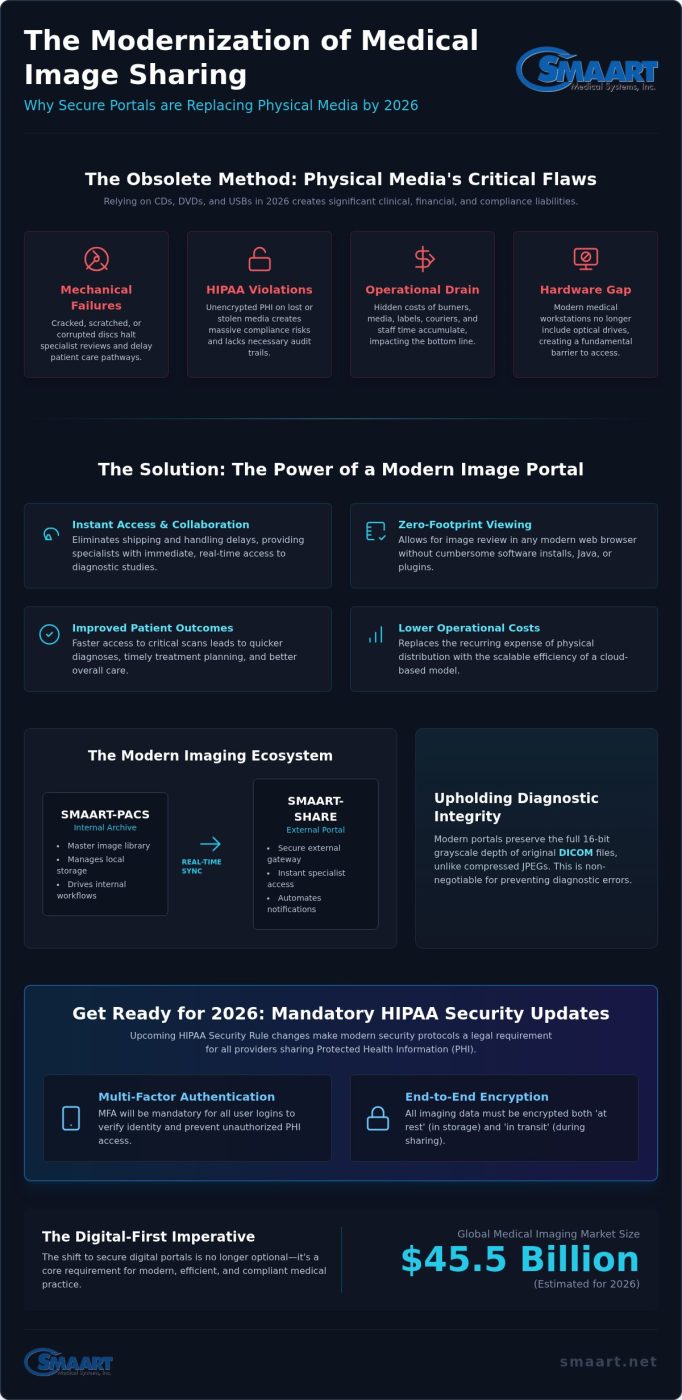
A referring physician image portal is a secure, web-based gateway designed to give specialists immediate access to radiology studies. For years, medical imaging was trapped in local servers, forcing clinicians to wait for physical media or faxed reports. The industry has moved away from these siloed Picture Archiving and Communication System (PACS) environments toward interoperable cloud sharing. This transition ensures that a patient’s diagnostic history isn’t stuck behind a facility’s firewall. By 2026, these portals have become the clinical standard for collaboration because they eliminate the latency inherent in traditional data transfers. With the global medical imaging market estimated at $45.5 billion in 2026, the shift toward digital-first distribution is no longer optional; it’s a requirement for modern practice.
The Role of DICOM in Diagnostic Quality
Standard image formats like JPEG or PNG might work for basic patient education, but they’re insufficient for medical diagnosis. These common formats compress data, which strips away the subtle 16-bit grayscale depth required to identify minute pathologies. A modern portal preserves the full integrity of the original scan, including essential metadata like slice thickness and patient orientation. DICOM is the non-negotiable format for specialist review because it ensures the image on the specialist’s screen is identical to the one interpreted by the radiologist. Portals that maintain these standards prevent the diagnostic errors that occur when using consumer-grade file sharing tools.
PACS vs. Sharing Portals: Understanding the Difference
It’s helpful to view these systems as two sides of the same coin. SMAART-PACS serves as your internal archive, managing clinical storage and local workflows within your facility. In contrast, SMAART-SHARE acts as the external-facing referring physician image portal. While the PACS holds the master library, the sharing portal creates a secure window for outside specialists. These systems synchronize in real time. When a radiologist finalizes a report in SMAART-PACS, the study and the findings become instantly available in SMAART-SHARE. This synchronization removes the manual push of data, allowing specialists to move from referral to review without picking up the phone.
Efficiency in 2026 isn’t just about speed; it’s about the seamless flow of information between disparate IT systems. This interoperability is what separates a professional portal from a simple file-sharing service. When a clinic adopts a dedicated portal, they’re not just buying software. They’re investing in a partnership that bridges the gap between technical IT requirements and high-level administrative goals. This approach reduces the overhead of burning discs and mailing folders, providing a level of fiscal relief that enterprise-level giants often overlook. It’s a refreshing alternative that prioritizes clinical outcomes over administrative complexity.
Why Physical Media is Obsolete: The Case for Digital Portals
By 2026, the optical drive has effectively vanished from standard medical workstations. Clinicians who still rely on CDs or DVDs find themselves searching for external drives just to view a single study. This hardware gap is more than an inconvenience; it’s a structural failure in the referral chain. While cloud platforms boast uptimes exceeding 99.9%, physical media suffers from high mechanical failure rates. Scratched surfaces, data corruption during the burning process, and simple human error make discs an unreliable medium for critical diagnostic data.
The financial drain of physical distribution is often underestimated. Facilities must account for the specialized burning hardware, expensive proprietary labels, and the recurring costs of courier services. When a disc is lost or broken, the price isn’t just the few cents for the plastic; it’s the cost of a delayed surgical opening or a specialist’s wasted hour. Transitioning to a referring physician image portal eliminates these hidden expenses. It replaces slow, manual logistics with a streamlined digital pipeline that respects both the clinic’s budget and the patient’s timeline.
The Security Risk of Unencrypted USBs and CDs
Physical media lacks the granular audit trails required by modern standards. Once a disc leaves your facility, you lose all control over who accesses the Protected Health Information (PHI) it contains. Most patient-carried discs lack encryption at rest, creating a massive vulnerability if the media is misplaced. Furthermore, inserting unverified USB drives into hospital networks poses a severe malware risk. Maintaining HIPAA compliance for physician practices requires a more robust approach. Unlike physical media, a digital portal provides automated logs and mandatory encryption, ensuring every interaction with a patient study is tracked and secured.
Cloud Efficiency: Instant Global Access
A professional referring physician image portal like SMAART-SHARE provides sub-second image loading via the cloud. Specialists no longer wait for a disc to spin up or a file to import into their local viewer. This speed allows for real-time collaborative viewing, where multi-disciplinary teams can review the same study from different locations simultaneously. It also lifts the administrative burden from front-desk staff who previously spent hours managing disc requests and mailings. If you’re ready to leave physical media behind, you can explore how SMAART-SHARE modernizes your workflow with zero-footprint viewing. This shift doesn’t just save time; it provides the operational relief your team needs to focus on patient care rather than hardware troubleshooting.
HIPAA Compliance and Security in Image Sharing
The regulatory landscape for 2026 has shifted significantly. The U.S. Department of Health and Human Services has finalized updates to the HIPAA Security Rule, making previously “addressable” safeguards mandatory. This includes the requirement for multi-factor authentication (MFA) at every access point to electronic Protected Health Information (ePHI). Implementing a referring physician image portal is no longer just a convenience; it’s a critical component of your compliance strategy. Standard email and messaging apps fail these encryption standards and lack the necessary oversight for secure clinical collaboration.
Granular access controls allow you to define exactly which studies a referring physician can see. Automated audit trails then document every interaction, creating a permanent record of who accessed what and when. This transparency is essential for the annual vendor verification now required under 2026 HIPAA standards. It transforms security from a source of anxiety into a manageable, automated part of your daily workflow. By centralizing access, you ensure that patient data never wanders into unencrypted or unmonitored channels.
Encryption Standards: At Rest and In Transit
Encryption is now a non-negotiable requirement for ePHI both at rest and in transit. SMAART software implements TLS 1.3 for all image transmissions, ensuring data remains unreadable to unauthorized parties during the move. Security, not just file size, makes portals superior to email. Beyond transmission, we ensure that data is encrypted within the cloud environment to protect against server-level breaches. Organizations must also perform vulnerability scans every six months and conduct annual penetration tests to maintain their standing. These rigorous protocols provide the technical authority needed to protect your practice and your patients.
The Security Advantage of Zero-Footprint Viewers
A “Zero-Footprint” viewer allows specialists to review diagnostic-quality images without downloading data to a local hard drive. This prevents PHI leaks on shared or public workstations because no residual data remains after the session ends. It also provides a significant advantage for IT security by eliminating the need for outdated Java or ActiveX plugins that are often targeted by cyberattacks. Specialists get the sub-second access they need, and IT teams get the relief of a reduced attack surface. This modern approach to viewing ensures that high-level security doesn’t come at the expense of clinical speed or accessibility.
Implementing a Seamless Referral Workflow
A manual workflow is a slow workflow. When you implement a referring physician image portal, you replace phone tag and faxing with automated efficiency. The process starts the moment a radiologist signs off on a study in your facility. Instead of waiting for a disc to be burned or a courier to be called, the system triggers an automated notification. This alert goes directly to the specialist, providing a secure, immediate pathway to the clinical results.
Integrating this portal with SMAART-RIS further streamlines your operation. Your Radiology Information System manages the front-end scheduling and billing, while the portal handles the back-end distribution. This synergy ensures that result delivery is a byproduct of the clinical workflow, not an extra task for your staff. For new or non-affiliated providers, a “Request for Access” protocol allows them to securely request studies through a standardized web form. Your team can then verify their credentials and grant time-limited access without compromising the security of your entire database.
Step-by-Step Portal Access for Specialists
Accessing patient data shouldn’t require an IT degree. The workflow is designed for immediate clinical use, allowing specialists to focus on the patient rather than the software:
- Step 1: The specialist receives a secure, automated link via email or text immediately after the report is finalized in the system.
- Step 2: They complete a two-factor authentication (2FA) process to verify their identity, ensuring full compliance with mandatory 2026 HIPAA standards.
- Step 3: The zero-footprint viewer opens in their browser, offering advanced diagnostic tools like zoom, pan, and windowing for a comprehensive review.
Integrating Portals with Existing EMR Systems
True efficiency comes from interoperability. SMAART software is built to communicate with your existing EHR or HIS platforms using standard protocols. This means imaging links appear directly within the patient’s clinical chart. When a specialist opens a patient record, the diagnostic images are right there. This level of integration significantly reduces “no-show” rates because specialists have the data they need before the appointment begins. It eliminates the “we don’t have your images” conversation that frequently frustrates both patients and physicians. If you’re ready to eliminate manual distribution bottlenecks, you can request a demo of our integrated workflow solutions today to see these tools in action.
Modernizing Your Clinic with SMAART-SHARE
Choosing a referring physician image portal shouldn’t require the massive capital expenditure typical of enterprise-level giants. SMAART-SHARE provides a refreshing, affordable alternative for clinics that need high-end functionality without the administrative bloat. SMAART Medical Systems, Inc. designed this platform to level the playing field, allowing smaller practices to offer the same sub-second access and zero-footprint viewing that patients expect from major hospital networks. This shift to cloud-based software transforms your imaging department from a cost center into a model of modern efficiency. You gain the technical authority of a premier imaging center while maintaining the fiscal responsibility your practice requires.
SMAART Medical Systems, Inc. acts as more than just a software provider; we are a reliable partner. We ensure your system remains current with seamless updates and ongoing support, which is vital in a landscape where technology moves fast. You don’t need a solution that requires constant manual intervention from your IT staff. We’ve built our ecosystem to bridge the gap between complex technical requirements and the practical, daily needs of a busy clinic. This partnership allows you to focus on specialist collaboration and patient outcomes rather than troubleshooting hardware failures.
Reducing Radiology Overhead with Modern Software
The ROI of switching to SMAART-SHARE is immediate. Automating your image distribution saves your front-desk staff hours of manual labor every week. You’ll eliminate the recurring costs of CD burning hardware, proprietary labels, and expensive courier services discussed earlier. These small, daily expenses often add up to thousands of dollars in annual waste. Beyond the numbers, you’re improving the referral experience for every doctor in your network. When specialists don’t have to fight with broken discs or outdated plugins, they’re more likely to continue referring patients to your facility. It’s a pragmatic approach to growth that prioritizes speed and reliability.
Future-Proofing Imaging Storage
The high-resolution modalities of 2026 generate massive datasets that can quickly overwhelm local servers. Scalable cloud storage is essential for managing these files without constantly purchasing new hardware. By utilizing a unified ecosystem of SMAART-RIS, SMAART-PACS, and SMAART-SHARE, you ensure that every study is archived, managed, and shared through a single, secure pipeline. This integration prevents data silos and ensures your facility is ready for the next generation of diagnostic technology. It’s time to leave the limitations of physical media behind and embrace a workflow built for the future. You can modernize your imaging workflow with SMAART Medical Systems, Inc. to start seeing these benefits in your practice today.
Transforming Specialist Collaboration for 2026 and Beyond
The shift from physical media to digital distribution is a clinical necessity for any modern facility. By adopting a robust referring physician image portal, you remove the latency and security risks that have historically hindered specialist care. We have explored how the 2026 HIPAA standards demand a higher level of technical rigor, and how cloud-based ecosystems provide the relief your administrative and clinical teams need. These tools ensure that diagnostic data is no longer a bottleneck but a catalyst for better patient outcomes.
SMAART Medical Systems, Inc. is dedicated to being your reliable partner in this modernization journey. Our solutions, including SMAART-SHARE and SMAART-PACS, bridge the gap between complex IT requirements and high-level administrative goals. This approach replaces the financial strain of traditional hardware with a streamlined, scalable model designed for the high-resolution demands of the future.
Don’t let outdated workflows limit your practice’s potential or compromise your compliance standing. Request a demo of the SMAART-SHARE Referring Physician Portal today to see how SMAART Medical Systems, Inc. can modernize your facility. We look forward to supporting your ongoing success with efficiency and elite expertise.
Frequently Asked Questions
Is a referring physician image portal more secure than a physical CD?
Yes. Portals use encryption at rest and in transit, which CDs often lack. Portals also provide audit trails that track who accessed the data and when. CDs can be lost, stolen, or broken, leading to unmonitored PHI exposure. In 2026, the shift to a referring physician image portal is the only way to meet mandatory multi-factor authentication requirements that physical media simply cannot support.
Does the specialist need to download software to view the images?
No software downloads are required when using SMAART-SHARE. Our zero-footprint viewer runs entirely within a standard web browser. This eliminates the need for specialists to install cumbersome plugins like Java or ActiveX, which often create security vulnerabilities. Specialists can review diagnostic-quality images on any modern device, providing immediate clinical relief without the traditional IT friction associated with legacy imaging software.
How does a portal ensure HIPAA compliance for 2026 standards?
Portals automate the latest security mandates, including mandatory multi-factor authentication (MFA) and data encryption both at rest and in transit. SMAART-SHARE also supports the required annual vendor verification and facilitates the vulnerability scans that must now occur every six months. By centralizing access, the portal ensures that every interaction with ePHI is logged, creating a comprehensive audit trail that protects your facility during official compliance reviews.
Can I integrate the physician portal with my existing EMR?
Yes, SMAART software is designed to integrate seamlessly with existing EMR and HIS platforms. This integration allows imaging links to appear directly within the patient’s clinical chart, ensuring that specialists don’t have to toggle between different applications. By bridging the gap between your referring physician image portal and your patient records, you reduce administrative overhead and ensure that diagnostic data is always available at the point of care.
How long do images remain accessible in the referring physician portal?
Access duration is fully customizable based on your facility’s specific clinical and legal requirements. While SMAART-PACS serves as your long-term internal archive, the sharing portal allows you to set time-limited access for external specialists. You can grant access for a specific window, such as 30 or 90 days, or maintain it indefinitely for ongoing collaborative care. This granular control ensures that patient data is only available to those who currently need it.
Will the image quality be high enough for a diagnostic MRI review?
Absolutely. The portal utilizes DICOM standards to preserve the full 16-bit grayscale depth and metadata of the original scan. Unlike consumer-grade file sharing that compresses images into JPEGs, our zero-footprint viewer delivers the exact diagnostic quality intended by the radiologist. Specialists can use advanced tools like windowing, leveling, and zooming to perform a comprehensive MRI review directly within their browser without any loss of detail.
What happens if a referring physician forgets their login credentials?
The system includes a secure, automated password recovery process that maintains high security standards. Referring physicians can trigger a reset that requires verification through their registered email and a secondary multi-factor authentication step. This ensures that only the authorized provider can regain access. Our support-related persona means we also provide responsive assistance to help your partners resolve access issues quickly, minimizing any delays in patient care.
Are there limits on the file size of images shared through the portal?
There are no practical limits on file sizes within the SMAART-SHARE ecosystem. Modern imaging modalities like 3D mammography or high-resolution CT scans generate massive datasets that would be impossible to email or burn to standard CDs. Our cloud-based architecture is built for the high-resolution demands of 2026, allowing for sub-second loading of even the largest studies. This scalability ensures your clinic remains efficient as diagnostic technology continues to advance.