
The Hidden Cost of Burning Radiology CDs: A 2026 Guide to Cloud Transition
Did you know that one health system reported spending nearly $550,000 on physical discs, excluding the price of labor and shipping? Even for smaller practices, the total cost of burning radiology CDs can climb to $15 per unit when you account for administrative time and the frequent failure of expensive hardware. These hidden expenses create a structural efficiency leak that drains your budget and slows down patient care.
You’re likely tired of the logistical headaches that come with physical media. It’s frustrating to watch staff waste hours mailing discs or dealing with patients who return because a CD is unreadable or lost. These delays don’t just cost money; they impact the quality of care and the professional reputation of your facility. You deserve a workflow that works as hard as your clinical team does.
This guide will help you uncover the hidden financial leaks in your current workflow and provide a clear path to replace discs with modern cloud sharing. You’ll learn how to reduce operational overhead while significantly boosting patient satisfaction scores. We’ll explore the true price of legacy hardware and outline a step-by-step process to integrate seamless imaging sharing with your existing RIS and PACS.
Key Takeaways
- Understand the full financial drain of legacy media by calculating the total cost of burning radiology CDs, including hidden labor and hardware depreciation.
- Identify the operational risks inherent in physical discs, ranging from HIPAA security vulnerabilities to the clinical impact of unreadable files.
- Compare the efficiency of instant cloud access against the logistical delays of multi-day shipping and outdated proprietary software.
- Get a practical roadmap to audit your imaging expenditures and select a HIPAA-compliant digital sharing solution that fits your volume.
- Learn how to unify your workflow by integrating modern cloud sharing with SMAART-PACS and SMAART-RIS to eliminate hardware overhead.
Calculating the Real Cost of Burning Radiology CDs in 2026
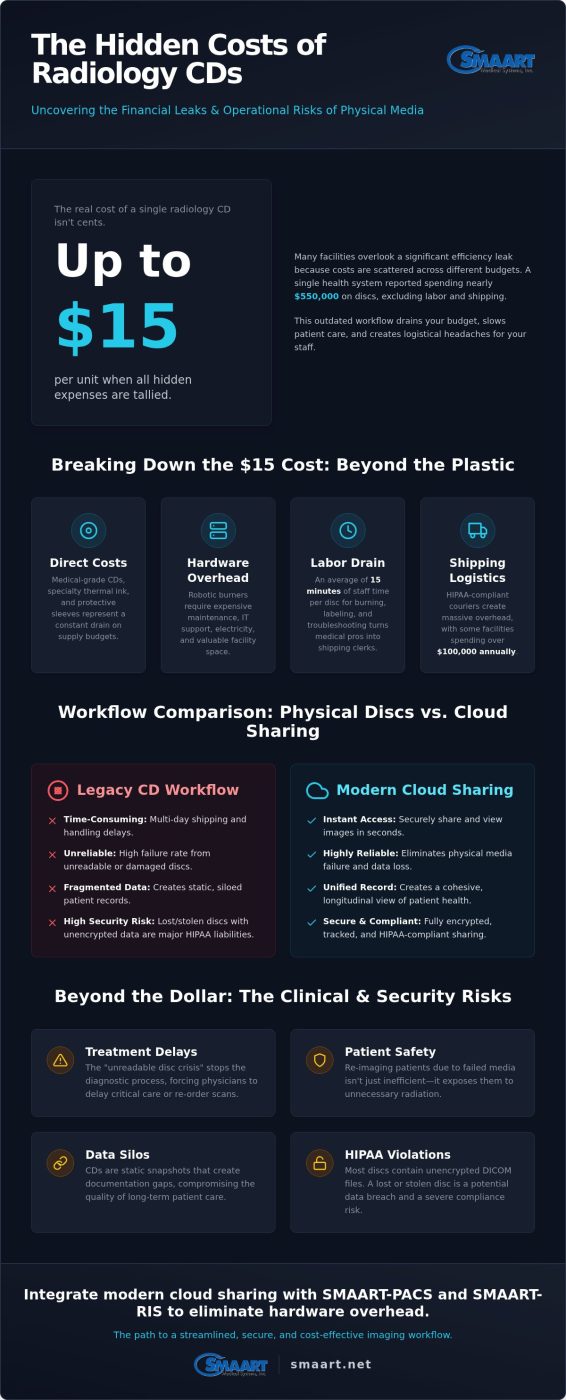
Calculating the true cost of burning radiology CDs in 2026 requires looking past the simple invoice for blank discs. While a single bulk CD-R might cost as little as $0.05, the total operational expense is a composite of hardware upkeep, administrative labor, and logistical premiums. Many facilities find that once all variables are tallied, they’re paying closer to $15 per study just to move data across the hall or across the city. This figure represents a significant efficiency leak that many administrators overlook because the costs are scattered across different departmental budgets.
The Direct Financial Impact: Media and Hardware
Direct costs start with medical-grade optical media, specialty thermal ink, and protective sleeves. These consumables represent a constant, recurring drain on your supply budget. However, the more significant financial burden lies in the hardware itself. High-volume robotic burners are complex mechanical devices prone to failure. They require expensive annual maintenance contracts and specialized IT support to ensure they remain functional. When a burner goes offline, your entire distribution workflow grinds to a halt.
Beyond maintenance, these systems consume electricity and occupy valuable square footage in the imaging suite. Storing physical archives of Digital Imaging and Communications in Medicine (DICOM) files on discs also introduces the cost of climate-controlled shelving and physical security. These are static expenses that offer zero return on investment and only grow as your volume increases. In a modern diagnostic environment, dedicating physical space to plastic discs is an expensive use of facility resources.
The Human Capital Drain: Labor and Opportunity Cost
The most expensive component of disc distribution isn’t the plastic; it’s the person holding it. Every minute a technician spends monitoring a burner is a minute they aren’t focused on patient throughput or diagnostic quality. Manual burning tasks create a bottleneck that ripples through the entire department. Staff must verify the data, label the disc, and manage the courier logs, all while juggling their primary clinical responsibilities.
Administrative teams also face the burden of managing “lost in mail” replacements and troubleshooting unreadable discs for frustrated patients. Based on an industry average of 15 minutes of specialized staff time per study, the labor cost for a single disc typically exceeds the price of the raw materials by a factor of ten. This human capital drain prevents your team from operating at the top of their license. It turns high-level medical professionals into shipping clerks, which is a poor use of your most valuable resource.
Finally, the cost of burning radiology CDs extends to shipping. Relying on HIPAA-compliant overnight couriers to transport physical media is a massive overhead expense. Some facilities report spending up to $100,000 annually just on transport. When you factor in the 2026 rates for fuel and labor, the price of moving a physical disc becomes a structural liability that cloud-based solutions like SMAART-SHARE are designed to eliminate.
Beyond the Dollar: Operational Risks of Physical Media
The total cost of burning radiology CDs isn’t limited to the invoice for blank media or courier fees. There’s a steep clinical price paid in the form of treatment delays and physician frustration. When a patient arrives at a specialist’s office with a disc that won’t load or is physically damaged, the diagnostic process stops. This “unreadable disc” crisis forces physicians to make a difficult choice: wait for a replacement or re-order the scan. Re-imaging a patient isn’t just a waste of resources; it exposes them to unnecessary radiation and delays critical surgical scheduling or emergency room throughput.
Physical media also creates dangerous silos in a patient’s longitudinal record. Unlike cloud-integrated systems, a CD is a static snapshot. It doesn’t update, and it doesn’t follow the patient automatically through their care journey. This lack of continuity leads to documentation gaps that can compromise long-term treatment outcomes. Moving toward a digital model allows for a more cohesive view of patient health, ensuring that every provider has the most current data at their fingertips.
Security and HIPAA Compliance Risks
Data security is perhaps the most overlooked risk of physical distribution. Most CDs contain unencrypted DICOM files, meaning any lost or stolen disc is a potential HIPAA violation. Because the DICOM standard does not include default encryption for files on physical media, you lose all control over the chain of custody the moment the patient walks out the door. There’s no way to track who viewed the data or where it went after it left your facility. This lack of oversight is a significant liability in a landscape where data privacy is paramount.
Modern facilities are realizing they must transition from cumbersome, unsecured CDs to ensure compliance and protect patient privacy. Cloud-based platforms provide a comprehensive audit trail, documenting every access event and ensuring that data remains encrypted both at rest and in transit, as required by HIPAA’s Security Rule. By implementing a secure solution like SMAART-SHARE, you can eliminate the risk of lost physical media while maintaining strict technical safeguards for electronic Protected Health Information (ePHI).
The Patient and Referring Physician Experience
We’ve entered the “no-drive” laptop era. Most modern computers and tablets lack the hardware required to read a CD, leaving patients and referring physicians searching for external drives just to view an image. This friction damages clinic loyalty. Patients expect the same instant digital access they receive from their bank or pharmacy. When you provide a frictionless experience through zero-footprint web viewers, you position your practice as a modern, efficient partner. This digital-first approach doesn’t just reduce the cost of burning radiology CDs; it builds a brand reputation for accessibility and technical excellence.
Cloud Image Sharing vs. CD Burning: A Performance Comparison
Comparing physical media to cloud infrastructure reveals a massive performance gap that impacts every level of clinical operations. The traditional cost of burning radiology CDs includes a hidden performance tax; specifically, the time lost to mechanical processes and physical logistics. While a disc requires minutes to burn, verify, and package, cloud-based distribution happens almost instantly. This shift from physical to digital isn’t just about saving money on plastic; it’s about accelerating the entire diagnostic cycle to match the pace of modern medicine.
Accessibility is where the performance divide becomes most visible. Legacy discs often rely on proprietary viewing software embedded on the media, which can conflict with hospital security protocols or simply fail to launch on newer operating systems. Cloud platforms like SMAART-SHARE utilize zero-footprint web viewers. These allow physicians to access high-resolution images from any browser without installing specialized software. This technical interoperability eliminates the manual data entry and “disc-swapping” that typically plagues busy diagnostic environments.
Financial predictability also favors the cloud model. Per-disc expenses are volatile, fluctuating with the price of specialized ink, robotic repair parts, and courier surcharges. Subscription-based cloud models offer a predictable cost per study, making it easier for administrators to forecast budgets. When you integrate these systems with your EMR, the workflow becomes a seamless stream of data rather than a series of disconnected, manual tasks. This alignment follows current trends in cloud computing for radiology, where data mobility and vendor-neutral access are becoming the gold standard for high-performing facilities.
Diagnostic Speed and Turnaround Time
In critical care settings, every second counts. Cloud sharing facilitates immediate second opinions and tele-consults that are impossible with physical media. A surgeon in the OR can view images via SMAART-SHARE the moment they’re uploaded, rather than waiting for a courier to navigate hospital hallways. This “click-to-view” capability significantly improves turnaround times in emergency departments and orthopedic clinics, where rapid decision-making is essential for patient outcomes. You don’t just save money; you gain the ability to provide faster, more responsive care.
Scalability for Growing Imaging Centers
Expanding an imaging center shouldn’t mean building larger archive rooms or buying more robotic burners. Cloud storage scales effortlessly as your exam volume grows. Adding new modalities to a digital network requires no additional physical footprint, allowing you to maximize your clinical space for patient care. By reducing your IT infrastructure footprint with SMAART-PACS and integrated cloud sharing, you create a lean, agile environment. This modular approach ensures that your facility can handle increased demand without the proportional increase in overhead that legacy hardware requires.
Step-by-Step: How to Replace Radiology CDs with Cloud Sharing
Transitioning away from physical media requires more than just a software installation; it’s a strategic shift in clinical culture. While the high cost of burning radiology CDs provides the financial motivation, a successful rollout depends on a methodical implementation plan. Moving to a digital-first environment eliminates the mechanical bottlenecks that slow down your department. This process ensures that your staff, patients, and referring partners experience the relief of a streamlined, modern workflow from day one.
Auditing Your Current Imaging Workflow
Start by looking at the data. You need to identify the true volume of discs burned versus the number of discs actually used or requested by patients. Many facilities find they’re burning “just in case” discs that end up in the trash. Track your current failure rate by documenting how many patients call back because a disc is unreadable or lost in transit. This audit provides the baseline you need to define your technical requirements for DICOM image exchange and justify the transition to your stakeholders.
Once you understand your volume, select a HIPAA-compliant cloud sharing platform that integrates directly with your existing RIS. The goal is to find a solution that feels like a natural extension of your current tools rather than a separate, siloed application. A secure patient portal is essential. In 2026, providing access via email or a secure QR code is the gold standard for patient engagement. It empowers patients to manage their own records while removing the administrative burden from your front-desk staff.
Integrating Cloud Sharing with PACS and RIS
Technical integration is the engine that drives your new workflow. You must ensure that tools like SMAART-SHARE communicate effectively with your primary database. Set up automated triggers so that an image sharing link or QR code is generated the moment a radiologist finalizes a report. This automation removes the manual “burn and verify” step entirely. During the initial phase, you might maintain a hybrid approach for a few weeks to accommodate legacy requests, but the goal should be a hard cutoff date for physical media distribution.
Training is the final, critical step. Your administrative and clinical staff need to be comfortable explaining the new digital process to patients. You also need to notify your network of referring physicians. Update your medical records release policy to reflect that digital sharing is now the primary method of distribution. This proactive communication builds trust and ensures that everyone in the care continuum is aligned. If you’re ready to stop managing hardware and start managing data, you can learn more about implementing SMAART-SHARE to modernize your facility’s distribution model.
SMAART-SHARE: Streamlining Image Distribution Without the Overhead
SMAART-SHARE represents the final step in your facility’s modernization journey. It’s not just a software patch; it’s a structural upgrade that removes the physical constraints of legacy media. By moving to a cloud-native platform, you effectively eliminate the recurring cost of burning radiology CDs while simultaneously upgrading your diagnostic capabilities. This shift allows you to focus on clinical excellence rather than hardware maintenance.
The true power of the platform lies in its synergy with SMAART-PACS and SMAART-RIS. Instead of jumping between disparate systems to burn a disc or log a courier, your team operates within a single, unified environment. This integration ensures that scheduling, imaging, and distribution work in concert. It’s an affordable, full-feature solution designed specifically for clinics and hospitals that need to reduce radiology overhead without sacrificing diagnostic quality.
Why SMAART-SHARE is the Logical CD Replacement
SMAART-SHARE provides a direct remedy for administrative fatigue. Features like secure links and QR code access replace the mechanical failure of disc burners with digital reliability. Administrative staff experience immediate relief because they no longer have to manage physical inventory or troubleshoot hardware downtime. SMAART-SHARE integrates with SMAART-RIS to automate patient notifications, ensuring that individuals receive access to their images the moment the report is finalized. This automation ensures that your workflow remains fast-paced and efficiency-driven.
Security is baked into the architecture. Unlike unencrypted physical discs, our cloud platform ensures that every image is protected by modern encryption standards. You gain a complete audit trail of who accessed the data and when, which is essential for maintaining HIPAA compliance in a digital-first world. It’s a pragmatic approach to data management that balances technical authority with user accessibility.
Enhancing Referring Physician Relationships
Your relationships with referring physicians are a primary driver of clinic growth. Providing these partners with a secure, zero-footprint portal for collaborative viewing signals that your facility is at the forefront of medical technology. It removes the friction of the “no-drive” era. Specialists can view diagnostic-quality images instantly on any device without installing proprietary software. This seamless experience builds trust and positions your practice as a refreshing, modern alternative to traditional imaging centers.
Modernization is about more than just technology; it’s about fiscal responsibility. By removing the need for proprietary hardware and disc media, you reclaim your budget and your staff’s time. You build a professional brand that is known for speed, reliability, and technical excellence. If you’re ready to leave the era of plastic discs behind, learn how SMAART Medical Systems, Inc. can reduce your radiology overhead.
Modernize Your Imaging Workflow Today
The evidence is clear: legacy media is a structural liability. By now, you understand that the total cost of burning radiology CDs involves much more than blank discs. It includes the daily strain on your administrative staff, the high price of courier logistics, and the clinical frustration of unreadable files. Moving to the cloud isn’t just about saving money; it’s about reclaiming your team’s time and significantly improving the patient experience by transforming a physical bottleneck into a digital asset.
SMAART Medical Systems, Inc. provides the tools you need to make this transition seamless. Our HIPAA-compliant cloud architecture and seamless EMR/RIS integration allow you to automate distribution and protect patient data without the need for proprietary hardware. We offer affordable subscription models designed to fit the specific volume of your clinic or hospital. You can finally leave the era of robotic burners behind and embrace a unified, modern diagnostic environment that prioritizes speed and security.
The future of your practice is digital, secure, and frictionless. Request a demo of SMAART-SHARE and see how to eliminate your CD costs. We look forward to helping you achieve a more efficient and profitable imaging workflow that benefits your staff and your patients alike.
Frequently Asked Questions
How much does it cost to burn a radiology CD in 2026?
The total cost of burning radiology CDs is estimated between $3 and $5 for raw materials and basic labor, but can climb to $15 per unit when accounting for hardware depreciation and shipping. While bulk blank media is available for as little as $0.05 per disc, the administrative time spent on manual burning and courier logistics creates a significant financial leak. Some large health systems report spending over $500,000 annually on physical media alone.
Is cloud medical image sharing more secure than physical CDs?
Cloud sharing is significantly more secure than physical media because it utilizes end-to-end encryption and granular access controls. Physical discs typically store DICOM files without default encryption, meaning any lost or stolen CD is a potential HIPAA violation. Cloud platforms provide a comprehensive audit trail that tracks every access event, ensuring you maintain a secure chain of custody that is impossible to achieve with a plastic disc.
Do patients prefer cloud access over physical radiology discs?
Modern patients overwhelmingly prefer digital access because it aligns with their expectation for instant, mobile-friendly healthcare. Most laptops and tablets sold in 2026 lack internal CD drives, which makes physical media a burden rather than a benefit. By providing a secure link or QR code, you allow patients to view and share their results instantly with specialists, which improves satisfaction scores and removes the risk of losing important medical records.
What hardware is required to switch from CD burning to cloud sharing?
Switching to cloud sharing actually reduces your hardware footprint by eliminating the need for expensive robotic burners and specialty printers. You only need a standard internet connection and a computer with a modern web browser to manage your image distribution. Because SMAART-SHARE utilizes zero-footprint viewing technology, there’s no requirement to install or maintain local software on your diagnostic workstations or the devices used by referring physicians.
Can cloud image sharing platforms integrate with my current RIS and PACS?
Yes, cloud platforms are designed to integrate seamlessly with your existing RIS and PACS to create a unified diagnostic environment. This connectivity allows you to automate the sharing process so that access links are generated the moment a radiologist signs off on a report. By linking these systems, you eliminate the manual “burn and verify” steps that currently drain your staff’s productivity and drive up the internal cost of burning radiology CDs.
How does replacing CDs with cloud sharing impact referring physicians?
Replacing CDs with cloud sharing improves your relationships with referring physicians by providing them with frictionless, instant access to high-resolution images. They no longer have to deal with the logistical delays of courier deliveries or the technical frustration of proprietary CD viewers. A secure, web-based portal allows them to view studies on any device, which facilitates faster consultations and more collaborative treatment planning for their patients.
Is cloud-based medical image sharing HIPAA compliant?
Cloud-based image sharing is fully HIPAA compliant provided the platform implements technical safeguards like encryption at rest and in transit. Unlike physical CDs, which are often unencrypted and easily lost, cloud systems use AES-256 encryption and secure access protocols to protect electronic Protected Health Information (ePHI). These platforms also generate the audit logs required by the HIPAA Security Rule, giving your facility the oversight needed to protect patient privacy and stay compliant.