
How to Optimize Radiology Reading Workflow: A 2026 Guide
Radiology reading doesn’t get faster just because radiologists are asked to read faster. If you’re trying to understand how to optimize radiology reading workflow, start with the handoffs around interpretation: cases waiting in a worklist, fragmented systems, and repeated steps that pull attention away from reading. These delays frustrate teams and make clinical priorities harder to see.
Quicker, more consistent turnaround is a reasonable goal, but speed only matters when diagnostic quality and clear communication remain intact. First find where work stalls, then make focused changes that help cases move from scheduling and image availability through interpretation and report distribution.
This guide explains how to identify reading-room bottlenecks, measure delays, and compare process and technology improvements. It also covers how PACS image distribution, RIS patient data and scheduling, and integration with existing EMR and HIS platforms fit into workflow decisions. Use the steps to reduce friction without treating every delay as a reason to add another tool or ask radiologists to work faster.
Key Takeaways
- Learn how to optimize radiology reading workflow by tracing delays from study readiness through reporting and communication.
- Separate clinical interpretation from operational handoffs to pinpoint where cases stall without rushing diagnostic decisions.
- Compare process, worklist, integration, ergonomics, and automation changes by the bottleneck they address and how you can measure their impact.
- Use a focused audit and pilot to test one improvement, gather team feedback, and refine the change before expanding it.
- Explore how connected PACS and RIS capabilities can support image access, patient information, scheduling, and smoother reading-stage handoffs.
Where radiology reading workflows lose time, and why the reading phase matters
Imaging demands can grow, but radiologists still need time and focus to interpret each study carefully. Interruptions, incomplete information, and cases missing from the appropriate worklist can add friction before interpretation begins. Asking readers to move faster won’t fix these handoffs. To understand how to optimize radiology reading workflow, separate operational delays from the clinical judgment a case requires.
Here, “reading workflow” means the steps from image readiness to case selection, interpretation, reporting, and result handoff. It doesn’t include every part of the imaging journey. That distinction matters: radiographers acquire images, while radiologists interpret them, as described in Radiography. Reading-stage improvements should support interpretation, not rush it.
Which reading-room bottlenecks should teams look for first?
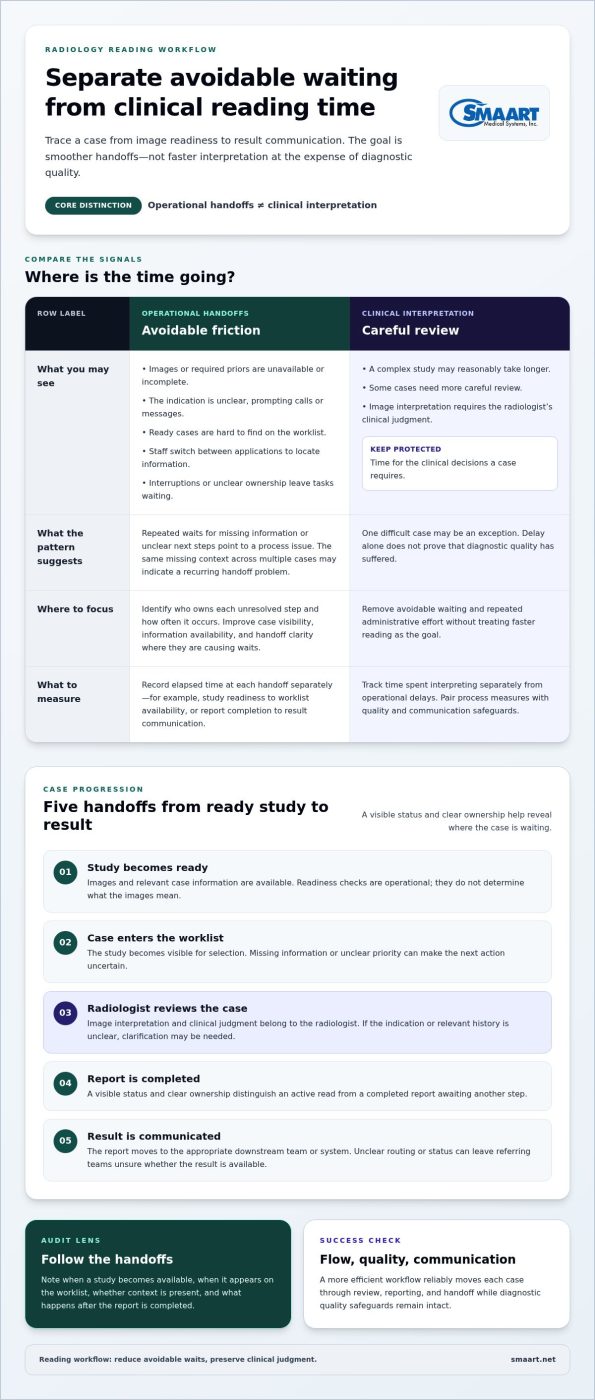
Trace what happens when a study is ready for review. Note when it becomes available, when it appears on the worklist, whether the radiologist has the needed context, and what happens after the report is completed. Record elapsed time at each handoff separately from time spent interpreting the case. A complex study may reasonably take longer; recurring waits for missing information point to a process issue.
Look for patterns such as:
- Studies held up because images are incomplete or required priors aren’t available.
- Unclear indications that prompt calls or messages before interpretation can proceed.
- Cases that are ready but hard to find because worklist visibility or selection rules don’t match clinical priorities.
- Repeated switching between applications to locate images or case information.
- Interruptions or unclear ownership that leave a clarification or reporting task waiting.
One case with a difficult history may be an exception. The same missing context across multiple cases suggests a recurring handoff problem. Before changing a worklist or adding technology, identify who owns each unresolved step and how often it occurs. This helps distinguish a case-specific challenge from a system-wide bottleneck.
How do reading delays affect radiologists and referring teams?
When cases wait between steps, the queue becomes harder to manage. Radiologists may need to resume work after interruptions or chase information, while referring teams may not know whether a study is awaiting interpretation, clarification, or report completion. That uncertainty complicates coordination, especially when teams can’t see where a case is stalled.
Delay alone doesn’t prove that diagnostic quality has suffered. Some studies need more careful review because of their complexity. The goal is to remove avoidable waiting and repeated administrative effort while preserving time for clinical decisions. Track process measures, such as time from study readiness to worklist availability or report completion, alongside quality and communication safeguards. Don’t treat shorter reading time by itself as success.
Reading-workflow efficiency is the reliable progression of each case through review, reporting, and handoff, with diagnostic quality safeguards intact. This definition keeps improvement focused on smoother case flow, not speed at any cost.
How a radiology reading workflow moves from ready study to final report
A clear sequence makes it easier to see where a case is waiting and who owns the next action. Each handoff depends on accurate information and a visible status. If a study appears ready while images are still incomplete, or a finished report has no clear communication path, the case can stall between steps.
A radiology reading workflow is the sequence that moves a ready study through worklist selection, clinical interpretation, report completion, and result communication. The steps below separate operational handoffs from the radiologist’s clinical decisions:
- The study becomes ready. Images and relevant case information are available for review. Readiness checks are operational; they don’t determine what the images mean.
- The case enters the worklist. The study becomes visible for selection, with a status that helps the team understand its place in the queue. Missing information or unclear priority can make the next action uncertain.
- The radiologist reviews the case. Image interpretation, including the clinical judgment needed to assess findings, belongs to the radiologist. If the indication or relevant history is unclear, clarification may be needed before interpretation can proceed confidently.
- The report is completed. The radiologist documents the interpretation. A visible status and clear ownership help distinguish an active read from a report that is complete but awaiting another step.
- The result is communicated. The report moves to the appropriate downstream team or system. Unclear routing or status can leave referring teams unsure whether the result is available.
What should happen before a case reaches the radiologist?
Before placing a study in the reading queue, confirm that the images are available, the study is complete, and the case includes a clear indication. Relevant prior studies can also give the radiologist useful context. These checks help prevent avoidable calls or messages after the case reaches the worklist.
Keep technical validation separate from interpretation. A check can establish that expected images and case details are present; it can’t establish whether the study is diagnostically adequate or what a finding means. If information is missing, make the gap and the next responsible handoff visible rather than allowing the case to appear ready without context.
How should interpretation and reporting connect to the next step?
Define what each report status means, who owns the next action, and how completion is signaled. For example, teams should be able to distinguish a report still in progress from one completed but not yet communicated. Consistent status and routing reduce ambiguity for readers and referring teams, supporting follow-up without adding unnecessary interruptions to interpretation.
Set measures around your department’s case mix and communication needs rather than applying one turnaround target to every study. Track intervals between readiness, worklist entry, report completion, and communication, while keeping clinical review distinct from operational waiting. If connected systems are part of your improvement plan, radiology workflow software can help you assess how case information and image access fit across those handoffs.
Compare radiology reading workflow improvements by the bottleneck they solve
The right change depends on where cases actually stall. A new tool won’t fix missing indications, and a faster reading target won’t resolve a worklist that hides ready studies. To decide how to optimize radiology reading workflow, match each intervention to a documented bottleneck. Then consider its dependencies, potential disruption, and a measure that will show whether it helped.
| Intervention | Problem addressed | Dependencies | Disruption risk | Suitable measure |
|---|---|---|---|---|
| Process standardization | Incomplete study details, inconsistent readiness checks, or repeated clarification loops. | Agreed responsibilities and a shared definition of “ready.” | Low to moderate; new steps may feel burdensome if they duplicate existing checks. | Rate of cases returned for missing information; time from readiness to worklist entry. |
| Worklist changes | Ready cases are hard to find, or priority and escalation rules are unclear. | Transparent prioritization criteria and defined escalation ownership. | Moderate; changing queue logic can alter established reading habits. | Time from study readiness to selection, reviewed by priority category. |
| System integration | Readers repeatedly switch applications to find images or case information. | Interoperability review, access requirements, and coordination across system owners. | Moderate to high; workflow changes may affect several teams and systems. | Application switches or delays between image access and case review. |
| Ergonomics | Physical setup or workstation layout makes sustained review less comfortable or interrupts task flow. | Radiologist input and a review of the reading environment. | Low to moderate, depending on the scope of changes. | User feedback and reported interruptions associated with workstation use. |
| Automation | Repetitive routing or administrative steps consume attention. | A clearly defined task, suitable data, validation, and ongoing oversight. | Moderate to high; incorrect routing or added alerts can create new work. | Task completion and exception rates, alongside user review of output. |
Which workflow intervention fits each common problem?
Match the fix to the cause. Missing indications or priors call for better intake and readiness steps, not simply a faster reading target. Poorly ordered cases call for transparent prioritization rules and a clear escalation path. Repeated system switching calls for reviewing application access and integration requirements. The integrated RIS and PACS workflow guide explores how systems can coordinate across these steps.
How should teams compare technology and process changes?
Ask whether a proposal removes a documented delay or adds another task, screen, alert, or handoff. Consider interoperability, user impact, governance, and the ongoing work needed to maintain the change. For example, browser-based viewing may be relevant when access across workstations is the issue; the browser-based diagnostic viewing guide covers that approach.
Evaluate AI or automation against one specific task and validate its performance in the intended workflow. Treat it as support for a defined process, not a shortcut around clinical judgment. Track exceptions and unintended effects as well as time saved. A change is useful only if it reduces friction without weakening review, communication, or accountability.
A practical plan to audit, pilot, and measure reading workflow changes
A focused improvement cycle helps teams address friction without changing several parts of the reading room at once. To determine how to optimize radiology reading workflow, map the current process, establish a baseline, and test one targeted change. Involve radiologists, technologists, operations staff, and IT so the audit captures clinical, operational, and system handoffs, not just what appears on a dashboard.
- Map the current flow. Follow a study from readiness through worklist entry, interpretation, report completion, and communication. Record where ownership changes and where a case can wait.
- Gather baseline data. Agree on stage definitions, then capture timestamps and relevant indicators before making changes.
- Select one bottleneck. Choose a recurring, clearly described issue, such as older ready cases remaining difficult to identify.
- Design a bounded pilot. Name an owner, define who is included, and document the change and its intended effect.
- Review the results. Compare pilot measures with the baseline and gather feedback from the people doing the work.
- Refine the approach. Keep, adjust, or roll back the change based on its overall effect, then decide whether a broader test makes sense.
What should a reading-workflow baseline include?
Use consistent definitions for locally meaningful timestamps, such as study ready, visible on the worklist, interpretation started, report completed, and result communicated. Compare worklist age and turnaround with rework, such as cases returned for missing information. Segment by modality, urgency, shift, or case type only when it helps explain differences without obscuring the overall pattern.
Numbers show where delay occurs, but staff can explain why. Ask radiologists, technologists, operations, and IT which handoffs require follow-up, where status becomes unclear, and which workarounds have become routine. For a broader view of how reading-room changes fit into department-wide efforts, use this hospital imaging workflow optimization strategy as enterprise context.
How can a team run a low-risk workflow pilot?
Keep the test narrow enough to observe. Before the pilot begins, document the owner, participating workflow, training, escalation routes, review period, and conditions for pausing or rolling back. Tell affected staff what is changing and how to report problems. Then review the planned measures alongside workload feedback, report consistency, and existing quality safeguards. Faster progression is useful only if the change remains dependable.
Interpret results carefully. A change may shorten one interval while shifting work to another team or increasing clarification requests. Compare like with like, discuss unexpected effects, and refine the process before expanding it. Explore SMAART radiology workflow software to assess how system capabilities can support the handoffs your audit identifies.
How integrated radiology software can support a more connected reading workflow
Software can support the handoffs around interpretation by connecting image access, patient and study information, and scheduling workflows. It won’t replace clinical judgment or fix every process problem. Evaluate whether systems support the specific steps your audit identified and allow information to move between them without creating extra work.
For teams deciding how to optimize radiology reading workflow, start with a practical question: what does the reader need at each stage, and where does that information currently live? A radiologist may need access to the correct images and relevant case details, while operations staff need clarity on scheduling and study status. Mapping these needs makes software evaluation more focused.
What roles can PACS and RIS play around interpretation?
PACS supports image storage and distribution. RIS manages patient data and clinical scheduling. Their roles differ, but both relate to reading-stage handoffs: images must be accessible for review, and case information must support the workflow surrounding the study. Assess where these functions connect with worklist entry, reporting, and downstream communication.
Review how information passes between systems, including where staff re-enter details or switch applications to find what they need. SMAART Medical Systems’ software is designed to integrate with existing EMR and HIS platforms, a relevant consideration when assessing system coordination. Include integration requirements and the intended workflow in the evaluation rather than assuming a connection will automatically resolve delays. The integrated RIS and PACS workflow guide provides broader context for assessing those relationships.
Use a focused review to clarify:
- Which system is the source for each piece of case information?
- Where do readers access images, and what handoffs depend on that access?
- How does a report’s status connect to the next communication step?
- Which existing EMR or HIS workflows need to be considered?
When should teams evaluate cloud image sharing?
Cloud-based image sharing may be useful when authorized collaborators need access to images beyond the immediate reading workflow. SMAART-SHARE provides a secure platform for collaborative image sharing. Consider the intended participants and how sharing fits into existing processes, while keeping image access distinct from diagnostic interpretation. A sharing platform supports collaboration; it does not itself provide a radiologist’s interpretation or teleradiology services.
Choose technology based on a defined handoff need, interoperability, user impact, and ongoing operational demands. Then assess the change against baseline measures, including any unintended effects on reporting or communication. To explore software designed for radiology workflows, view SMAART radiology workflow solutions.
Turn your workflow findings into the next improvement
Better reading workflows take shape through deliberate choices, not a sweeping overhaul. Use your audit findings to set a clear priority, involve the affected teams, and keep checking whether the change makes work more dependable without adding friction elsewhere. This gives your department a practical way to improve as its needs evolve.
Knowing how to optimize radiology reading workflow also means choosing systems that fit the way your team works. Compare each option with the handoffs and requirements you’ve identified. SMAART-PACS supports image storage and distribution, SMAART-RIS manages patient data and clinical scheduling, and SMAART software is designed to integrate with existing EMR and HIS platforms.
Explore SMAART radiology workflow solutions to see how connected software can fit your department’s priorities. Start with one well-defined opportunity, measure its impact thoughtfully, and build from there. Small, evidence-led improvements can help create a reading workflow that supports radiologists and the teams who rely on clear results.
Frequently Asked Questions
How can radiology teams reduce interruptions during image interpretation?
Set clear channels and agreed rules for non-urgent requests while preserving an explicit route for urgent clinical issues. For example, teams might direct routine status questions to a designated queue instead of interrupting a reader mid-case. Track when interruptions occur, what prompted them, and whether the task had to be resumed. Review the patterns with staff, then adjust the approach to fit departmental responsibilities and patient-care needs.
Can standardized protocols improve radiology reading workflow?
Yes. Standard protocols can make routine preparation and communication more consistent, provided they leave room for clinical judgment. Define who maintains each protocol, how staff find the current version, and how exceptions are recorded. For example, a shared reporting convention can reduce avoidable variation, while a documented exception path helps readers handle cases that don’t fit the routine. Review protocols with users and revise them as practice changes.
What should radiologists do when relevant prior images are unavailable?
Follow departmental policy and make the missing priors visible in the case status. The radiologist can determine whether the study can be interpreted with available information or whether obtaining prior images is clinically appropriate. The team should document the decision and route any retrieval request to its designated owner. Tracking these cases can reveal whether access delays recur for a particular source, workflow, or handoff.
How should urgent imaging cases be prioritized in a reading worklist?
Use clinically governed rules that make urgent cases identifiable and specify how to escalate them. The policy should clarify who may change a case’s priority, how that change is communicated, and what to do when the worklist status conflicts with a clinical request. Review examples of delayed or reclassified cases with the relevant team. A software label can support the process, but it shouldn’t replace clinical policy.
Does AI automatically make a radiology reading workflow more efficient?
No. AI’s value depends on the specific task, how it fits into practice, and how its output is overseen. Before introducing a tool, define what it should do and compare the workflow with and without it. For example, assess whether staff spend less time on the targeted task or instead gain new review steps. Include quality checks, clear responsibility for decisions, and a process for handling unexpected output.
Which metrics help assess a radiology reading workflow?
Choose measures that reflect the department’s goals, such as stage-specific turnaround, worklist age, rework, or reporting consistency. To understand how to optimize radiology reading workflow, compare similar case groups and examine the spread of results, not just an overall average. Pair the data with staff feedback: a shorter interval may still conceal extra follow-up work. Review quality safeguards alongside operational measures so improvements don’t shift friction elsewhere.