Modernizing Workflow with Integrated RIS PACS Solutions: A 2026 Strategic Guide
In 2025, healthcare data breaches impacted 138.5 million people, highlighting the dangerous vulnerability of fragmented, outdated systems. You’re likely feeling the strain of these disconnected tools through constant duplicate data entry, human errors, and report delays that frustrate your clinical team. It’s an exhausting cycle that drives up maintenance costs and slows down patient care. You deserve a workflow that supports your expertise instead of hindering it.
This 2026 strategic guide shows you how to find relief by transitioning to integrated RIS PACS solutions. By unifying your clinical and administrative data into a single, cohesive ecosystem, you can eliminate the silos that drain your profitability and accelerate your diagnostic turnaround times. We’ll explore how a single, unified worklist and modern interoperability standards lead to a lower total cost of ownership. You’ll see how platforms like SMAART-RIS and SMAART-PACS provide the seamless integration needed to modernize your entire imaging department without the complexity of traditional industry giants.
Key Takeaways
- Understand why transitioning from “connected” systems to a unified digital backbone is essential for eliminating data silos and operational friction.
- Discover how the automated “handshake” between patient scheduling and image acquisition accelerates diagnostic turnaround times and minimizes human error.
- Learn how to calculate the true ROI of integrated RIS PACS solutions by comparing single-platform maintenance against the hidden costs of disconnected legacy silos.
- Follow a strategic 2026 roadmap for migrating to a modern radiology ecosystem that prioritizes seamless EMR and HIS interoperability.
- Explore how SMAART-PACS and SMAART-RIS provide a scalable, affordable alternative to complex industry giants while SMAART-SHARE eliminates the need for outdated physical media.
Beyond Connectivity: Why Integrated RIS PACS Solutions are Essential in 2026
In 2026, the baseline for radiology excellence has shifted. It’s no longer enough for your systems to simply talk to each other through basic connections. You need a unified digital backbone. We call these integrated RIS PACS solutions, and they represent the next evolution in clinical efficiency. Moving from disconnected software to a single ecosystem isn’t just about technology. It’s about the emotional relief your staff feels when the friction of daily manual tasks finally disappears.
A traditional Picture Archiving and Communication System (PACS) manages images, but without a deep, native integration with the Radiology Information System (RIS), you’re still working in silos. True integration merges these functions into one fluid environment. This shift is essential for modern facilities that want to challenge high-cost industry giants by operating with leaner, more responsive workflows.
The Cost of Disconnected Data Silos
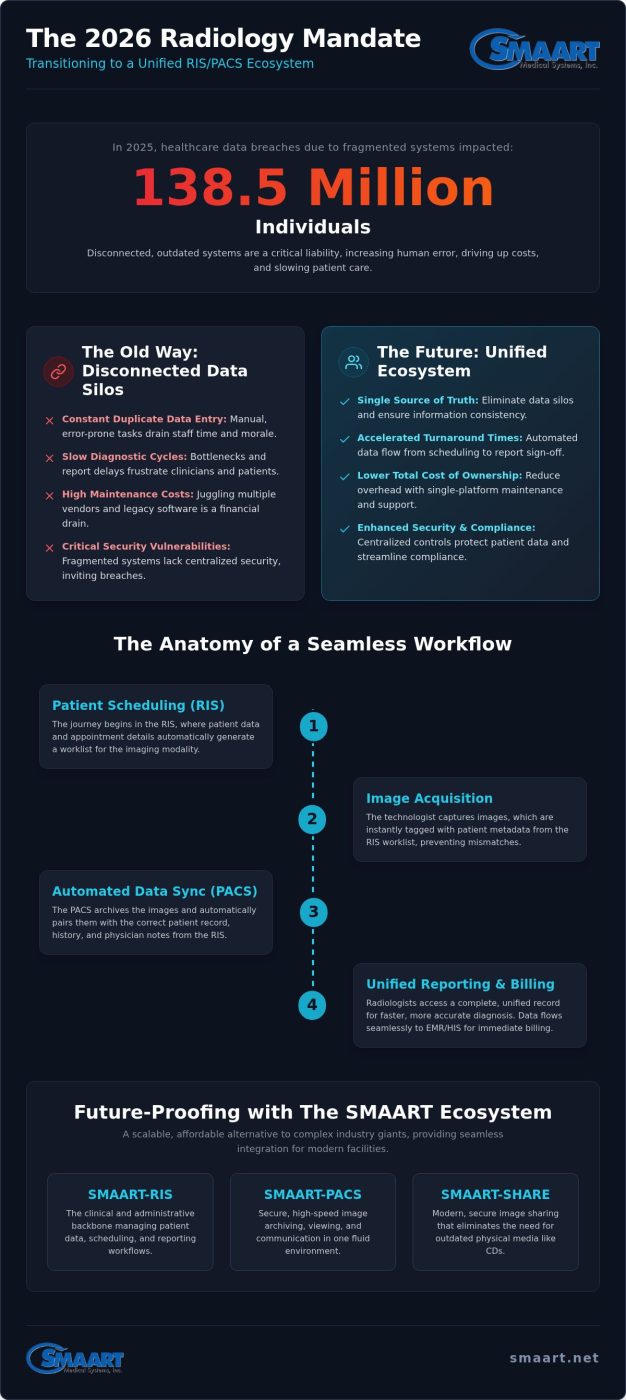
Fragmented systems are more than just an IT headache; they’re a financial drain. When your team has to enter the same patient data into two different interfaces, the risk of human error skyrockets. These data silos create bottlenecks that slow down your entire diagnostic reporting cycle. If a radiologist has to wait for a manual record update before they can sign off on a report, your turnaround time suffers. In 2025, healthcare data breaches affected approximately 138.5 million individuals. Disconnected legacy systems often lack the centralized security controls needed to combat these modern threats, making integration a matter of safety as much as speed.
The 2026 Standard: Interoperability as a Requirement
Interoperability is no longer a luxury for clinics. It’s a survival requirement. By 2026, the shift toward value-based care has made data fluidity essential. Your EMR and HIS platforms must communicate seamlessly with your imaging workflow to ensure faster billing and reimbursement cycles. When integrated RIS PACS solutions feed data directly into your billing software, you eliminate the lag that hurts your cash flow.
This connectivity also improves the patient experience. Patients don’t want to wait days for results or repeat their medical history at every desk. They want a streamlined journey that respects their time. Unified systems support this by ensuring that every stakeholder, from the front desk to the referring physician, has immediate access to the same accurate information. This level of transparency builds trust and positions your practice as a leader in modern healthcare delivery.
Choosing a unified ecosystem allows you to eliminate operational overhead and focus on what matters most: patient outcomes. You aren’t just buying software. You’re investing in a partnership that prioritizes your operational relief and clinical success.
The Mechanics of Seamless Data Flow: How RIS and PACS Work Together
The efficiency of your radiology department depends on a silent, digital handshake. In integrated RIS PACS solutions, this handshake ensures that clinical data and medical images move as one. It starts the moment a patient schedules an appointment. That information lives in the Radiology Information System (RIS), which then pushes a worklist entry to the imaging modality. Once the technologist captures the images, the Picture Archiving and Communication System (PACS) takes over, but it doesn’t work in isolation. The two systems remain in constant communication to ensure the right images are always paired with the right patient record.
SMAART-RIS acts as the clinical anchor during this process. It manages the vital metadata, such as physician notes and patient history, that gives context to the pixels. Without this synchronization, radiologists are forced to hunt for information across separate platforms. This fragmentation causes unnecessary cognitive load and invites error. Implementing a Single Sign-On (SSO) environment solves this. It allows a radiologist to log in once and access everything they need instantly. It’s a small technical detail that provides massive operational relief for a busy clinical team.
HL7 and DICOM: The Languages of Integration
HL7 handles the administrative side by transmitting patient demographics and order details between different software platforms. DICOM performs the heavy lifting of medical imaging data, ensuring high-resolution files are stored and displayed correctly across all modalities. These two protocols function as a universal translator, effectively preventing data mismatching between the patient record and the diagnostic image. Ensuring these standards are perfectly aligned is how we help you achieve a truly modern imaging workflow without the technical friction of legacy systems.
The Role of the Unified Worklist
A unified worklist is the ultimate tool for radiologist focus. It eliminates the need to toggle between different applications, which directly improves diagnostic accuracy. When a radiologist opens a study, SMAART-PACS provides immediate access to priors from the RIS interface. You don’t have to search a separate archive to compare current results with historical data. This seamless flow reduces the time spent on administrative navigation and keeps the focus where it belongs: on the patient. By removing these digital hurdles, you accelerate the entire diagnostic cycle while maintaining the highest standards of care.
Evaluating the ROI: Integrated Systems vs. Disconnected Silos
Calculating the true value of your imaging infrastructure requires looking far beyond the initial invoice. For many clinics, the sticker price of software is just the tip of the iceberg. The real financial drain comes from disconnected silos that require constant manual intervention. Integrated RIS PACS solutions offer a path to fiscal responsibility by consolidating your technology stack into a single, high-performance environment. You aren’t just buying a tool. You’re eliminating the operational overhead that eats into your margins every single day.
Think about the hidden costs of manual data reconciliation. When systems don’t talk to each other, your staff becomes the bridge. Every minute spent re-keying a patient’s name or correcting a birth date is a minute not spent on patient care. These micro-inefficiencies compound quickly. In a high-volume facility, this labor waste can represent thousands of dollars in lost productivity annually. SMAART-SHARE further reduces these costs by moving away from physical media like CDs and DVDs. By eliminating the need for specialized burning hardware and manual handling, you stop wasting money on outdated distribution methods.
Productivity Gains and Turnaround Times
A unified environment doesn’t just feel better; it performs better. Shaving minutes off every study adds up to a significant increase in your facility’s study volume capacity. You can process more patients without adding staff, which is the definition of scalable growth. Additionally, zero-footprint viewing provides the remote reading flexibility that modern radiologists demand. They can provide diagnostic-quality interpretations from any location without proprietary hardware, ensuring your turnaround times remain fast even during peak hours. This speed isn’t just a clinical win. It’s a competitive advantage that keeps referring physicians coming back.
Reducing IT Complexity and Maintenance
Managing two separate systems means managing two sets of updates, two support contracts, and two distinct points of failure. It’s a recipe for IT burnout and high maintenance costs. Choosing a single, integrated vendor dramatically reduces your support ticket volume. When an issue arises, there’s no finger-pointing between different software companies. You have one reliable partner who understands your entire workflow. Cloud-based medical image sharing simplifies multi-site management, allowing you to scale your operations without investing in expensive, proprietary on-site servers. It’s a pragmatic approach to growth that prioritizes long-term stability and lower total cost of ownership.
Strategic Implementation: Transitioning to a Unified Radiology Ecosystem
Modernizing your imaging workflow in 2026 requires a roadmap that balances speed with security. Transitioning to integrated RIS PACS solutions isn’t just a software upgrade; it’s a strategic move to eliminate the technical friction that stalls your clinic’s growth. One of the most significant advantages of modern platforms is the “Zero-Footprint” viewer. This technology allows for rapid deployment across your entire facility because it requires no local software installation. Your team can access diagnostic-quality images through a standard web browser, providing immediate relief from the IT burden of managing individual workstations.
Security must be at the forefront of your implementation strategy. As of July 2026, healthcare organizations are navigating proposed updates to the HIPAA Security Rule that emphasize mandatory multi-factor authentication and formal patch management. A unified, cloud-based ecosystem simplifies this compliance. By centralizing your data, you can implement robust security protocols once across the entire platform rather than patching disconnected legacy silos. This proactive approach protects your facility from the record-breaking data breaches seen in recent years while ensuring your data remains fluid and accessible to authorized users.
Step 1: Auditing Your Current Workflow
Before you begin the migration, you must identify exactly where your current data breaks down. Start by mapping the data path from your EMR to the imaging modality. Pinpoint every touchpoint where manual data entry occurs, as these are the primary sources of human error and diagnostic delays. Determine the specific interoperability requirements of your HIS to ensure your new system can handle the necessary data exchange without custom, high-cost programming. This audit provides the clarity needed to choose a system that fits your actual clinical needs rather than just a generic feature list. Following established RIS EMR integration best practices during this phase can help you reduce denial rates and eliminate the prior authorization failures that drain your revenue cycle.
Step 2: Choosing an Integration-First Partner
Success depends on selecting a vendor that views EMR/HIS interfacing as a core requirement, not an afterthought. Evaluate potential partners based on their history of successful, seamless integrations. SMAART Medical Systems focuses on providing full-feature, affordable integrated RIS PACS solutions that challenge the complexity of industry giants. We believe in being a reliable partner, which is why we provide responsive, US-based technical support during your rollout. This local expertise is vital for navigating the nuances of your specific IT infrastructure and ensuring a smooth transition for your clinical staff. If you’re ready to stop the administrative drain, contact SMAART to discuss your integration roadmap today.
Future-Proofing with SMAART: Scalable Integration for Modern Facilities
Choosing a technology partner for your radiology department is a decision that impacts your clinical efficiency for years. Many facilities feel trapped by the high-cost, rigid structures of legacy industry giants. SMAART-PACS and SMAART-RIS offer a pragmatic alternative designed for the realities of 2026. These integrated RIS PACS solutions provide the scalability you need to grow from a single site to a multi-site clinic group without the typical financial strain. By moving to a unified platform, you gain the professional confidence that comes with knowing your data is secure, fluid, and always available when a diagnosis is on the line.
The shift toward modern efficiency also means leaving outdated physical media behind. SMAART-SHARE eliminates the need for burning CDs and DVDs, which are prone to loss and mechanical failure. Instead, you can provide patients and referring physicians with secure, instant access to images via the cloud. This transition provides immediate operational relief by removing the labor and hardware costs associated with physical image distribution. It’s a cleaner, faster, and more professional way to manage your facility’s output.
Seamless EMR and HIS Integration
SMAART’s commitment to “plug-and-play” interoperability means your imaging workflow won’t exist on an island. Our systems are built to integrate deeply with your existing EMR and HIS platforms, ensuring that patient data moves without friction. This unified data flow improves the accuracy of clinical scheduling and ensures that billing cycles are triggered the moment a report is finalized. SMAART plays a vital role in reducing radiology overhead by automating the administrative tasks that previously required manual intervention. When your systems work together, your staff can focus entirely on patient care rather than data entry.
Accessible Innovation for Every Clinic
We believe that elite technology should be accessible to every clinic, not just large-scale hospital networks. SMAART challenges the high-cost norms of traditional industry giants by offering a subscription-based model. This approach allows for predictable budgeting and eliminates the need for massive, upfront capital expenditures on proprietary hardware. It’s a fiscally responsible way to access the latest innovations in medical imaging while maintaining a lean operational profile.
Modernizing your facility doesn’t have to be a source of stress. With the right partner, the transition to integrated RIS PACS solutions becomes a catalyst for growth and a source of clinical relief. You can finally step away from the complexity of legacy enterprise systems and embrace a streamlined, future-proof ecosystem that respects both your time and your budget. It’s time to experience the clarity of a truly unified radiology workflow.
Take Control of Your Imaging Future
The path to a more efficient radiology department starts with eliminating the digital friction that slows your team down. By moving away from fragmented legacy silos and adopting integrated RIS PACS solutions, you’re choosing a workflow that prioritizes both clinical accuracy and financial responsibility. You’ve seen how a unified ecosystem reduces duplicate data entry, lowers your total cost of ownership, and provides the relief of a truly seamless diagnostic environment.
Modernizing your facility doesn’t have to be an overwhelming or high-cost endeavor. SMAART Medical Systems, Inc. is here to be your reliable partner in this transition. We provide the tools you need to succeed in 2026 and beyond, including seamless EMR/HIS integration and responsive, US-based expert support. Our affordable subscription-based models ensure you can access elite innovation without the financial strain of traditional enterprise giants.
Streamline your radiology workflow with SMAART Medical Systems, Inc. today. It’s time to experience the clarity of a modernized imaging practice that works as hard as you do.
Frequently Asked Questions
What is the difference between RIS and PACS integration and an interface?
An interface is a basic connection that allows two separate systems to exchange data, while integration is a deeper unification into a single ecosystem. An interface often requires manual triggers or third-party middleware to function. In contrast, integrated RIS PACS solutions ensure that data flows seamlessly and automatically. A change in the patient record is immediately reflected across the entire platform, eliminating redundant logins and manual data transfers.
Can SMAART-PACS integrate with my existing EMR or HIS system?
Yes, SMAART-PACS is specifically built for high-level EMR and HIS interoperability using standard HL7 and DICOM protocols. Our team focuses on “plug and play” connectivity to ensure your imaging data flows directly into your primary patient records. This setup allows your clinical team to access diagnostic images without leaving their familiar EMR environment. It provides immediate operational relief by creating a unified, easy to access view of patient health.
How does an integrated RIS/PACS solution improve patient safety?
Integration improves patient safety by virtually eliminating the human errors associated with manual data entry and record matching. When patient demographics flow automatically from the RIS to the modality and PACS, you remove the risk of attaching an image to the wrong patient file. Faster diagnostic turnaround times also ensure that critical results reach referring physicians sooner. This allows for more timely clinical interventions and significantly improved patient outcomes.
What are the hardware requirements for a zero-footprint PACS viewer?
A zero-footprint viewer requires no specialized hardware or local software installation because it runs entirely within a standard web browser. You can access diagnostic-quality images on existing PCs, laptops, or tablets, provided they have a stable internet connection. This flexibility allows your facility to modernize its workflow without the massive capital expenditure typically required for proprietary diagnostic workstations. It’s a pragmatic way to scale your technology as your facility grows.
How long does it typically take to implement an integrated RIS/PACS?
Most implementations are completed within a few weeks, although the exact timeline depends on the complexity of your existing EMR or HIS environment. We prioritize a methodical rollout that minimizes clinical downtime. By conducting a thorough pre-implementation audit and providing US-based expert support, we ensure your team is trained and your data is migrating safely. Our goal is a smooth transition that delivers immediate efficiency gains for your staff.
Is cloud-based medical image sharing HIPAA compliant?
Yes, cloud-based sharing through platforms like SMAART-SHARE is fully HIPAA compliant when configured with mandatory encryption and multi-factor authentication. As of July 2026, we adhere to the latest security standards to protect against record-breaking data breaches. This includes formal patch management and secure, audit-logged access controls. You can share images with patients and referring physicians with complete professional confidence, knowing your facility’s sensitive data remains protected by enterprise-grade security.
How does integration help with radiology billing and reimbursement?
Integration accelerates the billing cycle by automatically triggering reimbursement claims the moment a radiologist signs off on a diagnostic report. By linking integrated RIS PACS solutions directly to your billing software or HIS, you eliminate the lag time caused by manual coding. This automation reduces claim denials related to clerical errors and ensures a steadier, more predictable cash flow. It’s a vital strategy for maintaining fiscal responsibility in a high-volume imaging environment.