RIS EMR Integration Best Practices: A Guide to Seamless Radiology Workflows
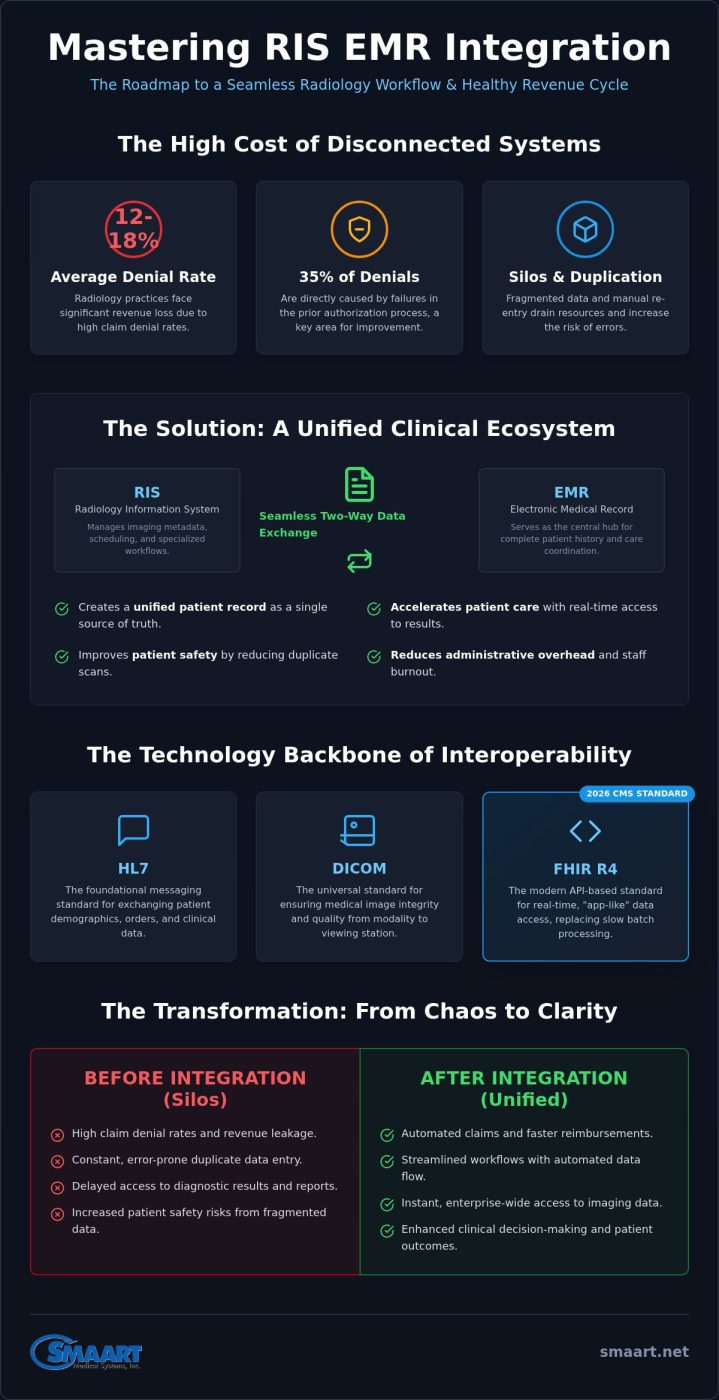
Radiology practices currently face denial rates averaging between 12 and 18 percent, with a staggering 35 percent of those rejections tied directly to prior authorization failures. It’s a heavy burden for any clinic to carry, especially when you’re already fighting departmental silos and the constant drain of duplicate data entry. Implementing RIS EMR integration best practices isn’t just a technical upgrade; it’s the fastest way to find relief from these operational strains. You deserve a workflow where imaging data flows as freely as your clinical expertise.
We understand the pressure of meeting the 2026 CMS Interoperability Framework while trying to maintain a healthy revenue cycle. This guide shows you how to master the complexities of connecting your radiology information system with EMRs to eliminate data silos and accelerate patient care. We’ll walk through the essentials of FHIR R4 compliance, strategies for reducing administrative overhead, and the path to faster reimbursement. By the end, you’ll have a clear roadmap to a unified ecosystem that protects your bottom line and your patients’ experience.
Key Takeaways
- Understand how the 2026 interoperability standards shift the focus from simple data storage to a seamless, automated exchange of patient records and results.
- Master the technical standards like FHIR R4 and HL7 that form the backbone of successful RIS EMR integration best practices for modern radiology workflows.
- Discover how a radiology information system with integrated billing closes the revenue loop by automating claims and reducing industry-standard denial rates.
- Learn to execute a successful implementation by conducting a thorough workflow audit and aligning clinical, IT, and administrative stakeholders from day one.
- See how cloud-based platforms like SMAART-RIS and SMAART-PACS eliminate hardware silos and provide zero-footprint viewing for faster diagnostic access across your enterprise.
What is RIS EMR Integration and Why Does Interoperability Matter?
RIS-EMR integration is the automated, two-way exchange of patient data, orders, and diagnostic results between specialized imaging software and the primary electronic medical record. For years, the industry focused on “meaningful use,” but 2026 marks a definitive shift toward “seamless interoperability.” This transition moves us away from simply having digital records to ensuring those records communicate without human intervention. Adopting RIS EMR integration best practices is the only way to eliminate the data silos that lead to redundant scans and administrative burnout.
The cost of these silos is high. When a Radiological information system (RIS) operates in isolation, it creates a vacuum where reports get lost and billing cycles lag. The ultimate goal is a unified patient record. This single source of truth ensures that every clinician, from the radiologist to the primary care provider, sees the same imaging history and diagnostic data in real time. It’s about moving from a collection of separate files to a synchronized clinical ecosystem.
Breaking Down the Silos Between Radiology and Primary Care
Data fragmentation creates dangerous blind spots. When primary care physicians can’t access radiology results instantly, clinical decision-making slows down. A dedicated RIS is essential for managing the complexities of imaging metadata and specialized scheduling. EMRs are powerful, but they aren’t designed to handle the intricate technical requirements of a radiology department. Integration bridges this gap. It allows the RIS to handle the imaging heavy lifting while the EMR remains the central hub for patient history.
The Impact of Integration on Patient Safety and Outcomes
Patient safety improves when systems share data. Better visibility into a patient’s imaging history reduces duplicative radiation exposure from unnecessary repeat scans. Integration also ensures that critical findings are flagged immediately within the EMR, alerting the care team to urgent issues without delay. Interoperability is the lifeblood of modern value-based care. By streamlining these workflows, you reduce the risk of human error and ensure that every diagnostic insight contributes to a faster path to recovery. This connectivity provides the relief of knowing no critical detail has slipped through the cracks.
Technical Best Practices: HL7, FHIR, and Data Standards
Building a robust technical foundation is the first step toward operational relief. For decades, Health Level Seven (HL7) has served as the foundational messaging standard for clinical data exchange. It handles the “who, what, and where” of patient demographics and orders. However, imaging requires a second, specialized layer. Digital Imaging and Communications in Medicine (DICOM) ensures image integrity, allowing high-resolution scans to move from the modality to the workstation without losing diagnostic quality. One of the most critical RIS EMR integration best practices is prioritizing vendors that utilize these universal standards rather than proprietary, custom-coded interfaces that are expensive to maintain and difficult to scale.
Success starts with a structured approach to technical alignment. An EMR implementation systematic review highlights that technical readiness and standardized protocols are primary drivers of long-term adoption. By sticking to established frameworks, you avoid the “vendor lock-in” that plagues many legacy systems. This strategy ensures your data remains portable and your workflows stay agile as regulations evolve.
Why FHIR is Changing the Integration Game in 2026
The industry has moved beyond slow batch processing. Fast Healthcare Interoperability Resources (FHIR), specifically the mandated FHIR R4 standard, allows for real-time, “app-like” data access via modern APIs. This shift is transformative for radiology. Instead of waiting for a message to “push” through the system, an EMR can “pull” specific data points instantly. This modern protocol simplifies the connection between SMAART-RIS and legacy EMRs, drastically reducing the time and cost associated with interface development. It turns a complex IT project into a plug-and-play reality, providing immediate relief to overstretched IT departments.
Ensuring DICOM and Non-DICOM Data Synchronization
True integration requires a perfect marriage between the radiology report and the actual study images. While the RIS manages the text-based findings, SMAART-PACS provides the essential viewing layer within the EMR. Maintaining this link is vital for data integrity. If the report and the images aren’t synchronized, clinicians waste time searching for files, which delays patient care. Using a zero-footprint viewer ensures that physicians can access diagnostic-quality images directly from the patient’s chart without installing heavy software. If you’re ready to modernize your technical stack, you can explore how our cloud-based solutions bridge these gaps effortlessly. This synchronization creates a seamless experience that feels like a single, unified platform rather than a collection of disconnected tools.
Optimizing the Financial Workflow: Radiology Information System with Billing Integration
Precision in billing is just as important as precision in diagnostics. When RIS EMR integration best practices are applied to the financial workflow, the results are immediate. A radiology information system with billing integration closes the revenue loop by creating a direct, automated path from the initial order to the final claims submission. You no longer have to worry about staff manually transcribing data between two disconnected platforms. This automation doesn’t just save time; it protects your bottom line from the costly transcription errors that frequently lead to claim rejections.
Revenue leakage often happens at the very beginning of the patient journey. By flagging missing insurance details or expired authorizations during the scheduling phase, your team can resolve issues before clinical resources are even deployed. This proactive stance reduces days in Accounts Receivable (A/R) and provides the financial relief that modern clinics crave. Following the guidance in the Health IT Playbook ensures that your financial workflows remain compliant while maximizing your operational efficiency. It’s about building a system that works for your staff, not the other way around.
Eliminating Coding Errors and Denials
Manual coding is a relic of the past that your practice can’t afford. Integrated systems automatically map complex clinical procedures to their corresponding CPT codes, ensuring that the bill accurately reflects the work performed. This is especially critical in high-volume centers where “lost charges” can easily go unnoticed. Real-time eligibility verification within the integrated workflow allows your front-desk staff to confirm coverage instantly. This prevents the frustration of denied claims and the administrative burden of chasing down payments after the fact. It’s a pragmatic shift that turns billing into a competitive advantage.
Real-Time Financial Reporting and Audit Trails
Managing a department requires data you can trust. You can track the financial health of your imaging center directly within the RIS, monitoring everything from denial rates to reimbursement speeds. This visibility allows you to make informed decisions about staffing and equipment investments based on actual revenue data. These systems also generate comprehensive audit trails that simplify HIPAA and insurance compliance. Implementing RIS EMR integration best practices ensures every study is captured, coded, and billed with total accuracy. SMAART-RIS streamlines the billing journey to provide administrative relief by ensuring your financial data is as clear as your imaging. This level of control allows you to focus on patient care while the system handles the financial heavy lifting.
Implementation Roadmap: Best Practices for a Smooth Transition
A successful transition requires more than just flipping a switch. It demands a structured approach that respects the daily realities of your clinical staff. Before you ever select an integration partner, you must conduct a thorough workflow audit. This audit identifies where data currently bottlenecks and where manual entry is most likely to cause errors. Following RIS EMR integration best practices means you aren’t just digitizing a broken process; you’re optimizing the entire journey from order to archive. This clarity provides immediate relief to teams previously bogged down by redundant paperwork. To benchmark your current systems against 2026 standards, a comprehensive evaluation using radiology workflow management software audit tools and checklists can help you pinpoint exactly where your infrastructure needs to evolve.
Alignment is your greatest asset. Involving clinical, IT, and administrative stakeholders in the planning phase ensures that the final system meets everyone’s needs. One of the most critical technical hurdles is data mapping. You must ensure patient IDs match perfectly across all systems via a Master Patient Index (MPI). Without this synchronization, you risk creating duplicate records that compromise patient safety and billing accuracy. A phased rollout plan allows you to test these connections in a controlled environment, minimizing disruption to patient care while you fine-tune the system. Implementing these RIS EMR integration best practices during the rollout phase ensures that your technology serves your clinical goals without causing operational friction.
Staff Training and Change Management
User adoption is the primary failure point for new software integrations. If the staff finds the new workflow cumbersome, they’ll find workarounds that bypass the system’s benefits. To prevent this, identify and train “super-users” within the radiology department. These individuals act as internal advocates and first-line support for their peers. Establish continuous feedback loops post-implementation. This allows you to refine the workflow based on real-world usage, ensuring the system provides the relief it promised rather than new administrative headaches.
Security and Compliance: HIPAA in an Integrated Environment
Data security is a shared responsibility in a connected ecosystem. End-to-end encryption is non-negotiable for data in transit between your RIS and EMR. You must also manage user permissions with surgical precision. Only authorized personnel should have access to sensitive imaging data across the integrated platforms. Regular security audits for cloud-based image sharing help you stay ahead of evolving threats and maintain strict HIPAA compliance. If you’re ready to build a secure, high-performance workflow, connect with our team to start your implementation roadmap. This proactive stance protects your practice from liability and ensures your patients’ most private data remains secure.
The SMAART Advantage: Seamless and Affordable Integration
Choosing the right technology partner is the final, most impactful step in your journey toward operational efficiency. SMAART-RIS serves as the vital bridge between your department’s imaging expertise and the broader requirements of EMR management. It transforms the way you handle patient data by adhering to RIS EMR integration best practices without the prohibitive costs associated with legacy industry giants. This affordable, full-feature model provides the relief of high-tier functionality tailored specifically for budget-conscious facilities. You get the power of an enterprise solution with the agility of a modern, cloud-based platform.
Efficiency extends to every screen in your facility. SMAART-PACS provides diagnostic zero-footprint viewing, allowing physicians to access high-quality images from any authorized web browser. This eliminates the need for complex, local software installations on every workstation. Additionally, SMAART-SHARE removes the burden of expensive, proprietary hardware by enabling cloud-based image distribution. By moving away from physical disks and on-site servers, you reduce your capital expenditure while improving the speed of care. It is a pragmatic approach to modernization that prioritizes your clinic’s financial health.
Cloud-Based Flexibility for Modern Clinics
Managing on-site servers is a constant drain on your IT staff and your budget. SMAART’s cloud-hosted solutions significantly reduce this burden, allowing your team to focus on clinical support rather than hardware maintenance. As your facility grows, our platform scales with you effortlessly. You can add new modalities or locations without the need for massive upfront investments. We position ourselves as a reliable partner rather than just a software vendor. Our commitment to ongoing support ensures that your integration remains stable and efficient long after the initial setup is complete.
Ready for the Future: Interoperability Without the Complexity
The 2026 regulatory landscape requires a level of connectivity that many legacy systems simply cannot provide. SMAART prepares your facility for these changes by ensuring full compliance with FHIR R4 and the latest HL7 standards. We handle the technical complexity so you can focus entirely on your patients. If you’re ready to see how these tools work in a real-world environment, we invite you to see a demo of the SMAART-RIS integration in action. Explore our integrated RIS and PACS solutions today and discover a more streamlined, cost-effective way to manage your radiology workflow.
Future-Proof Your Radiology Workflow
Mastering the clinical and financial data streams allows your facility to move beyond the frustration of disconnected systems. By adhering to RIS EMR integration best practices, you ensure that every diagnostic report and billing code moves instantly from the RIS to the EMR without manual intervention. This level of synchronization eliminates the redundant data entry that drains your staff’s energy and protects your revenue cycle from costly coding errors. It’s a pragmatic shift that turns technical complexity into operational relief.
Modernizing your department doesn’t have to be an overwhelming or expensive ordeal. SMAART provides the relief of seamless EMR/HIS integration and affordable cloud-based PACS/RIS with zero-footprint diagnostic viewing. Beyond connectivity, accelerating the documentation process itself is equally critical; exploring radiology information system reporting features like integrated speech recognition can further reduce turnaround times and eliminate transcription bottlenecks across your department. We are here to partner with you through every stage of the transition, ensuring you meet 2026 standards with professional confidence. Our platform is designed to scale with your growth while keeping your data secure and accessible.
Schedule a Demo of SMAART’s Integrated Radiology Solutions to see how we simplify the path to interoperability. You have the expertise to provide world-class care; let’s build the technology that supports it.
Frequently Asked Questions
What is the difference between HL7 and FHIR in RIS EMR integration?
HL7 is a legacy messaging standard that “pushes” static snapshots of data between systems. FHIR is a modern, API-driven standard that allows systems to “pull” specific data points in real time. Following RIS EMR integration best practices in 2026 requires moving toward FHIR R4 to ensure your systems communicate with the agility of modern web apps.
Can SMAART-RIS integrate with any EMR platform?
SMAART-RIS is built specifically to work with all major EMR and HIS platforms that support standard communication protocols. Because it utilizes universal standards like HL7 and FHIR, it bridges the gap between your imaging department and the broader clinical record without requiring custom, proprietary code. This ensures your workflow remains seamless regardless of your primary record system.
How long does a typical RIS EMR integration project take?
The timeline depends on the complexity of your existing technical stack and the number of modalities involved. A phased rollout strategy usually allows for a smooth transition over several weeks. This methodical approach ensures that data mapping is accurate and staff are fully trained before the final “go-live” date, providing the relief of a disruption-free implementation.
What are the biggest challenges in radiology workflow optimization?
Departmental information silos and manual data entry are the primary obstacles to efficiency. These bottlenecks lead to delayed reporting and increased billing errors. Overcoming these challenges requires a unified patient record where imaging data and clinical history are accessible from a single point of truth, reducing the administrative burden on your team.
Is cloud-based image sharing HIPAA compliant?
Cloud-based platforms like SMAART-SHARE are fully HIPAA compliant when they utilize end-to-end encryption and robust user access controls. These systems protect patient privacy while eliminating the need for physical disks. You get the security of a modern infrastructure without the high costs of maintaining legacy on-site hardware.
How does a radiology information system with billing improve ROI?
A radiology information system with billing integration improves ROI by automating the flow from order entry to claims submission. It helps mitigate the 12 to 18 percent denial rate common in the industry by flagging insurance issues early. This synchronization ensures every study is billed accurately and reimbursed faster, protecting your bottom line.
What is a zero-footprint PACS viewer and why is it better for EMR integration?
A zero-footprint viewer like SMAART-PACS is a browser-based tool that requires no software installation on local workstations. It’s superior for EMR integration because it allows physicians to view diagnostic-quality images directly within the patient chart. This provides immediate access across the entire enterprise without the technical friction of managing local applications.
Do I need on-site IT staff to manage an integrated SMAART-RIS system?
You don’t need a dedicated on-site IT team to manage our integrated systems. SMAART’s cloud-hosted solutions handle the technical heavy lifting, including updates and security monitoring. This reduces your operational overhead and allows your staff to focus on patient care rather than server maintenance.