
Calculating ROI for Radiology Information Systems (2026)
Did you know that up to 65% of denied radiology claims are never appealed? This translates directly into written-off bad debt that most practices simply accept as a cost of doing business. When you begin calculating ROI for radiology information system upgrades, these invisible leaks often represent a larger financial opportunity than the software cost itself. You likely feel the strain of rising operational overhead and the frustration of revenue leakage due to poor billing integration. It’s a heavy burden that leads to staff burnout and stagnant growth.
We’re here to help you turn that around with a clear, pragmatic approach to your technology investment. This article provides the definitive mathematical framework to justify a transition to SMAART-RIS, focusing on relief from administrative weight and improved billing capture. You’ll master the specific formulas needed to quantify direct labor savings and identify hidden recovery zones in your workflow. We will walk through the four pillars of ROI, including how to eliminate transcription fees and maximize scanner utilization to protect your margins against 2026 Medicare fee adjustments.
Key Takeaways
- Shift from legacy silos to integrated enterprise imaging to stabilize cash flow and navigate 2026 reimbursement changes.
- Reclaim clinical hours by utilizing integrated speech recognition and automated modality worklists to significantly reduce report turnaround times.
- Stop revenue leakage by integrating your RIS directly with billing workflows and deploying automated tools to eliminate the high cost of patient no-shows.
- Simplify your financial justification using our pragmatic framework for calculating ROI for radiology information system upgrades, beginning with your current labor and maintenance baselines.
- Discover how the SMAART-RIS unified suite achieves a faster payback period by eliminating the heavy IT overhead and excessive licensing fees typical of industry giants.
The Financial Landscape of Radiology: Why RIS ROI Matters Now
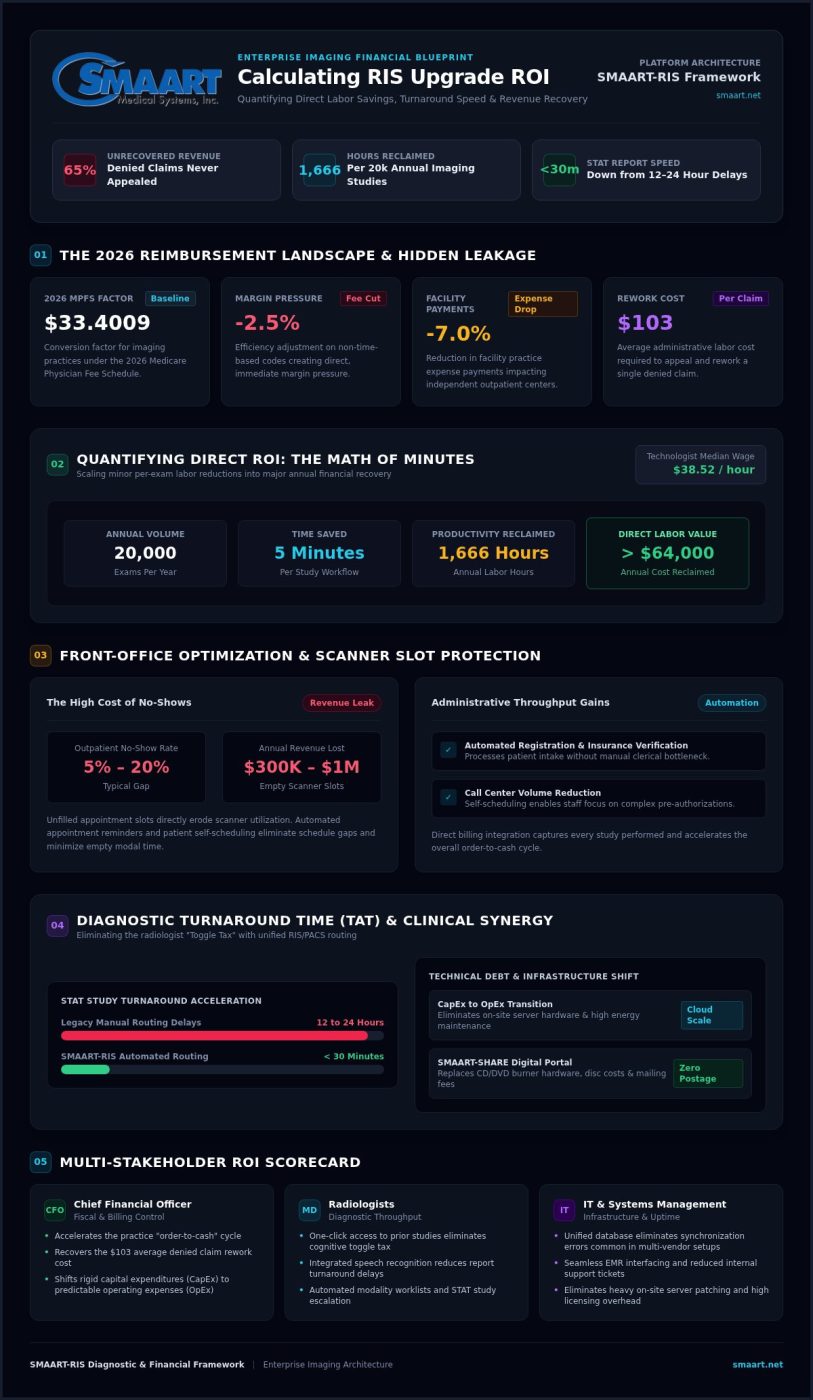
The 2026 Medicare Physician Fee Schedule (MPFS) brings a harsh reality for imaging centers. While the conversion factor for most practices rose slightly to $33.4009, a new -2.5% efficiency adjustment on non-time-based codes creates immediate margin pressure. Calculating ROI for radiology information system upgrades isn’t just about software; it’s a survival strategy for independent practices facing a 7% reduction in facility practice expense payments. You can’t afford to let revenue leak through outdated workflows or siloed data.
Technical debt is the hidden tax on your practice. Legacy systems that require constant patching and manual workarounds drain your staff’s energy and your center’s budget. By moving from disconnected silos to an integrated enterprise imaging model, you eliminate the friction that slows down patient care. This shift directly impacts hospital-wide fiscal health by accelerating the “order-to-cash” cycle and ensuring that every study performed is accurately captured and billed.
The Transition from Legacy Systems to Cloud RIS
Legacy systems are financial anchors. They demand on-site server maintenance, high energy costs, and constant IT intervention. Moving to a cloud-based model like SMAART-RIS shifts your burden from heavy capital expenditure (CapEx) to predictable operating expenses (OpEx). You pay for what you use. This scalability protects your cash flow during volume fluctuations. Additionally, using SMAART-SHARE eliminates the physical costs of CD and DVD distribution. You replace expensive burner hardware and mailing fees with secure, instant cloud access, providing immediate relief to your bottom line.
Defining the ROI Stakeholders
ROI isn’t a one-dimensional metric. It looks different depending on who is signing the checks or reading the scans. For the CFO, the focus is on shortening revenue cycles and recovering the $103 average administrative cost of reworking a denied claim. Radiologists prioritize clinical hours and diagnostic throughput. By understanding core radiology information system functions like automated modality worklists and STAT study escalation, they can focus on patient care rather than administrative hurdles.
IT managers see relief through reduced support tickets and seamless EMR interfacing. SMAART-RIS is designed to bridge these gaps, offering a unified database that eliminates the synchronization errors common in multi-vendor setups. When you’re calculating ROI for radiology information system investments, remember that the goal is a partnership that supports every role in your facility, not just a one-time transaction.
Quantifying Direct ROI: Labor, Speed, and Clinical Throughput
Efficiency in a radiology practice is often measured in seconds. When you’re calculating ROI for radiology information system upgrades, the most immediate gains appear in reclaimed time. Consider the “math of minutes.” If your facility performs 20,000 exams annually, saving just five minutes of administrative or technical labor per exam equates to 1,666 hours of reclaimed productivity. At the median wage for radiologic technologists of $38.52 per hour, that represents over $64,000 in direct labor value recovered every year. These small, consistent gains scale into significant financial relief.
Labor Savings in the Front Office
Front-office staff often struggle with manual scheduling and phone-based reminders. Automated appointment reminders within SMAART-RIS target the 5% to 20% no-show rate typical in outpatient imaging. Reducing these gaps doesn’t just save staff time; it protects the $300,000 to $1,000,000 in annual revenue that centers lose to empty scanner slots. Self-scheduling tools further lower call center volume, allowing your team to focus on complex authorizations rather than routine data entry. Administrative throughput in the context of SMAART-RIS is the measurable rate at which a practice processes patient registrations and insurance verifications through automated workflows without requiring manual clerical intervention.
Clinical Efficiency and Radiologist Productivity
The synergy between SMAART-PACS and SMAART-RIS eliminates the “toggle tax” that slows down radiologists. One-click access to patient history and prior images reduces the cognitive load and physical mouse clicks required for every read. This integration is vital for achieving modern turnaround times (TAT). While manual workflows often result in 12 to 24-hour delays, automated RIS/PACS routing can drop STAT TAT to under 30 minutes and routine reports to under two hours.
- Speech Recognition: Integrated dictation engines eliminate outsourced transcription costs, saving practices between $15,000 and $30,000 per radiologist annually.
- Zero-Footprint Viewers: These tools enable secure remote reading from any location, providing the flexibility needed to manage high-volume worklists without being tied to a specific workstation.
- Modality Worklist (MWL): Automating the MWL eliminates manual entry at the console, preventing the data errors that lead to billing denials.
By streamlining these clinical touchpoints, you empower your team to handle higher volumes with less stress. If you are ready to see how these efficiencies look in your specific workflow, you can explore our streamlined imaging solutions to find the right fit for your practice. These improvements transform your RIS from a simple database into a high-performance engine for clinical growth.
Revenue Recovery: Billing Integration and Scheduling Optimization
Revenue recovery is the heartbeat of a sustainable practice. When you’re calculating ROI for radiology information system investments, looking solely at labor savings ignores the massive financial impact of billing synchronization. A siloed RIS often leads to lost charges and missed invoicing opportunities. By closing the revenue loop, you ensure that every procedure performed is accurately tracked and billed without delay. This is especially critical under the 2026 Medicare Physician Fee Schedule, where margin compression makes every captured dollar vital for survival.
Eliminating Revenue Leakage
SMAART-RIS provides a non-negotiable link between clinical workflows and financial systems. It interfaces seamlessly with your billing platform to ensure no study falls through the cracks. Statistics show that radiology practices face initial claim denial rates between 12% and 18%. Since 35% of these denials stem from front-end registration breakdowns, SMAART-RIS uses pre-authorization automation to scrub data before it ever reaches the payer. This saves the $103 average administrative cost required to manually rework a single denied claim. Recovering these lost hours provides immediate relief to your billing team. Additionally, SMAART-SHARE replaces expensive physical media with QR-based exam sharing. This improves referring physician satisfaction by delivering results instantly while removing the overhead of burning and mailing CDs. It turns a historical cost center into a streamlined communication tool.
Optimizing the Scheduling Calendar
An empty gantry is one of the most significant drains on your bottom line. Outpatient no-show rates typically range from 5% to 20%, but advanced modalities like 3T MRI can see rates as high as 40%. When an MRI slot goes unfilled, your center loses over $700 in potential revenue. Recovering just 5% of these missed appointments across a year can reclaim hundreds of thousands of dollars. An average outpatient imaging center loses between $300,000 and $1,000,000 annually in uncaptured revenue due to these schedule gaps. SMAART-RIS uses automated multi-channel reminders and data analytics to identify “dark time” in your modality schedule. It allows you to fill gaps proactively through standby queues and dynamic overbooking. You can also use integrated referral tracking to identify which sources provide your most profitable cases. This level of insight empowers you to focus your outreach efforts where they generate the highest return, transforming your scheduling desk into a strategic revenue driver.
The Step-by-Step RIS ROI Calculation Framework
Moving from operational theory to financial reality requires a structured approach. When you’re calculating ROI for radiology information system upgrades, you need to look beyond the sticker price. A successful framework accounts for both the obvious savings and the subtle revenue recoveries discussed in previous sections. By following these five steps, you can build a business case that satisfies even the most skeptical CFO.
- Step 1: Establish your current baseline costs. Document your total spend on administrative labor, transcription fees, and legacy system maintenance. Include the cost of revenue leakage from the 12% to 18% denial rate mentioned earlier.
- Step 2: Project efficiency gains. Estimate the impact of reducing report turnaround times and reclaiming staff hours through automation.
- Step 3: Calculate revenue growth. Factor in the recovery of the $700 lost per missed MRI slot and the potential for higher referral volumes from satisfied physicians.
- Step 4: Factor in total cost of ownership (TCO). This includes the software license, implementation, training, and ongoing support.
- Step 5: Apply the ROI formula. Use the calculation: (Net Gain / Cost of Investment) x 100.
Calculating Total Cost of Ownership (TCO)
TCO is more than just a software license. It encompasses implementation, staff training, and 24/7 support costs. Legacy vendors often hide these behind complex tiered pricing. SMAART-RIS simplifies this by sharing hardware with SMAART-PACS, which eliminates the need for separate, heavy IT infrastructure. Whether you choose a purchase, lease, rental, or cloud SaaS model, our focus remains on affordability. This flexibility is a core component of hospital imaging workflow optimization. By selecting a model that matches your cash flow, you protect your practice from the capital strain typical of industry giants.
The “Time to Value” Metric
How quickly can a clinic reach the break-even point with SMAART-RIS? Time to value depends heavily on implementation speed. SMAART-RIS uses automated HL7 and FHIR R4 interfaces to ensure seamless EMR integration, which accelerates the transition period. While legacy installs can drag on for months, our streamlined architecture gets you up and running faster. We also provide 24/7 US-based expert telephone support to minimize downtime. When a system is down, you aren’t just losing time; you’re losing revenue. Reliable support ensures your “math of minutes” stays on the positive side of the ledger. If you want a tailored analysis for your facility, request a personalized ROI assessment today to see your potential savings in black and white.
Maximizing ROI with SMAART-RIS: The Strategic Choice
SMAART-RIS is built for practices that must move fast without the burden of excessive capital. When you’re calculating ROI for radiology information system investments, the initial cost of ownership is the most critical variable. High entry fees from legacy vendors can extend your break-even point by years. SMAART-RIS reverses this trend. By offering the industry’s least expensive advanced RIS, we ensure that your efficiency gains translate into net profit much sooner. A lower entry cost doesn’t just save money; it accelerates your entire financial recovery timeline.
Affordability Without Compromise
You don’t have to sacrifice functionality for a lower price point. SMAART-RIS delivers enterprise-level capabilities, such as automated triage and real-time billing audit trails, at a fraction of the cost charged by traditional giants. This affordability is amplified by our zero-footprint diagnostic viewing, which slashes your local IT overhead. You can explore how this fits into a broader technology strategy by reviewing our guide on integrated RIS PACS solutions. This unified approach prevents the synchronization errors that frequently plague multi-vendor environments.
Community hospitals across the country are already seeing these results. By replacing fragmented legacy silos with the SMAART-PACS, RIS, and SHARE ecosystem, these facilities have stabilized their cash flow despite the 2026 MPFS efficiency cuts. They’ve eliminated the $15,000 to $30,000 annual transcription cost per radiologist while simultaneously reducing their claims denial rates. These real-world gains prove that calculating ROI for radiology information system transitions is about more than software; it’s about reclaiming the clinical and financial health of your practice.
Next Steps for Your Facility
The 2026 imaging landscape is complex, but your technology shouldn’t be. We stay current with the latest standards, including HL7 and FHIR R4, to ensure your facility remains future-proof. Whether you’re interested in a purchase, lease, rental, or cloud-based SaaS model, we provide the flexibility your budget requires. Our 24/7 US-based support team is always ready to assist, ensuring you never face technical hurdles alone.
We invite you to request a customized ROI audit tailored specifically to your clinic’s volume and current overhead. Our experts will help you identify exactly where you’re losing revenue and how quickly you can recover it. Don’t let legacy debt hold your practice back. Get SMAART today and maximize your ROI to secure your facility’s future and provide the operational relief your team deserves.
Secure Your Practice’s Financial Future
The 2026 imaging landscape requires a departure from expensive legacy silos. Transitioning to integrated enterprise imaging isn’t just about technical modernization; it’s a fundamental shift toward fiscal health. By automating the modality worklist and eliminating transcription costs, your practice can reclaim thousands of clinical hours. Closing the revenue loop through billing integration ensures that every scan performed contributes to your bottom line rather than becoming a write-off.
When you’re calculating ROI for radiology information system upgrades, the numbers favor agility and integration. SMAART-RIS provides the industry’s least expensive advanced RIS/PACS solution, backed by 24/7 US-based expert support. Our platform ensures seamless integration with all HIS and EMR platforms, allowing you to achieve a faster payback period than traditional industry giants. You don’t have to navigate these operational burdens alone.
Ready to see the math for your own facility? Calculate your potential savings with a SMAART-RIS demo and discover how modern efficiency can provide the relief your team needs. Your path to a more profitable and sustainable practice starts with a single strategic choice.
Frequently Asked Questions
What is the average ROI timeline for a new Radiology Information System?
Most practices see a break-even point within 6 to 12 months. This timeline depends on implementation speed and the volume of recovered revenue from denied claims. When calculating ROI for radiology information system upgrades, you’ll find that faster payback periods are achievable by eliminating legacy maintenance fees immediately. By using a system that shares hardware with existing PACS, you reduce upfront capital and accelerate your financial recovery.
How does RIS integration with EMR impact financial performance?
Seamless EMR and HIS integration stabilizes financial performance by ensuring data consistency across the patient journey. It eliminates manual double-entry, which is a primary source of billing errors. When your RIS communicates bidirectionally with the EMR, you reduce the 35% of denials caused by front-end registration breakdowns. This synchronization accelerates the order-to-cash cycle and improves overall fiscal health by ensuring every procedure is accurately captured and billed.
Can a cloud-based RIS really reduce IT maintenance costs?
Cloud-based models like SMAART-RIS significantly lower IT overhead by removing the need for on-site server management. You no longer pay for local hardware cooling, physical security, or constant patching. Zero-footprint diagnostic viewers allow staff to work from any device without complex local installs. This shift from capital expenditure to a predictable operating model provides immediate relief to your technology budget while ensuring your data remains secure and accessible.
What are the hidden costs to watch out for when calculating RIS ROI?
Watch out for tiered support fees, data migration penalties, and third-party interface costs. Many legacy vendors charge extra for HL7 or FHIR R4 connections that should be standard. When calculating ROI for radiology information system transitions, factor in the cost of staff downtime during training. Choosing a partner with 24/7 US-based expert support helps mitigate these risks by resolving technical hurdles before they impact your daily revenue stream.
How do automated reminders specifically contribute to RIS ROI?
Automated reminders target the 5% to 20% no-show rate that drains imaging center profits. By sending multi-channel alerts via SMS and email, you fill gaps in the modality schedule that otherwise cost $70 to $700 per slot. Recovering just a few missed appointments each week provides a direct boost to annual revenue. This automation also frees front-office staff from manual calling, allowing them to focus on high-value authorization tasks.
Is it better to purchase a RIS or use a subscription-based SaaS model for ROI?
The choice between a purchase, lease, or SaaS model depends on your practice’s cash flow goals. A purchase model offers the lowest long-term cost, while a subscription-based SaaS model minimizes initial capital requirements. SMAART offers flexible financing to ensure the system pays for itself through efficiency gains. Subscription models are often preferred for their scalability, allowing you to pay only for the volume you actually process each month.
How does SMAART-RIS compare to more expensive enterprise systems in terms of ROI?
SMAART-RIS provides a higher ROI than enterprise giants by delivering full-featured capabilities at a fraction of the cost. Industry giants often bundle unnecessary features that inflate the price without adding clinical value. Because SMAART-RIS is the industry’s least expensive advanced RIS, the break-even point is reached much faster. You get the same interoperability and support without the excessive licensing fees that erode your margins in a competitive market.
Does integrated speech recognition actually pay for itself?
Integrated speech recognition pays for itself by eliminating medical transcription costs. Outsourcing transcription costs practices between $0.07 and $0.14 per line, which adds up to $15,000 to $30,000 per radiologist annually. By moving to a built-in dictation engine, you remove this variable expense entirely. This integration also drops report turnaround times from days to minutes, significantly improving referring physician satisfaction and driving higher referral volumes to your facility.