
Radiology Software Financing: 2026 Guide for CFOs
In 2026, the most successful radiology departments treat software as a strategic utility rather than a depreciating asset. You’re likely tired of the crushing upfront costs associated with traditional imaging platforms. It’s frustrating to sign a massive check for technology that feels obsolete in just three years, especially when evaluating various radiology software financing models that often seem to ignore your clinic’s cash flow.
This guide reveals how modern financial strategies can finally align your clinical needs with your fiscal reality. You’ll discover how to secure predictable monthly costs while ensuring your imaging department stays at the cutting edge. We’ll explore the shift toward OpEx-heavy strategies, the benefits of scalable cloud storage, and how platforms like SMAART-PACS and SMAART-RIS provide the seamless updates you need to protect your long-term ROI. By moving away from rigid ownership toward flexible, integrated solutions like SMAART-SHARE, you can scale your storage as patient volume grows without the fear of technology lock-in.
Key Takeaways
- Understand why shifting from Capital Expenditure (CapEx) to Operational Expenditure (OpEx) is the most effective way to protect your clinic’s cash flow in 2026.
- Compare various radiology software financing models, including SaaS and perpetual licensing, to determine which structure offers the highest long-term ROI for your facility.
- Discover how to leverage current tax regulations to maximize the fiscal benefits of subscription-based software acquisitions.
- Learn how to evaluate your current IT infrastructure to ensure SMAART-PACS and SMAART-RIS integrate seamlessly with your existing EMR and HIS platforms.
- Explore how cloud-based image distribution through SMAART-SHARE eliminates the need for costly proprietary hardware while supporting collaborative care.
Navigating Radiology Software Financing in 2026
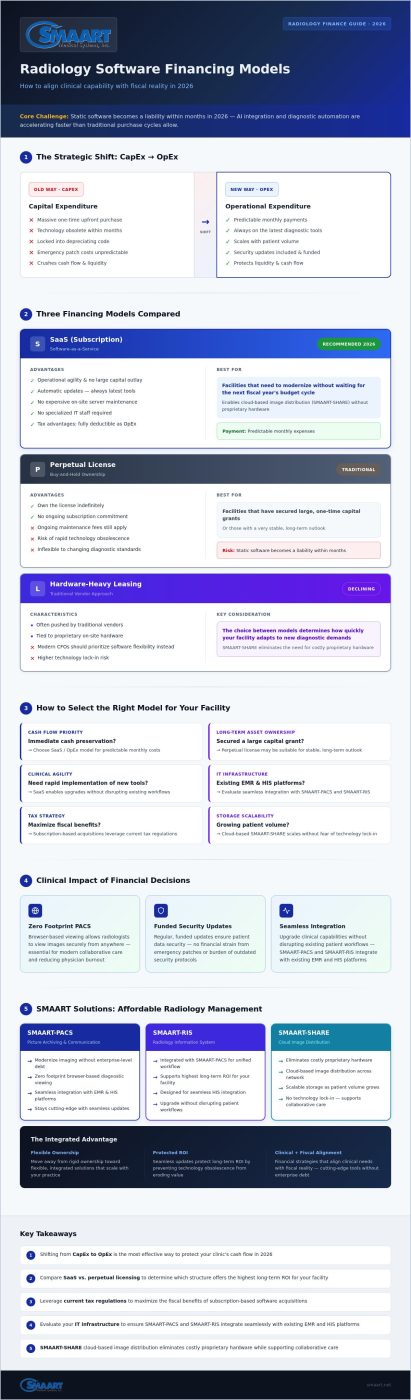
Radiology software financing is more than a simple transaction; it’s the strategic acquisition of PACS and radiology information systems using payment structures that safeguard your facility’s liquidity. For years, the industry relied on a buy-and-hold model. CFOs would approve a massive one-time expense for a perpetual license and hope the technology remained relevant for a decade. This strategy is no longer viable. In 2026, the pace of AI integration and diagnostic automation is so rapid that static software becomes a liability within months. The core challenge is balancing high-level clinical capability with fiscal responsibility. By exploring diverse radiology software financing models, you can deploy SMAART-PACS to modernize your imaging department without the burden of enterprise-level debt.
Why Traditional CapEx is Evolving
Committing to a large upfront software purchase creates a dangerous risk of technology obsolescence. When you tie up capital in a traditional purchase, you lose the ability to pivot as new diagnostic standards emerge. The 2026 market favors flexible spending models that treat software as an evolving service rather than a fixed asset. Software-as-a-Service (SaaS) has revolutionized healthcare budgeting by moving costs from Capital Expenditure (CapEx) to Operational Expenditure (OpEx). This transition provides the relief of predictable monthly payments while ensuring your department isn’t tethered to outdated tools. It’s a pragmatic shift that prioritizes modern efficiency over the ownership of depreciating code.
The Clinical Impact of Financial Decisions
Your financing strategy has a direct line to clinical outcomes and staff satisfaction. Flexible funding models enable the rapid implementation of zero footprint PACS viewers. These browser-based tools allow radiologists to view images securely from anywhere, which is essential for modern collaborative care. This level of accessibility helps reduce physician burnout by eliminating the clunky, slow interfaces associated with older, unmaintained systems. These modern models also ensure patient data security through regular, funded updates. You won’t have to worry about the financial strain of emergency patches or the operational burden of outdated security protocols. Instead, your team can focus on what matters most: accurate and timely patient care. Because SMAART-PACS and SMAART-RIS are designed for seamless integration, you can upgrade your clinical capabilities without disrupting existing patient workflows.
Comparing SaaS, Perpetual Licenses, and Leasing
Selecting the right path forward requires a clear understanding of how different radiology software financing models impact your balance sheet. While traditional vendors often push hardware-heavy leases, the modern CFO must prioritize software flexibility. The choice between a subscription, a one-time purchase, or a lease determines how quickly your facility can adapt to new diagnostic demands. Each model offers distinct advantages depending on whether you prioritize immediate cash preservation or long-term asset ownership. Understanding these mechanics is the first step toward implementing integrated RIS PACS solutions that actually grow with your patient volume.
The SaaS Model: Scalability and Speed
The Software-as-a-Service (SaaS) model is the modern standard for operational agility. It replaces the heavy burden of capital outlays with predictable monthly expenses. This shift provides immediate relief for departments that need to modernize without waiting for the next fiscal year’s budget cycle. Because the software is hosted, you eliminate the need for expensive on-site server maintenance and the specialized IT staff required to manage it.
Security and performance are built into the subscription. You receive automatic updates, ensuring your team always works with the latest diagnostic tools. This model is particularly effective when deploying SMAART-SHARE, as it enables cloud-based image distribution across your network without requiring proprietary hardware. It’s a streamlined approach that prioritizes clinical uptime over the complexities of server management.
Perpetual Licensing: Long-Term Ownership
Perpetual licensing represents the traditional “buy-and-hold” strategy. You pay a significant upfront fee to own the software license indefinitely. This model is often preferred by facilities that have secured large, one-time capital grants or those with a very stable, long-term outlook. However, ownership doesn’t mean the end of payments. Most perpetual licenses come with mandatory annual maintenance fees, which often range from 18% to 25% of the initial purchase price. These fees cover basic support but might not include major version upgrades. You must also account for the cost of the physical hardware needed to run the software locally. If you’re looking for a more accessible way to start, exploring our platform options can provide a clearer picture of modern alternatives.
Software Leasing: The Strategic Middle Ground
Leasing bridges the gap between the total ownership of a perpetual license and the flexibility of a subscription. It allows you to use SMAART-PACS and SMAART-RIS immediately while spreading the cost over a fixed term, typically 36 to 60 months. This preserves your credit lines and keeps cash available for other clinical priorities. At the end of the lease, you may have the option to purchase the software for a nominal fee or upgrade to the latest version. It’s a pragmatic way to manage the lifecycle of your technology while maintaining a predictable budget. This structure is especially useful for mid-sized facilities that need enterprise-grade tools without the enterprise-level debt.
CapEx vs. OpEx: The Strategic Shift in Imaging Budgets
Traditional radiology budgeting often forces a choice between clinical excellence and fiscal liquidity. Capital Expenditure (CapEx) involves significant upfront investments in hardware and perpetual licenses, effectively locking your capital into a depreciating asset. In contrast, Operational Expenditure (OpEx) treats software as an ongoing service. This shift is a cornerstone of modern radiology software financing models, allowing CFOs to preserve cash for essential clinical staffing and patient care initiatives. By moving away from heavy upfront costs, facilities gain the agility to adapt as diagnostic standards evolve.
The true value of an OpEx model lies in its impact on the Total Cost of Ownership (TCO). While CapEx might look cheaper on a long-term timeline, it often ignores the hidden expenses of server maintenance, electricity, and dedicated IT support. OpEx models simplify these variables into a single, predictable line item. This financial predictability is essential for hospital imaging workflow optimization, as it ensures the department always has access to the latest software versions without requesting new capital approvals every few years.
Maximizing ROI with OpEx
Choosing an operational model provides immediate relief to your balance sheet. It allows your facility to scale storage costs to match actual exam volume, ensuring you never pay for capacity you don’t use. SMAART-SHARE exemplifies this efficiency by offering cloud-based image distribution that eliminates the need for expensive proprietary hardware. You get enterprise-level functionality with a footprint that respects your clinical space and your budget. This approach turns a fixed cost into a flexible utility that supports growth rather than hindering it.
Tax Implications and Balance Sheet Benefits
Software leasing can be structured as an operating lease to ensure that monthly payments are treated as fully deductible business expenses rather than long-term debt. This “off-balance-sheet” financing keeps your debt-to-equity ratios healthy, which is vital for maintaining high credit ratings. While we recommend consulting with your financial advisors regarding specific Section 179 deductions for medical software, the general trend in 2026 tax regulations favors these flexible, service-based acquisitions. It’s a pragmatic way to modernize your imaging suite while maximizing your year-end tax benefits.
How to Select the Right Model for Your Facility
Choosing the ideal framework among various radiology software financing models requires an honest assessment of your facility’s operational DNA. You shouldn’t just look at today’s patient volume. You must consider where your clinic will be in three years. Growth projections are the foundation of fiscal responsibility. If you anticipate a 20% increase in imaging volume, your financing must allow for scalable storage without punishing your bottom line. Evaluating your existing IT infrastructure and EMR/HIS integration requirements early prevents expensive mid-project corrections. It’s about finding the relief of a system that fits your current workflow while leaving room for future innovation.
Decision Matrix for Small Clinics
Rural clinics and independent imaging centers frequently face a “hardware trap” where they invest heavily in on-site servers that they eventually lack the specialized IT staff to maintain. For these facilities, SaaS is often the most “Smaart” choice. It prioritizes low upfront costs and moves the burden of maintenance to the vendor. By utilizing cloud-native viewers, you can avoid the high price of proprietary workstations. This model ensures faster implementation times, allowing you to start generating revenue from new diagnostic services almost immediately. It’s a pragmatic way to modernize without the weight of enterprise-level debt.
Strategies for Large Hospitals and Multi-Site Groups
Large healthcare organizations often benefit from leveraging enterprise-wide leasing for SMAART-PACS and RIS. This approach allows you to unify multiple sites under a single financial umbrella, reducing the redundant storage costs that plague fragmented systems. Many groups are now adopting hybrid models. They use perpetual licenses for core local functions while utilizing cloud-based medical imaging storage for remote reading and disaster recovery. This strategy provides the security of ownership with the flexibility of the cloud. Centralizing your imaging data through SMAART-SHARE ensures that radiologists can collaborate across the entire network without technical friction. If you’re ready to see how these models apply to your specific volume, connect with our team for a tailored analysis.
Determining your tolerance for technical maintenance is equally critical. If your internal IT team is already stretched thin, a model that includes managed updates and 24/7 support is essential. Conversely, if you have robust on-site resources, you might prefer a model that gives you more granular control over your server environment. The goal is to eliminate operational burdens so your team can focus entirely on diagnostic accuracy and patient care.
SMAART Solutions: Affordable Radiology Management
SMAART Medical Systems represents the pragmatist’s choice in a market often dominated by overly complex and overpriced industry giants. We understand that your goal isn’t just to buy software; it’s to streamline your clinical operations without compromising your fiscal health. By offering high-end diagnostic capabilities at a fraction of enterprise costs, we provide the relief of modern efficiency without the burden of excessive debt. Our platforms, including SMAART-PACS and SMAART-RIS, are designed to integrate seamlessly with your existing HIS and EMR environments, ensuring that your data flows as smoothly as your finances.
One of the most significant operational drains in traditional radiology is the reliance on physical media for image distribution. SMAART-SHARE solves this by replacing costly, unreliable CDs with efficient, cloud-based sharing. This transition doesn’t just save money on materials. It eliminates the administrative friction of managing physical assets and improves the speed of collaborative care. We’re committed to being a reliable partner that stays invested in your success long after the initial transaction is complete.
Full-Feature Software Without the Giant Price Tag
Choosing between different radiology software financing models shouldn’t mean sacrificing performance for price. SMAART provides the same sophisticated diagnostic tools found in enterprise-level systems but does so through a more accessible financial lens. Our “Reliable Partner” persona isn’t just marketing. It’s a commitment to providing ongoing support that reduces your internal IT burden. SMAART-SHARE serves as a completely hardware-free distribution tool that allows you to distribute images securely via the cloud without purchasing proprietary servers.
Getting Started with a Smaart Financial Plan
We recognize that every facility operates on a unique budget cycle. That’s why we offer flexible implementation timelines that align with your specific fiscal requirements. Whether you’re transitioning to an OpEx model to preserve cash flow or looking for a streamlined digital workflow to reduce overhead, our team works with you to find the right fit. Modernizing your department doesn’t have to be a source of financial strain. It can be a strategic step toward a more sustainable and efficient future. Contact SMAART Medical Systems for a personalized financing consultation to discover how we can help you balance clinical excellence with practical fiscal management.
Secure Your Department’s Future with Strategic Financing
Modernizing your imaging suite in 2026 requires a departure from rigid, high-cost acquisition strategies. By embracing flexible radiology software financing models, you protect your facility’s liquidity while ensuring your radiologists have access to the latest diagnostic tools. You’ve seen how shifting toward OpEx models and leveraging cloud-based distribution like SMAART-SHARE can eliminate the burden of proprietary hardware and unpredictable maintenance fees.
The right financial structure does more than just balance the books; it creates a foundation for scalable growth. SMAART Medical Systems acts as your pragmatic partner, offering seamless HIS/EMR integration and client-focused support that prioritizes your operational relief. Replace the strain of enterprise-level debt with a streamlined, efficient workflow that grows alongside your patient volume. We’re ready to help you build a sustainable path toward clinical excellence and fiscal responsibility.
Request a Tailored Quote for SMAART-PACS Financing
Frequently Asked Questions
What is the difference between SaaS and perpetual licensing for PACS?
SaaS functions as a predictable operational expense, providing automatic updates and cloud scalability without the need for on-site server management. In contrast, perpetual licensing involves a significant upfront capital investment for a lifetime software license. While ownership sounds attractive, it often carries hidden annual maintenance fees ranging from 18% to 25% of the initial purchase price. Most modern clinics prefer SaaS to avoid technology obsolescence and ensure their diagnostic tools stay current.
Can we lease radiology software without buying new hardware?
You can absolutely lease software as a standalone solution. This approach allows your facility to acquire SMAART-PACS or SMAART-RIS while spreading the cost over a fixed term, typically three to five years. It’s an ideal strategy for clinics that already have functional hardware but need to modernize their diagnostic tools. Leasing preserves your existing credit lines and keeps cash available for other clinical priorities like staffing or patient care.
How does cloud-based image sharing reduce radiology overhead?
Cloud-based sharing through SMAART-SHARE eliminates the recurring costs of burning and mailing physical CDs or DVDs. It also removes the need for expensive, proprietary hardware that requires constant IT maintenance and cooling. By centralizing distribution, you reduce the administrative time spent on manual image transfers and patient follow-ups. This shift provides immediate relief to your budget by replacing fixed hardware costs with a streamlined digital utility that scales with volume.
Are software subscription fees tax-deductible for medical clinics?
Software subscription fees are generally treated as fully deductible operational expenses in the year they are paid. This contrasts with capital purchases, which must be depreciated over several years. While many facilities utilize Section 179 to accelerate deductions for medical software, specific benefits depend on your current financial structure. We recommend consulting with your tax professional to ensure your chosen radiology software financing models maximize your clinic’s year-end tax advantages.
What happens to our data if we cancel a radiology software subscription?
Your patient data always belongs to your facility, regardless of your subscription status. If you decide to cancel, HIPAA regulations and standard data protocols ensure you have a clear path to export your studies in a standard DICOM format. A reliable partner will provide a structured transition period to move your records to a new archive or local storage. It’s essential to review these data migration terms before signing any agreement.
How do I calculate the TCO for a new RIS PACS system?
Calculating the Total Cost of Ownership (TCO) requires looking beyond the initial price tag. You must factor in annual maintenance fees, the cost of physical server hardware, electricity for cooling, and the labor costs for on-site IT support. Additionally, account for the expense of regular security patches and major version upgrades. Subscription models often simplify this calculation by bundling these variables into a single, predictable monthly payment that covers everything.
Is software financing available for small or rural radiology clinics?
Financing is widely available and often specifically tailored for smaller or rural facilities. These clinics frequently benefit most from subscription-based radiology software financing models because they require very little upfront capital. By removing the need for local server rooms and specialized IT staff, small centers can deploy enterprise-grade tools like SMAART-PACS. This democratization of technology ensures that rural providers can offer the same diagnostic speed and accuracy as large urban hospitals.
Does SMAART-PACS integrate with my existing EMR system?
SMAART-PACS is built to integrate seamlessly with your existing EMR and HIS platforms. Our developers prioritize interoperability to ensure that images and reports flow directly into the patient record without manual entry. This connectivity reduces the operational burden on your staff and eliminates redundant data silos. Whether you’re using a large enterprise HIS or a specialized clinic EMR, our tools provide the technical bridge needed for a truly modern, integrated workflow.