
Overcoming the Challenges with Legacy PACS Systems: A 2026 Modernization Guide
Did you know that a single hour of unplanned PACS downtime can cost an acute-care hospital up to $50,000 in lost productivity and diverted care? It’s a staggering figure, yet many clinical leaders feel trapped by aging infrastructure that’s increasingly difficult to maintain. You’re likely dealing with the daily friction of slow image loading and the constant worry of security gaps in software that’s well past its prime. These specific challenges with legacy PACS systems do more than just frustrate your radiologists; they create a massive financial and operational liability for your entire organization.
We understand the need for a refreshing alternative to the complex, expensive industry giants. This guide will help you identify hidden operational risks and show you how modern, integrated solutions can restore your clinical efficiency and fiscal health. We’ll provide a clear roadmap for a cost-effective transition, focusing on improved interoperability with your existing EMR and the relief of secure, cloud-based image sharing that grows with your facility. It’s time to move beyond technical debt and embrace a system that supports your team’s success.
Key Takeaways
- Identify the “silent killers” of clinical productivity, including laggy viewers and manual workarounds, that signal your infrastructure has reached its limit.
- Uncover the hidden security vulnerabilities and interoperability gaps that define the primary challenges with legacy PACS systems in 2026.
- Calculate the true Total Cost of Ownership by accounting for “unseen” expenses like specialized IT maintenance and emergency hardware repairs.
- Master a phased migration strategy that eliminates clinical downtime while prioritizing essential data cleanup and archiving.
- Explore how modern, cloud-based alternatives like SMAART-PACS restore operational relief through seamless EMR integration and any-device accessibility.
Defining Legacy PACS: Why Your Current System is Holding You Back
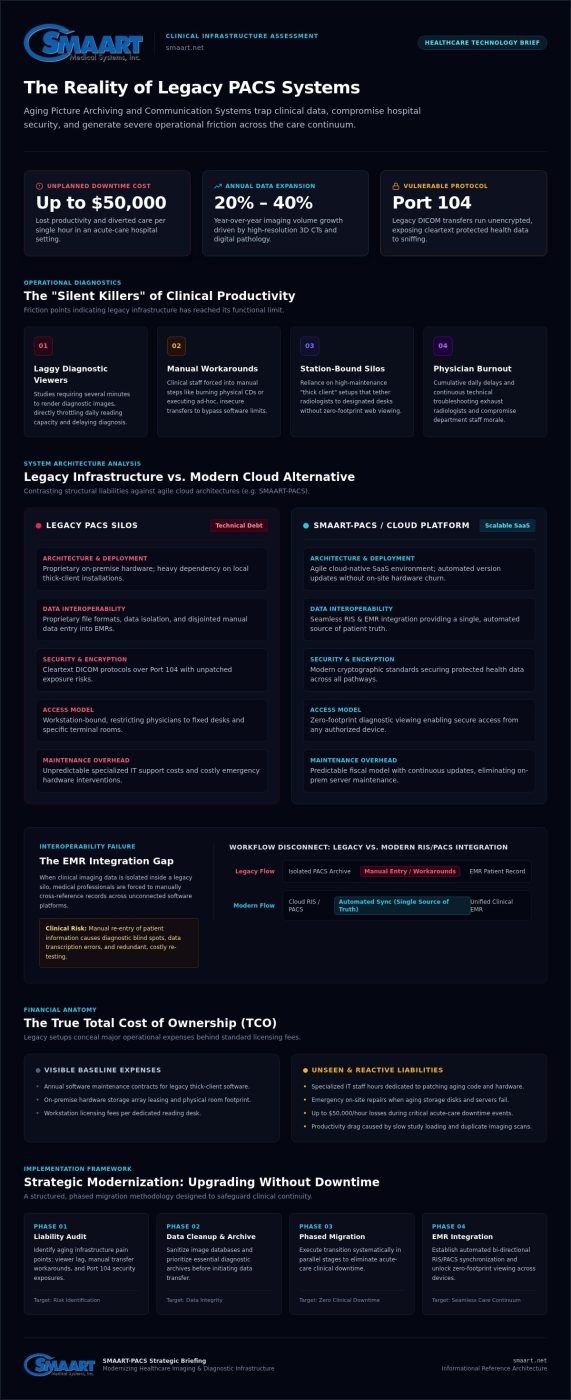
Legacy systems aren’t just aging software; they’re silos that trap your data. A traditional Picture Archiving and Communication System (PACS) was designed for a different era of healthcare. Back then, data stayed in one room. Today, that isolation is one of the primary challenges with legacy PACS systems. These setups rely on proprietary hardware and local installations, forcing your team to work around the technology rather than with it. It’s a bottleneck that stifles clinical flow and drains your budget.
The “silent killers” of productivity are often the hardest to quantify but the easiest to feel. Laggy viewers that take minutes to load a single study are more than just an annoyance. They’re clinical drains. When your staff resorts to manual workarounds, like burning CDs or using insecure file transfers, your system has failed. This friction doesn’t just slow down diagnosis; it creates a ripple effect of inefficiency that touches every department. Modern healthcare demands a shift from workstation-bound viewing to zero-footprint accessibility, allowing radiologists to work from any secure device without being tethered to a specific desk.
The Anatomy of an Outdated Imaging System
An aging system is characterized by rigid architecture. You’ll often find proprietary file formats that make cross-platform sharing nearly impossible. These systems are typically dependent on specific, aging hardware configurations that are expensive to maintain and difficult to replace. Without native web-based diagnostic viewing, your facility remains stuck in a cycle of high-maintenance “thick client” installations. This hardware-heavy approach is the opposite of modern SaaS platforms, which offer automatic updates and eliminate the need for constant on-site intervention.
Why ‘Good Enough’ is No Longer Safe in 2026
Accepting a slow system is a significant risk. Medical imaging data volumes are expanding at an annual rate of 20% to 40% due to high-resolution 3D CTs and digital pathology. Legacy storage arrays simply weren’t built for this scale. Furthermore, the expectation for instant image access across the care continuum is now a baseline requirement, not a luxury. One of the most critical challenges with legacy PACS systems is how this friction leads directly to physician burnout. When diagnostic delays become the norm, patient outcomes and staff morale both suffer. You can’t afford to wait for a total system collapse before realizing that your “good enough” solution is actually a liability. Moving to an update-automatic platform provides the relief your team needs to focus on patient care instead of troubleshooting tech.
Interoperability and Security: The Technical Debt of Aging Infrastructure
Technical debt isn’t just a line item on a budget. It’s a structural weakness that compromises patient care and data safety. One of the most persistent challenges with legacy PACS systems is their inability to speak the same language as modern Enterprise Medical Records (EMR). When imaging data remains trapped in a silo, clinicians are forced to hunt for information across multiple platforms. This fragmentation prevents a fluid exchange of patient history, leading to diagnostic blind spots and redundant testing. Patient info must be fluid to be useful. Older architectures simply weren’t built for the interconnected nature of 2026 healthcare.
The evolution of PACS architectures shows a clear shift away from these rigid, on-premise silos toward agile, cloud-native environments. Legacy systems often rely on unencrypted DICOM communications over port 104. This leaves cleartext protected health information vulnerable to protocol sniffing. Modern standards have moved on, yet many facilities remain anchored to hardware that can’t support the latest encryption protocols. This gap creates a massive liability for any organization handling sensitive imaging data.
The EMR Integration Gap
Manual data entry between a PACS and an EMR is a significant liability. It introduces human error and slows down the entire diagnostic cycle. By adopting integrated RIS PACS solutions, you can achieve a single source of truth for every patient record. Automated synchronization ensures that when a radiologist signs a report, the results are immediately available to the referring physician. This level of seamlessness eliminates the friction that typically defines challenges with legacy PACS systems, allowing your staff to focus on patients instead of data entry.
Cybersecurity and HIPAA Compliance in 2026
Security risks are no longer theoretical. Microsoft terminated support for Windows 10 workstations in October 2025, and Windows Server 2012 has been end-of-life since 2023. Operating a PACS on these unpatched systems is a direct violation of current HIPAA standards. Federal civil penalties now reach up to $71,162 per individual violation for willful neglect. To remain compliant, your infrastructure must support 2026 cybersecurity mandates, including:
- Mandatory AES-256 data-at-rest encryption.
- TLS 1.2 or 1.3 for all data in transit.
- Multi-factor authentication (MFA) for all user access.
- Micro-segmentation to prevent lateral movement during a breach.
With healthcare data breaches now averaging $9.77 million per incident, the cost of inaction is too high. Modern cloud storage simplifies HIPAA audit trails by providing automated, immutable logs of every data access event. Transitioning to a secure platform like SMAART-PACS can provide the operational relief and peace of mind your IT team needs.
The Economic Impact: Hidden Costs of Maintaining Legacy PACS
Financial strain in radiology departments often hides beneath the surface of daily operations. While the initial purchase of a system is a known expense, the ongoing challenges with legacy PACS systems include a massive “unseen” Total Cost of Ownership (TCO). Maintaining on-premise hardware requires dedicated server rooms with high-energy climate control, specialized IT personnel, and frequent emergency repairs when aging components fail. Research from HIMSS Analytics and WWT suggests that organizations spend 2 to 3 times more annually to maintain legacy healthcare IT than they would on modern cloud-native architectures. This technical debt builds up quietly until it impacts your bottom line.
Beyond the physical infrastructure, there’s the heavy cost of inefficiency. Slow image loading times don’t just frustrate staff; they actively drive away business. Referring physicians prioritize speed and ease of access for their patients. If your system forces them to wait for slow downloads or navigate clunky portals, they’ll likely send their next referral to a competitor with faster turnaround times. This loss of referral revenue is a direct, measurable consequence of sticking with an outdated platform.
Hardware Maintenance vs. Software Subscriptions
The traditional 3-5 year server refresh cycle is a financial trap. It keeps clinics in a state of constant capital expenditure, forcing you to buy peak-capacity hardware that sits underutilized for years. Modern enterprise PACS solutions change this dynamic. By moving to a Software-as-a-Service (SaaS) model, you stabilize your cash flow with predictable monthly payments. This shift eliminates the need for expensive on-site server refreshes and reduces the demand for specialized on-site IT hardware support.
ROI of Workflow Optimization
Every minute saved during a diagnostic read translates to higher facility throughput. Zero-footprint viewers allow radiologists to open studies instantly from any location, removing the lag associated with thick-client installations. This improvement is a core part of hospital imaging workflow optimization. When you reduce the time spent waiting for images to render, your team can process more studies per shift without increasing burnout. The ROI isn’t just in saved IT hours; it’s in the increased diagnostic capacity and improved fiscal health of your clinic. It’s a clear path toward relief from the operational burdens that define challenges with legacy PACS systems.
Strategic Modernization: How to Upgrade Without Clinical Downtime
Modernizing your imaging infrastructure doesn’t have to be a disruptive event. The primary reason many facilities tolerate the challenges with legacy PACS systems is the fear of crippling clinical downtime during a transition. However, a strategic, phased approach allows you to upgrade without halting your diagnostic workflow. By deploying background migration agents and dual-routing gateways, you can ensure that live modalities route directly to the new system while historical priors are retrieved on-demand. This “progressive prefetching” ensures radiologists have the data they need exactly when they need it, providing immediate relief from the lag of older architectures.
Data Migration Best Practices
Successful migration starts with a comprehensive digital audit. You don’t need to move every byte of data immediately. Prioritize your most recent studies, typically the last two to three years, for active migration while moving older data into a secure, searchable archive. This cleanup phase is the perfect time to address one of the common challenges with legacy PACS systems: inconsistent metadata. Ensuring DICOM tag integrity during the transfer prevents study ingestion failures and ensures that patient records remain linked across platforms. A hybrid cloud strategy provides the necessary flexibility, keeping your current operations active while the heavy lifting of data transfer happens in the background.
Choosing a Future-Proof Partner
Your choice of vendor determines your long-term operational success. Look for a partner that prioritizes open standards and RESTful DICOMweb protocols over proprietary wrappers. Accessibility is a major factor here. A zero footprint PACS viewer is essential for modern teams, as it enables secure, browser-based diagnostic viewing without the need for dedicated workstations. This flexibility supports remote teleradiology and cross-facility reading groups, effectively future-proofing your practice against shifting healthcare trends.
Finally, don’t overlook the human element. High adoption rates depend on intuitive interfaces and robust staff training. When a system is designed for modern efficiency, the learning curve is significantly shorter, reducing the burden on your clinical team. If you’re ready to leave technical debt behind and see how a streamlined transition works, request a personalized modernization roadmap from our team.
The SMAART-PACS Advantage: Seamless Integration and Cloud Scalability
Modernizing your imaging department shouldn’t feel like an uphill battle against complex industry giants. SMAART-PACS offers a refreshing, affordable alternative designed to solve the specific challenges with legacy PACS systems we’ve explored. By moving away from hardware-dependent silos, you gain immediate relief from the financial and operational strain of technical debt. Our solution provides a full-feature environment that balances technical authority with a client-focused warmth. It’s built for clinicians who need speed and administrators who demand fiscal responsibility.
The centerpiece of this efficiency is our diagnostic zero-footprint viewer. It removes the need for expensive, proprietary workstations by providing any-device accessibility through a standard web browser. Whether your radiologists are on-site or reading remotely, they experience the same high-performance rendering and intuitive interface. This accessibility is a direct answer to the lag and rigidity found in older architectures, ensuring your team remains productive regardless of their physical location.
Unified Radiology Workflow
A fragmented system is a slow system. SMAART-PACS and SMAART-RIS work together to eliminate data silos, creating a unified environment where information flows without friction. We ensure seamless integration with your existing EMR and HIS, creating a single source of truth for every patient record. This connectivity eliminates the manual data entry errors that often define the challenges with legacy PACS systems. With customizable worklists tailored to your specific clinical needs, your team can manage high volumes with modern efficiency and precision.
Modern Image Sharing with SMAART-SHARE
Relying on antiquated CDs for image sharing is a logistical burden that your facility can no longer afford. SMAART-SHARE replaces this outdated practice with cloud-based collaborative viewing that doesn’t require proprietary hardware. It streamlines communication between referring physicians and specialists, ensuring that diagnostic images are available instantly. This shift significantly enhances the patient experience by providing a modern patient portal for medical images. Patients can access their exams from home, while your staff is relieved of the cost and time spent burning, labeling, and mailing physical discs. We’re here to be your pragmatic partner in modernization, helping you restore both clinical efficiency and fiscal health.
Restoring Clinical Efficiency and Fiscal Health
We’ve explored how aging infrastructure drains resources and compromises security. Transitioning to a cloud-native platform eliminates the “silent killers” of productivity, such as laggy viewers and manual data entry. By prioritizing interoperability and secure accessibility, you transform your imaging department from a cost center into a streamlined asset. Moving past the challenges with legacy PACS systems is no longer a luxury; it’s a necessity for survival in the 2026 healthcare landscape.
SMAART-PACS provides the relief of seamless EMR/HIS integration, a diagnostic zero-footprint viewer for any-device access, and affordable subscription-based pricing that stabilizes your budget. These tools empower your team to focus on what matters most: accurate, timely patient care. You don’t have to carry the burden of outdated technology alone. Our team is ready to partner with you to build a more responsive, secure, and profitable future for your practice.
Modernize your radiology workflow with SMAART-PACS; request a professional consultation today.
Frequently Asked Questions
What are the most common signs that our PACS system is considered ‘legacy’?
A system is legacy if it relies on end-of-life software like Windows 10 or Windows Server 2012. Other signs include slow loading times and proprietary hardware dependence. These challenges with legacy PACS systems often force staff into manual workarounds. If your radiologists cannot access images securely via a web browser, your current infrastructure is likely holding back clinical efficiency. Modernizing provides the relief your team needs.
Can we upgrade our PACS without replacing our entire EMR system?
You can absolutely modernize your imaging infrastructure without touching your EMR. SMAART-PACS and SMAART-RIS are specifically designed to integrate seamlessly with existing hospital and clinic platforms. This allows you to upgrade your radiology workflow while maintaining a single source of truth for patient records. This targeted approach provides immediate operational relief without the massive cost and disruption of a total enterprise software overhaul.
How long does a typical data migration from a legacy PACS to a cloud-based system take?
Migration timelines vary based on your total data volume and database complexity. A typical transition involves a phased approach that protects ongoing clinical operations. By using background migration agents, active studies move first while older data follows. This ensures radiologists have immediate access to current cases. Most facilities see a full transition within several weeks to a few months, depending on their specific archival needs.
Is a cloud-based PACS as secure as an on-premise server for HIPAA compliance?
Modern cloud-based platforms are often more secure than aging on-premise servers. Legacy hardware frequently runs on unpatched operating systems, creating significant vulnerabilities. In contrast, cloud solutions like SMAART-PACS simplify HIPAA compliance by providing:
- AES-256 encryption at rest.
- Multi-factor authentication (MFA).
- Automated, immutable audit trails.
This shift reduces the risk of expensive data breaches, which now average $9.77 million per incident in healthcare.
What is a zero-footprint viewer, and why is it essential for modern radiology?
A zero-footprint viewer is a browser-based tool requiring no local software installation. It’s essential because it allows radiologists to view diagnostic-quality images from any secure device. This flexibility eliminates one of the core challenges with legacy PACS systems: being tethered to a specific workstation. It supports modern teleradiology and cross-facility collaboration. Your team can provide care from any location with internet access.
How does legacy PACS maintenance impact radiologist burnout and retention?
Outdated systems are a primary driver of physician burnout. Laggy rendering times and fragmented workflows create daily frustration that accumulates. When radiologists spend more time fighting software than interpreting images, job satisfaction plummets. Modernizing your PACS provides the relief your team needs to focus on patient diagnosis. Improving the daily user experience is a powerful tool for retaining top talent and maintaining a healthy clinical environment.
What happens to our old imaging data during a system modernization?
During modernization, your data undergoes a comprehensive digital audit to determine what to migrate. Active studies from the last two to three years typically move to the cloud for instant access. Older imaging data is placed in a secure archive. This process includes cleaning up metadata and ensuring DICOM tag integrity. Historical priors remain correctly linked to patient records in the new system.