
Cloud PACS Disaster Recovery: Ensuring Radiology Continuity in 2026
What if a local server crash or a sudden hardware failure didn’t result in a single minute of clinical downtime? For many radiology practices, the fear of permanent data loss or the crushing cost of maintaining on-site redundant servers feels like an unavoidable burden. You shouldn’t have to choose between financial strain and operational paralysis when your primary systems go dark. It’s a high-stakes environment where every second of delay impacts patient outcomes.
Implementing a robust cloud PACS disaster recovery strategy is the modern solution to these legacy headaches. By moving away from fragile, proprietary hardware, you gain the relief of a system that’s built for resilience. This article explores how to protect your diagnostic workflow and patient data with a cloud-native approach that prioritizes continuity and eliminates the need for expensive on-site IT staffing.
We’ll examine the path to achieving zero-loss data protection and a rapid recovery time objective (RTO) that keeps your team moving. You’ll discover how tools like SMAART-PACS provide the diagnostic-grade viewing and HIPAA-compliant security necessary to meet 2026 audit requirements. We’re moving past the era of complex, expensive backups and into a future of seamless, affordable image distribution.
Key Takeaways
- Understand why simple data backups are insufficient and how a comprehensive continuity plan prevents operational paralysis during an outage.
- Reduce your financial and maintenance burdens by shifting from costly on-site hardware to a more efficient, cloud-native operational model.
- Discover how cloud PACS disaster recovery leverages multi-region redundancy and end-to-end encryption to ensure zero-loss data protection.
- Follow a practical guide to auditing your current workflow and prioritizing critical clinical pathways for rapid system restoration in 2026.
- Learn how SMAART-PACS and SMAART-SHARE eliminate hardware dependencies while maintaining HIPAA compliance and diagnostic-grade viewing.
Beyond Simple Backups: Why PACS Disaster Recovery is Non-Negotiable
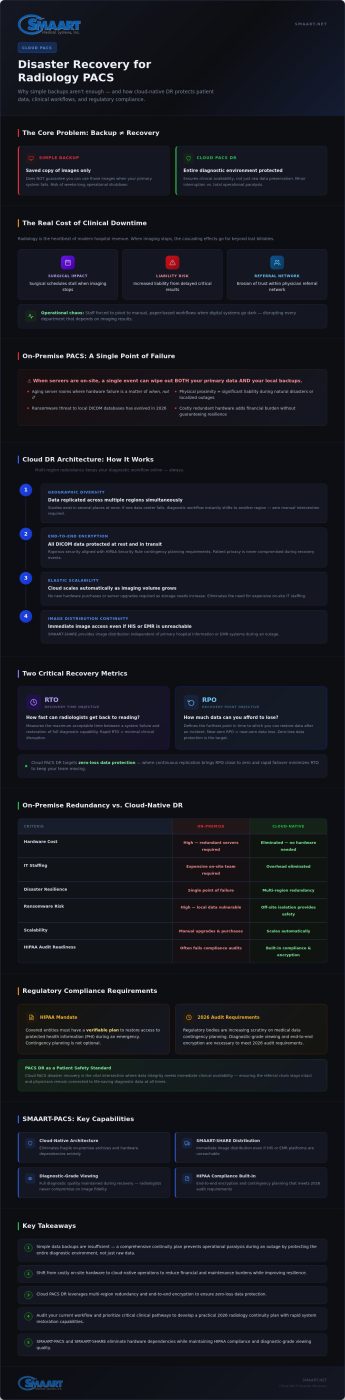
Many radiology departments mistake a data backup for a survival plan. A backup is just a saved copy of your images; it doesn’t guarantee you can actually use them when your primary system fails. A comprehensive cloud PACS disaster recovery strategy ensures that your entire diagnostic environment, not just the raw data, remains accessible. This distinction is the difference between a minor service interruption and a weeks-long operational shutdown that compromises your practice’s reputation.
Radiology is the heartbeat of modern hospital revenue. When imaging stops, surgical schedules stall and emergency departments bottleneck. The high cost of clinical downtime isn’t just measured in lost billables. It includes:
- Erosion of trust within your physician referral network.
- Increased liability risks due to delayed critical results.
- Operational chaos as staff pivot to manual, paper-based workflows.
Regulatory bodies are increasing scrutiny on medical data contingency planning. HIPAA mandates that covered entities have a verifiable plan to restore access to protected health information during an emergency. SMAART-PACS offers a refreshing alternative to the fragile, on-premise archives that often fail these audits. It provides a cloud-native architecture that ensures compliance while removing the financial strain of maintaining redundant hardware. You gain the relief of knowing your data is secure without the overhead of a traditional IT department.
The Vulnerability of On-Premise PACS Archives
Maintaining a local Picture Archiving and Communication System (PACS) archive creates a single point of failure. Aging server rooms are ticking time bombs where hardware failure is a matter of when, not if. Physical proximity is a significant liability during localized outages or natural disasters. Additionally, the ransomware threat to local DICOM databases has evolved in 2026, making isolated, off-site cloud resilience a necessity rather than a luxury. When your servers are on-site, a single event can wipe out both your primary data and your local backups.
Disaster Recovery as a Patient Safety Standard
System downtime is more than an IT headache; it’s a patient safety risk. Delayed diagnostics lead to postponed treatments and increased anxiety for those awaiting critical results. A resilient cloud PACS disaster recovery plan keeps the referral chain intact, ensuring physicians stay connected to the data they need to make life-saving decisions. It’s about maintaining a seamless flow of information when it matters most. PACS disaster recovery is the vital intersection where data integrity meets immediate clinical availability to ensure uninterrupted patient care.
The Architecture of Resilience: How Cloud-Based DR Protects Patient Data
The foundation of cloud PACS disaster recovery lies in geographic diversity. Unlike traditional systems that rely on a single physical location, a cloud-native architecture replicates your data across multiple regions simultaneously. This means your studies exist in several places at once. If a data center in one part of the country experiences an outage, your diagnostic workflow shifts to another region instantly. This level of resilience ensures that patient data remains available regardless of local environmental factors or infrastructure failures.
Security remains a top priority during any recovery event. All DICOM data is protected with end-to-end encryption, both at rest and while in transit. This rigorous approach aligns with HIPAA Security Rule contingency planning requirements, ensuring that patient privacy isn’t compromised in the rush to restore services. As your imaging volume grows, the cloud scales with you automatically. You won’t need to purchase new hardware or wait for server upgrades every time your storage needs increase. Tools like SMAART-SHARE complement this architecture by providing immediate image distribution even if your primary HIS or EMR platforms are temporarily unreachable.
Understanding RTO and RPO in Radiology
Defining success for cloud PACS disaster recovery requires looking at two critical metrics: Recovery Time Objective (RTO) and Recovery Point Objective (RPO). RTO measures how fast your radiologists can get back to reading after a failure. In a high-volume center, an RTO of minutes is often the benchmark for success. RPO defines how much data you can afford to lose. For a modern diagnostic facility, the goal is near-zero data loss. Balancing these targets allows you to prioritize clinical pathways that require the fastest restoration.
Zero-Footprint Viewing: The Key to Instant Recovery
Traditional recovery often hits a wall when IT teams must re-install software on dozens of machines. A zero footprint PACS viewer removes this hurdle entirely. Since the viewer runs in a standard web browser, your team can access diagnostic-grade images from any device, anywhere, the moment an outage occurs. This mobility is essential for maintaining continuity when a facility becomes physically inaccessible. If you’re looking to streamline your workflow and secure your data, exploring SMAART Medical Systems can help you implement these resilient technologies today.
Comparing On-Premise Redundancy vs. Cloud-Native Disaster Recovery
Traditional disaster recovery often involves building and maintaining a mirrored data center. This “do-it-yourself” approach requires massive Capital Expenditure (CAPEX) for hardware that sits idle most of the time. In contrast, cloud PACS disaster recovery leverages an Operational Expenditure (OPEX) model where you only pay for the resources you use. This shift provides immediate financial relief and eliminates the need for the large, upfront budgets typically required for infrastructure refreshes.
The “Relief Factor” of the cloud goes beyond just the balance sheet. Managing on-site redundancy means your team is responsible for constant patching, firmware updates, and physical security. By adopting a cloud-native strategy, you transfer these operational burdens to specialized providers. This allows your internal IT staff to focus on high-value clinical support rather than the tedious maintenance of redundant server racks. It’s a pragmatic modernization that replaces complexity with streamlined efficiency.
The Financial Impact of Infrastructure Redundancy
The cost of maintaining dual-site hardware is often double the expense of a single cloud-integrated SMAART-PACS license. Beyond the initial purchase, you must account for the ongoing costs of electricity, industrial cooling, and physical security for an off-site facility. These hidden expenses quickly erode your department’s margins. When you look at the 5-year total cost of ownership, cloud-based DR consistently proves more affordable than purchasing, housing, and maintaining proprietary on-premise hardware. Adhering to the NIST contingency planning framework for IT systems ensures your financial investment aligns with the highest standards of technical resilience.
Seamless Integration with EMR and HIS
A recovery plan is only effective if it maintains the vital link between imaging and patient records. SMAART-PACS ensures that DICOM data remains synchronized with your HIS and EMR platforms during any restoration event. This interoperability is crucial for maintaining clinical continuity and preventing data silos. Modernizing your workflow requires integrated RIS PACS solutions that sync faster and more reliably than fragmented legacy systems. By integrating SMAART-RIS with your PACS, you ensure that patient data flows seamlessly across all critical clinical pathways, even when your primary local systems are offline.
Developing Your 2026 Radiology Continuity Plan: A Step-by-Step Guide
A continuity plan is your department’s insurance policy against the unexpected. It transforms cloud PACS disaster recovery from a technical concept into a functional safety net that protects your patients and your revenue. Building this framework requires a pragmatic approach that balances immediate accessibility with long-term data integrity. Follow these steps to ensure your practice remains operational regardless of the challenges 2026 may bring.
Step 1: Conduct a Comprehensive Audit. You cannot protect what you haven’t mapped. Document every storage node, server, and workstation within your network. Identify exactly where data enters and leaves your system. This baseline allows you to spot vulnerabilities before they become points of failure during a crisis.
Step 2: Define Your Critical Clinical Pathways. Not all studies require the same restoration speed. Determine which imaging types need immediate availability. An ER trauma scan requires a much faster recovery time than a routine outpatient screening. Categorizing your data helps you allocate bandwidth and resources effectively when every second counts.
Step 3: Implement a Hybrid-Cloud Approach. Use local caching for high-speed diagnostic access while maintaining a real-time, encrypted mirror in the cloud. This provides the best of both worlds: local performance for daily tasks and cloud-native resilience for emergencies. It ensures that a local hardware failure doesn’t stop your clinical workflow.
Step 4: Regular Testing. Schedule quarterly drills to simulate system failures and data restoration. A plan is only as good as its last successful drill. Testing your cloud PACS disaster recovery protocols ensures your team stays sharp and your technology performs exactly as expected when a real outage occurs.
Auditing Your Workflow for Vulnerabilities
Identifying single points of failure is the most critical part of your audit. Look for aging hardware or unencrypted sharing protocols that could invite a network breach or cause a sudden crash. Evaluating these risks is a core component of hospital imaging workflow optimization. Addressing these gaps now prevents the operational paralysis that often follows a system-wide failure. It’s about building a foundation that supports growth and security simultaneously.
Staff Training and Crisis Communication
Technology only works if your team knows how to use it under pressure. Train your staff on how to switch to SMAART-SHARE for emergency image distribution when primary portals fail. Radiologists should be proficient in using the SMAART-PACS zero-footprint viewer for remote reading during facility-wide outages. Establish clear, written protocols for patient data access to ensure compliance remains intact during a network breach. Clear communication prevents panic and ensures a methodical restoration of services.
Ready to secure your practice with a modern resilience strategy? Contact SMAART Medical Systems to start building your comprehensive continuity plan today.
SMAART-PACS: Seamless Disaster Recovery and Image Mobility
SMAART Medical Systems stands as a refreshing alternative to the complex, overpriced legacy giants of the imaging world. We simplify the transition to a modern cloud PACS disaster recovery model by removing the technical barriers that often stall progress. Instead of managing a sprawling inventory of proprietary servers, you gain a streamlined, cloud-native environment designed for immediate movement. Our approach replaces the cold detachment of traditional software vendors with a supportive partnership focused on your long-term success.
Choosing SMAART-PACS means choosing a resilient foundation that reduces your operational burdens. We prioritize accessibility and technical authority, ensuring your diagnostic workflow remains uninterrupted during local outages. You don’t just get a software license; you get a reliable partner deeply invested in the ongoing success of your radiology department. This shift to a cloud-native strategy provides the relief of knowing your data is protected by elite expertise without the typical industry bloat.
Fiscal Responsibility Meets Technical Excellence
Hospitals and imaging centers face constant pressure to reduce radiology overhead without sacrificing quality. SMAART offers subscription models that align perfectly with your facility’s growth and budget, turning a massive capital risk into a predictable operating expense. This pragmatic approach to cloud PACS disaster recovery allows you to scale storage and user access as needed. You gain the professional confidence of a high-performance system while maintaining strict fiscal responsibility. It’s a modern solution for administrators who demand technical excellence and financial clarity.
The SMAART-SHARE Digital Front Door
Outdated CDs are a significant point of failure in the referral chain and a source of constant frustration for patients. A modern patient portal for medical images replaces these physical media with secure, cloud-based distribution. SMAART-SHARE creates a digital front door that improves the experience for both patients and referring physicians. You ensure full HIPAA compliance while providing the image mobility required in 2026. This hardware-free distribution model eliminates the hidden costs of shipping and handling physical exams.
Taking the next step toward a resilient future is straightforward. You can request a comprehensive workflow audit to identify your specific vulnerabilities and see how our tools integrate with your existing HIS or EMR. A personalized demo of SMAART-PACS will show you exactly how we deliver diagnostic-grade viewing from any location. Move past the complexity of traditional systems and experience the relief of a truly modern imaging solution.
Securing the Future of Your Diagnostic Workflow
Protecting your radiology department against the unexpected doesn’t have to be a financial or operational burden. By shifting from fragile on-premise hardware to a resilient cloud PACS disaster recovery strategy, you ensure that patient care never stalls. You’ve seen how multi-region redundancy and zero-footprint viewing provide instant restoration while cutting the hidden costs of legacy infrastructure. It’s about replacing complexity with a partnership that prioritizes your facility’s continuity and growth.
SMAART-PACS offers seamless EMR and RIS integration to keep your data synchronized during any crisis. You can finally eliminate hardware overhead with SMAART-SHARE while providing diagnostic-grade zero-footprint viewing from any location. This modernization isn’t just about security. It’s about the relief of knowing your system is built for 2026 and beyond. Take the next step toward a more efficient, secure imaging environment. Request a SMAART-PACS Demo and Workflow Audit today to discover how easy it is to modernize your resilience strategy. Your team deserves a system that’s as dedicated to patient outcomes as they are.
Frequently Asked Questions
What is the difference between PACS backup and disaster recovery?
A backup is simply a copy of your imaging data, whereas cloud PACS disaster recovery is a comprehensive plan to restore your entire diagnostic environment. While backups protect the raw files, disaster recovery ensures your clinical staff can actually view and interpret those images during an outage. This distinction is vital for maintaining patient safety and preventing revenue loss. It’s about moving from simple data storage to full operational continuity.
How long does it take to restore medical images from a cloud PACS?
Restoration times depend on your facility’s defined Recovery Time Objective (RTO). With a cloud-native architecture, critical studies can be accessible in minutes rather than hours or days. SMAART-PACS prioritizes clinical pathways to ensure that emergency department scans are available almost immediately. This rapid restoration eliminates the operational paralysis that typically follows a hardware crash. It allows your radiologists to get back to reading without waiting for physical server repairs.
Is cloud PACS disaster recovery HIPAA compliant?
Yes, a properly implemented cloud DR strategy is fully HIPAA compliant. It meets federal contingency planning requirements by ensuring that protected health information remains accessible and secure during emergencies. All DICOM data is protected with end-to-end encryption during transit and at rest in the cloud. By using SMAART-PACS, you fulfill the 2026 audit mandates for medical data resilience. This provides the relief of knowing your practice remains compliant even during a major failure.
Can I access SMAART-PACS if our local hospital network goes down?
You can access SMAART-PACS from any device with an internet connection if your local hospital network fails. Because the system uses a diagnostic-grade zero-footprint viewer, your radiologists can work from home or use a cellular hotspot to continue reading studies. This flexibility removes the single point of failure inherent in traditional on-premise setups. It ensures that a local infrastructure problem doesn’t result in a complete shutdown of your diagnostic imaging services.
How much does cloud-based PACS disaster recovery cost compared to on-premise?
Implementing cloud PACS disaster recovery typically follows an Operational Expenditure (OPEX) model, which is more affordable than the high Capital Expenditure (CAPEX) of on-premise hardware. You eliminate the need to purchase, house, and cool redundant servers that often sit idle. While on-premise costs include physical security and ongoing IT maintenance, a cloud subscription covers these burdens automatically. This shift provides significant financial relief while ensuring your technology stays modernized without expensive infrastructure refreshes.
What happens to my DICOM data if there is an internet outage?
If your facility loses internet access, your DICOM data remains safely stored and synchronized in the cloud. Most modern workflows utilize a hybrid approach where local caching allows you to continue short-term operations while waiting for connectivity to return. Once the internet is restored, the system automatically re-syncs any new data. For urgent needs, staff can often switch to mobile data or secondary providers to access the SMAART-SHARE platform and maintain image distribution.
Does SMAART-PACS integrate with my existing EMR during recovery?
SMAART-PACS and SMAART-RIS are specifically designed to integrate seamlessly with your existing EMR and HIS platforms, even during a recovery event. Maintaining the link between patient records and diagnostic images is essential for clinical accuracy. This integration ensures that your workflow remains fluid and that data silos don’t form when you switch to your backup environment. It provides a methodical restoration process that keeps your administrative and clinical teams aligned without manual data entry.
How often should we test our radiology disaster recovery plan?
Industry standards recommend testing your radiology disaster recovery plan at least quarterly or semi-annually. Regular drills ensure that your staff knows how to pivot to backup systems like SMAART-SHARE without panic. A plan is only effective if it’s proven to work under simulated pressure. These tests help you identify and fix bottlenecks in your restoration process before a real crisis occurs. Consistent testing builds professional confidence and ensures your continuity strategy remains robust.