
Cloud PACS for Rural Hospitals: 2026 Radiology Guide
What if the biggest hurdle to delivering elite radiology services in your community isn’t a lack of medical talent, but the aging server room down the hall? For many administrators, the transition to cloud PACS for rural hospitals represents a vital shift away from the constant cycle of hardware refreshes and rising maintenance costs. It’s difficult to recruit specialized IT staff to manage complex imaging databases, and slow image sharing with urban specialists often delays critical patient care.
Adopting a cloud-based model is the great equalizer, offering a way to eliminate IT overhead while gaining access to enterprise-grade diagnostic tools. We understand that rural facilities face unique pressures, and we’re here to help you move toward a more sustainable, efficient model. This 2026 guide explores how modernizing your workflow provides the relief of predictable monthly costs and seamless integration.
We’ll detail how moving to a cloud-based architecture helps your facility achieve HIPAA-compliant storage and enables instant remote reading. You’ll discover how to modernize your department, reduce financial strain, and ensure your patients receive the fast, accurate diagnoses they deserve.
Key Takeaways
- Eliminate the burden of aging on-site servers and the high cost of specialized IT recruitment by moving to a secure, hosted platform.
- Transition from large upfront capital expenditures to a predictable monthly operational expense model that scales with your facility’s volume.
- Discover how cloud PACS for rural hospitals provides “zero-footprint” diagnostic viewing, allowing specialists to access images instantly from any web browser.
- Learn why seamless EMR and HIS integration is critical for removing data silos and ensuring a smooth, unified radiology workflow.
- Explore how SMAART-PACS and SMAART-RIS deliver affordable, full-feature tools designed specifically for the unique constraints of smaller healthcare facilities.
The Challenges of Rural Radiology Management in 2026
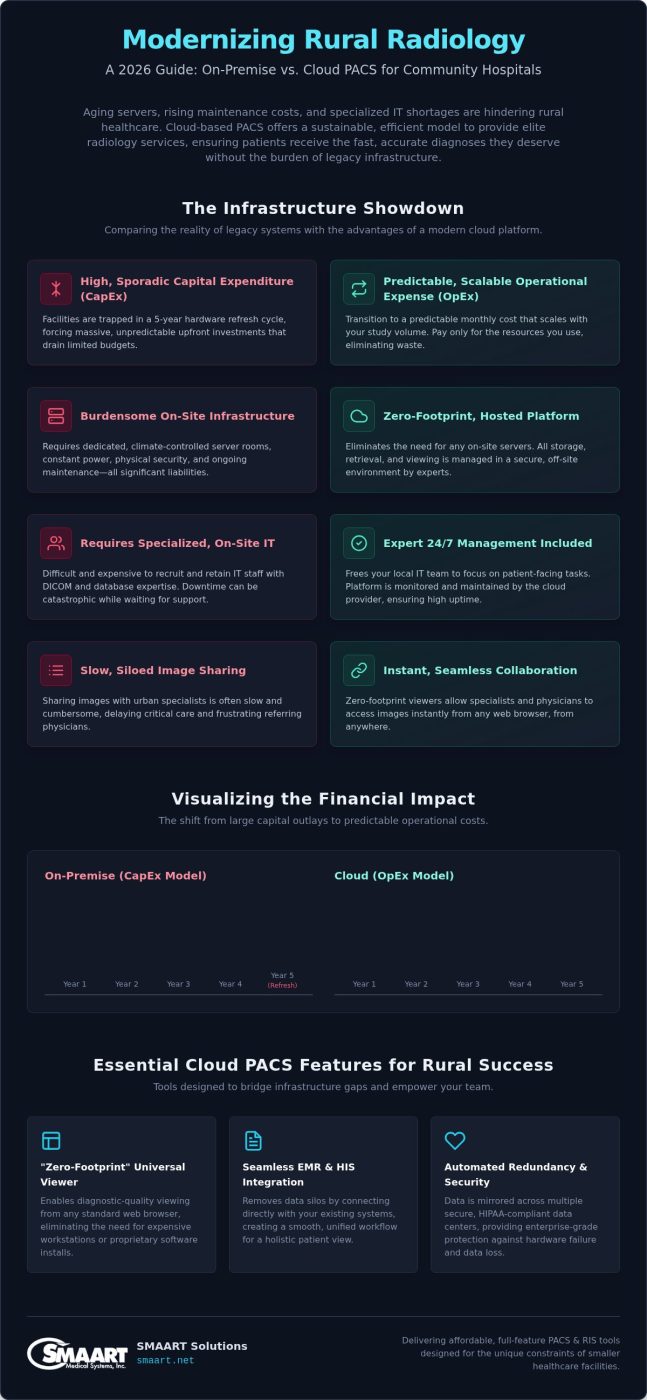
Running a radiology department in a small facility has never been more complex. By 2026, the financial burden of maintaining a legacy Picture archiving and communication system (PACS) has reached a breaking point. Many rural administrators find themselves caught in a hardware refresh trap. Every five years, they’re forced into massive capital expenditures to replace aging servers that are already obsolete by the time they’re installed. These on-site units aren’t just expensive; they’re liabilities. They require climate-controlled rooms, constant electricity, and physical security, all of which drain limited budgets that could be better spent on frontline patient care.
The human element is equally strained. It’s notoriously difficult to recruit specialized IT professionals who understand the nuances of DICOM routing and SQL database management in remote areas. When a server fails at 2:00 AM, a rural hospital shouldn’t have to wait for a technician to drive three hours from the nearest city. This lack of immediate support creates dangerous bottlenecks in emergency departments, where every minute of downtime impacts patient outcomes. High maintenance costs and staffing shortages often lead to a “status quo” mindset, but this is the most expensive strategy a facility can adopt.
Bridging the Infrastructure Gap
A common concern among board members is that local connectivity isn’t strong enough for cloud PACS for rural hospitals. In 2026, this is largely a myth. Modern platforms use intelligent bandwidth management and background uploading to ensure diagnostic quality isn’t sacrificed even on modest connections. Relying on outdated imaging workflows doesn’t just frustrate staff; it drives patients to urban centers. When a local hospital can’t share images instantly with an urban specialist, patients lose confidence and take their healthcare dollars elsewhere. Modernizing the infrastructure is the only way to stop this “urban drift” and keep care within the community.
Recruitment and Retention through Technology
Adopting cloud PACS for rural hospitals is a powerful recruitment tool. Modernizing your tech stack empowers local technicians with intuitive, browser-based interfaces that reduce the daily administrative load. By removing the friction of complex logins and clunky software installs, you significantly reduce burnout among your existing team. This level of modern efficiency allows your facility to stay competitive with larger regional health networks. It proves that providing high-quality diagnostic services doesn’t require a metropolitan zip code, making your hospital a more attractive place for top-tier talent to build their careers.
How Cloud-Based PACS Overcomes Rural Infrastructure Gaps
Unlike legacy systems that require a dedicated basement server room, cloud PACS functions as a fully hosted platform. It centralizes storage, retrieval, and diagnostic viewing in a secure off-site environment. This architecture is revolutionary for facilities with limited physical space or specialized IT staff. By moving to the cloud, you’re no longer responsible for the physical upkeep of the hardware that powers your imaging department.
One of the most significant advantages for smaller facilities is scalability. Instead of buying a server that sits half-empty for years, you pay for exactly the storage you use. This shift reflects the broader cost-effectiveness of Cloud PACS, where storage capacity expands automatically as your study volume grows. Additionally, cloud providers offer automated redundancy. Your data is mirrored across multiple secure data centers, providing a level of protection against hardware failure that a local server room simply can’t match. Transitioning to cloud PACS for rural hospitals means your data is always available, even if local hardware fails.
Zero-Footprint Viewing for Remote Access
Zero-footprint viewing is a practical solution for remote access. It allows diagnostic-quality viewing on standard hardware through a simple web browser. You don’t need to install proprietary software on every terminal in the hospital. SMAART-PACS leverages this technology to facilitate instant access for referring physicians, removing the technical barriers that usually slow down collaboration. By using browser-based tools, you reduce the need for high-end diagnostic workstations at every station. This saves significant capital and allows your team to work from any secure device without compromising image quality.
Security and HIPAA Compliance in the Cloud
Security and HIPAA compliance are often top of mind for rural administrators. Moving to the cloud offloads the heavy lifting of cybersecurity and data encryption to specialized providers who focus exclusively on data protection. This is especially vital for disaster recovery. If a local natural disaster strikes, your patient data remains safe and accessible in the cloud. It’s also much easier to maintain a secure digital audit trail for regulatory compliance when the system handles the logging automatically. For those looking to modernize their workflow without the typical technical headaches, exploring a modern imaging solution can provide the relief your administrative team needs.
Cost Analysis: On-Premise vs. Cloud PACS for Limited Budgets
Traditional imaging infrastructure relies on a Capital Expenditure (CapEx) model that’s often incompatible with the tight margins of smaller facilities. Purchasing on-site servers requires a massive upfront investment every few years, followed by unpredictable maintenance fees. In contrast, cloud PACS for rural hospitals operates on an Operational Expenditure (OpEx) model. This shifts the financial burden to a predictable monthly subscription, allowing administrators to align their technology costs directly with patient volume. It’s a fiscal relief that transforms a volatile budget item into a stable, manageable expense.
Beyond the initial purchase price, on-premise systems carry heavy hidden costs. These include the electricity required to run high-performance hardware, the specialized cooling systems needed for server rooms, and the physical real estate those servers occupy. There’s also the “Radiology CD tax,” which is the cumulative cost of burning, labeling, and shipping physical media to urban specialists. By 2026, these manual processes are more than just an inconvenience; they’re a drain on resources that a modern Software-as-a-Service (SaaS) model completely eliminates.
Eliminating the Hidden Overhead
Moving to the cloud allows you to decommission expensive on-site server rooms and repurpose that space for clinical use. You also reduce the need for dedicated IT support to troubleshoot database errors or perform manual backups. Total Cost of Ownership (TCO) for radiology software represents the sum of all direct and indirect costs associated with the system throughout its entire operational lifespan. By offloading these burdens, your facility can focus its human and financial capital on patient care rather than hardware maintenance.
ROI of Cloud Implementation
The return on investment for cloud migration is seen most clearly in faster turnaround times (TAT). When images are available instantly, diagnoses happen quicker, leading to faster treatment and improved hospital revenue cycles. Accessibility also plays a critical role in reducing denied claims, as clear, available documentation ensures that payers have the information they need the first time. Efficiency is further amplified through natural integration. Adopting integrated RIS PACS solutions ensures that scheduling and imaging work in tandem, removing the data silos that typically slow down rural workflows. This streamlined approach doesn’t just save time; it builds a more resilient and profitable radiology department.
Key Features to Look for in a Rural-Ready PACS System
Selecting a cloud PACS for rural hospitals requires looking beyond basic storage. You need tools built for the realities of limited connectivity and lean staffing. Intelligent bandwidth management is non-negotiable. Modern systems use smart uploader tools that prioritize active studies and handle fluctuating internet speeds without crashing. This ensures that even during peak hours, your diagnostic workflow remains uninterrupted. A truly rural-ready system doesn’t just store data; it manages the limitations of the local environment to ensure consistent performance.
Interfacing PACS with EMR
Interoperability is the backbone of a modern radiology department. Relying on HL7 and DICOM standards ensures that patient data flows seamlessly between your imaging platform and your hospital information system. When you focus on interfacing PACS with EMR, you significantly improve diagnostic accuracy by giving clinicians a complete view of the patient’s medical history alongside their scans. This integration also removes the need for manual, duplicate data entry. Clinical staff can spend less time on administrative paperwork and more time on direct care, providing a major relief for departments with limited personnel.
Modern Image Sharing Solutions
The era of burning CDs and mailing film is over. Collaborative tools like SMAART-SHARE allow you to replace physical media with secure, encrypted cloud links. This shift drastically improves the patient experience by providing modern exam sharing solutions that patients can access securely from home. Specialists at urban centers can view these images instantly through a browser without needing proprietary hardware or local software installs. It’s about creating a frictionless environment for consultation that speeds up the time to treatment.
A unified environment that combines SMAART-RIS with your PACS further streamlines operations. Managing scheduling, patient demographics, and diagnostic images in one place eliminates the confusion of toggling between different vendor platforms. This cohesive approach is what makes a system truly “rural-ready.” If you’re ready to see how these features can modernize your facility, request a demo of our integrated radiology solutions today.
SMAART Solutions: Bridging the Gap for Rural Healthcare
SMAART Medical Systems, Inc. delivers a suite of tools engineered for the unique constraints of smaller healthcare facilities. Our flagship solution, SMAART-PACS, offers the zero-footprint diagnostic viewing discussed in previous sections, effectively removing the need for on-site server upkeep. It provides enterprise-grade performance at a price point that respects rural budgets. When paired with SMAART-RIS, your facility gains a streamlined environment for scheduling and patient management. This integration eliminates the data silos that often plague independent clinics. For collaboration, SMAART-SHARE serves as a secure, cloud-based platform that allows you to distribute images to specialists instantly without proprietary hardware.
We understand that the transition to cloud PACS for rural hospitals can feel daunting. That’s why SMAART Medical Systems, Inc. prioritizes implementation without disruption. Our team manages the migration of your legacy data, ensuring your department remains operational throughout the switch. We handle the technical heavy lifting so you can focus on patient care. This transition offers immediate relief from the hardware refresh trap, replacing it with a scalable, modern infrastructure that grows with your facility.
A Partner in Modernization
SMAART Medical Systems, Inc. positions itself as a refreshing alternative to the overly complex industry giants. We don’t just provide software; we act as a reliable partner that understands the specific pressures of rural healthcare. Our support team is deeply knowledgeable about the landscape you navigate daily. Our focus is on modernization, streamlining, and fiscal responsibility. We’re here to provide the relief of reduced operational burdens and predictable monthly costs. By choosing a partner that values accessibility and technical authority, you ensure the long-term success of your radiology department while maintaining an elite level of service.
Next Steps for Facility Administrators
Modernizing your workflow is a methodical process that begins with a clear understanding of your current state. Start with these three steps to begin your transition:
- Step 1: Conduct a digital audit of your current radiology workflow to identify bottlenecks and security gaps.
- Step 2: Evaluate the true cost of your current on-premise hardware, including electricity, cooling, and specialized IT labor.
- Step 3: Schedule a demo of SMAART-PACS to see zero-footprint viewing in action and discuss your facility’s specific needs.
Ready to modernize? Contact SMAART Medical Systems, Inc. for a tailored consultation.
Modernizing Your Radiology Department for 2026 and Beyond
Transitioning to the cloud is a strategic move toward long-term financial and operational sustainability. By adopting cloud PACS for rural hospitals, you replace the burden of aging on-site servers and unpredictable maintenance costs with a scalable, browser-based environment. This shift ensures your facility remains competitive, keeping diagnostic services local and stopping the flow of patients to urban centers. You’ve seen how the right technology eliminates the hardware refresh trap while providing your team with the tools they need to work efficiently from any location.
Achieving seamless EMR/HIS integration and zero-footprint diagnostic viewing no longer requires a massive IT budget or specialized on-site staff. This level of modern efficiency provides the relief your administrative team needs to focus on clinical excellence rather than technical troubleshooting. Affordable radiology management is within reach for every hospital and clinic ready to embrace a more streamlined future. Your community deserves enterprise-grade care, and modern cloud solutions make that standard possible today.
Explore SMAART-PACS: The Affordable Cloud Solution for Rural Hospitals
Frequently Asked Questions
Is my rural hospital internet fast enough for a cloud-based PACS?
Most modern cloud systems use intelligent background uploading and bandwidth management to function on modest connections. cloud PACS for rural hospitals is designed to handle fluctuating speeds. It prioritizes active studies and uses progressive loading so clinicians don’t wait for the full high-res file to begin viewing. This ensures diagnostic quality without requiring a massive fiber optic overhaul. It’s a practical solution for facilities in areas where high-speed infrastructure is still evolving.
How does cloud PACS improve HIPAA compliance for small hospitals?
Cloud systems offload the security burden to providers who specialize in data protection and encryption. These platforms ensure all data at rest uses AES-256 encryption, meeting the latest 2026 HIPAA standards. For a small hospital, this provides relief from managing complex security patches and audit logs internally. Automated redundancy and off-site storage also provide a robust disaster recovery plan that protects patient records from local hardware failures or natural disasters.
Can cloud-based radiology software integrate with our existing EMR/HIS?
Yes, SMAART-PACS and SMAART-RIS are specifically designed to integrate seamlessly with existing EMR and HIS platforms using HL7 and DICOM standards. This integration removes data silos by syncing patient demographics and scheduling information automatically. It eliminates the need for manual data entry, which reduces clerical errors and allows your clinical staff to focus on patient care. Modern software bridges the gap between different systems to create a unified medical workflow.
What is the difference between SMAART-PACS and SMAART-SHARE?
SMAART-PACS is a comprehensive Picture Archiving and Communication System for long-term storage and diagnostic workflow, while SMAART-SHARE is a cloud-based collaboration platform. SMAART-PACS manages the full lifecycle of an image within your facility. In contrast, SMAART-SHARE allows for secure distribution and collaborative viewing with outside specialists without requiring them to install proprietary hardware. Together, they provide a complete, affordable solution for both internal management and external sharing.
How long does it typically take to migrate from an on-premise PACS to the cloud?
Migration timelines vary based on your archive size, but most facilities complete the transition within 30 to 90 days. The process involves auditing your current data, configuring the cloud environment, and performing a phased transfer of legacy images. SMAART Medical Systems manages this migration to ensure implementation happens without disrupting your daily operations. A structured approach minimizes downtime, allowing your team to adopt the new workflow while maintaining consistent patient care.
Does a cloud PACS require us to hire more IT staff?
No, adopting a cloud-based model actually reduces the need for specialized on-site IT staff to manage radiology databases. Since the provider handles server maintenance, security updates, and backups, your local team is freed from the burden of troubleshooting hardware failures. This shift provides significant financial relief for rural facilities that often struggle to recruit niche IT talent. You gain enterprise-grade support and technical expertise without adding to your permanent headcount.
Can radiologists perform primary diagnostic readings from home with a cloud PACS?
Yes, radiologists can perform primary diagnostic readings from any secure location using zero-footprint browser-based tools. cloud PACS for rural hospitals enables remote access without the need for local software installations or high-end workstations at every terminal. This flexibility is vital for retaining staff and ensuring that images are read quickly, regardless of where the radiologist is physically located. It supports an efficient workflow that speeds up turnaround times for critical diagnoses.
What happens to our patient data if the hospital loses internet connectivity temporarily?
Your data remains securely stored in the cloud and is immediately accessible once your connection is restored. Most modern systems also include local caching or “edge” tools that allow for temporary viewing of current studies during short outages. While internet reliability is important, your patient records are protected by automated redundancy across multiple data centers. This ensures that a local connectivity issue never results in permanent data loss or a breach of patient privacy.