
Radiology Patient Tracking Software: A Guide to Streamlining Clinical Workflows in 2026
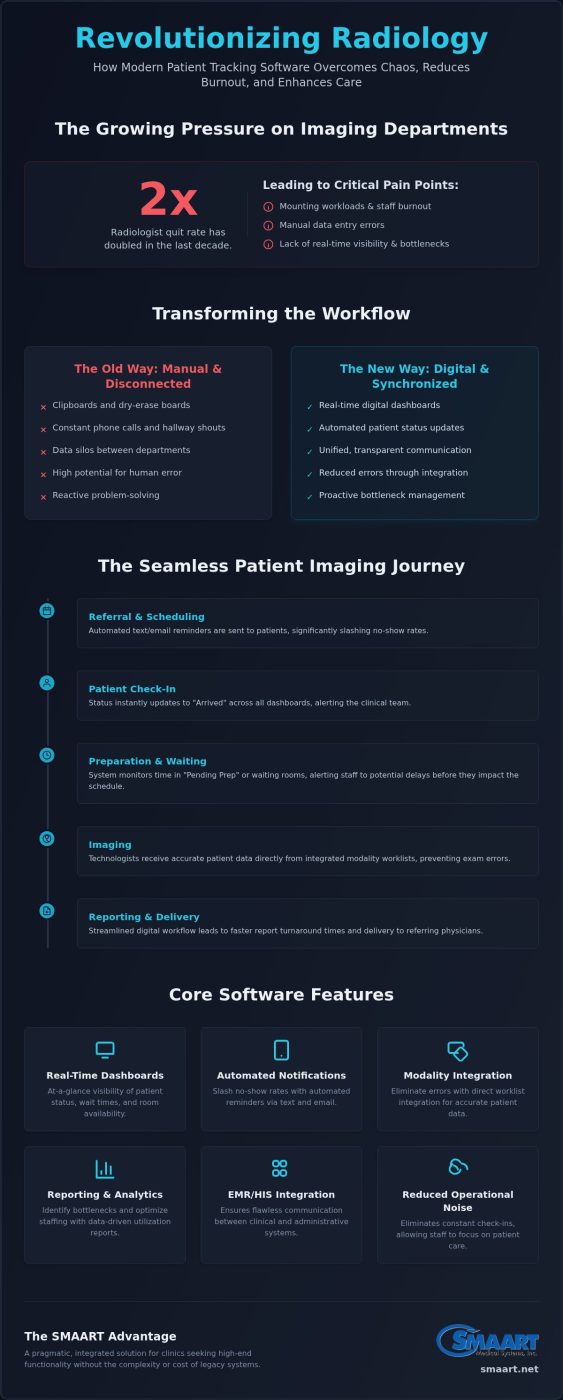
Did you know that the quit rate for radiologists has doubled over the last decade? This staggering statistic highlights the immense pressure modern imaging departments face as they struggle with mounting workloads and manual data entry errors. You’re likely all too familiar with the sight of a crowded waiting room that just won’t clear or the lack of real-time visibility into your modality utilization. Implementing radiology patient tracking software is no longer just an IT upgrade; it’s a necessary step to provide your staff with the relief they deserve while maintaining a high standard of patient care.
We understand that clinical efficiency is the backbone of your practice. This guide will show you how modern tracking solutions eliminate bottlenecks and significantly reduce no-show rates. We’ll explore how to synchronize your department for maximum efficiency, ensuring a seamless digital workflow from check-in to final signature. You’ll discover how the latest 2026 advancements in AI-driven integration, particularly through platforms like SMAART-RIS, lead to faster report turnaround times and a more predictable, profitable clinical environment that respects both your time and your patients’ needs.
Key Takeaways
- Replace manual, error-prone workflows with real-time digital dashboards to gain instant visibility into every stage of the patient imaging journey.
- Discover how modern radiology patient tracking software slashes no-show rates and reduces administrative burdens by automating patient notifications.
- Evaluate the financial and security trade-offs between cloud-based and on-premise solutions to optimize your clinic’s operational budget.
- Master a practical five-step implementation process to audit your current patient flow and configure custom status triggers that match your team’s needs.
- Learn how SMAART-RIS provides a pragmatic, integrated solution for clinics seeking high-end functionality without the complexity or cost of legacy systems.
What is Radiology Patient Tracking Software and Why Does It Matter?
In the high-pressure environment of a modern imaging center, efficiency is your most valuable asset. Radiology patient tracking software is a digital ecosystem designed to monitor every movement and milestone within the clinical journey. It’s no longer enough to simply know a patient has arrived; you need to know exactly where they are, how long they’ve been there, and what the next step in their care entails. This technology replaces the outdated manual clipboards and dry-erase boards that once defined the industry, offering a real-time pulse of your facility’s heartbeat.
The transition to digital tracking addresses a fundamental flaw in traditional workflows: data silos. Often, the front desk and the technologist operate in separate worlds. The administrative staff sees a full waiting room, while the clinical team might be waiting on a patient who is still stuck in the changing room. By integrating these functions into a unified Radiology Information System (RIS), you bridge this communication gap. In 2026, the focus has shifted toward hyper-transparent, patient-centric care. Tracking software is the engine that drives this transparency, ensuring that no patient feels forgotten and no staff member feels overwhelmed by avoidable chaos.
The Lifecycle of a Radiology Patient
The diagnostic journey is complex, beginning long before the patient walks through your doors. Modern software tracks the lifecycle from the initial referral and scheduling phase through to the final report delivery. It provides a granular view of the “in-between” moments that often lead to bottlenecks. For example, if a patient remains in a “Pending Prep” status for more than fifteen minutes, the system can trigger a subtle alert. This allows your team to identify “stalled” patients in waiting or changing rooms before their delay impacts the entire day’s schedule. Additionally, these real-time status updates can be shared with referring physicians, keeping them informed and strengthening your professional partnerships.
Operational Relief: Beyond Simple Scheduling
One of the most immediate benefits of implementing radiology patient tracking software is the dramatic reduction in “operational noise.” You’ve likely experienced the constant stream of phone calls or hallway shouts between departments just to check on a patient’s status. Digital tracking eliminates this friction. When everyone can see a live dashboard, the need for manual check-ins vanishes. This provides immense emotional relief for your staff. Clear roles and a predictable environment reduce burnout and allow your team to focus on what they do best: patient care. SMAART-RIS serves as the pragmatic foundation for this visibility, offering the sophisticated tools you need to synchronize your department without the unnecessary complexity of legacy systems.
Key Features of Advanced Patient Tracking in Radiology Information Systems
Advanced radiology patient tracking software acts as a command center for your entire facility. Real-time status dashboards provide immediate, at-a-glance facility management, allowing administrators to see room availability and patient wait times instantly. By integrating directly with modality worklists, the system ensures technologists receive accurate patient data without manual intervention. This eliminates the risk of misidentifying exams and ensures the right scan is performed for the right patient every time. When your clinical team has immediate access to the correct data, the entire diagnostic process moves faster.
Automated patient notifications are a primary tool for slashing no-show rates. These systems send text or email reminders based on the live schedule, keeping your modalities running at peak capacity. Beyond the daily workflow, robust reporting and analytics help you visualize modality utilization over time. You can identify exactly when peak-hour bottlenecks occur, allowing you to make data-driven decisions about staffing and equipment upgrades. This level of insight transforms a reactive office into a proactive clinical environment. Accelerating the final step of this process is equally critical, and exploring radiology information system reporting features like integrated speech recognition can dramatically reduce the time between exam completion and report delivery.
Seamless EMR and HIS Integration
Interoperability is the bridge between clinical data and administrative flow. For a tracking system to be truly effective, it must communicate flawlessly with your existing medical records. Seamless EMR and HIS integration ensures that patient demographics and insurance details flow into the RIS automatically. The benefit is clear: zero-duplicate data entry for patient registration. This reduces the burden on your front-office staff and eliminates the clerical errors that often lead to billing delays. Following RIS EMR integration best practices can provide the technical harmony and operational relief your clinic needs to eliminate data silos and accelerate reimbursement. If your current setup feels like a collection of disconnected tools, exploring integrated radiology solutions can provide the technical harmony and operational relief your clinic needs.
Patient Engagement and Portals
Modern patients expect the same digital convenience in healthcare that they find in every other industry. Self-service check-in kiosks and mobile-friendly registration forms reduce front-desk friction and speed up the “Arrived” status trigger in your tracking system. Once the imaging is complete, SMAART-SHARE facilitates easy results distribution to both patients and referring physicians. Providing secure, cloud-based access to images and reports significantly improves patient retention. When patients can access their results on their own terms, it builds trust and reduces the volume of status-check phone calls coming into your office.
Cloud-Based vs. On-Premise Tracking: Which Fits Your Clinic?
Choosing the right infrastructure for your radiology patient tracking software is a pivotal decision that impacts both your daily operations and your long-term financial health. Traditionally, many clinics opted for on-premise servers to maintain a sense of total control. However, this model requires significant capital expenditure (CapEx) for hardware, cooling, and physical security. In contrast, cloud-based solutions shift the burden to predictable operational costs (OpEx). This allows you to pay for what you use while avoiding the sudden, massive costs of server replacements. It’s a pragmatic shift that aligns your technology spend with your actual patient volume.
Security remains a top priority for any imaging center. Modern cloud-based platforms offer HIPAA-compliant storage that often exceeds the security capabilities of a local IT closet. These systems encrypt data both at rest and in transit, providing a level of protection that’s difficult for small-to-midsize clinics to replicate on their own. The flexibility of the cloud is also a major advantage. Radiologists can access worklists and images from home, and administrators can monitor facility performance from any location. This remote access ensures that your workflow never stops, even if you aren’t physically in the office.
Let’s address the reliability myth. Many fear that an internet outage will paralyze their clinic. While connectivity is essential, local servers are actually more likely to suffer from hardware failures, power surges, or software corruption. Cloud providers maintain redundant data centers with near-perfect uptime. If your local power goes out, your data remains safe and accessible the moment you’re back online. You don’t have to worry about a single point of failure crashing your entire diagnostic schedule.
Scalability for Multi-Site Clinics
Cloud systems act as a single source of truth for organizations with multiple locations. Instead of managing separate databases for each branch, you can synchronize patient data across geographic boundaries instantly. Adding a new modality or a second office doesn’t require buying new servers. You simply scale your existing subscription. SMAART-SHARE serves as a perfect model here, providing secure, hardware-free image distribution that grows alongside your business without the growing pains. This seamless expansion is vital for clinics looking to capture more of the market in 2026.
Reducing IT Overhead and Maintenance
The emotional relief of offloading technical maintenance shouldn’t be underestimated. With a cloud-based RIS, your software provider handles all server patches, security updates, and backups. You don’t need a massive on-site IT team just to keep the lights on. This focus on fiscal responsibility ensures you’re maximizing your ROI. For smaller imaging centers, this means redirecting funds from IT infrastructure toward better patient care and advanced diagnostic equipment. Cloud tracking ensures business continuity, letting you focus on clinical results rather than server maintenance.
How to Implement a Radiology Patient Tracking Workflow: A 5-Step Guide
Implementing radiology patient tracking software requires more than just a software installation; it demands a strategic shift in how your team handles data. Success depends on a clear roadmap that bridges the gap between your front office and the reading room. By following a structured implementation plan, you can transform a chaotic waiting area into a synchronized, efficient clinical environment. This process ensures that your technology investment translates into immediate operational relief.
Step 1: Mapping the Patient Journey
Before you configure a single setting, you must audit your current flow to identify where patients wait the longest and where data typically gets lost. Involve both your front-desk coordinators and your clinical technologists in this mapping process. They see the friction points that administrators might miss. A bottleneck in a radiology context is defined as any stage where a patient’s dwell time exceeds 15 minutes without a status change or staff interaction. Identifying these specific points allows you to target your software configuration for maximum impact and staff satisfaction.
Step 2 involves configuring specific status triggers within your RIS. You’ll need to define clear milestones such as “Arrived,” “Changing,” “In-Exam,” and “Pending Report.” Once these are set, Step 3 focuses on staff training. Establish a “single source of truth” policy where every team member is responsible for real-time data entry. If a status isn’t updated in the software, it didn’t happen. This discipline ensures that your live dashboard remains accurate and reliable for every department in the facility.
Step 4: Integrating with Existing Infrastructure
Your tracking system cannot exist in a vacuum. It must communicate flawlessly with your Hospital Information System (HIS) and Electronic Medical Records (EMR). This integration typically happens via HL7 protocols or proprietary APIs. Ensure that SMAART-RIS and SMAART-PACS are fully synced with your HIS to allow for a seamless data flow. You must test the “round-trip” of data. This means verifying that an order entered in the HIS correctly triggers a patient record in the tracking software and that the final diagnostic report flows back to the patient’s permanent record without manual intervention. Verifying HIPAA compliance at every touchpoint of the tracking journey is non-negotiable during this phase. For a deeper look at how to structure this process effectively, reviewing RIS EMR integration best practices for seamless radiology workflows can help you avoid common pitfalls and reduce claim denials tied to data mismatches.
Finally, Step 5 requires a commitment to continuous improvement. Review your weekly analytics to compare your scheduled appointment times against actual exam durations. This data allows you to refine your scheduling templates, reducing wait times and maximizing modality throughput. If you’re ready to bring this level of precision to your facility, you can explore SMAART-RIS workflow solutions to see these tracking features in action. This methodical approach ensures your clinic remains competitive and patient-focused throughout 2026.
The SMAART Advantage: Affordable, Integrated Radiology Management
Choosing the right radiology patient tracking software shouldn’t feel like a financial gamble. Many smaller imaging centers feel forced into legacy enterprise systems that are over-engineered and overpriced. We offer a pragmatic alternative that balances technical authority with a refreshing level of accessibility. SMAART-RIS delivers high-end tracking and scheduling capabilities without the prohibitive costs often associated with industry giants. It’s about giving your team the tools they need to succeed while maintaining strict fiscal responsibility over your operational budget.
We’ve discussed the technical steps of implementation in previous sections. What sets our approach apart is the focus on reducing deployment anxiety through a supportive partnership model. We ensure our software works in technical harmony with your current EMR and HIS platforms from the very first day. We don’t just provide a one-time transaction; we act as a long-term ally in your clinic’s success. This ongoing support ensures that as your patient volume grows, your workflow remains synchronized and efficient.
Why SMAART-RIS Outperforms Generic Solutions
Generic office management tools often fail because they don’t understand the specific pressures of a high-volume imaging environment. SMAART-RIS was built by radiology experts who know the importance of modality synchronization and real-time data visibility. The deep integration between SMAART-RIS and SMAART-PACS creates a unified clinical ecosystem where data flows without friction. Beyond tracking, the platform’s radiology information system reporting features, including built-in speech recognition, further accelerate turnaround times by eliminating costly third-party transcription. You get a single, reliable point of contact for support and a partner who is deeply invested in the ongoing success of your users. This expert-driven design provides the operational relief your staff needs to focus on diagnostic excellence.
Ready to Streamline Your Patient Tracking?
Modernizing your facility is a journey toward greater efficiency and reduced administrative strain. If your current manual processes are causing bottlenecks or data silos, it’s time to see how a digital command center can change your daily routine. We make the transition from legacy software straightforward and predictable, ensuring your clinical operations continue without interruption. You deserve a system that is both elite in its expertise and humble in its service to your team.
Don’t let outdated workflows hold your practice back. We invite you to see our integrated solutions in action and experience a more approachable way to manage your facility. Contact SMAART Medical Systems, Inc. for a personalized workflow audit and take the first step toward achieving maximum efficiency in your radiology department.
Transform Your Clinical Workflow for 2026 and Beyond
The evolution of clinical imaging in 2026 demands a shift from reactive problem-solving to proactive facility management. Throughout this guide, we’ve explored how a robust radiology patient tracking software solution serves as the central nervous system of a modern clinic. By eliminating manual data silos and synchronizing staff roles, you provide the operational relief necessary to combat industry burnout while simultaneously improving the patient experience. Whether you’re transitioning to the cloud or auditing your current journey, the goal remains the same: a seamless, digital-first environment.
SMAART Medical Systems, Inc. is committed to being your reliable partner in this modernization. We’ve built our tools, including SMAART-RIS and the cloud-based SMAART-SHARE, to ensure that high-end functionality remains accessible and affordable for clinics of all sizes. By prioritizing technical harmony and fiscal responsibility, we help you achieve a faster report turnaround and a more resilient practice. You don’t have to navigate the complexities of digital transformation alone.
Request a SMAART-RIS Demo to Modernize Your Radiology Workflow and see how our integrated approach can transform your daily operations. Let’s work together to build an efficient, patient-centric future for your facility.
Frequently Asked Questions
How does radiology patient tracking software reduce no-show rates?
Tracking software reduces no-shows by automating the patient communication cycle through text and email reminders. These notifications are triggered directly by the schedule within your RIS, ensuring patients receive timely alerts about their upcoming appointments. By keeping the patient engaged and providing easy options for confirmation, you create a more predictable schedule and maximize your modality utilization.
Can patient tracking software integrate with my existing EMR system?
Yes, modern radiology patient tracking software is designed to communicate with existing EMR and HIS platforms using standard HL7 and DICOM protocols. This integration allows for a seamless flow of patient demographics and insurance data, which eliminates the need for manual, duplicate data entry. SMAART-RIS is specifically engineered to bridge these clinical and administrative data silos for a unified digital environment.
Is cloud-based radiology software secure enough for HIPAA compliance?
Cloud-based solutions often provide superior security compared to local servers by using advanced encryption for data both at rest and in transit. These platforms are built to meet strict HIPAA compliance standards, offering redundant data storage and automated backups that protect against local hardware failures. Choosing a cloud-native system ensures your patient data remains secure while providing the flexibility of remote access for your staff.
What is the difference between a RIS and a patient tracking system?
A Radiology Information System (RIS) is a comprehensive platform that manages the entire imaging business, while patient tracking is a specific workflow feature within that system. While the RIS handles billing and long-term records, the tracking component focuses on the real-time physical location and clinical status of the patient. Effective radiology patient tracking software provides the granular visibility needed to manage daily facility traffic efficiently.
How long does it typically take to implement a new tracking workflow?
Implementation generally takes between four to eight weeks, depending on the complexity of your current infrastructure and the level of EMR integration required. This timeframe includes the initial workflow audit, software configuration, and comprehensive staff training to ensure everyone follows a single source of truth. A structured approach minimizes downtime and allows your team to experience operational relief quickly.
Does patient tracking software help with radiology billing accuracy?
Yes, tracking software improves billing accuracy by ensuring that every completed exam is automatically documented and time-stamped within the system. This digital trail prevents “lost” charges that often occur with manual paper-based tracking methods. By verifying that the clinical exam status matches the administrative record, you ensure that your billing department has the precise data needed for clean claim submissions.
Can I track patient wait times across multiple clinic locations?
Cloud-based tracking platforms allow you to monitor wait times and modality utilization across all your geographic locations from a single, centralized dashboard. This high-level visibility is essential for multi-site administrators who need to balance patient loads and identify peak-hour bottlenecks in real time. It provides a unified view of your entire organization, allowing for better resource allocation and consistent patient care standards.