
RIS Implementation Best Practices: Integrating Billing for Maximum Revenue in 2026
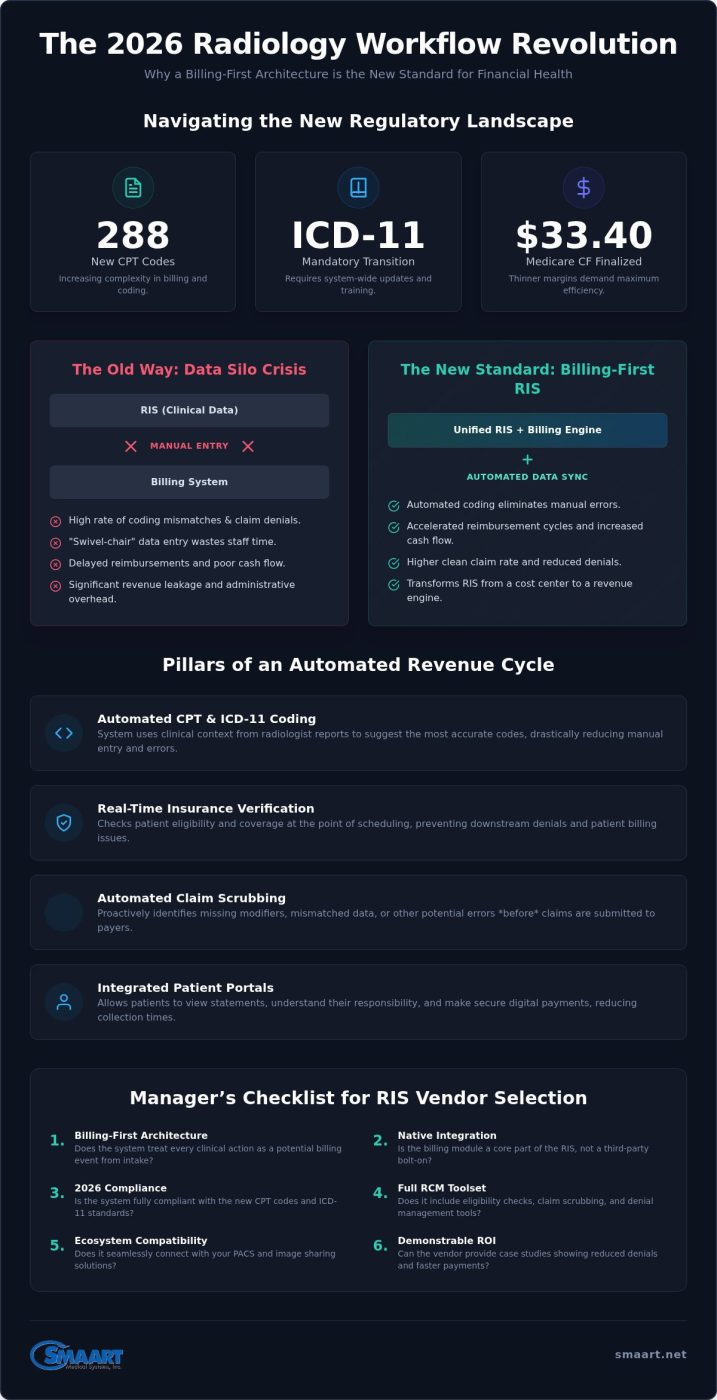
With 288 new CPT codes introduced for 2026 and a finalized Medicare conversion factor of $33.4009, your margin for administrative error has never been thinner. It’s frustrating to manage a practice where manual data entry between clinical and billing systems leads to coding mismatches and denied claims. You deserve the relief of a system that works as hard as your radiologists do. Successful RIS implementation best practices in this new regulatory environment require a billing-first architecture that turns clinical data into a frictionless revenue engine.
We understand that software transitions often feel like an operational headache. That’s why we’ve designed this guide to help you master the complexities of modernizing your workflow. You’ll learn how to eliminate data silos, automate the ICD-11 transition, and accelerate your reimbursement cycles. We will preview the strategic steps to integrate your financial and clinical data into a single, reliable source using solutions like SMAART-RIS. By the end of this article, you’ll have a clear roadmap to reduce your IT burden and ensure your practice thrives in 2026.
Key Takeaways
- Learn how a billing-first architecture transforms your RIS from a simple scheduling tool into a high-performance revenue engine.
- Discover RIS implementation best practices for automating CPT and ICD-10 coding to eliminate manual entry errors and accelerate your reimbursement cycles.
- Identify the hidden operational costs of data silos and how integrated systems prevent claim denial rates from impacting your bottom line.
- Access a pragmatic manager’s checklist to verify vendor compliance with 2026 US billing standards and native software integration.
- Explore how a unified ecosystem like SMAART-RIS integrates with SMAART-PACS and SMAART-SHARE to create a seamless flow of clinical and financial data.
Defining the 2026 Radiology Information System: Why Billing Integration is the New Standard
A modern Radiology Information System is far more than a digital calendar for scheduling scans. In 2026, it serves as the central nervous system for your facility, managing the complex intersection of clinical care and financial sustainability. Traditional systems often siloed patient care from the billing office, creating a gap where revenue frequently leaked out. Modern RIS implementation best practices now prioritize a “billing-first” architecture that treats every clinical interaction as a financial data point from the moment of intake.
Your team handles two distinct languages every day. Clinical data relies on DICOM and HL7 protocols to move images and reports. Financial data uses CPT and ICD-10 codes to secure reimbursement. When these systems are disconnected, your staff spends hours manually translating clinical findings into billable codes. This manual “swivel-chair” data entry is a primary source of errors that trigger claim denials. The industry is rapidly moving away from disconnected third-party billing services in favor of native, unified ecosystems that sync these data streams automatically.
The Evolution of RIS Informatics
We’ve moved past the era of digital clipboards. Today’s informatics platforms function as automated revenue engines. For regional clinics and hospitals, the shift toward unified platforms is a necessity for survival. SMAART-RIS bridges the gap between patient care and payment by ensuring that the moment a radiologist signs a report, the corresponding billing data is already moving toward the payer. It eliminates the delay between the service provided and the invoice generated, providing a level of modern efficiency that legacy systems can’t match.
Why Billing Integration is No Longer Optional
The US insurance landscape in 2026 is incredibly complex. With 288 new CPT codes and finalized ICD-11 transition requirements, relying on manual data transfer is a recipe for financial strain. Disconnected billing services often lack the real-time clinical context needed to fight denials effectively. By following RIS implementation best practices and integrating your financial modules, you remove the friction that slows down your cash flow. Integrating your billing directly into your RIS typically yields a positive return on investment within the first year by reducing administrative overhead and slashing claim denial rates.
Key Implementation Pillars: Automating the Revenue Cycle within the RIS
Automation isn’t just a luxury; it’s the foundation of modern financial health for radiology practices. Implementing a system that handles the heavy lifting of billing ensures your staff can focus on patient care rather than paperwork. One of the most effective RIS implementation best practices involves embedding automation directly into the clinical workflow. This starts with automated CPT and ICD-11 coding triggered by the radiologist’s finalized report. By using clinical context to suggest the most accurate codes, you reduce the risk of mismatches that lead to costly denials.
Efficiency begins before the patient even walks through the door. Real-time insurance eligibility verification at the point of scheduling prevents coverage gaps that stall the revenue cycle. Once a service is rendered, seamless claim scrubbing identifies missing modifiers or mismatched data before the claim hits the payer’s portal. This proactive approach ensures a higher clean claim rate and faster reimbursement. To see how these automated features work in a live clinical environment, you can explore the SMAART-RIS workflow and its integrated billing capabilities.
Transparency builds trust and speeds up the collection process. Integrated patient portals allow patients to view their statements, understand their financial responsibility, and make digital payments instantly. This reduces the administrative burden of mailing paper statements and significantly lowers the time spent chasing outstanding balances. When the patient experience is frictionless, your revenue cycle moves faster.
Revenue Cycle Management (RCM) Tools
Managing the lifecycle of a claim shouldn’t require multiple software logins or manual spreadsheets. Advanced RCM tools allow your team to track claims from submission to final adjudication within a single interface. When a denial occurs, SMAART-RIS allows you to use clinical data as evidence for the appeal, simplifying the rebuttal process. The system also alerts staff to missing billing data instantly, preventing incomplete submissions from leaving the office and ensuring every exam is accounted for.
Advanced Financial Analytics and Reporting
You can’t manage what you don’t measure. Modern dashboards provide real-time visibility into KPIs like Days in AR and clean claim rates. Analyzing modality-specific revenue helps you make informed decisions about equipment investments or staffing needs based on actual profitability. These tools also generate digital audits, ensuring your facility remains compliant with 2026 HIPAA and payer requirements without the stress of manual record-keeping or last-minute data gathering.
Integrated RIS vs. Standalone Billing: Breaking the Data Silo Crisis
Many clinics still struggle with “swivel-chair” data entry. This is the exhausting process of manually copying patient names, dates of birth, and insurance IDs from a clinical RIS into a separate billing portal. It’s not just tedious; it’s a financial risk. Data silos are a primary driver behind claim denial rates that often exceed 10% in radiology departments. When your clinical and financial systems don’t talk, errors become inevitable. Adopting RIS implementation best practices means choosing a system that serves as a single source of truth for both patient records and financial history.
Moving to an integrated model significantly reduces IT overhead. Maintaining multiple software licenses, managing separate updates, and troubleshooting fragmented interfaces drains your technical resources. A unified platform simplifies your tech stack. It provides a cohesive environment where clinical outcomes and financial performance are viewed together. This allows administrators to make better decisions without digging through disconnected reports or waiting for manual reconciliation at the end of the month.
Eliminating Redundant Data Entry
The real-world impact of integration is immediate relief for your administrative staff. When a patient checks in, their demographic and insurance information should auto-populate the billing forms directly from the initial RIS intake and PACS metadata. This eliminates the “human factor” in data entry errors. A streamlined, one-click billing workflow allows your team to spend less time on reconciliation and more time on patient-facing tasks. It’s the difference between chasing data and managing a practice.
Enhancing Interoperability with PACS and EMR
True efficiency requires your RIS to communicate fluently with other critical systems. SMAART-RIS is built to interface with integrated RIS PACS solutions, ensuring that clinical images and financial data remain linked throughout the patient journey. This interoperability ensures financial data is accessible within the broader hospital EMR ecosystem, reducing friction during software transitions. By using SMAART-SHARE, you can distribute results to referring physicians alongside clear billing info, creating a transparent experience for both providers and patients. This level of connectivity is a cornerstone of modern RIS implementation best practices.
A Manager’s Checklist for RIS Deployment: Ensuring Billing Accuracy
Transitioning to a new system shouldn’t feel like a gamble. As a manager, your priority is ensuring that the software you choose doesn’t just work, but works specifically for your financial goals. One of the core RIS implementation best practices is evaluating a vendor’s history with US billing compliance. You need a partner that stays ahead of 2026 ICD-11 updates and Medicare conversion factors. Avoid “bolt-on” billing modules; these third-party additions often lack the deep integration required to prevent data lag. Native billing ensures that clinical data flows into financial forms without a hitch.
Intake is the front line of your revenue cycle. If the software is too complex for front-desk staff, your data quality will suffer. Verify that the interface is intuitive enough to allow for rapid patient check-ins and real-time eligibility checks. Your system also needs to grow with you. Assess whether the software can handle a significant increase in exam volume without slowing down or requiring expensive hardware upgrades. To see how a pragmatically designed system can streamline your facility, request a walkthrough of SMAART-RIS today.
Technical Integration and Security Requirements
Security isn’t just about passwords; it’s about how your data moves. Ensure the system supports current DICOM and HL7 standards to maintain compatibility with your other tools. A robust RIS should also handle hospital imaging workflow optimization to keep patients moving and revenue flowing. When discussing security, ask the vendor for specific protocols regarding cloud-based storage. Cloud systems often provide superior disaster recovery and HIPAA-compliant encryption compared to aging on-premise servers.
Evaluating Support and Training
The relief of a successful launch comes from having a reliable partner in your corner. Your vendor’s support team should understand the high-stakes nature of radiology. Training is the final hurdle. Look for a vendor that provides modular training sessions, allowing your staff to learn new billing workflows without causing clinical downtime. The ideal vendor-client partnership for RIS implementation is one where technical expertise meets a deep, ongoing commitment to your facility’s operational success. By following these RIS implementation best practices, you can ensure your team feels supported and your revenue cycle remains secure.
Optimizing Your Clinic with SMAART-RIS: Pragmatic Deployment for Modern Facilities
SMAART-RIS isn’t just another software package; it’s a strategic response to the financial and operational pressures facing US clinics. By adhering to RIS implementation best practices, we’ve developed a system that prioritizes administrative relief without sacrificing technical depth. It bridges the gap between clinical excellence and fiscal responsibility. Our approach focuses on removing the “swivel-chair” data entry that plagues so many facilities, allowing your team to focus on patient care instead of fighting with fragmented software. We provide the tools you need to stay competitive in an increasingly complex market.
The true power of the system lies in its seamless connectivity. SMAART-RIS works in perfect harmony with SMAART-PACS and SMAART-SHARE. This unified ecosystem ensures that images, reports, and billing data move through your facility without the friction of third-party “bolt-on” modules. You get a single, reliable stream of information that accelerates your revenue cycle. This level of integration reduces the IT burden of managing separate licenses and ensures that your financial data is always as accurate as your clinical reports, providing a foundation for long-term growth.
The SMAART Advantage for Radiology Centers
Many facilities feel trapped by legacy software from industry giants that carry high costs and complex interfaces. SMAART-RIS offers a full-feature alternative designed specifically for the needs of regional hospitals and private clinics. Our user-friendly interfaces prioritize clarity, significantly reducing the training time for your staff. We provide dedicated, US-based support to ensure you’re never left troubleshooting critical systems alone. This commitment to ongoing partnership ensures that your software modernizes alongside the industry, keeping your facility compliant and efficient as regulations shift.
Taking the Next Step Toward Efficiency
Preparing for a 2026 workflow upgrade requires a partner that understands the evolving regulatory landscape. From managing the finalized 3.26% Medicare conversion factor increase to accurately billing for the 288 new CPT codes, your RIS must be agile. We invite you to see how our clinical and billing modules can transform your daily operations and eliminate revenue leaks. A live demo can show you exactly how RIS implementation best practices are baked into every screen of our software. Experience the SMAART-RIS difference today and discover the relief of a truly integrated radiology workflow.
Transform Your Radiology Revenue Cycle
Mastering your facility’s financial health in 2026 requires more than just updated software; it demands a strategic shift toward unified data. By prioritizing RIS implementation best practices, you can bridge the gap between clinical excellence and administrative efficiency. We’ve explored how automated coding and real-time eligibility checks provide the relief of a frictionless workflow. Moving away from fragmented systems ensures that your clinical reports and financial claims remain perfectly synchronized, protecting your bottom line from avoidable denials.
SMAART Medical Systems, Inc. provides affordable, full-feature solutions designed to integrate seamlessly with your existing EMR and HIS platforms. Our proprietary ecosystem, including SMAART-PACS and SMAART-SHARE, focuses on modern efficiency while reducing your daily operational burdens. You don’t have to navigate these technical complexities alone. It’s time to experience the clarity and financial stability your practice deserves.
Request a SMAART-RIS Demo to Modernize Your Billing Workflow and see how a pragmatic approach can accelerate your reimbursement cycles today. We look forward to helping your facility thrive.
Frequently Asked Questions
What is the difference between a RIS and a radiology billing system?
A Radiology Information System (RIS) primarily manages the clinical workflow, including patient registration, scheduling, and tracking results. A radiology billing system focuses on financial transactions, insurance claims, and payment processing. Following RIS implementation best practices means choosing a unified platform like SMAART-RIS that combines these functions. This integration eliminates the need for manual data transfer between clinical and financial desks, reducing administrative errors and speeding up your reimbursement cycle.
Can an integrated RIS really reduce my claim denial rates?
Integrated systems significantly lower claim denial rates by ensuring clinical and financial data stay synchronized. When your RIS and billing modules share a single database, the system identifies coding mismatches or missing insurance information before you submit the claim. This proactive scrubbing prevents the common errors that lead to the 10% denial rates often seen in fragmented workflows. It’s a pragmatic way to secure your revenue and reduce the burden on your administrative staff.
How long does it take to implement a new RIS with billing integration?
Implementation timelines vary based on your facility’s size and the complexity of your existing data. Most clinics can expect a full transition to take between eight to twelve weeks. This period includes data migration, system configuration, and staff training. We focus on a methodical deployment that minimizes clinical downtime. Our team works as a reliable partner to ensure your billing workflows are fully functional and your staff feels confident before you go live.
Is it better to have a cloud-based or on-premise RIS for billing?
Cloud-based systems are the modern standard for radiology billing due to their superior accessibility and security. They offer real-time updates for 2026 coding changes and ensure your data is stored in HIPAA-compliant environments with automatic backups. On-premise systems often require significant hardware investments and manual maintenance. A cloud-based RIS reduces your IT burden and allows your team to manage billing and scheduling from any secure location, providing a level of flexibility that on-premise servers can’t match.
Does SMAART-RIS integrate with my existing EMR and PACS?
SMAART-RIS is specifically built to integrate seamlessly with existing EMR and HIS platforms using standard HL7 and DICOM protocols. It also works natively with SMAART-PACS and SMAART-SHARE to create a unified imaging ecosystem. This connectivity ensures that clinical images and financial data move fluidly through your facility. By bridging the gap between clinical care and administrative tasks, we help you maintain a single source of truth for all patient clinical and financial records.
What are the ICD-10 and CPT coding requirements for 2026 radiology?
Radiology practices in 2026 must manage 288 new CPT codes and the ongoing transition toward ICD-11 standards. These updates focus on coronary therapeutic services and lower extremity revascularization. Using RIS implementation best practices involves deploying software that automates these code updates. SMAART-RIS identifies the most accurate codes directly from radiologist reports, helping you stay compliant with the finalized 2026 Medicare conversion factor and avoiding the financial strain of outdated coding practices.
How much does integrated radiology information system software cost?
The cost of an integrated RIS depends on your facility’s volume and the specific modules your team requires. SMAART Medical Systems focuses on providing an affordable alternative to overpriced industry giants without sacrificing full-feature functionality. Instead of high upfront costs for proprietary hardware, our subscription-based model allows for predictable monthly expenses. This approach helps regional clinics and hospitals reduce their financial strain while gaining access to modern, high-performance radiology management tools.
Can SMAART-RIS handle multi-site billing for clinic groups?
SMAART-RIS is designed to manage complex, multi-site billing for clinic groups and regional hospital networks. It centralizes your financial data, allowing administrators to track revenue across multiple locations from a single dashboard. You can customize billing rules for each site while maintaining a unified patient database. This scalability ensures that as your facility’s exam volume grows or you add new locations, your billing infrastructure remains stable and your reporting stays accurate.