
2026 Guide: Reducing Medical Image Storage Costs & PACS Total Cost of Ownership
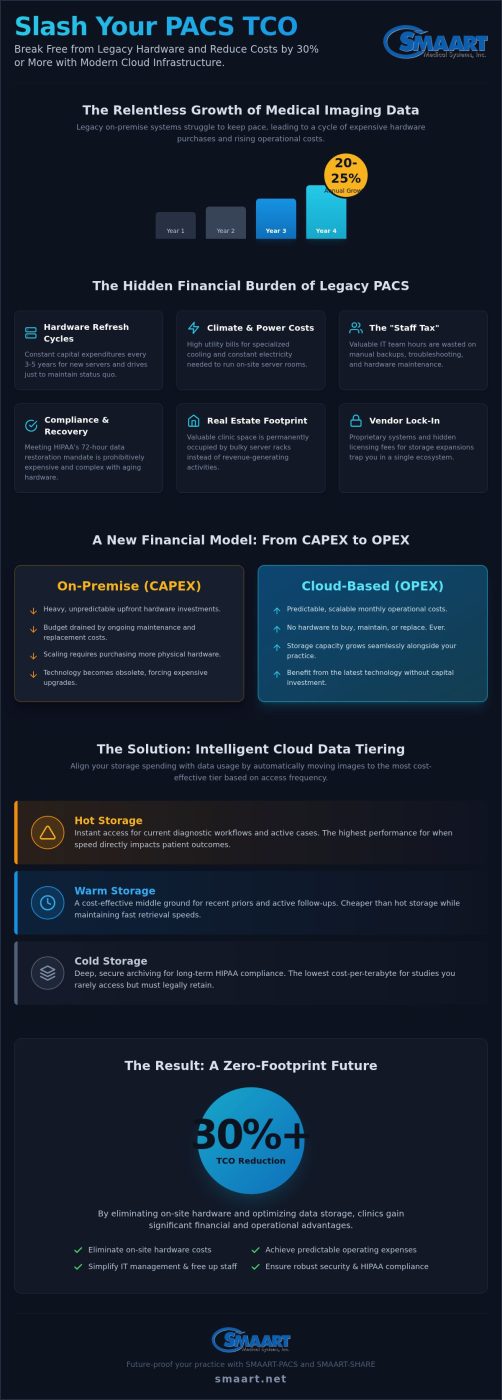
Did you know that the average medical practice now sees its imaging data volumes explode by 20 to 25 percent every single year? It’s a relentless cycle of buying more hard drives and paying for expensive maintenance on aging on-site servers just to keep your head above water. You likely feel the weight of these rising expenses every month as you struggle to manage complex multi-site data without a clear path toward financial relief.
We understand that the burden of maintaining legacy hardware often feels like a barrier to providing better patient care. This guide shows you how to break that cycle and slash your PACS total cost of ownership by 30 percent or more through modern cloud tiering and infrastructure optimization. By moving away from the hidden costs of on-premise systems, you can secure a more predictable financial future for your facility.
We’ll explore the strategic shift from heavy upfront capital expenditures to flexible monthly operating models. You’ll discover how tools like SMAART-PACS and SMAART-SHARE create a scalable, zero-footprint environment that grows alongside your clinic while simplifying your IT footprint. It’s time to stop overpaying for storage and start investing in modern efficiency.
Key Takeaways
- Understand the transition from heavy upfront capital expenditures to predictable monthly operating costs that scale with your clinic’s growth.
- Learn to optimize your PACS total cost of ownership by implementing tiered storage strategies that move data based on access frequency.
- Identify immediate savings opportunities by conducting a digital audit and replacing outdated physical media with secure, cloud-based sharing.
- Discover how SMAART-PACS and SMAART-SHARE provide a modern, zero-footprint alternative to the hardware-heavy systems of legacy industry giants.
The Hidden Financial Burden of Legacy Medical Image Storage
Many administrators view their Picture archiving and communication system (PACS) budget as a simple line item for server space. However, true storage overhead includes every dollar spent keeping that hardware operational. With imaging data volumes climbing 20 to 25 percent annually, the gap between disk price and operational reality is widening. Calculating your PACS total cost of ownership requires looking beyond the hardware invoice to the secondary expenses that drain your monthly revenue.
Physical servers demand climate-controlled environments. You’re paying for dedicated square footage, specialized cooling systems, and the constant electricity required to keep high-performance drives spinning. These utility costs are often buried in general facility overhead, but they’re direct contributors to a bloated imaging budget. When you factor in the physical real estate occupied by server racks, the cost per gigabyte effectively doubles.
Then there’s the “Staff Tax.” Every hour your IT team spends troubleshooting a failing local RAID array or managing manual backups is an hour they aren’t improving clinic throughput. This labor cost is a significant part of the PACS total cost of ownership that many facilities overlook until technical debt becomes unmanageable. Relying on outdated backup protocols also creates a massive financial liability. If a local server fails without a modern, automated recovery plan, the cost of disaster recovery and potential compliance fines can easily exceed the original price of the system.
Why Traditional PACS Hardware is a Sunk Cost
On-premise hardware typically follows a 3 to 5 year refresh cycle. Just as you finish paying off the initial capital expenditure, the equipment reaches its end-of-life, forcing another massive investment. These cycles often include hidden licensing fees for proprietary storage expansions that lock you into a single vendor’s ecosystem. Maintaining redundant, geographically separate local backups further increases your hardware footprint without adding diagnostic value.
Regulatory Pressures and Retention Costs
The 2026 HIPAA updates mandate a 72-hour restoration capability for all data, which is technically difficult and prohibitively expensive to achieve with aging on-site hardware. HIPAA and HITECH regulations create a financial drain when clinics default to indefinite retention for non-accessed prior exams. Storing 15 years of “cold” data on “hot” local servers is an expensive mistake. Data retention fatigue serves as a primary driver of radiology budget bloat.
Mastering Data Tiering: Hot, Warm, and Cold Storage Models
Managing your PACS total cost of ownership effectively requires a shift in how you view data storage. Cloud tiering isn’t just a technical buzzword. It’s a pragmatic strategy to align your spending with how you actually use data. Instead of paying premium prices to keep every image on high-speed hardware, you distribute data across three distinct levels based on access frequency.
Early Analysis of the cost-effectiveness of PACS highlighted how critical resource allocation is to a facility’s bottom line. Modern tiering models solve this by segmenting storage into three categories:
- Hot Storage: This provides high-performance, instant access for current diagnostic workflows. It’s the most expensive tier but essential for active cases where speed impacts patient outcomes.
- Warm Storage: A cost-effective middle ground for recent priors and active follow-ups. It’s cheaper than hot storage while maintaining retrieval speeds that don’t disrupt a radiologist’s rhythm.
- Cold Storage: Deep archiving for long-term HIPAA compliance. This tier offers the lowest cost per terabyte for studies you rarely access but must legally retain for years.
By implementing these levels, clinics can stop the financial drain of “over-provisioning” their hardware. You only pay for high-speed performance when you actually need it. This architectural shift provides immediate relief to your operational budget without sacrificing diagnostic quality.
Automating the Lifecycle of a DICOM Image
Manual data management is a recipe for error and wasted time. Modern systems use metadata and AI to trigger the automatic movement of studies between tiers. You can set specific retention policies, such as moving any study over three years old to cold storage automatically. This reduces retrieval latency for current cases while ensuring your storage footprint stays lean. If you want to see how automation simplifies these complex workflows, explore how SMAART-PACS integrates these rules into your daily routine.
Tiering vs. Traditional Compression
Lossless compression was once the primary way to save space, but it’s no longer enough for today’s high-resolution imaging. 3D mammography and high-slice CT scans create massive datasets that demand more than just file shrinking. Tiering addresses the PACS total cost of ownership by focusing on the infrastructure cost rather than just the file size. While compression helps, moving a 10TB archive from hot to cold storage provides a much more significant impact on your monthly operating expenses.
CAPEX vs. OPEX: The Financial Case for Cloud-Based PACS
The traditional model of medical imaging relies heavily on Capital Expenditure (CAPEX). This approach requires massive upfront investments in servers, networking hardware, and perpetual software licenses. For a growing clinic, this creates a significant financial hurdle every few years. Shifting to an Operating Expenditure (OPEX) model changes the math entirely. Instead of a one-time budget shock, you move to a predictable monthly subscription that aligns with your actual clinical volume.
This transition is a cornerstone of reducing your PACS total cost of ownership. Cloud-based systems offer financial elasticity that physical hardware simply can’t match. In a legacy environment, you must purchase enough storage to last five years, meaning you’re paying for empty disk space today. With a cloud model, you pay only for the terabytes you use this month. This “pay-as-you-grow” structure provides immediate relief to your cash flow and allows for more aggressive reinvestment in patient care technology.
Moving to the cloud also reshapes your human resource costs. Vendor-managed infrastructure reduces the need for specialized on-site IT staffing dedicated to server maintenance and hardware troubleshooting. Your team can pivot from managing “blinking lights” in a server room to optimizing clinical workflows. This reduction in indirect labor costs is often the hidden catalyst that makes the cloud model more profitable over a ten-year horizon.
Eliminating the Hardware Refresh Cycle
Cloud-native systems remove the burden of the dreaded hardware refresh cycle. You’ll never have to worry about server end-of-life or the technical debt associated with aging processors. Scaling your capacity happens instantly in the software, not by ordering and installing physical drives. To understand the long-term benefits of this transition, read more about Enterprise PACS Solutions: The Shift to Cloud Based Medical Imaging Storage in 2026.
Improving Interoperability and Workflow Efficiency
Financial waste often stems from fragmented data. When your RIS and PACS don’t communicate perfectly, you end up with duplicate entries and redundant storage. Integrated solutions solve this by creating a single source of truth for patient data. Additionally, using a zero-footprint diagnostic viewer eliminates the need for high-end, proprietary workstation hardware at every desk. You can find more details on these efficiencies in our Modernizing Workflow with Integrated RIS PACS Solutions: A 2026 Strategic Guide. This approach further lowers your PACS total cost of ownership by extending the life of your existing office computers.
5 Immediate Steps to Lower Your Radiology Storage Overhead
Reducing your PACS total cost of ownership doesn’t have to be a multi-year project. You can start seeing relief in your monthly budget by addressing specific inefficiencies today. These five steps provide a roadmap to modernize your infrastructure while cutting unnecessary expenses.
- Step 1: Conduct a Digital Audit. Identify “orphan data” and underutilized storage capacity. Purging redundant or disconnected files often reveals immediate space savings.
- Step 2: Ditch Physical Media. Moving away from CDs and DVDs eliminates the hidden costs of hardware maintenance and mailing.
- Step 3: Adopt a Zero-Footprint Strategy. Retire expensive, high-maintenance local workstations in favor of browser-based viewing that works on any existing computer.
- Step 4: Consolidate Storage Silos. Bring disparate data from various departments into a single, vendor-neutral cloud archive to eliminate redundant storage fees.
- Step 5: Transition to Subscriptions. Switch to a subscription model for your software to stabilize your cash flow and avoid large, unpredictable capital outlays.
Executing these steps allows your facility to reclaim budget that was previously lost to technical debt. It’s about working smarter with the data you already have. If you’re ready to see how these improvements impact your bottom line, connect with our team to start your storage audit.
The ‘Quick Win’: Eliminating Radiology CDs
Producing physical CDs is a massive drain on resources. When you calculate the cost of specialized burners, the media itself, and the staff time required for burning and labeling, the price per study is surprisingly high. SMAART-SHARE replaces this outdated process with secure, QR-code based access. Patients and referring physicians get instant access to images without the hassle of physical disks. You can learn more about this transition in our guide on the Patient Portal for Medical Images: The Evolution of Exam Sharing Solutions.
Optimizing the Radiology Workflow
Storage bloat often starts with inefficient scheduling. Redundant imaging caused by lost records or scheduling errors fills your servers with unnecessary data. Integrated RIS features help reduce “no-show” rates and ensure that every study performed is essential. Streamlining these processes prevents the accumulation of duplicate files that drive up your PACS total cost of ownership. For a deeper look at these efficiencies, explore our Hospital Imaging Workflow Optimization: A 2026 Strategy Guide. Better workflow leads directly to a leaner storage footprint.
Future-Proofing with SMAART-PACS and SMAART-SHARE
Choosing a medical imaging platform shouldn’t feel like a compromise between high-end features and financial survival. SMAART Medical Systems, Inc. serves as the pragmatic choice for budget-conscious clinics that refuse to settle for subpar technology. We’ve designed SMAART-PACS to deliver enterprise-level diagnostic tools without the inflated price tags typical of legacy industry giants. This approach allows your facility to modernize its infrastructure while keeping your PACS total cost of ownership under control.
The transition to a hardware-free sharing ecosystem is a critical component of long-term scalability. By utilizing SMAART-SHARE, you eliminate the need for proprietary hardware and the logistical nightmare of physical media. Our cloud-based architecture ensures that your facility remains compliant with the 2026 HIPAA security standards, including mandatory multi-factor authentication and NIST-aligned encryption. You gain a system that doesn’t just meet today’s requirements but scales effortlessly as your data volumes grow.
Relief comes from knowing your technology partner is invested in your ongoing success. SMAART-PACS integrates seamlessly with your existing EMR and HIS platforms, removing the operational friction that often leads to staff burnout. By centralizing your imaging data in a secure, vendor-neutral cloud, you provide your team with the modern efficiency they deserve. This strategic shift transforms your imaging department from a cost center into a streamlined, high-performance asset.
A Partner in Your Clinical Success
We pride ourselves on being more than just a software provider. Our commitment to ongoing support ensures that your integration remains stable and productive. SMAART-RIS complements your storage savings by improving scheduling accuracy and reducing billing errors. When your RIS and PACS work in perfect harmony, you eliminate the duplicate data entry that often drives up your PACS total cost of ownership. It’s a comprehensive approach to clinical health and fiscal responsibility.
Next Steps for Your Facility
The path to a leaner imaging budget starts with a clear understanding of your current inefficiencies. We invite you to participate in a comprehensive workflow audit to identify specific areas where you can reduce storage overhead. SMAART Medical Systems, Inc. acts as a modernizer, bridging the gap between technical IT requirements and high-level administrative goals. Don’t let aging hardware dictate your clinic’s future. Reach out today to request a demo of the SMAART software suite and see how much you can save.
Streamline Your Radiology Financial Future
Managing the exponential growth of medical imaging data doesn’t have to drain your facility’s resources. By embracing cloud tiering and shifting from heavy capital investments to predictable operating models, you can achieve immediate relief from technical debt. Transitioning to a modern, zero-footprint environment simplifies IT management and ensures your clinic remains fully prepared for the latest regulatory standards. These strategic shifts provide the foundation for a more sustainable clinical environment.
A lower PACS total cost of ownership is within reach when you replace outdated hardware with integrated, scalable software. SMAART Medical Systems, Inc. provides affordable, full-feature radiology management that works seamlessly with your existing EMR and HIS platforms. It’s time to stop paying for maintenance on aging on-site servers and start investing in tools that prioritize clinical success. Our zero-footprint diagnostic viewing options ensure your team has high-performance access from any location.
Ready to see the impact on your bottom line? Request a Workflow Audit and See How Much You Can Save with SMAART-PACS. Our team is here to help you build an efficient, hardware-free ecosystem that grows alongside your practice. You’ve seen the path toward modernization; now it’s time to take the first step toward lasting operational relief.
Frequently Asked Questions
How much can a clinic typically save by switching to cloud-based medical image storage?
Most organizations reduce their PACS total cost of ownership by 30% to 50% when moving from on-premise to cloud solutions. This relief comes from eliminating large capital expenditures for servers and reducing ongoing IT maintenance. You also save on utility costs like cooling and physical floor space. These predictable monthly fees allow your facility to scale storage up or down based on actual imaging volume.
Is cloud storage for medical images HIPAA compliant in 2026?
Modern cloud storage is fully HIPAA compliant and built to meet the rigorous 2026 Security Rule updates. These standards mandate multi-factor authentication (MFA) and NIST-aligned encryption for all data at rest and in transit. SMAART-PACS utilizes these advanced security protocols to protect patient information. Additionally, cloud systems support the required 72-hour data restoration capability, which is often difficult to achieve with aging on-site hardware.
What is the difference between Hot and Cold storage for DICOM images?
Hot storage provides high-performance access for current diagnostic workflows where speed is essential. Cold storage is a deep archive used for long-term data retention with lower access frequency. Using both tiers helps optimize your imaging budget. You keep active cases in the hot tier for immediate viewing while moving older priors to cold storage. This strategy ensures you only pay for high-speed performance when it’s clinically necessary.
Do I need to replace my existing EMR to reduce imaging storage costs?
You don’t need to replace your existing EMR to lower your storage expenses. SMAART-PACS and SMAART-RIS are specifically designed to integrate seamlessly with your current EMR and HIS platforms. This interoperability prevents the need for a total system overhaul. By connecting our tools to your existing infrastructure, you can streamline workflows and reduce duplicate data entry without the cost of a full electronic medical record replacement.
How does a zero-footprint PACS viewer help reduce hardware expenses?
A zero-footprint viewer operates entirely within a web browser, which removes the need for high-end, proprietary diagnostic workstations. This shift significantly reduces your hardware footprint and associated maintenance costs. You can access images from any existing computer or mobile device without installing specialized software locally. This flexibility lowers your overall PACS total cost of ownership by extending the lifespan of your current office hardware.
Can cloud-based sharing really eliminate the need for radiology CDs?
Cloud-based sharing platforms like SMAART-SHARE completely remove the need for physical media. Instead of burning CDs, you can provide secure access via QR codes or encrypted links. This change eliminates the cost of burners, blank disks, and the staff time wasted on manual production. Patients and referring physicians appreciate the instant access, while your clinic benefits from a hardware-free sharing ecosystem that is much easier to manage.
What happens to my imaging data if I decide to switch vendors in the future?
Your imaging data remains your property, and modern systems use standardized DICOM formats to ensure portability. If you decide to switch vendors, your data can be migrated from the cloud archive to a new system. Most cloud providers offer clear data exit strategies to prevent vendor lock-in. It’s vital to review these migration protocols during your initial setup to ensure long-term flexibility for your facility’s digital assets.
Is the transition from on-premise to cloud storage disruptive to clinical staff?
The transition to cloud storage is designed to be seamless and typically results in immediate operational relief for clinical staff. Most of the migration happens in the background without affecting daily diagnostic workflows. Because modern viewers are intuitive and browser-based, the learning curve is minimal. Radiologists often find that cloud systems provide faster access to priors and easier collaboration tools, which actually improves their daily productivity rather than disrupting it.