
Business Case for Cloud PACS Migration: 2026 Strategic Guide
Approximately 70% of hospitals and imaging centers have already moved their data to the cloud, yet many facilities still struggle with the high costs of on-premise hardware. It’s a common frustration to balance diagnostic speed with aging infrastructure that fails when you need it most. As you develop a business case for cloud PACS migration, you likely recognize that scaling storage for massive 3D studies has become prohibitively expensive, leaving your team stuck with slow retrieval times and frustrated physicians. You aren’t alone in seeking a more sustainable way to manage your imaging data.
This guide will show you how to transition from managing hardware to mastering clinical workflows. You’ll discover how moving to a cloud-native environment reduces overhead, eliminates the burden of physical maintenance, and significantly improves diagnostic efficiency. We’ll break down the strategic shift from unpredictable capital outlays to a stable, predictable OPEX budget. You’ll also see how solutions like SMAART-PACS offer seamless EMR integration and the robust remote reading capabilities required for the 2026 healthcare landscape. It’s time to trade operational strain for modern efficiency and superior patient outcomes.
Key Takeaways
- Identify why traditional three-to-five-year hardware refresh cycles are draining clinic capital and how to transition to a more sustainable financial model.
- Learn to distinguish between true cloud-native architecture and “lift-and-shift” hosting to ensure your facility achieves maximum long-term ROI.
- Strengthen your business case for cloud PACS migration by quantifying the total cost of ownership (TCO) and tracking improvements in image retrieval speeds.
- Explore phased migration strategies that prioritize data integrity and ensure zero downtime for critical clinical operations during the transition.
- Modernize your image sharing workflows by replacing outdated physical media with secure, integrated tools like SMAART-PACS and SMAART-SHARE.
The Financial and Operational Burden of Legacy On-Premise PACS
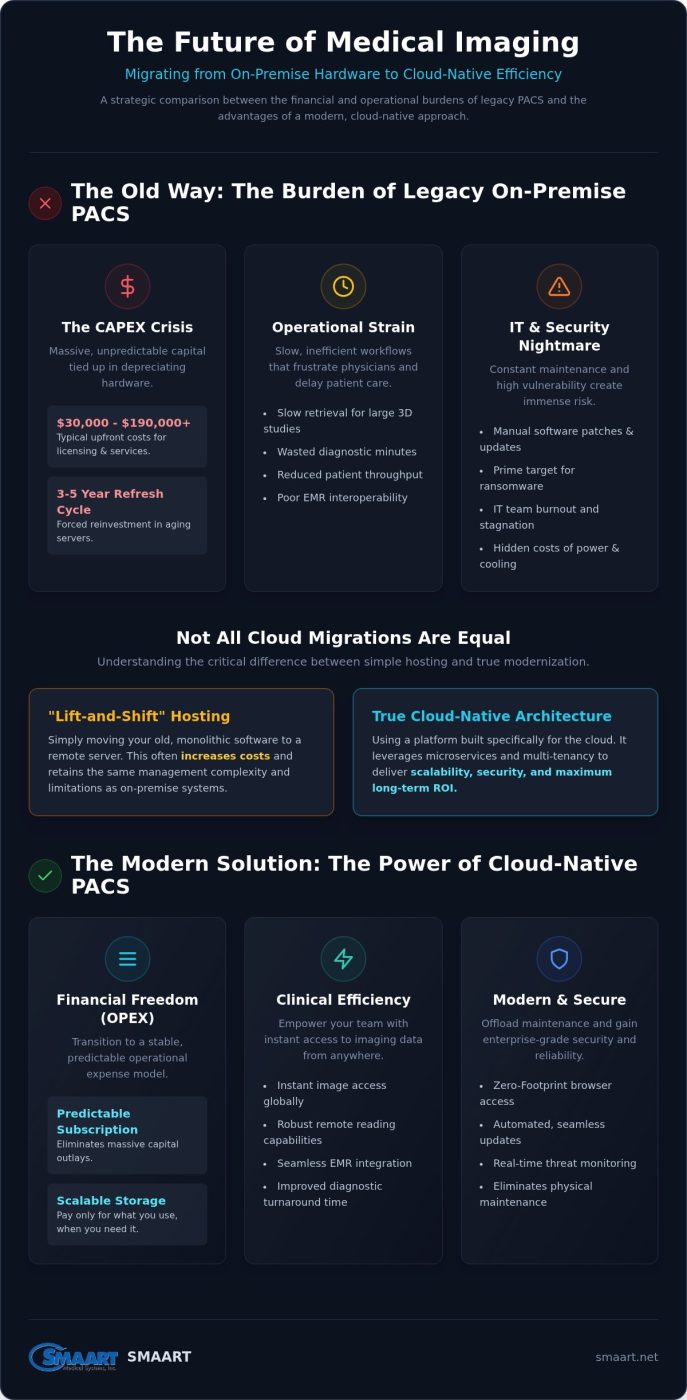
Maintaining a legacy Picture Archiving and Communication System (PACS) often feels like running on a treadmill that only speeds up. Every three to five years, clinics fall into the “hardware refresh” trap. This cycle forces you to reinvest massive amounts of capital into physical servers that begin depreciating the moment they’re installed. When you’re building a business case for cloud PACS migration, the first realization is often that on-premise systems aren’t just tools; they’re expensive liabilities that drain your clinic’s liquid capital.
Beyond the visible hardware, hidden IT costs accumulate in the background. You pay for climate-controlled server rooms, redundant power supplies, and manual backup routines. These local environments have become prime targets for ransomware because they often lack the sophisticated, real-time threat monitoring found in modern cloud data centers. This operational friction extends to the reading room. Radiologists feel the strain through slow retrieval times. Waiting for a large 3D study to load from a local disk wastes valuable diagnostic minutes, slows patient throughput, and directly impacts your facility’s bottom line.
The CAPEX Crisis in Medical Imaging
The upfront financial requirements for on-premise systems are staggering. Industry data indicates that upfront software licensing for a single-site deployment ranges from $20,000 to $150,000. When you add one-time professional services for configuration and training, which typically cost between $10,000 and $40,000, the initial hurdle becomes a significant roadblock. These traditional models force you to over-provision storage for future needs you might not actually have. In radiology, CAPEX represents a rigid financial barrier that prevents clinics from adopting the latest diagnostic innovations because their capital is tied up in depreciating metal and server room cooling costs.
Maintenance and Stagnation
Legacy systems create a “patchwork” infrastructure that demands constant, manual attention. IT teams often suffer from burnout while managing software patches and security updates that must be applied to each local server individually. This stagnation makes interoperability with modern EMRs nearly impossible. Every missed update or manual patch pushes your clinic further away from the seamless integration required to stay competitive in 2026. A strong business case for cloud PACS migration highlights the relief of offloading these burdens to a partner. Transitioning to a managed environment ensures your software is always current without exhausting your internal IT resources.
Cloud-Native vs. Lift-and-Shift: Architecting for Long-Term ROI
Not all cloud migrations deliver the same value. Many facilities fall into the “lift-and-shift” trap, which involves simply hosting legacy, monolithic software on a remote server. This approach often increases costs because you’re still paying for dedicated virtual hardware and managing the same complex software updates. A valid business case for cloud PACS migration relies on choosing a platform built specifically for the cloud environment. True modernization requires moving beyond just “hosting” to a system that leverages the cloud’s inherent strengths.
Understanding True Cloud Architecture
True cloud-native solutions use microservices. This design breaks the software into small, independent parts that scale separately. It’s the difference between replacing an entire engine and just swapping a spark plug. Multi-tenancy is another key feature. It allows multiple clinics to share the same underlying infrastructure securely, which slashes overhead costs for everyone. You get enterprise-grade secure DICOM storage without the enterprise-grade price tag. This architecture ensures that your system remains agile, allowing for rapid updates and seamless integration with other web-based tools.
The Value of Zero-Footprint Technology
One of the most immediate points of relief comes from eliminating local software installations. Traditional systems require IT teams to maintain diagnostic workstation software on every computer. In contrast, a Zero Footprint PACS Viewer allows radiologists to read from any browser. This flexibility is essential for on-call staff and remote reading. It turns any secure device into a diagnostic powerhouse, ensuring that physician productivity isn’t tethered to a specific desk or office. By removing the need for local software maintenance, you reduce the strain on your IT department and eliminate a major source of technical friction.
Scalability is the final pillar of long-term ROI. On-premise systems force you to buy storage for where you might be in five years. Cloud-native platforms let you pay only for the storage you actually use today. If your study volume grows, your storage expands automatically. This shift from capital expenditure to a predictable operating budget is a cornerstone of a modern business case for cloud PACS migration. If you’re ready to see how this architecture fits your workflow, you can explore our cloud-native solutions to find the right balance of performance and price.
Quantifying the Business Case: TCO and Operational KPIs
Building a compelling business case for cloud PACS migration requires looking beyond the initial setup fee. When evaluating Total Cost of Ownership (TCO) over a seven-year horizon, the financial relief of the cloud becomes undeniable. On-premise systems demand heavy upfront capital and a massive reinvestment in year four or five to replace aging hardware. Cloud-native models replace these spikes with a flat, manageable line. This shift allows administrators to redirect funds toward patient care instead of server maintenance and emergency repairs.
Operational Key Performance Indicators (KPIs) provide the data needed to justify this transition. Efficiency isn’t just a technical metric; it’s a clinical necessity. Faster image retrieval speeds and shorter reporting turnaround times directly influence patient outcomes. Streamlined workflows also play a critical role in reducing radiologist burnout. By removing technical friction, you improve physician retention and ensure your team can focus on diagnostics rather than troubleshooting software. This transition from a rigid CAPEX model to a predictable OPEX budget provides the fiscal agility required for modern healthcare.
KPIs that Drive Administrative Approval
Administrators need concrete numbers to approve a migration. One of the most impactful metrics is “Time-to-Image” for referring physicians. Cloud systems deliver studies instantly, eliminating the lag associated with local network bottlenecks. You should also calculate the savings from phasing out physical media. Moving to digital sharing reduces the labor and material costs of burning and shipping CDs. By 2026, ROI in the context of PACS migration is defined as the total value of increased clinical throughput combined with the elimination of emergency infrastructure spending.
Budgeting for a Predictable Future
Medical imaging software subscriptions stabilize cash flow by turning a variable expense into a fixed monthly cost. This predictability is a cornerstone of a sound business case for cloud PACS migration. You no longer have to worry about emergency budget requests when a local server fails or a backup drive crashes. Every update and security patch is included in the service, ensuring your facility stays at the cutting edge without hidden fees. For a deeper look at refining these processes, see our guide on Hospital Imaging Workflow Optimization. This approach ensures your facility remains technologically relevant while maintaining strict fiscal responsibility.
Mitigating Migration Risks: Data Integrity and Workflow Continuity
Migration anxiety often stems from the fear of lost data or clinical downtime. A successful business case for cloud PACS migration must account for these risks with a pragmatic, phased strategy. You don’t have to flip a switch and hope for the best. Instead, we transition data in stages, prioritizing current studies to ensure radiologists never face an empty worklist. This methodical approach maintains workflow continuity while background synchronization handles the historical data move. It’s about providing relief to your clinical team, not adding to their stress.
The Data Migration Roadmap
Inventorying your legacy data is the first step in a reliable roadmap. We identify “hot” storage, which includes studies from the last two years that require immediate access, and “cold” storage for long-term archives. This distinction allows us to optimize retrieval speeds and storage costs from day one. Data cleansing is equally vital. If your legacy metadata is messy, those errors will follow you to the cloud. We focus on preventing “garbage in, garbage out” scenarios by validating DICOM headers and cleansing metadata before the final transfer. Research shows that migration costs typically range from $0.05 to $0.50 per study, making it vital to get it right the first time to avoid expensive re-work. Our validation protocols ensure 100% image integrity post-migration.
Ensuring Interoperability
Your PACS doesn’t live in a vacuum. It must communicate effectively with your EMR, HIS, and RIS platforms. We conduct rigorous testing to ensure SMAART-PACS interfaces seamlessly with your existing tech stack. This synchronization ensures that billing and scheduling data flow without manual intervention, which eliminates the administrative friction that leads to staff burnout. To learn more about unifying your clinical tools, read our guide on Integrated RIS PACS Solutions. This level of integration is essential for maintaining a high-density information flow across your entire facility.
Security remains paramount throughout the entire journey. We maintain strict HIPAA and SOC2 compliance, using end-to-end encryption to protect ePHI while it’s in transit. This isn’t just about meeting 2026 regulatory standards; it’s about protecting your reputation and your patients’ trust. If you’re ready to move forward without the risk, contact us today for a migration assessment.
Strategic Modernization with SMAART Cloud Solutions
SMAART Medical Systems understands that high performance shouldn’t break your budget. While many industry giants focus exclusively on massive healthcare networks, we specialize in making elite technology accessible for clinics and community hospitals. Strengthening your business case for cloud PACS migration involves finding a partner that balances sophisticated features with fiscal responsibility. We offer the full functionality of a modern imaging ecosystem without the prohibitive enterprise price tag. This approach provides immediate relief from the financial strain of legacy systems while ensuring your facility remains competitive.
Why Hospitals Choose SMAART-PACS
SMAART-PACS delivers diagnostic-grade viewing directly in any web browser. This browser-based flexibility eliminates the need for proprietary hardware or complex local software installations that often clutter a medical IT environment. Your radiologists can work securely from any location, which is a critical requirement for modern remote reading workflows. Our storage is inherently scalable. As your facility grows, your storage capacity expands automatically; you never pay for space you aren’t using. Beyond the technology, we provide an active partnership. Our responsive, US-based support team acts as an extension of your IT department, ensuring that your transition remains smooth and your daily operations stay efficient.
The SMAART-SHARE Advantage
One of the fastest ways to reduce operational overhead is to eliminate physical media. SMAART-SHARE replaces the outdated practice of burning and shipping radiology CDs with secure, cloud-based sharing. This transition significantly lowers material costs and reduces the administrative burden on your staff. It also improves the patient experience by providing instant access to imaging results. For a deeper look at how this technology is changing the industry, explore our guide on the Patient Portal for Medical Images. This modern approach to distribution ensures that patients and referring physicians receive information without the delays of physical transport.
By 2026, the standard for medical imaging will be a fully unified workflow. SMAART-RIS and SMAART-PACS work together to create a seamless environment for both clinicians and administrators. This integration ensures that scheduling, diagnostic reading, and billing all happen within a single, streamlined ecosystem. Choosing SMAART means your business case for cloud PACS migration isn’t just about solving today’s hardware problems. It’s about positioning your facility as a modern, agile leader in a traditional field. We provide the tools to help you scale efficiently while maintaining the highest standards of diagnostic care.
Modernize Your Workflow and Reclaim Your Capital
The transition to a cloud-native environment is more than a technical upgrade; it’s a strategic move to eliminate the “hardware refresh” trap and stabilize your facility’s financial future. By choosing a system built for the cloud rather than one just hosted in it, you ensure your radiologists have the high-speed, zero-footprint tools they need to stay productive. A strong business case for cloud PACS migration rests on the dual pillars of operational relief and measurable ROI. You can finally trade unpredictable emergency repairs for a predictable, subscription-based budget that supports growth.
SMAART Medical Systems is here to act as your reliable partner in this journey. We offer seamless EMR/HIS integration and affordable, full-feature radiology management designed specifically for the modern clinical landscape. Our US-based expert support team is ready to help you navigate every step of the migration process. Request a SMAART-PACS Demo and TCO Analysis to see exactly how much your facility can save while improving diagnostic efficiency. It’s time to leave the burdens of legacy infrastructure behind and embrace a more efficient way to manage medical imaging.
Frequently Asked Questions
Is a cloud PACS really more secure than an on-premise server?
Cloud providers utilize sophisticated encryption and multi-factor authentication that local IT teams often struggle to maintain. With the HIPAA Security Rule update scheduled for July 2027, these features are becoming mandatory. Moving to the cloud provides immediate relief from the vulnerability of on-premise servers, which are frequent targets for ransomware. You benefit from enterprise-grade security protocols that are managed and updated automatically without manual intervention from your staff.
How long does a typical cloud PACS migration take for a mid-sized clinic?
A typical migration for a mid-sized clinic is a clinical project, not just an IT task. While timelines depend on your historical study volume, active clinical operations can often transition within a few weeks. We use a phased strategy to ensure zero downtime. This allows your team to read new exams immediately while legacy data synchronizes in the background. A solid business case for cloud PACS migration includes this transition plan.
Will our radiologists experience lag when viewing images from the cloud?
Modern cloud-native viewers eliminate lag through intelligent data streaming. Instead of waiting for a massive 3D study to download to a local drive, the viewer fetches only the pixels needed for the current view. This results in faster image retrieval times than many aging on-premise systems. Radiologists can read from any browser with the same diagnostic confidence they have at a dedicated workstation. The performance is optimized for high-density information delivery.
Can we migrate our legacy data from an older PACS to SMAART-PACS?
We provide comprehensive data migration services to move your historical studies into SMAART-PACS. Our team handles the extraction and validation of DICOM data from your legacy system. We also perform metadata cleansing to ensure your records are accurate and searchable. This methodical process prevents data loss and ensures that your entire imaging history is available within your new, streamlined workflow. We focus on maintaining 100% image integrity throughout the transfer.
What happens if our internet connection goes down during a cloud-based reading session?
Internet reliability is a valid concern, which is why most modern clinics use redundant connections. If your primary line fails, the system can operate on a secondary ISP or even a secure mobile hotspot. Because SMAART-PACS uses web-based technology, radiologists aren’t tethered to a single physical office. They can maintain workflow continuity from any location with a stable connection, ensuring that patient throughput never suffers during local network outages.
How does cloud PACS migration impact our HIPAA compliance status?
Migrating to the cloud strengthens your HIPAA compliance by leveraging professional data center security. Your cloud provider acts as a business associate, and you must sign a Business Associate Agreement (BAA) to define responsibilities. This partnership ensures that encryption, access controls, and audit logs meet the latest standards. It removes the burden of managing physical server security from your internal staff, providing significant operational relief and reducing your facility’s liability.
Do we need to buy new hardware to use SMAART-PACS?
You don’t need to invest in new hardware to deploy our solutions. SMAART-PACS is designed to run on your existing diagnostic workstations through a standard web browser. This eliminates the need for expensive server rooms and cooling infrastructure. Removing the requirement for proprietary hardware is a key component of the business case for cloud PACS migration, as it turns a large capital expense into a predictable operating cost.
What is the difference between a lift-and-shift and a cloud-native migration?
A lift-and-shift migration involves moving old, monolithic software to a cloud server without changing how it functions. This often fails to save money because the software still requires manual updates. Cloud-native systems like SMAART-PACS use microservices and multi-tenancy. This modern architecture allows for better scalability and seamless integration with EMRs. It ensures you only pay for the resources you use while benefiting from continuous, automatic updates that improve diagnostic efficiency.