
Medical Imaging Software Subscription: The 2026 Guide to Radiology SaaS
Owning your own radiology server in 2026 is becoming a financial liability rather than a clinical asset. You likely already feel the strain of high upfront licensing costs and the relentless cycle of maintaining on-premise hardware that feels obsolete before it’s even fully depreciated. It’s exhausting to manage complex IT updates when your real priority is providing fast, accurate diagnoses for your patients. We understand that the burden of server maintenance and the difficulty of sharing images with referring physicians can make your daily operations feel unnecessarily heavy.
This guide demonstrates how a modern medical imaging software subscription can eliminate capital overhead while providing clinics of any size with elite diagnostic tools. By shifting to a SaaS model, you gain predictable monthly costs and the relief of a streamlined, modern imaging environment. We’ll explore how platforms like SMAART-PACS and SMAART-RIS integrate seamlessly with your hospital systems, ensuring you meet the strict 2026 HIPAA security requirements without the hassle of manual upgrades. You’ll discover how to transform your workflow from a series of technical hurdles into a responsive, patient-centered operation that scales as you grow.
Key Takeaways
- Replace bulky capital expenditures with a predictable operational budget that scales alongside your clinical volume.
- A medical imaging software subscription provides access to elite diagnostic tools without the burden of maintaining complex on-site hardware.
- Streamline patient scheduling and image distribution through SMAART-RIS and SMAART-PACS for a more responsive radiology workflow.
- Modernize your facility’s IT infrastructure in days with zero-footprint viewers that offer secure, browser-based access for referring physicians.
- Stay ahead of 2026 HIPAA security updates with automated software patches and integrated multi-factor authentication.
What is a Medical Imaging Software Subscription in 2026?
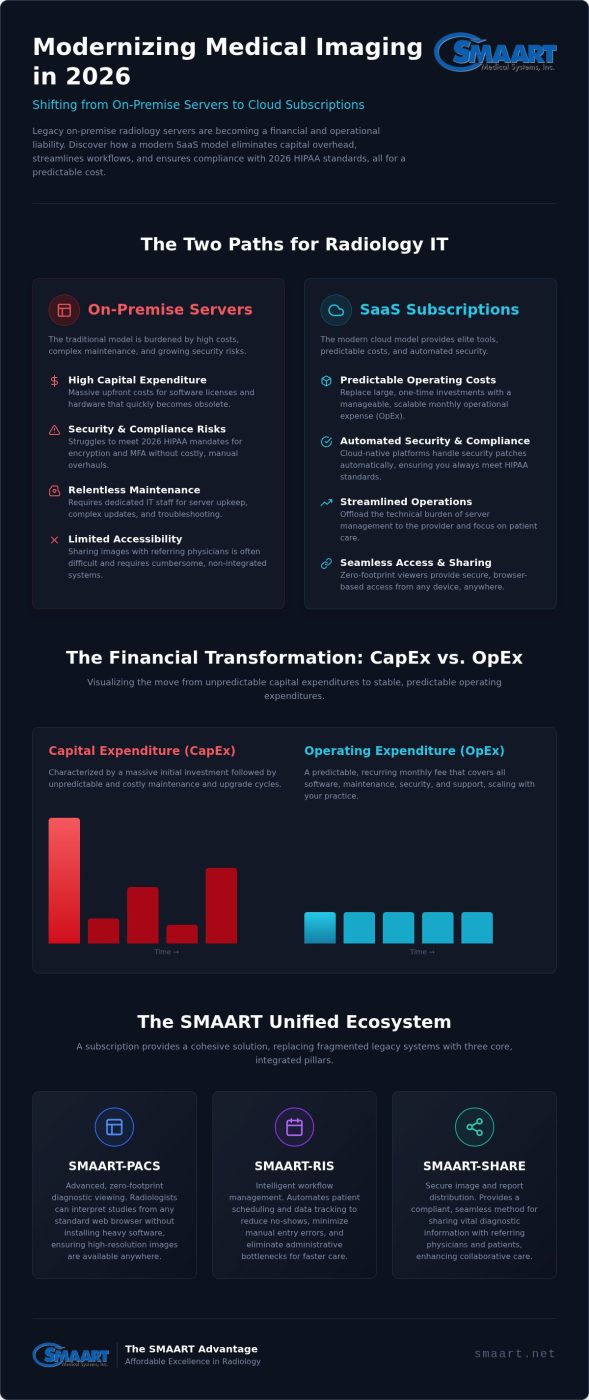
A medical imaging software subscription is a cloud-based service model that delivers essential radiology tools, including a Picture Archiving and Communication System (PACS), Radiology Information Systems (RIS), and secure sharing platforms through a recurring fee. Instead of purchasing software as a one-time asset, clinics “rent” the technology. This shift represents a fundamental move from Capital Expenditure (CapEx) to Operating Expenditure (OpEx). It allows healthcare providers to trade massive, unpredictable hardware costs for a steady, manageable monthly payment. This financial relief is a cornerstone of modern practice management.
2026 marks a significant tipping point for this technology. New HIPAA security standards now mandate advanced encryption and multi-factor authentication that many legacy on-premise systems simply can’t support without expensive overhauls. Cloud-native platforms handle these updates automatically. By adopting a subscription, you offload the technical burden of cybersecurity and server maintenance to the provider. The core components of these systems include diagnostic viewing, patient data management, and secure image distribution, all accessible from any compatible device.
The Evolution of PACS and RIS Licensing
Traditional perpetual licenses often feel like a safe bet initially. However, they frequently hide long-term costs. Legacy software requires on-site servers, dedicated IT staff, and expensive “maintenance contracts” just to stay functional. Modern subscriptions eliminate these hidden anchors. Platforms like SMAART-PACS and SMAART-RIS provide enterprise-grade diagnostic viewing and patient data management without the “buy-once” trap. You pay for what you use, ensuring your technology evolves as fast as your practice. This model makes elite tools accessible to small clinics that were previously priced out by the heavy lifting of traditional IT.
Key Terminology for SaaS Radiology
Understanding the technical landscape helps you make better administrative decisions. The current industry revolves around three primary concepts:
- SaaS (Software as a Service): The entire application is hosted in the cloud and accessed via the internet, removing the need for local server rooms.
- Zero-Footprint: This refers to diagnostic viewers that require no local software installation. They run entirely in a web browser, which is critical for remote access and reducing IT overhead.
- Interoperability: This is the system’s ability to communicate across different platforms. Modern subscriptions prioritize interfacing PACS with EMR systems to ensure patient data flows effortlessly between departments.
By focusing on these elements, a medical imaging software subscription provides a cohesive ecosystem. It bridges the gap between technical IT requirements and high-level administrative goals, creating a more responsive clinical environment.
Core Features of SMAART Imaging Subscriptions
SMAART provides a unified ecosystem that addresses the specific technical needs of modern radiology. A medical imaging software subscription with SMAART isn’t just about storage; it’s about creating a cohesive diagnostic environment. We provide three core pillars: SMAART-PACS for imaging, SMAART-RIS for administrative flow, and SMAART-SHARE for secure distribution. These tools work together to replace fragmented legacy systems with a single, streamlined solution.
Advanced Diagnostic Viewing with SMAART-PACS
SMAART-PACS is a diagnostic zero-footprint solution for 2026 that allows radiologists to interpret studies from any standard web browser. You don’t need to install heavy software on every workstation. This flexibility is supported by research from the Society for Imaging Informatics in Medicine (SIIM), which highlights the importance of browser-based accessibility in modern informatics. Our system integrates directly with existing hospital infrastructure, ensuring that high-resolution images are available exactly where they’re needed.
Patient and Workflow Management via SMAART-RIS
Administrative bottlenecks often slow down clinical care. SMAART-RIS automates patient scheduling and data tracking to reduce no-shows and manual entry errors. It’s built for speed and accuracy. For facilities looking to maximize these benefits, exploring integrated RIS PACS solutions can reveal how synchronized data improves the entire patient journey. This integration ensures that clinical data and imaging studies remain perfectly aligned.
SMAART-SHARE: The Cloud Sharing Revolution
The days of burning CDs and mailing proprietary hardware are over. SMAART-SHARE enables secure, collaborative viewing for referring physicians and patients via the cloud. This reduces the significant costs associated with physical media distribution. It also fosters better partnership between clinicians, as they can view studies simultaneously from different locations. By removing the need for specialized hardware, we make image sharing as simple as sending a secure link.
All SMAART subscriptions prioritize seamless integration with your current EMR and HIS platforms. This ensures your data isn’t trapped in a silo. If you’re ready to see how these features can modernize your facility, you can explore our full suite of radiology tools.
Financial and Operational Benefits of the SaaS Model
The hardware refresh cycle is a relentless drain on clinical resources. Every few years, traditional on-premise systems require expensive server replacements and hardware upgrades just to keep pace with modern data demands. A medical imaging software subscription ends this cycle. By moving to the cloud, you eliminate the need for on-site server rooms and the electricity, cooling, and space they consume. This shift provides immediate financial relief, allowing you to reallocate capital toward patient care instead of depreciating assets.
Predictability is the primary advantage of the SaaS model. Instead of facing a massive upfront price tag for licensing, you manage a consistent monthly budget. Scalability is equally effortless. As your clinic grows, you can add users or increase storage capacity instantly. You don’t have to worry about whether your physical server can handle the extra load. The system grows with you, ensuring that your technical infrastructure never bottlenecks your clinical expansion.
Reducing Radiology Overhead
When calculating the Total Cost of Ownership (TCO), subscriptions consistently outperform on-premise installations for small to mid-sized facilities. On-premise systems require dedicated IT staffing to manage updates, backups, and troubleshooting. A SaaS model offloads these requirements to the provider. This provides a profound sense of relief for clinic administrators. You no longer need to monitor server uptime or manage complex database migrations. Your team can stay focused on diagnostic accuracy while the software provider handles the technical heavy lifting in the background.
Security and Compliance in the Cloud
Security standards for 2026 are more rigorous than ever. Recent updates to the HIPAA Security Rule have made several previously addressable safeguards mandatory. To remain compliant, your system must now utilize AES-256 encryption for data at rest and TLS 1.2 or higher for data in transit. Additionally, multi-factor authentication (MFA) is required for all access to electronic protected health information (ePHI).
Cloud-based subscriptions are uniquely positioned to meet these standards. Providers implement redundant storage across multiple geographic zones, protecting your data against local disasters and ransomware. Under 2026 regulations, organizations must be able to restore access to ePHI within 72 hours of a disruption. Professional cloud environments offer the robust backup protocols necessary to meet this deadline, providing a level of security that is difficult and expensive to replicate on a local clinic server.
Choosing the Right Subscription Tier for Your Facility
Selecting the ideal medical imaging software subscription requires a pragmatic look at your current caseload and your three-year growth plan. You don’t want to pay for high-volume enterprise features if you’re a low-volume orthopedic clinic. Conversely, a high-volume hospital system cannot afford the bottlenecks of a “lite” system. Start by assessing your monthly study volume. Most subscription tiers are structured around these numbers, ensuring you only pay for the capacity you actually use. This flexibility provides the financial relief mentioned earlier, as you can scale your plan as your patient base expands.
Simultaneous user access is another critical factor. Consider how many radiologists, technicians, and referring physicians need to be in the system at once. A modern subscription should allow for seamless collaboration without charging a premium for every individual login. Finally, determine your storage needs. You’ll need high-performance storage for active diagnostic studies and cost-effective, long-term archiving for older records to remain compliant with data retention laws. Your provider should offer a clear path for moving data between these tiers without technical friction.
The Clinical Readiness Checklist
Before you commit to a new tier, ensure your facility is technically prepared. Cloud-native diagnostic viewing relies on stable internet bandwidth. While zero-footprint viewers reduce the load on local machines, your network must handle the transmission of high-resolution DICOM files without lag. You should also audit your existing hardware. While SaaS platforms run in a browser, your radiologists still require diagnostic-grade monitors to maintain clinical standards. Staff training is the final piece of the puzzle. Modern SaaS interfaces are designed for efficiency, but a brief orientation ensures your team can leverage every tool from day one.
Comparing Enterprise PACS Solutions
In the 2026 market, “affordable” is no longer a synonym for “low-feature.” Innovations in cloud architecture have allowed providers like SMAART to offer elite tools at a fraction of the cost of traditional industry giants. When evaluating vendors, prioritize support responsiveness and a proven history of seamless integration. If your facility manages complex, multi-departmental data, you may need a more robust hospital imaging workflow optimization strategy to ensure your PACS, RIS, and EMR talk to each other perfectly.
Choosing the right partner means finding a team that acts as a reliable extension of your own IT department. If you’re ready to find the perfect fit for your clinic’s specific needs, request a consultation with SMAART Medical Systems today to explore our available subscription tiers.
The SMAART Advantage: Affordable Excellence in Radiology
SMAART Medical Systems is a refreshing alternative to the overly complex industry giants that dominate the radiology space. We built our medical imaging software subscription to solve the specific pressures faced by modern clinics. By focusing on professional confidence and pragmatic solutions, we provide the tools you need without the bloated features or hidden costs of legacy providers. Our approach creates a unified ecosystem where SMAART-PACS, SMAART-RIS, and SMAART-SHARE work in perfect synchronization. This integration ensures your facility operates with modern efficiency from day one. You get the relief of a system that works as hard as you do.
Implementation speed is where SMAART truly challenges industry norms. While traditional enterprise systems can take months to deploy, we focus on high-density information delivery that gets your system live in days. We act as a reliable partner, offering dedicated support to ensure your ongoing success. Our team bridges the gap between technical IT requirements and your high-level administrative goals. This means you get a system that satisfies your technicians and your CFO simultaneously. We’re deeply invested in your success, not just a one-time transaction.
Modernizing Without the Complexity
The SMAART mission is centered on the concept of relief. We understand the financial strain of traditional licensing and the operational burden of hardware maintenance. By providing a zero-footprint diagnostic viewer, we simplify your infrastructure. You don’t need to be an IT expert to manage our software. We handle the 2026 cybersecurity standards and automated updates so you don’t have to. It’s about providing elite expertise with a humble, service-oriented heart. We’re modernizers in a traditional field, and we aren’t afraid to challenge the status quo.
Next Steps: Transitioning to SMAART-PACS
Making the switch is a straightforward process designed to minimize clinical downtime. Your first step is requesting a demo to see how our tools fit your specific workflow. This transition to a medical imaging software subscription allows you to finally offload the technical debt of on-premise servers. We’ll assess compatibility with your existing HIS or EMR to ensure a seamless data flow. Our migration experts then handle the heavy lifting of moving your legacy data to the cloud. We ensure that every study is accounted for and accessible through our secure, web-based viewer. Your path to modernization involves three simple steps:
- Request a personalized demo to see the zero-footprint viewer in action.
- Audit your current HIS/EMR for seamless integration points.
- Schedule a legacy data migration to move your archives to the cloud.
You’ll move from a state of technical stress to one of modern, cloud-based efficiency. Modernize your radiology workflow today with SMAART Medical Systems.
Future-Proof Your Radiology Infrastructure Today
Transitioning to a medical imaging software subscription is more than a financial shift; it’s a strategic move toward clinical freedom. You’ve seen how the SaaS model eliminates the burden of hardware maintenance while providing enterprise-grade tools like SMAART-PACS and SMAART-RIS. By prioritizing zero-footprint diagnostic viewing and seamless EMR/HIS integration, your facility can finally shed the weight of legacy servers. This modernization ensures you meet 2026 security standards while offering affordable cloud-based sharing to your referring physicians and patients.
The relief of a predictable budget and automated updates allows your team to return their focus to where it belongs: patient care. You don’t have to navigate this transition alone. Our team is ready to serve as your reliable partner in this digital evolution. Modernize your clinic’s workflow with a SMAART-PACS subscription and experience the efficiency of a system built for the modern healthcare landscape. We look forward to helping you build a more responsive, cost-effective future for your radiology department.
Frequently Asked Questions
Is a medical imaging software subscription HIPAA compliant?
Yes, a modern medical imaging software subscription is designed to exceed 2026 HIPAA security standards. These platforms utilize AES-256 encryption for data at rest and TLS 1.2 or higher for data in transit. They also enforce mandatory multi-factor authentication for all users accessing electronic protected health information. This level of automated security provides significant relief to clinic administrators by removing the burden of manually patching local servers to maintain strict regulatory compliance.
How much does a medical imaging software subscription typically cost?
The cost of a medical imaging software subscription depends on your monthly study volume, the number of simultaneous users, and your long-term storage requirements. Instead of a massive upfront capital expenditure, you pay a predictable monthly or annual fee. This model allows your facility to scale costs alongside your clinical growth. This shift to an operational expenditure model eliminates the hidden costs of on-site server maintenance, electricity, and the inevitable hardware refresh cycle.
Can I integrate a subscription-based PACS with my existing EMR?
Yes, you can integrate subscription-based solutions like SMAART-PACS and SMAART-RIS with your existing EMR or HIS platforms. These systems are built for interoperability, ensuring that patient data and imaging studies flow seamlessly between different departments. This integration reduces manual data entry and minimizes the risk of clinical errors. It creates a unified workflow that allows your staff to access diagnostic tools directly from a patient record without switching between multiple software applications.
What happens to my data if I cancel my software subscription?
Your data remains your property even if you decide to cancel your subscription. Standard industry practices and 2026 data portability regulations ensure that you can export your DICOM files and patient records to a new system. Most providers offer a structured migration process to facilitate a seamless transition. It’s important to review your service level agreement to understand the specific timelines and formats available for data retrieval to ensure clinical continuity and data retention compliance.
Do I need special hardware to use a zero-footprint PACS viewer?
You don’t need proprietary local hardware to use a zero-footprint PACS viewer. These viewers run entirely within a standard web browser, making them accessible from existing laptops, tablets, or workstations. However, radiologists still require diagnostic-grade monitors that meet medical standards for primary interpretation. For referring physicians and administrative staff, the zero-footprint nature of SMAART-PACS provides the flexibility to view studies from any location without installing heavy software or managing complex local configurations.
Is cloud-based imaging storage safe from ransomware?
Cloud-based imaging storage is generally more secure than local clinic servers against ransomware attacks. Professional providers implement redundant storage across multiple geographic zones and use immutable backups that cannot be altered by malicious software. Under 2026 HIPAA guidelines, these systems are built to restore access to patient data within 72 hours of a disruption. This robust architecture provides a level of disaster recovery and data protection that is difficult and expensive to replicate on-site.
Can a subscription model support high-volume hospital imaging?
Yes, a subscription model is ideal for high-volume hospital imaging due to its inherent scalability. Cloud-native platforms can handle sudden increases in study volume without requiring new physical hardware or on-site IT interventions. This allows large facilities to manage peaks in patient demand with professional confidence. By utilizing SMAART-PACS and SMAART-RIS, hospital systems can streamline complex workflows and maintain high-speed diagnostic performance regardless of the number of studies being processed across the enterprise.
How often is the software updated in a SaaS model?
Software updates in a SaaS model occur automatically and frequently, often without any clinical downtime. Unlike legacy systems that require manual installation and on-site IT support, cloud-based providers push security patches and feature enhancements in real-time. This ensures your facility always runs the latest version of the software. This hassle-free approach means you always have access to the most advanced diagnostic tools and stay compliant with the latest 2026 cybersecurity regulations automatically.