
Web Based PACS Viewer: Streamlining Radiology Workflow in 2026
What if the most expensive piece of hardware in your radiology department became completely obsolete by the end of the year? It’s a frustrating reality for many clinical leaders. You’re likely balancing astronomical maintenance fees for dedicated workstations against sluggish image loading times across remote sites. The constant anxiety regarding local data security and the mandatory 2026 HIPAA updates only adds to the burden. These bottlenecks don’t just drain your budget; they slow down patient care and exhaust your IT staff with endless software patches.
Adopting a modern web based PACS viewer is no longer just a convenient alternative. It’s the primary engine for financial relief and clinical agility in 2026. You can finally provide your team with diagnostic-grade access from any device without installing a single byte of software on local machines. This article explores how zero-footprint technology and seamless EMR integration are reshaping the medical landscape. We’ll examine how to meet the latest CMS virtual supervision mandates and HHS accessibility standards while significantly reducing your IT overhead through solutions like SMAART-PACS. Discover how to reclaim your workflow and eliminate the hardware bottlenecks of the past.
Key Takeaways
- Learn how a modern web based PACS viewer eliminates the need for expensive workstations while significantly reducing radiology staff fatigue.
- Understand the security advantages of zero-footprint technology, ensuring patient data is never cached or stored on local devices.
- Compare the financial and operational benefits of browser-based systems that deploy in minutes rather than weeks or months.
- Explore the advanced diagnostic toolsets and multi-modality support that allow for seamless viewing of CT, MRI, and Ultrasound images on any device.
- Discover how integrating SMAART-PACS with your existing EMR and SMAART-RIS creates a unified, high-efficiency workflow for your entire facility.
The Evolution of Medical Imaging: Why Web-Based Viewers are Essential
Medical imaging has undergone a massive transformation since the early days of the Picture Archiving and Communication System (PACS). Historically, radiologists were tethered to dark rooms and monolithic workstations that required constant, hands-on IT maintenance. Today, the shift toward a flexible web based PACS viewer represents more than a technical upgrade; it’s a fundamental change in how clinicians interact with patient data. This evolution replaces clunky, localized hardware with agile, cloud-integrated environments that prioritize speed and accessibility above all else.
Tech fatigue is a significant burden in modern radiology. Dealing with slow loading bars, proprietary software plugins, and constant system crashes exhausts even the most seasoned specialists. By moving to browser-based access, we remove these friction points and provide immediate relief to clinical teams. This flexibility is vital for supporting a distributed, remote workforce. Whether a radiologist is in a high-volume hospital or reviewing cases from a home office, they need the same high-performance experience. This transition is made possible by zero footprint PACS viewer technology, which ensures that no specialized software is ever needed on the end-user’s device.
Breaking the Hardware Dependency
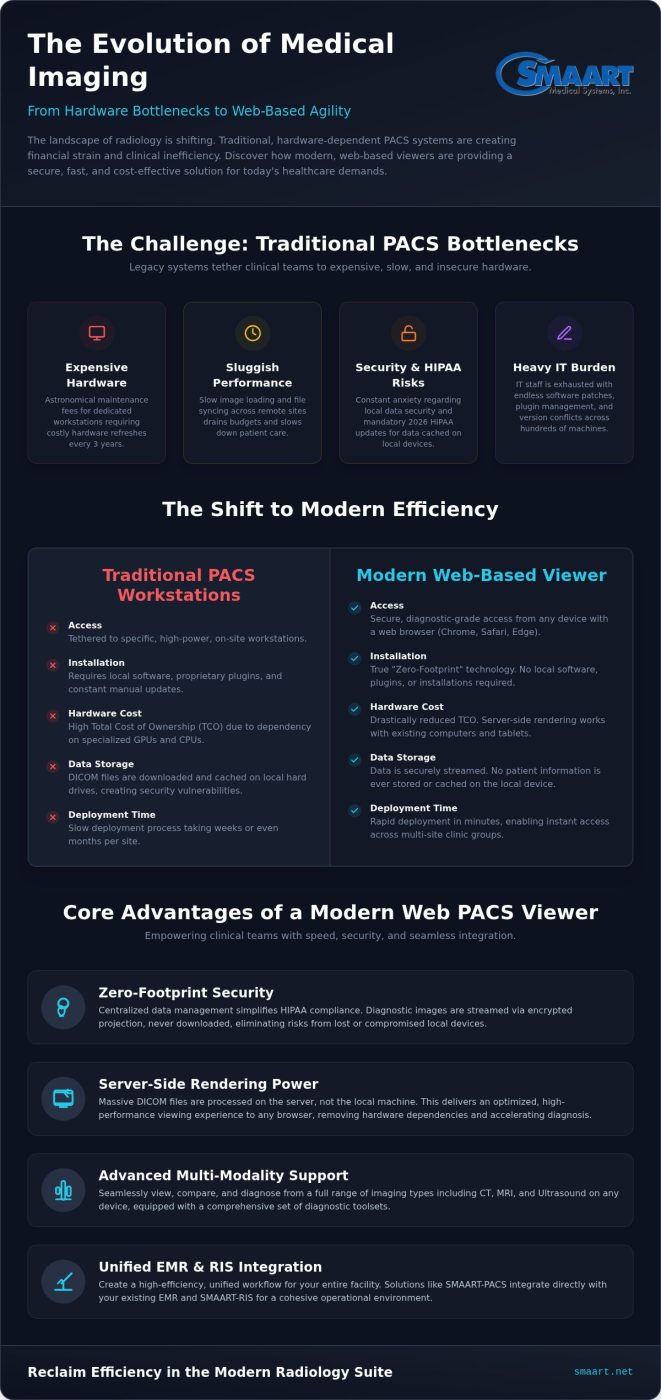
Specialized GPUs and high-end CPUs used to be the gatekeepers of diagnostic imaging. If your local machine wasn’t powerful enough, the images simply wouldn’t render properly. That’s no longer the case. Modern systems use server-side rendering to handle the heavy lifting. The server processes the massive DICOM files and delivers an optimized view directly to your browser. This approach drastically reduces the total cost of ownership (TCO) for imaging facilities. You don’t need to refresh expensive hardware every three years. Instead, you can use existing computers and tablets, effectively extending the life of your current IT assets while maintaining diagnostic integrity.
Meeting the 2026 Demand for Speed
The healthcare landscape in 2026 demands instant access across multi-site clinic groups. Patients and referring physicians aren’t willing to wait for results while files slowly sync across a local network. A high-performance web based PACS viewer allows for rapid diagnostic turnaround by eliminating the “wait time” associated with downloading large datasets. SMAART-PACS is built to address this specific need. It’s designed to streamline your operations, accelerate the reporting process, and empower your clinical team to make faster, more accurate decisions. By centralizing the data and decentralizing the access, you create a workflow that is both resilient and remarkably fast.
Understanding Zero-Footprint Technology in Modern PACS
A zero-footprint viewer requires no local software installation or plugins, ensuring that sensitive patient data is never cached or stored on the local device. This architecture represents a massive leap forward for healthcare IT departments. Instead of managing hundreds of local installations, administrators maintain a single server environment. Whether your clinicians prefer Chrome, Safari, or Microsoft Edge, the experience remains consistent and high-performing. This cross-browser compatibility eliminates the version conflict headaches that used to plague hospital workstations. It’s a clean, efficient approach to imaging that prioritizes both the user experience and data integrity.
In 2026, the transition to a cloud-based PACS environment is driven by the dual needs of security and speed. By utilizing a web based PACS viewer, you’re moving away from the inherent risks of local data storage. If a laptop is lost or a home office computer is compromised, there’s no patient information residing on that hard drive to be exploited. The data remains safely behind your secure firewall, streamed only when needed.
Security and HIPAA Compliance
Centralized data management is the ultimate defense against local data breaches. When you use an encrypted streaming model, the diagnostic images are rendered on the server and projected to the clinician’s screen. No DICOM files are actually downloaded to the workstation. This setup simplifies HIPAA audits for IT managers because all access logs are centralized. You can see exactly who viewed which study and from where, without having to scrape data from multiple endpoints. Mandatory 2026 updates to the HIPAA Security Rule require enhanced encryption and multi-factor authentication, features that are far easier to manage in a centralized web environment than across a fleet of legacy desktops.
Universal Accessibility for Clinicians
The “bring your own device” (BYOD) trend is no longer a future prediction; it’s the standard. Clinicians expect to access SMAART-PACS from hospital wards, home offices, or even on the go. By 2026, the industry has finally buried the dependencies on Java or Silverlight that made remote viewing so temperamental. Today’s clinicians need tools that just work, regardless of the operating system. This level of accessibility provides immense relief to overstretched radiology departments. You can explore our integrated solutions to see how this universal access transforms daily operations. By removing the technical barriers to entry, you empower your staff to focus on patient outcomes rather than troubleshooting software plugins.
Traditional desktop PACS deployments are a logistical marathon. They often require weeks of hardware procurement, manual software installation on every single workstation, and complex network configurations. In contrast, a modern web based PACS viewer can be operational across your entire facility in minutes. This shift represents a fundamental move from heavy Capital Expenditure (CapEx) to a more predictable, scalable Operational Expenditure (OpEx) model. For clinical administrators, this change provides immediate financial relief and allows for much better budget forecasting. When you combine this with integrated RIS PACS solutions, the reduction in administrative overhead becomes even more pronounced as scheduling, billing, and imaging move into a single, unified ecosystem.
The Real Cost of Desktop Maintenance
The price tag on a desktop PACS license is just the beginning of your investment. Hidden costs like specialized IT labor for local troubleshooting, frequent hardware upgrades, and productivity-killing downtime quickly erode your ROI. Every time a local software version conflicts with a routine operating system update, your IT team loses hours to manual fixes. Moving to a web-based model removes these troubleshooting tickets from the queue entirely. It’s about providing relief for your technical staff and ensuring your radiologists stay productive. Scalability also becomes effortless; you can add new users or remote locations without purchasing specialized hardware or waiting for onsite installs. You simply provide secure access credentials and your team is ready to work.
Performance Benchmarks in 2026
Performance concerns used to be the primary argument against web-based systems, but by 2026, the script has flipped. Traditional systems often struggle when a client-side machine tries to process thousands of slices from a high-resolution CT scan. A web based PACS viewer utilizes server-side rendering to stream only the specific pixels the user needs to see at that moment. This results in significantly faster load times for massive 3D and multi-modality datasets compared to traditional local processing. SMAART-PACS leverages this technology to provide diagnostic-grade performance on standard hardware, ensuring that image manipulation like panning, zooming, and windowing is virtually lag-free. You aren’t limited by the local CPU anymore; the power resides in the cloud, delivering a seamless experience regardless of the user’s physical location.
Key Features of a High-Performance Web PACS Viewer
A high-performance web based PACS viewer is defined by its ability to replicate the complex functionality of a desktop workstation within a standard browser window. It’s not just about seeing an image; it’s about the precision of the diagnostic tools available. Modern clinicians require a full suite of manipulation tools including window/level adjustments, zoom, pan, and advanced measurements. Multi-modality support is equally critical. Whether you’re reviewing CR, DR, CT, MRI, or Ultrasound studies, the interface must remain fluid and intuitive. This versatility ensures that your radiology workflow isn’t fragmented by different software for different imaging types. By centralizing these capabilities, you remove the friction of switching between disparate systems, providing immediate relief to your clinical team.
Diagnostic-Grade Visualization Tools
Advanced reconstruction features, like Multi-Planar Reconstruction (MPR), are now standard in high-end browser-based viewers. This allows radiologists to visualize anatomy in three dimensions without leaving the web interface. Customizable hanging protocols further enhance efficiency by automatically arranging images according to the specific preferences of each radiologist. SMAART-PACS maintains absolute diagnostic integrity by utilizing lossless compression and server-side rendering to ensure every pixel is accurate and compliant with medical standards. This level of technical sophistication provides immense relief to clinicians who previously felt limited by mobile or remote viewing solutions. You can trust that the image on your tablet is as reliable as the one on a dedicated workstation.
Collaborative Sharing and Patient Portals
The days of burning CDs and mailing DVDs are finally over. By using SMAART-SHARE, your facility can transition to instant, cloud-based image distribution. You can send secure web links to referring physicians or patients, providing immediate access to critical exams. This shift is a key part of the patient portal for medical images evolution, where transparency and speed define the provider-patient relationship. It simplifies the administrative burden on your front-desk staff and ensures that the right data reaches the right hands in seconds. It’s a modern approach that respects the time of both the provider and the patient.
True efficiency comes from a unified patient record. A high-quality web based PACS viewer integrates seamlessly with your existing EMR and HIS platforms. This means a clinician can launch a study directly from the patient’s chart, eliminating the need to log into multiple systems or manually search for DICOM files. This cross-platform mobility extends to tablets and laptops, bridging the gap between the radiology suite and the patient’s bedside. Ready to modernize your facility’s imaging capabilities? Schedule a demo of SMAART-PACS today to see these features in action.
Optimizing Your Radiology Workflow with SMAART-PACS
True efficiency in a modern radiology department isn’t achieved through a single tool, but through a unified ecosystem. By pairing SMAART-PACS with SMAART-RIS, you create a synchronized environment where patient scheduling, billing, and diagnostic imaging flow without friction. This integration eliminates the data silos that often plague healthcare facilities, providing immediate relief to both clinical and administrative teams. You’re no longer just managing software; you’re orchestrating a complete clinical workflow that prioritizes patient outcomes and operational speed. This holistic approach ensures that every stakeholder, from the front-desk coordinator to the lead radiologist, has the exact information they need at the right moment.
Adopting a web based PACS viewer is a strategic decision that bridges the gap between technical IT requirements and high-level administrative goals. While IT teams appreciate the reduced maintenance and centralized security, administrators value the financial relief of moving away from expensive legacy hardware. SMAART Medical Systems acts as a reliable partner throughout this journey, offering comprehensive implementation support and 24/7 assistance. We don’t just provide a platform; we invest in your facility’s ongoing success. This partnership model ensures that your transition to the cloud is smooth, secure, and tailored to the specific pressures of your clinical environment.
Seamless EMR and HIS Integration
Data fluidity is the cornerstone of the SMAART approach to interoperability. Our solutions are designed to integrate seamlessly with your existing EMR and HIS platforms, ensuring that a unified patient record is always within reach. This connectivity reduces manual entry errors and saves valuable time that would otherwise be spent toggling between disparate systems. When you consult with our team, we work to tailor the web based PACS viewer to your specific clinic needs, ensuring the interface matches your existing protocols. This level of customization transforms a standard tool into a specialized asset for your facility.
Taking the Next Step Toward Modernization
The transition to a modern imaging workflow doesn’t have to be a source of stress. Our structured transition process includes meticulous data migration and comprehensive staff training to ensure everyone is comfortable with the new system from day one. You’ll experience the relief of a streamlined, browser-based imaging workflow that scales effortlessly as your facility grows. For organizations looking to implement a broader enterprise-wide change, our guide on hospital imaging workflow optimization provides a detailed strategy for 2026 and beyond. Modernizing your facility is about more than just technology; it’s about reclaiming your time and focusing on what matters most: exceptional patient care.
Reclaiming Efficiency in the Modern Radiology Suite
The healthcare landscape is moving faster than ever. Adopting a high-performance web based PACS viewer is no longer a luxury; it’s a strategic necessity for any clinic or hospital looking to thrive in 2026. By moving away from hardware-heavy workstations, you gain the freedom to access diagnostic-grade images from any device while ensuring patient data remains secure. This shift provides immediate financial relief by replacing unpredictable CapEx costs with a scalable, efficient OpEx model.
Integrating SMAART-PACS into your facility means more than just a software upgrade. It represents a partnership dedicated to reducing your operational burdens. With zero-footprint diagnostic viewing for ultimate flexibility and seamless integration with your existing EMR and RIS platforms, you can finally focus on patient outcomes instead of IT troubleshooting. Cloud-based sharing via SMAART-SHARE further reduces operational overhead, ensuring that your team and your patients stay connected.
Experience the modern efficiency of SMAART-PACS today and see how a streamlined workflow can transform your daily practice. The future of radiology is accessible, secure, and remarkably efficient.
Frequently Asked Questions
Is a web-based PACS viewer as fast as a traditional desktop application?
Yes, a modern web based PACS viewer often outperforms desktop apps by using server-side rendering. Instead of forcing the local computer to process massive DICOM files, the server handles the heavy lifting and streams only the necessary pixels. This eliminates the “loading bar” frustration common with legacy systems. Clinicians experience near-instant image access even when reviewing high-resolution studies from remote locations or home offices.
What are the system requirements for a zero-footprint PACS viewer?
Zero-footprint technology removes the need for specialized hardware or local software installations. You only need a standard device with a modern web browser like Google Chrome, Microsoft Edge, or Apple Safari. Because the processing happens on the server, you don’t need high-end GPUs or massive RAM on your workstation. This allows facilities to use existing laptops and tablets, significantly extending the life of their current IT inventory.
How does a web-based PACS viewer ensure HIPAA compliance?
Web-based viewers enhance security by keeping patient data off local hard drives. Because no images are cached or stored on the device, a lost or stolen laptop doesn’t result in a data breach. Systems like SMAART-PACS utilize encrypted streaming and multi-factor authentication to meet 2026 HIPAA standards. Centralized access logs also make it easier for IT managers to conduct audits and track exactly who viewed specific patient records.
Can I use a web-based DICOM viewer on a mobile device for diagnostic purposes?
You can use a web based PACS viewer on mobile devices for diagnostic purposes if the software is diagnostic-grade. SMAART-PACS provides high-fidelity visualization that allows radiologists to make critical decisions from tablets or laptops. It’s important to ensure your mobile screen meets the necessary brightness and resolution standards for the specific modality you’re reviewing. This flexibility is essential for clinicians who need to provide consultations while away from the hospital.
Does SMAART-PACS integrate with my existing EMR/HIS software?
SMAART-PACS is specifically built for seamless integration with existing EMR and HIS platforms. Our team focuses on data fluidity, allowing you to launch imaging studies directly from a patient’s electronic chart without toggling between different applications. This unified approach reduces manual entry errors and ensures that the imaging workflow remains a natural extension of your broader clinical environment. We consult with you to ensure the integration matches your specific clinic requirements.
What happens if the internet connection is unstable during viewing?
While a stable connection is ideal, modern web viewers are designed to be resilient. They use intelligent streaming protocols that prioritize the most critical image data first. If your connection dips, the viewer manages the data flow to prevent the system from crashing. Because the heavy processing happens on the server rather than your local machine, the system requires less bandwidth than traditional methods that involve downloading entire DICOM datasets before viewing can begin.
How do web-based viewers handle large 3D imaging files like CT or MRI?
Handling large 3D datasets like CT or MRI is much more efficient in a browser than on a desktop. The server performs the Multi-Planar Reconstruction (MPR) and 3D rendering, sending only the final view to your screen. This means you can manipulate complex volumes and scroll through thousands of slices without experiencing the lag typical of local processing. It’s a faster, more reliable way to manage high-volume imaging studies in a distributed environment.
What is the difference between SMAART-PACS and SMAART-SHARE?
SMAART-PACS is a comprehensive Picture Archiving and Communication System used for internal storage, diagnostic viewing, and radiology workflow management. In contrast, SMAART-SHARE is a cloud-based platform specifically designed for secure image distribution and collaborative viewing with external parties. While PACS handles your facility’s core imaging needs, SHARE provides an affordable way to distribute results to referring physicians and patients without relying on proprietary hardware or physical media like CDs.