
Cloud PACS for Imaging Centers: 2026 Migration Guide
Did you know that 58% of all new imaging deployments are now fully cloud-based? Your physical server room is likely becoming more of a financial liability than a clinical asset, especially as you look for a modern cloud PACS for imaging centers to replace aging hardware. It’s exhausting to manage disjointed workflows and high maintenance fees while your radiologists struggle with slow remote access and the constant fear of data loss.
The transition to a cloud-hosted environment shouldn’t be a source of stress. We’re here to help you find relief from operational burdens through a pragmatic, step-by-step approach to modernization. This guide shows you how to master the transition by evaluating mission-critical features and calculating a true ROI for your facility. You’ll discover how to ensure a zero-downtime data migration that protects your records while enabling faster report turnaround times. We’ll preview the shift from CapEx to OpEx models and explain how integrated solutions like SMAART-PACS and SMAART-RIS create a seamless diagnostic cockpit for your entire team. It’s time to trade technical headaches for a streamlined, scalable future.
Key Takeaways
- Modernizing with a cloud PACS for imaging centers shifts your focus from managing hardware to ensuring instant data accessibility for radiologists.
- Evaluate high-performance features like zero-footprint viewers and seamless RIS integration to streamline your diagnostic workflows.
- Master a zero-downtime migration strategy that safeguards your legacy DICOM data while maintaining active clinical operations.
- Calculate a clear ROI by comparing unpredictable on-premise maintenance costs against a predictable, volume-based subscription model.
- Choose a partner that prioritizes responsive support and deep technical integration with your current EMR/HIS platforms.
Beyond Storage: Why Imaging Centers are Migrating to Cloud PACS in 2026
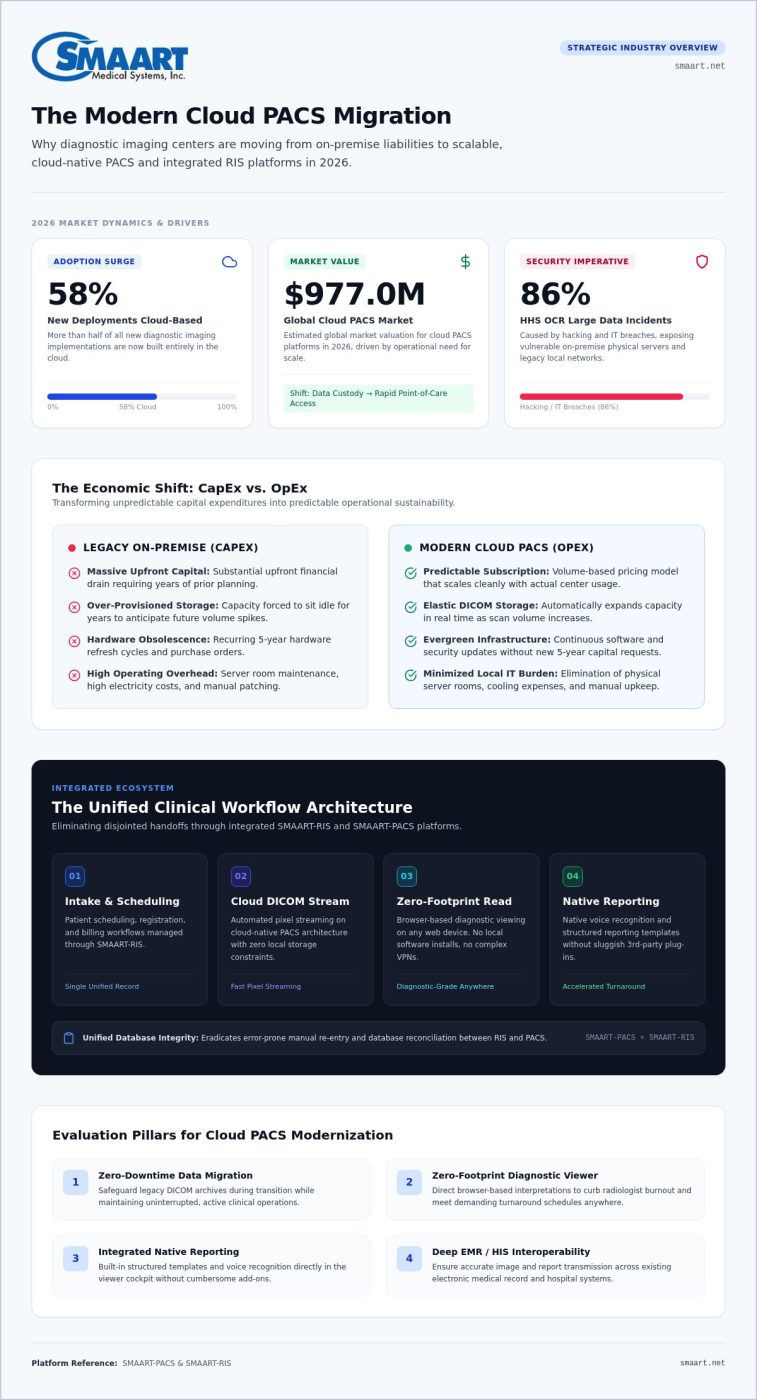
A cloud PACS for imaging centers is no longer a luxury for large hospital networks; it is a clinical necessity for centers of all sizes. In 2026, the definition of a picture archiving and communication system has evolved from a static storage box into a dynamic, SaaS-based ecosystem. This shift marks the transition from data custody to data accessibility. Instead of focusing on where the data sits, centers now prioritize how quickly and securely that data moves to the point of care. This modernization offers a profound sense of relief for administrators. It removes the constant burden of server maintenance, hardware refresh cycles, and the high electricity costs associated with on-premise server rooms.
The 2026 market reflects this urgency, with the global cloud PACS market reaching an estimated $977.0 million this year. This growth is driven by the need for better security and streamlined operations. Legacy on-premise systems are becoming liabilities, especially as hacking and IT breaches account for 86% of large healthcare data incidents reported to the HHS OCR. By moving to the cloud, you gain automatic security updates and reduced local IT footprints, allowing your team to focus on patients rather than patching software.
The Economic Shift: CAPEX to OPEX
Traditional PACS implementations require massive upfront capital investments that drain your budget. These CAPEX models force you to predict your storage needs years in advance, often leading to over-provisioned hardware that sits idle. Transitioning to an OPEX model replaces these spikes with predictable, volume-based subscriptions. This approach protects your facility against technology obsolescence. Your software stays current without requiring a new purchase order every five years. SMAART-PACS provides an affordable, full-feature alternative to the overly complex industry giants. It delivers the same high-tier functionality at a price point that respects your center’s fiscal responsibility.
Remote Access and Radiologist Flexibility
Radiologist burnout is a significant challenge in modern imaging. Providing the ability to read from any location is a powerful way to improve retention and efficiency. Modern workflows rely on zero footprint PACS viewers to deliver diagnostic-grade images to any web-enabled device. These viewers eliminate the need for local software installations or complex VPNs. By using a browser-based approach, radiologists can interpret studies with the same precision they would have in the office. This flexibility speeds up interpretations and ensures your center can meet demanding turnaround times, regardless of where your specialists are located.
Essential Features of a High-Performance Cloud PACS
Selecting a cloud PACS for imaging centers requires looking beyond basic storage. You need a system that acts as a clinical engine, not just a digital archive. High-performance platforms in 2026 rely on cloud-native PACS architecture to ensure that pixel streaming is fast, secure, and reliable. This isn’t just about moving files to the web. It’s about building a scalable DICOM storage foundation that expands automatically as your case volume grows. Modern systems also incorporate advanced reporting tools, such as native voice recognition and structured templates, to eliminate the need for third-party plug-ins that often clutter the workspace and slow down the diagnostic process.
Integrated RIS and PACS Workflows
Efficiency starts where the RIS and PACS meet. Using integrated RIS PACS solutions is the most effective way to eliminate the disjointed workflows that plague traditional centers. When these systems speak the same language, you reduce manual data entry and the human errors that follow. SMAART-RIS and SMAART-PACS work in tandem to create a unified patient record. This connection streamlines everything from initial scheduling to final billing. It provides a sense of relief for administrative staff who no longer have to reconcile patient data across two separate databases. A unified workflow ensures that the right images are always attached to the right patient record, every time.
Diagnostic Viewing Requirements
Your radiologists need tools that work wherever they are. Meeting 2026 standards for diagnostic-quality rendering requires a zero-footprint architecture. This means the viewer runs entirely in a browser without local installations or Java-based downloads. Cross-platform compatibility is essential. Whether your team uses Windows, Mac, or a tablet, the experience must be consistent and fluid. SMAART-PACS leverages high-speed image loading techniques to ensure that even large datasets, like 3D mammography or multi-slice CT scans, stream instantly. This performance remains stable regardless of local bandwidth limitations, allowing for a seamless reading experience from the office or a home workstation. If you want to see how these features can transform your daily operations, you can explore our full suite of imaging tools designed for modern clinics.
Solving the Migration Hurdle: Transitioning Legacy DICOM Data
The single greatest fear during a transition to a cloud PACS for imaging centers is the loss of historical data. Decades of patient history represent more than just records; they are the clinical foundation for longitudinal care. Transitioning this data requires more than a simple file transfer. It demands a meticulous process of tag reconciliation and data normalization. Many legacy systems use proprietary or non-standard DICOM tags that don’t always align with modern EMR requirements. Without a proper audit and cleansing phase, your historical studies might become difficult to query once they reach the cloud. We prioritize data integrity from the start, ensuring that every study is searchable and correctly mapped before the move begins.
A “Big Bang” cutover, where everything moves at once, often creates unnecessary clinical risk. Instead, we advocate for a phase-based migration. This strategy prioritizes “active priors”—typically studies from the last two to three years—to ensure radiologists have immediate access to the most relevant history. Older, non-active data moves in the background or resides in low-cost deep archive tiers. This approach provides immediate relief to your staff by allowing them to use the new system without waiting for petabytes of historical data to finish uploading. Our “Zero-Downtime Migration” ensures your clinic remains fully operational throughout the entire transition.
Cloud PACS Data Migration Services
Success depends on the expertise of the team handling the transfer. Specialized migration teams focus on mapping legacy DICOM tags to ensure that patient IDs, study descriptions, and accession numbers remain consistent across platforms. This level of precision is vital for maintaining HIPAA compliance and data integrity. Data migration is the secure transfer of historical studies to a cloud-native archive. By leveraging automated validation tools, we confirm that every image set is accounted for and hasn’t been corrupted during the ingestion process. This technical oversight removes the burden from your local IT team and places it in the hands of experts.
Handling Large Volumes and Bandwidth
Moving massive datasets can easily throttle a clinic’s internet speed if not managed correctly. We use intelligent routing and bandwidth scheduling to ensure that migration traffic doesn’t interfere with daily diagnostic streaming. While the migration occurs, SMAART-SHARE facilitates collaborative viewing, allowing physicians to access and share images even before the full archive is moved. This ensures that clinical collaboration never pauses. By prioritizing the ingestion of recent cases, we guarantee that the studies your radiologists need most are the first to arrive in your new cloud PACS for imaging centers.
Evaluating ROI: Cost-Benefit Analysis of Cloud vs. On-Premise
Calculating the return on investment for a cloud PACS for imaging centers requires looking beyond the monthly subscription fee. Traditional on-premise systems hide their true costs in the background. You pay for physical servers, dedicated cooling systems, and the square footage required to house them. These direct costs are just the beginning. In 2026, rising energy prices and real estate values make maintaining a local server room a significant financial drain on outpatient facilities. Shifting to the cloud provides immediate relief by converting these unpredictable capital expenses into a steady, manageable operational budget.
Indirect expenses often impact your bottom line more than hardware. Your IT team likely spends valuable hours on manual patches, hardware maintenance, and troubleshooting connectivity issues. If a local server fails, the resulting downtime stops your radiologists from reading, which instantly halts your revenue stream. Cybersecurity insurance premiums are also rising for centers with on-premise setups due to the increased risk of local breaches. Cloud models mitigate these risks by providing built-in redundancies and automatic disaster recovery. This ensures your data remains accessible even if your local facility faces a power outage or hardware failure.
Reducing Radiology Overhead
You can learn how to reduce radiology overhead by adopting software that scales with your actual study volume. SMAART-SHARE eliminates the need for proprietary hardware, allowing you to view and distribute images without a heavy capital investment. You only pay for the storage your center actually uses. This flexibility is a refreshing alternative to legacy giants that force you into expensive, multi-year contracts for capacity you don’t yet need. SMAART-PACS ensures that as your center grows, your technology costs remain proportional to your billing.
Security and Compliance as a Cost Saver
Security is a major area where cloud migrations save significant capital. Managing a HIPAA-compliant security layer on-premise requires constant audits and expensive specialized software. In 2026, the cost of a single data breach far outweighs the investment in a managed cloud platform. Cloud providers handle the expensive burden of security audits and infrastructure hardening. SMAART-PACS adheres to the latest global security standards for image sharing, ensuring your data remains protected without the need for an in-house SecOps team. This managed approach reduces your liability and lowers the cost of maintaining compliance. If you are ready to modernize your facility, request a demo of SMAART-PACS today to see how we streamline your fiscal and clinical operations.
Implementation Strategy: Choosing Your Cloud PACS Partner
Selecting a cloud PACS for imaging centers is a commitment to a long-term clinical partnership. You need more than just a software license; you need a team that understands the high-stakes environment of medical imaging. Evaluating a partner starts with their responsiveness and technical depth. A reliable partner acts as an extension of your own team, providing the expertise required to manage 2026 security standards and complex data workflows. You must test the integration capabilities of any new platform with your existing EMR and HIS before the final rollout. A successful implementation depends on the seamless exchange of patient data and diagnostic reports across all your clinical systems.
Referral relationships are the lifeblood of your center. Providing referring physicians with a zero-footprint viewer is a strategic move that improves your service level. When doctors can access diagnostic-quality images instantly from a web browser, they can make faster treatment decisions. This eliminates the frustration of hardware compatibility issues or slow software downloads. A high-performance viewer ensures that your center remains the preferred choice for local physicians who value speed and reliability. Offering this level of accessibility creates a competitive advantage that legacy on-premise systems simply cannot match.
The SMAART-PACS Advantage
SMAART-PACS offers a refreshing alternative to the complex and expensive systems provided by legacy industry giants. It delivers an affordable, full-feature solution that doesn’t compromise on performance. Our platform integrates smoothly with existing enterprise PACS solutions to optimize your current workflow. You gain the relief of 24/7 technical support and automatic software updates that keep your center at the forefront of imaging technology. We handle the technical heavy lifting, so you can focus on delivering exceptional patient care without the distraction of IT failures.
Next Steps for Your Imaging Center
Before you begin your migration, conduct a thorough internal audit of your current imaging volume and storage requirements. This data provides the foundation for a customized migration assessment. You should also prepare your IT team for the transition to cloud-based management. The shift away from local server maintenance allows your staff to focus on higher-value tasks like network optimization and user training. When you are ready to move forward, we are here to guide you through every step of the process. Schedule a SMAART-PACS demo to start your migration plan.
Future-Proofing Your Imaging Operations in 2026
Modernizing your facility with a cloud PACS for imaging centers is more than a technical upgrade; it’s a strategic move toward clinical and fiscal relief. By moving away from the heavy maintenance of on-premise servers, you gain a scalable infrastructure that adapts to your center’s growth. This transition ensures your radiologists benefit from zero-footprint diagnostic viewing while your administrative team enjoys seamless EMR/RIS integration. You’re trading the burden of hardware cycles for a streamlined environment that prioritizes patient care and diagnostic speed.
The path to a more efficient workflow starts with choosing a partner that prioritizes your operational success. Our affordable SaaS models are designed to eliminate the financial strain of proprietary hardware, providing a predictable path to modernization. You don’t have to navigate the complexities of data migration alone. We provide the technical authority and supportive partnership needed to ensure your historical studies are secure and accessible from day one. It’s time to replace legacy complexity with modern efficiency.
Ready to leave legacy hardware behind? Request a custom SMAART-PACS demo and migration assessment today. We look forward to helping you build a more responsive, profitable, and patient-centered imaging facility.
Frequently Asked Questions
How long does a cloud PACS data migration typically take for an imaging center?
Migration timelines vary based on the total volume of historical DICOM data and your local internet speeds. A typical transition for a mid-sized facility can take several weeks to a few months. We prioritize “active priors” from the last two years first, allowing your team to use the new system within days. The remaining historical archive moves securely in the background to ensure your clinical operations never experience a bottleneck.
Is cloud PACS storage more secure than on-premise servers for HIPAA compliance?
Cloud storage is often more secure because it eliminates the physical vulnerabilities of on-site hardware. Modern cloud PACS for imaging centers leverage enterprise-grade encryption and automated security patches that outpace manual on-premise maintenance. These platforms are built to meet 2026 HIPAA standards, providing a managed security layer that protects against the hacking and IT breaches that currently account for the majority of large healthcare data incidents.
Do I need special hardware to run a zero-footprint PACS viewer?
You don’t need proprietary hardware or high-end workstations to run a zero-footprint viewer. These tools are browser-based, meaning they function on standard PCs, Macs, and even tablets. SMAART-SHARE utilizes this architecture to deliver diagnostic-quality images without requiring local software installations. This flexibility allows your radiologists and referring physicians to view studies from any location with a standard internet connection, significantly reducing your center’s total hardware investment.
Can cloud PACS integrate with my existing RIS and billing software?
Yes, seamless integration is a core feature of modern imaging ecosystems. SMAART-PACS is specifically designed to work with existing EMR, HIS, and billing platforms to create a unified workflow. This connection reduces manual data entry and ensures that patient records are synchronized across your entire facility. By integrating your RIS and PACS, you eliminate disjointed processes, leading to more accurate billing and a more efficient scheduling experience for your administrative staff.
What happens to my imaging data if the internet connection goes down?
Most modern systems use local edge caching or smart DICOM routers to ensure clinical continuity during an outage. These appliances store recent studies locally, allowing radiologists to continue reading even if the external connection is interrupted. Once the internet is restored, the system automatically synchronizes any new data with the cloud archive. This redundant architecture provides peace of mind, ensuring that your imaging center remains operational regardless of temporary connectivity issues.
How does cloud PACS improve report turnaround times for radiologists?
A cloud PACS for imaging centers improves turnaround times by providing instant access to studies from any location. Radiologists no longer wait for large files to download over slow VPNs; instead, images stream directly into the viewer. Integrated tools like voice recognition and structured reporting templates further accelerate the interpretation process. This streamlined workflow allows for faster communication with referring physicians, which is essential for maintaining a high standard of patient care.
Are there hidden costs like data egress fees in cloud PACS migrations?
Some vendors charge data egress fees when you move or retrieve large volumes of data, but transparent providers build these costs into their subscription models. It’s important to evaluate the total cost of ownership, including ingestion and long-term storage fees. SMAART Medical Systems focuses on fiscal responsibility, offering affordable SaaS models that eliminate the surprise expenses often associated with legacy giants. Always request a detailed cost breakdown to ensure your monthly subscription remains predictable.
Can I share images directly with patients using a cloud-based platform?
Yes, you can securely share images and reports with patients through dedicated portals. SMAART-SHARE allows for the distribution of radiology results without the need for physical media like CDs or USB drives. Patients can access their images through a secure link, which improves their overall experience and reduces the administrative burden on your front-desk staff. This digital-first approach to image sharing is faster, more secure, and significantly more convenient for everyone involved.