
Cost to Implement RIS in a Small Hospital: 2026 Buyer Guide
The biggest financial trap in radiology modernization isn’t the software license; it’s the hidden complexity of legacy architecture. If you’re calculating the cost to implement RIS in a small hospital, you probably already dread the standard enterprise playbook: surprise interface fees, protracted consulting hours, and heavy physical servers your lean IT team doesn’t have time to maintain. You shouldn’t have to risk clinical downtime or budget blowouts just to upgrade your department workflow.
Sustainable implementation depends on architectural simplicity, not massive enterprise infrastructure. This guide uncovers the real cost drivers behind small hospital deployments, distinguishing predictable operational subscriptions from expensive capital traps. You’ll learn how to identify hidden integration fees, assess cloud-ready alternatives that eliminate on-premise server maintenance, and evaluate vendors using a practical interoperability checklist. Below, we examine the essential budget categories and rollout strategies you need to modernize your scheduling, tracking, and billing with total financial confidence.
Key Takeaways
- Evaluating the true cost to implement RIS in a small hospital requires separating baseline software access from recurring service commitments and infrastructure demands.
- Uncover hidden deployment line items before signing, specifically third-party EHR interface tunnel fees, legacy data migration, and modality integration charges.
- Assessing five-year total cost of ownership demonstrates how cloud-ready systems protect lean IT teams from server maintenance and unexpected downtime.
- Focus your procurement evaluation on practical operational drivers, prioritizing tools that streamline patient scheduling, tracking, and report distribution.
- Accelerate radiology return on investment with platforms like SMAART-RIS that automate charge capture at the modality to stop billing leakage.
Core Budget Components of Small Hospital RIS Implementation
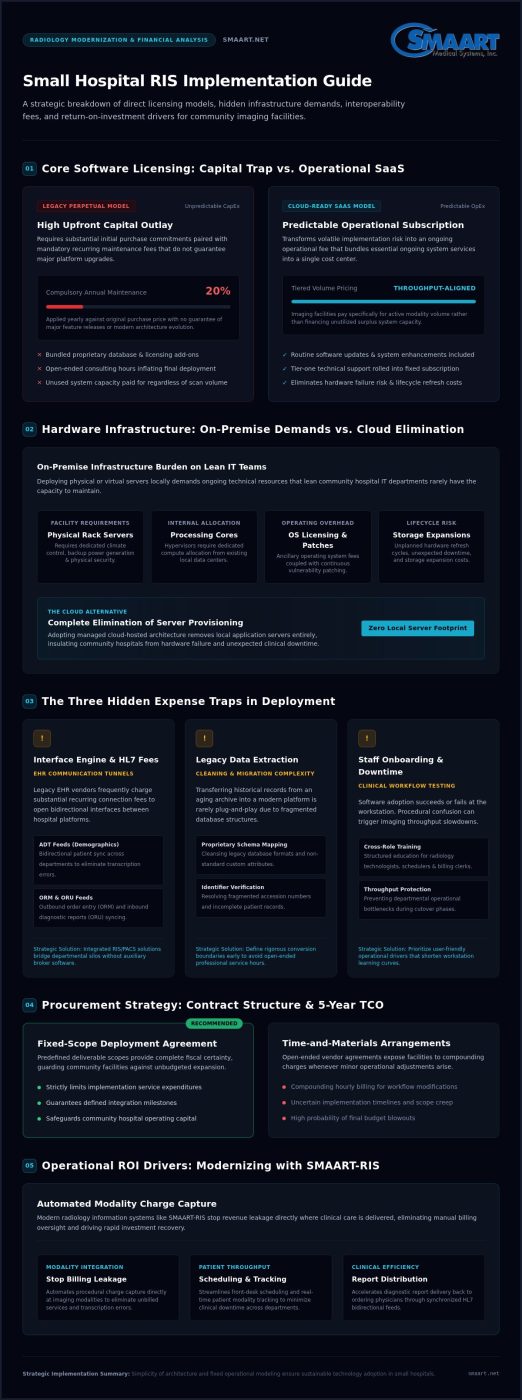
Assessing the baseline cost to implement RIS in a small hospital begins by dissecting initial setup requirements from ongoing operational overhead. Legacy vendors frequently obscure this distinction by bundling proprietary software, database licenses, and open-ended professional service hours into monolithic contracts. In contrast, agile community facilities evaluate a modern Radiology Information System (RIS) through distinct architectural components. Choosing fixed-scope deployment agreements protects limited operating funds, whereas open-ended time-and-materials vendor arrangements expose facilities to compounding service fees whenever minor workflow adjustments arise.
Software Licensing Structures: Subscription SaaS vs Perpetual Models
Perpetual licensing demands substantial upfront capital outlay paired with compulsory annual maintenance agreements. These maintenance contracts typically cost twenty percent of the original purchase price each year without guaranteeing major feature releases. A cloud-ready Software-as-a-Service (SaaS) model shifts these expenses into predictable operational budgeting. Subscription arrangements roll routine software updates, system enhancements, and tier-one support into a single predictable fee. Furthermore, tiered volume tiers align software expenses directly with patient throughput, allowing a growing imaging center to pay only for active modality volume rather than surplus system capacity.
Hardware Infrastructure and Server Provisioning Requirements
On-premise deployments impose heavy physical infrastructure burdens on community facilities. Purchasing physical rack servers requires dedicated climate control, backup power generation, and physical security measures. Even when leveraging hypervisors within an existing data center, your internal team must allocate dedicated processing cores, purchase ancillary operating system licenses, and oversee continuous security patching.
Adopting modern cloud-hosted platforms removes server provisioning entirely. Eliminating local application servers shields lean hospital teams from hardware lifecycle refreshes and unexpected storage expansions. This shift fundamentally alters the total cost to implement RIS in a small hospital by trading unpredictable hardware failure risk for dependable, managed cloud performance.
Hidden and Indirect Expenses in Radiology Information System Rollouts
Unbudgeted expenses derail technology projects faster than base software pricing. When analyzing the cost to implement RIS in a small hospital, leadership teams routinely overlook third-party connection fees, historical data cleaning, and internal labor diversion. Software licenses represent only the baseline; the true fiscal footprint hides in the operational seams between disconnected hospital platforms.
Interface Engine Configuration and HL7 Interoperability Fees
Seamless clinical communication requires reliable bridges between your core Hospital Information System (HIS), EHR, and imaging workflows. Legacy EHR vendors routinely charge substantial recurring connection fees just to open bidirectional communication tunnels. Outbound order entry (ORM) and inbound diagnostic report (ORU) feeds must sync flawlessly. Similarly, bidirectional admission, discharge, and transfer (ADT) feeds must match patient demographics across departments to eliminate transcription mistakes.
Evaluating integrated RIS PACS solutions early in procurement helps eliminate duplicate interface fees, bridging departmental silos without requiring auxiliary broker software.
Legacy Patient Data Extraction, Cleaning, and Migration
Transferring historical patient records from an aging archive into a modern platform is rarely plug-and-play. Legacy databases often utilize proprietary fields, fragmented accession numbers, or incomplete patient identifiers. Extracting and cleansing this data requires meticulous schema mapping and patient master identity verification. Without clear boundary definitions in your initial vendor scope, data conversion quickly escalates into billable professional service hours that inflate your final deployment budget.
Clinical Staff Onboarding, Workflow Testing, and Departmental Downtime
Software adoption succeeds or fails at the workstation. Transitioning radiology technologists, front-desk schedulers, and billing coordinators requires structured training schedules. Even minor procedural confusion can trigger imaging throughput slowdowns and temporary clinical disruptions. Small facilities must conduct rigorous simulated go-live dry runs before cutting over active patient queues.
Factoring these indirect commitments into the overall cost to implement RIS in a small hospital ensures realistic launch expectations. Selecting intuitive platforms backed by responsive vendor support, such as the modular systems engineered by SMAART Medical Systems, minimizes clinical disruption while keeping staff productive from day one.
Cloud-Hosted vs. On-Premise RIS: Total Cost of Ownership Analysis
Calculating the true cost to implement RIS in a small hospital requires examining a comprehensive five-year horizon rather than judging software solely by initial acquisition numbers. Legacy on-premise installations often tempt leadership teams with lower perpetual license quotes. That initial perception unravels quickly once recurring hardware refreshes, round-the-clock systems engineering, off-site disaster recovery, and escalating cyber-insurance premiums hit the balance sheet. Conversely, managed cloud platforms consolidate multi-tiered operational burdens into a transparent operating expenditure model.
On-Premise Infrastructure Maintenance and IT Resource Demands
Internal infrastructure management demands relentless technical intervention. On-site deployments force your hospital IT department to manage complex operating system patch cycles, database tuning, manual snapshot backups, and hypervisor allocations. In addition, physical hospital server hardware faces an inevitable replacement cliff every three to five years. Factoring in vulnerability assessments, hardware firewall maintenance, and continuous HIPAA compliance auditing reveals that maintaining self-managed infrastructure drains scarce technical staffing hours away from patient-facing clinical systems.
Cloud-Based RIS: Scalability, Upgrades, and Predictable OPEX
A cloud-native framework fundamentally redefines departmental economics. Software enhancements, schema updates, and compliance revisions occur seamlessly in the background with zero planned clinical downtime. Clinical availability is preserved through automated multi-region data replication, eliminating the need to construct and test isolated secondary disaster recovery environments.
Small facilities must pair cloud deployments with sensible local network resilience. While cloud architecture removes back-end server upkeep, community hospitals should maintain secondary internet connections and traffic-shaping switches to protect daily modality connectivity during broadband outages. This cloud-first modernization mirrors the enterprise-wide transition toward modern enterprise PACS solutions, uniting diagnostic imaging workflows and administrative tracking within unified, cloud-ready frameworks.
Switching from on-premise infrastructure to a managed operational subscription transforms the financial equation. It protects rural and independent healthcare facilities from unpredictable capital calls, stabilizes long-term technology outlays, and keeps clinical teams supported by current software standards.
Strategic Procurement Guide: How Small Hospitals Select the Right RIS
Small community facilities can’t afford protracted evaluation cycles that result in runaway consulting bills. Selecting the right technology requires a lean procurement sequence focused strictly on practical clinical utility. When assessing vendors, your objective is locking down departmental performance while insulating your balance sheet from open-ended consulting adjustments that inflate the cost to implement RIS in a small hospital.
Essential Small Hospital Functional Checklist
Avoid bloated enterprise software suites that drive up licensing tiers without improving patient care. Independent community facilities should prioritize core functional capabilities that directly accelerate clinical throughput and protect departmental revenue:
- Intelligent Resource Scheduling: Automated conflict resolution across examination rooms, imaging modalities, and technologist schedules to prevent double bookings.
- Modality Worklist Tracking: End-to-end departmental tracking that monitors study progress in real time, from patient check-in to radiologist signature.
- Integrated Billing Scrubbers: Direct validation of procedure codes and modality triggers at exam completion, ensuring clean diagnostic reports and faster claim submission.
Contract Terms, Service Level Agreements, and Hidden Clause Audits
Vendor contract fine print often conceals the expenses that blow past preliminary estimates. Scrutinize proposals for open-ended travel expenses, rigid caps on included remote training sessions, and billable service hours for standard software releases. Insist on clear Service Level Agreements (SLAs) with strict uptime commitments and defined escalation protocols for urgent imaging disruptions.
In addition, audit interface expansion clauses before signing. Legacy providers frequently charge punitive interface fees whenever your hospital updates its core clinical software or adds a secondary outpatient location. Protect hospital capital by binding vendor payment schedules directly to concrete delivery milestones, such as verified interface data exchange and formal user acceptance sign-off, rather than arbitrary project dates.
Ready to modernize your radiology workflow without legacy contractual bloat? Review how SMAART Medical Systems delivers scalable radiology solutions built to provide robust clinical capability alongside predictable long-term financial control.
Maximizing Radiology ROI with SMAART-RIS Integration
Modernizing departmental technology shouldn’t just be an administrative expense; it should function as a reliable revenue driver. Community hospitals often view new radiology software as an unavoidable capital strain. However, deploying a modern platform transforms department economics by plugging revenue leaks, compressing study turnaround times, and reclaiming lost billable hours. Evaluating the cost to implement RIS in a small hospital requires weighing initial onboarding expenses against the immediate financial returns of tighter charge capture and streamlined patient tracking.
Streamlining Departmental Workflow and Accelerated Billing
Revenue leakage frequently occurs in the chaotic handoff between image acquisition and billing submission. When technologists complete an exam, manual documentation delays can hold up professional fee coding for days. Automated status triggers change that equation entirely. The moment an imaging study completes at the modality, timestamp verification instantly routes the case to the reading worklist while validating procedure codes for billing reconciliation.
Eliminating manual transcription stops costly double-booking errors and missed technical components. By integrating strategies outlined in hospital imaging workflow optimization, small facilities compress diagnostic turnaround times, accelerate reimbursement cycles, and prevent unbilled procedures from falling through departmental cracks.
The SMAART-RIS Advantage: Built for Lean Hospital Operations
Small hospitals don’t need the cumbersome footprint or rigid service contracts of legacy enterprise vendors. SMAART-RIS delivers a flexible, responsive alternative engineered specifically around the operational realities of community imaging centers. Its clean, web-based interface flattens the learning curve for technologists and administrative staff, keeping department morale high and onboarding hours low.
Deployment flexibility ensures that SMAART-RIS integrates directly into your existing hospital environment without requiring proprietary server hardware. For a cohesive diagnostic imaging ecosystem, facilities can couple the platform with native imaging tools such as SMAART-PACS, SMAART-SHARE, or a browser-based zero footprint PACS viewer. This modular approach preserves capital, protects your staff from IT overload, and lowers the overall cost to implement RIS in a small hospital through direct, collaborative vendor implementation support.
Modernize Your Radiology Operations Without Budget Surprises
Managing the true cost to implement RIS in a small hospital comes down to architectural simplicity and procurement discipline. By moving away from costly perpetual licenses, eliminating local server maintenance, and auditing third-party EHR interface fees early, your facility can secure modern departmental efficiency on predictable terms. You don’t have to accept bloated enterprise contracts or clinical disruptions just to upgrade your department’s scheduling, tracking, and charge capture.
SMAART Medical Systems provides proven, modular radiology software designed specifically for high-efficiency community healthcare. Our cloud-ready architecture integrates smoothly with leading EMR and HIS platforms, eliminating physical hardware overhead and on-site database upkeep. Upgrading your radiology workflow should bring operational relief, not administrative headaches. Discover how SMAART-RIS streamlines hospital workflow without enterprise cost and equip your clinical team with dependable tools built for sustainable growth.
Frequently Asked Questions
How long does a typical RIS implementation take in a small hospital?
A typical deployment takes between four and twelve weeks depending on your chosen system architecture. Cloud-ready platforms deploy much faster than legacy systems because they eliminate physical server installation and local database configuration. The primary variables influencing launch speed are EHR interface validation and legacy data migration. Choosing an experienced vendor with guided onboarding ensures departmental workflows stay on schedule without disrupting active patient care.
What is the biggest hidden cost when deploying a new RIS?
Third-party interface connection fees levied by incumbent EHR vendors represent the single largest unexpected expense. Software proposals often exclude the licensing charges hospital EHR providers assess to open bidirectional HL7 or FHIR communication channels. These external connection fees significantly increase the overall cost to implement RIS in a small hospital. Historical record extraction and legacy database cleansing also create unplanned professional service billing if not scoped early.
Can a small hospital implement a cloud RIS without expanding IT staff?
Yes, cloud-hosted architectures are specifically designed to eliminate the need for dedicated database administrators or on-site server technicians. The vendor manages backend infrastructure, regulatory updates, security patches, and disaster recovery off-site. Your internal personnel only need to maintain local network connectivity and standard web browsers, allowing community facilities to modernize radiology operations without increasing permanent technical headcount or overwhelming existing staff.
What is the difference between RIS licensing and PACS licensing?
RIS licensing covers operational workflow management, whereas PACS licensing covers diagnostic image archiving and distribution. Your RIS manages patient scheduling, technologist tracking, report creation, and billing charge capture. The PACS stores DICOM files and provides high-resolution viewing tools for radiologist interpretations. While licensed separately, selecting modular software designed for native integration ensures both platforms communicate smoothly without requiring duplicate interface software.
Does our hospital need to replace our current PACS when upgrading RIS?
No, you don’t need to replace a functional PACS when upgrading to a modern RIS platform. Standards-based systems communicate smoothly with third-party PACS archives using standard DICOM worklists and HL7 messaging. However, many community hospitals choose to pair solutions like SMAART-RIS alongside SMAART-PACS to consolidate vendor relationships, reduce interface complexity, and provide staff with a unified diagnostic imaging experience.
How does RIS software integrate with our existing hospital EHR?
Modern RIS software integrates with hospital EHR platforms using standard bidirectional HL7 and FHIR communication protocols. The interface synchronizes patient demographics through ADT feeds, imports clinician imaging orders via ORM messages, and automatically sends signed diagnostic reports back to the electronic medical record via ORU messages. This automated loop eliminates manual transcription, speeds up report turnaround, and ensures billing codes reach revenue teams instantly.
What ongoing maintenance expenses should our hospital expect post-launch?
Ongoing expenses depend primarily on whether your hospital selects an operational SaaS subscription or an on-premise perpetual model. Subscription agreements package software licensing, feature updates, regulatory updates, and technical support into a predictable operational fee. On-premise deployments require separate software support contracts, internal server maintenance, and recurring hardware refresh budgets. Evaluating these factors provides a reliable picture of the five-year cost to implement RIS in a small hospital.