
Integrated RIS PACS Solutions: Streamlining Radiology Workflows in 2026
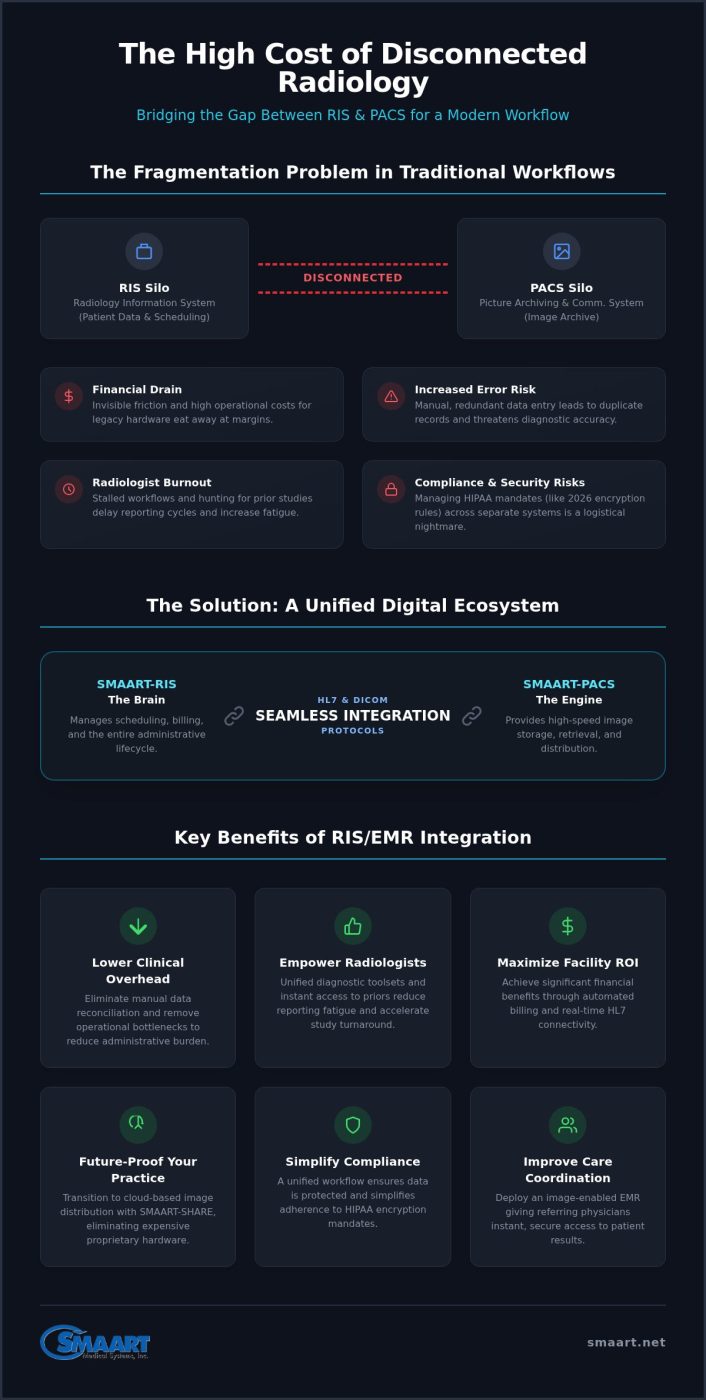
The true cost of your radiology department isn’t the imaging equipment; it’s the invisible friction between your scheduling software and your diagnostic image archive. In 2026, maintaining separate silos for patient data and imaging results is no longer just an inconvenience. It’s a significant financial drain and a potential compliance risk under the latest HIPAA encryption mandates. When you bridge these gaps, the RIS EMR integration benefits become undeniable: you eliminate redundant data entry, reduce the risk of administrative errors, and finally stop the cycle of radiologist burnout.
You’ve likely felt the frustration of a reporting workflow that stalls just as patient volume peaks. We know that the pressure to modernize can feel overwhelming when you’re already stretched thin. This article explores how merging your Radiology Information System with a Picture Archiving and Communication System creates a unified digital ecosystem. You’ll discover how tools like SMAART-RIS and SMAART-PACS remove operational bottlenecks and lower clinical overhead. We will examine the shift toward cloud-native connectivity and show you how to achieve seamless EMR integration that respects both your staff’s time and your facility’s bottom line.
Key Takeaways
- Stop the operational drain caused by data silos by uniting your imaging and scheduling systems into a single, cohesive digital environment.
- Maximize your facility’s ROI by understanding the RIS EMR integration benefits that arise from automated billing and real-time HL7 connectivity.
- Empower your radiologists with unified diagnostic toolsets designed to reduce reporting fatigue and significantly accelerate study turnaround times.
- Improve care coordination by deploying an image-enabled EMR that provides referring physicians with instant, secure access to patient results.
- Future-proof your practice by transitioning to cloud-based image distribution through SMAART-SHARE, eliminating the need for expensive proprietary hardware.
The High Cost of Fragmentation: Why Modern Radiology Needs Integration
Radiology facilities are facing unprecedented financial pressure as we move through 2026. Reimbursement rates remain under scrutiny while operational costs for legacy hardware continue to climb. For many clinics, the biggest drain isn’t the cost of the scanners themselves. It’s the fragmentation between their patient data and their imaging archives. When your Radiology Information System (RIS) doesn’t talk to your PACS, you’re paying for inefficiency in every single study. Transitioning to a software-driven model isn’t just about tech; it’s about survival. One of the primary RIS EMR integration benefits is the immediate relief of clinical overhead by removing the manual labor required to sync disparate systems.
The 2026 HIPAA Security Rule update has added another layer of complexity. Encryption for medical images at rest is now mandatory. If your systems are siloed, managing these security requirements across different vendors becomes a logistical nightmare. A unified digital workflow simplifies compliance. It ensures that data remains protected without slowing down the clinical team. By merging these functions, you move from a reactive posture to one of modern efficiency.
Identifying the Bottlenecks in Traditional Workflows
Traditional workflows often rely on manual data entry across multiple screens. This creates a dangerous environment for duplicate patient entries, which directly threatens diagnostic accuracy. If a technician mistypes a patient ID in the RIS, that error can propagate into the imaging archive, leading to fragmented medical histories. Beyond the clinical risk, there’s a heavy financial toll. Maintaining non-integrated legacy databases requires specialized IT attention and expensive proprietary hardware. These hidden costs eat away at your margins. Fragmented image retrieval also delays reporting cycles, forcing radiologists to hunt for previous studies instead of focusing on the current diagnosis.
The Move Toward Unified Imaging Management
The industry is shifting away from “best-of-breed” silos that require complex custom coding to function together. Modern facilities are opting for “single-platform” ecosystems where patient data and medical images coexist. Achieving hospital imaging workflow optimization requires a strategy that prioritizes interoperability. By 2026, compliance standards demand that systems communicate via updated HL7 and DICOM protocols to ensure data integrity and security. SMAART-RIS acts as the central hub in this modern architecture. It bridges the gap between the HIS and the imaging archive, ensuring that every stakeholder has the right data at the right time. This unified approach provides the RIS EMR integration benefits necessary to scale your operations without ballooning your administrative staff.
What Are Integrated RIS PACS Solutions? The Core Architecture
An integrated RIS PACS is a unified platform for clinical data management. While traditional “brokered” integrations simply pass messages between separate databases, a modern unified architecture ensures patient data and medical images coexist seamlessly in a single environment. This shift removes the lag and data discrepancies common in older systems. The technical bridge of this architecture relies on HL7 and DICOM protocols. HL7 handles the administrative lifecycle, including patient demographics and scheduling, while DICOM manages the heavy lifting of medical imaging traffic. When these protocols work in harmony, you realize the full scope of RIS EMR integration benefits, specifically the elimination of manual data reconciliation.
SMAART-RIS acts as the brain of the operation, managing the administrative lifecycle from the moment a patient registers. It handles the scheduling, billing, and tracking of every study. In contrast, SMAART-PACS serves as the high-speed engine for image storage and distribution. It ensures that when a radiologist opens a study, the images are available instantly, regardless of file size. This partnership provides a level of professional relief that fragmented systems simply cannot match.
The Symbiotic Relationship Between Data and Images
In a unified environment, a single worklist synchronizes scheduling with the diagnostic workstation. This means when a technician updates a patient’s status in the RIS, the change reflects immediately in the PACS. Automated patient tracking follows the individual from registration to the final report, leaving no room for lost studies or mislabeled records. A quantitative analysis of the benefits of such systems shows a significant decrease in the time required to access clinical data. By aligning these workflows, your facility stops wasting time on administrative housekeeping and focuses on diagnostic precision. You can explore our integrated platforms to see how this technical synergy translates into daily operational savings.
Cloud-Native vs. On-Premise Integration Models
The landscape of 2026 is moving rapidly toward zero-footprint viewing. Web-based PACS environments offer a level of scalability that on-premise hardware cannot replicate. By leveraging the cloud, you remove the financial strain of maintaining expensive server rooms and proprietary hardware. This model allows radiologists to access diagnostic-grade images from any secure location, which is a major factor in maximizing RIS EMR integration benefits for distributed teams. If you are looking to scale, you should review our modernizing workflow with integrated RIS PACS solutions strategic guide. Moving to a cloud-native model ensures your facility remains agile and ready for future volume increases without requiring a massive capital expenditure.
The Operational and Financial Benefits of a Unified Workflow
Many providers view software integration as a luxury tech upgrade, but in 2026, it’s a fiscal necessity. The financial burden of manual data reconciliation is simply unsustainable for modern clinics. One of the primary RIS EMR integration benefits is the significant reduction in the total cost of ownership (TCO) for your imaging department. By eliminating the need for expensive, proprietary hardware and moving toward software-centric solutions like SMAART-SHARE, you can slash maintenance costs and reduce your IT footprint. This shift allows you to move away from rigid capital expenditure models toward more predictable, scalable operational models that grow with your volume.
Efficiency also translates directly into improved patient outcomes. When results move through a unified system, turnaround times for critical findings drop significantly. This speed isn’t just about convenience; it’s about getting life-saving information to the treating physician as quickly as possible. A seamless flow of data ensures that every stakeholder has a complete picture of the patient’s history, which reduces the likelihood of redundant testing and medical errors.
Streamlining the Administrative Lifecycle
Paper-based workflows and manual report distribution are major bottlenecks that drain staff productivity. Integrated systems like SMAART-RIS provide immediate relief by automating patient notifications and scheduling. This ensures your front-desk team isn’t bogged down by repetitive phone calls or manual data entry. Additionally, integrated billing modules reduce claim denials by ensuring that every study is correctly coded and linked to the patient record at the point of service. These improvements mirror the widely recognized Health Information Exchange (HIE) benefits, including enhanced care coordination and increased administrative efficiency across the healthcare enterprise.
Empowering Radiologists with Diagnostic Speed
Radiologist burnout is often driven by inefficient software that forces doctors to struggle with slow image retrieval. A unified workflow solves this by providing instant access to prior exams directly within the diagnostic viewer. This eliminates the need to toggle between different applications, which is a major factor in reducing diagnostic fatigue. Our zero footprint PACS viewer technology supports this by enabling secure, browser-based diagnostic viewing from any location. By providing radiologists with high-speed, ergonomic tools, you’re maximizing the RIS EMR integration benefits that lead to higher throughput and more accurate reporting without increasing the clinical burden on your staff.
Interfacing PACS with EMR and HIS: Ensuring Seamless Connectivity
Connecting your PACS to the EMR isn’t just a technical checkbox; it’s the foundation of a modern healthcare enterprise. When you image-enable your EMR, you give referring physicians instant access to results without forcing them to log into a separate portal. This convenience is one of the most visible RIS EMR integration benefits. It builds loyalty among your referring network while reducing the administrative burden on your staff. Physicians can make faster clinical decisions when the diagnostic image is only a click away from the patient’s medical history.
Technical hurdles often stop facilities from achieving this level of connectivity. Disparate systems often use different versions of HL7, creating interoperability gaps that lead to data errors. SMAART-RIS solves this by acting as the central hub. It sits between the Hospital Information System (HIS) and the imaging archive, ensuring data flows correctly regardless of the underlying software versions. This centralized approach removes the complexity of managing multiple point-to-point interfaces, providing a more stable and scalable environment. Consult with our team to learn how SMAART-RIS can bridge your existing connectivity gaps.
The Power of Bidirectional Data Exchange
Bidirectional data exchange is the engine of clinical efficiency. When your HIS synchronizes patient demographics to the RIS automatically, you eliminate the risk of typos that lead to duplicate records. The flow continues as the RIS sends diagnostic reports back to the EMR without manual intervention, ensuring the clinical record is always current. This real-time synchronization provides status updates at every stage of the imaging lifecycle. It significantly reduces the risk of ‘lost’ exams because every stakeholder can see exactly where a study sits in the pipeline, from scheduling to final signature.
Interoperability Standards in 2026
By 2026, standards like FHIR (Fast Healthcare Interoperability Resources) and HL7 have evolved to handle more complex data structures across cloud environments. These updates are critical for maintaining HIPAA compliance, especially since the 2026 Security Rule now mandates encryption for medical images at rest. Integrated platforms must manage these security protocols without sacrificing speed or accessibility. You can learn more about these shifts in our guide on enterprise PACS solutions. Modernizing your connectivity ensures you meet these legal requirements while providing a superior experience for both your staff and your patients.
Implementing SMAART-RIS and SMAART-PACS: A Path to Modernization
Modernizing a radiology department often feels like a monumental task. It’s easy to get overwhelmed by the technical debt of legacy systems and the complexity of new compliance mandates. However, a scalable integration strategy doesn’t require a total overhaul of your existing infrastructure. By leveraging software-native solutions like SMAART-RIS and SMAART-PACS, you can build a bridge to the future without the typical disruptions. These tools are designed to work together seamlessly, ensuring that your facility captures the full spectrum of RIS EMR integration benefits from day one.
Central to this shift is SMAART-SHARE. It provides secure, cloud-based image distribution that bypasses the need for burning CDs or maintaining complex VPNs for referring physicians. In 2026, the move toward cloud-native environments is no longer optional for facilities that want to remain competitive. By adopting a software-native approach, you eliminate the high costs of maintaining proprietary hardware silos. This transition allows your team to focus on patient care instead of troubleshooting server issues. Our commitment is to provide elite expertise with a supportive, partner-focused approach that ensures your success long after the initial implementation.
Scaling Without the Financial Strain
Many industry giants lock facilities into rigid, expensive contracts that make scaling nearly impossible. SMAART Medical Systems, Inc. challenges this norm with affordable, full-feature licensing models that prioritize your facility’s growth. Moving from on-premise silos to cloud-based flexibility provides the immediate relief of a predictable, subscription-based management model. You won’t face sudden, massive capital requests for hardware refreshes or proprietary storage upgrades. Instead, you get a system that scales naturally alongside your patient volume. This fiscal responsibility is a core component of the RIS EMR integration benefits we deliver to our partners.
Next Steps: Modernizing Your Facility
The first step toward a unified digital workflow is a comprehensive audit. You need to identify exactly where your current integration gaps are causing the most friction. Are your radiologists waiting too long for images to load? Is your billing team manually re-entering patient data from the HIS? Once you’ve identified these bottlenecks, you can collaborate with a reliable partner to design a clear transition roadmap. Modernizing your facility isn’t just a software transaction; it’s an ongoing investment in operational excellence. Ready to reduce your overhead? Contact SMAART Medical Systems, Inc. today to start your modernization journey.
Empowering Your Radiology Practice for a Unified Future
Transitioning from fragmented data silos to a unified digital ecosystem isn’t just a technical upgrade; it’s a strategic move to reclaim your time and protect your margins. By prioritizing seamless bidirectional data exchange and cloud-native storage, you solve the chronic issues of radiologist burnout and administrative error. The landscape of 2026 demands this level of agility, ensuring your facility remains compliant and efficient as patient volumes grow.
One of the most significant RIS EMR integration benefits is the immediate relief of clinical overhead, allowing your team to focus on diagnostic precision rather than manual data entry. You don’t have to navigate this transition alone or settle for the high costs of industry giants. We’re here to help you achieve a modernized, software-driven workflow that supports your staff and your bottom line.
Ready to experience the relief of a truly integrated system? Streamline your radiology workflow with SMAART Medical Systems. As a trusted national partner for radiology modernization, we provide affordable, full-feature radiology software and seamless EMR/HIS integration. Modernization doesn’t have to be a burden when you have the right partner. Let’s build a more efficient future together.
Frequently Asked Questions
What is the primary difference between a RIS and a PACS?
A Radiology Information System (RIS) manages the administrative lifecycle of a patient, including scheduling, tracking, and demographics. In contrast, a Picture Archiving and Communication System (PACS) handles the storage and distribution of the actual medical images. While they serve different roles, they function best as a unified environment. This synergy is a core part of the RIS EMR integration benefits that modern clinics seek to achieve.
How do integrated RIS PACS solutions improve radiology billing accuracy?
Integration improves billing accuracy by ensuring that every study performed is automatically captured and coded within the financial module. When the RIS and PACS communicate, the system verifies that the procedure performed matches the order in the patient record. This eliminates manual entry errors and reduces claim denials. It ensures that your facility captures all legitimate revenue while minimizing the administrative burden on your billing staff.
Can SMAART-PACS integrate with my existing EMR system?
Yes, SMAART-PACS is specifically designed to integrate with existing EMR and HIS platforms. It uses standard interoperability protocols like HL7 and DICOM to bridge the gap between your diagnostic archive and clinical records. This allows for an “image-enabled EMR” where referring physicians can access results directly from the patient chart. Our team focuses on specialized software tools that fit into your current infrastructure without requiring complex custom coding.
What are the security requirements for cloud-based RIS PACS integration in 2026?
As of 2026, the HIPAA Security Rule mandates encryption for all medical images at rest, moving it from an addressable safeguard to a mandatory requirement. Cloud-based integrations must also comply with evolving FHIR and HL7 standards for secure data exchange. SMAART systems use these modern protocols to protect patient privacy while maintaining high-speed access. Ensuring your platform meets these 2026 standards is critical for avoiding legal penalties and maintaining data integrity.
Does integrating radiology software require new hardware installation?
No, integrating radiology software like SMAART-RIS and SMAART-PACS typically doesn’t require new hardware installations. These are software-native solutions designed to work with your existing computers and servers. In fact, SMAART-SHARE often allows clinics to eliminate expensive proprietary hardware by moving to a cloud-based distribution model. This shift reduces your facility’s total cost of ownership and removes the financial strain of maintaining physical server rooms.
How does RIS PACS integration reduce radiologist turnaround time?
Integration reduces turnaround time by removing the manual steps between image acquisition and final reporting. When the system is unified, radiologists get instant access to prior exams and patient histories within their diagnostic viewer. This streamlined workflow eliminates the need to toggle between different applications. Faster access to data leads to quicker interpretations, which is one of the primary RIS EMR integration benefits for busy radiology departments.
What is a ‘single source of truth’ in radiology workflow management?
A ‘single source of truth’ refers to a unified database where all patient data and clinical images are synchronized in real time. In this model, every stakeholder accesses the same updated information, whether they are in the EMR, RIS, or PACS. This prevents the creation of conflicting records or duplicate patient entries. It ensures that diagnostic decisions are based on the most current and complete medical history available across the entire enterprise.
Is SMAART-SHARE compatible with non-SMAART imaging systems?
Yes, SMAART-SHARE is built on vendor-neutral protocols, making it compatible with non-SMAART imaging systems. It functions as a cloud-based bridge that can distribute images regardless of the original PACS vendor. This allows you to collaborate with external partners and referring physicians who may use different software platforms. It provides a flexible, affordable solution for secure image sharing without forcing you into a single-vendor ecosystem for all your imaging needs.