
Legacy PACS Data Migration Strategy: The 2026 Guide to Modernizing Radiology Workflows
Maintaining an aging imaging system is no longer just an IT headache; it’s a strategic drain on your facility’s financial agility. You likely feel the mounting pressure of high maintenance costs and the persistent fear of data loss during a complex transition. Integrating these systems with your EMR shouldn’t feel like a constant uphill battle against outdated architecture and proprietary hardware constraints.
This 2026 guide outlines a proven legacy PACS data migration strategy to help you eliminate technical debt and move toward a modern, cloud-native workflow. We’ll show you how to trade unpredictable hardware expenses for a stable financial framework while ensuring your data remains secure and accessible throughout the process. You can achieve a predictable five year total cost of ownership and seamless interoperability with your existing HIS. We’ll also explore the benefits of zero footprint diagnostic viewing, positioning your practice as a leader in modern radiology efficiency and patient care.
Key Takeaways
- Identify and liquidate the technical debt that turns legacy imaging systems into administrative anchors.
- Master a legacy PACS data migration strategy that prioritizes data integrity while transitioning to a cloud-native environment.
- Eliminate the labor of CD burning and proprietary hardware costs by leveraging SMAART-SHARE for streamlined image exchange.
- Build a predictable five year TCO framework that accounts for both infrastructure savings and reduced radiologist burnout.
- Ensure seamless interoperability between SMAART-PACS and your existing EMR to optimize clinical workflows.
The Evolution of Radiology Economics: Assessing Legacy Technical Debt
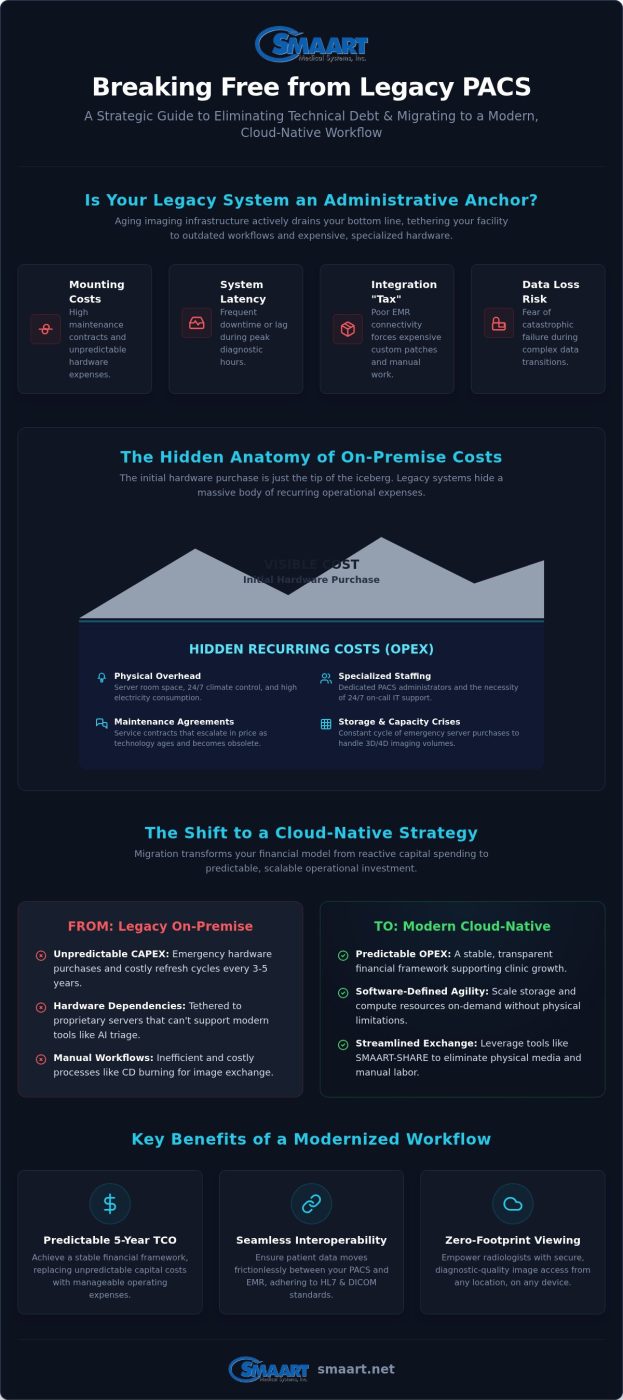
Aging infrastructure does more than slow down your radiologists; it actively drains your bottom line. In 2026, technical debt in radiology is defined by the mounting costs of maintaining a legacy Picture Archiving and Communication System (PACS) that can’t keep pace with modern clinical demands. These systems act as administrative anchors, tethering your staff to outdated workflows and expensive, specialized hardware that requires constant attention. When your technology is more of a burden than a tool, it’s time to reassess its place in your facility.
Every time a clinician has to toggle between disparate windows or manually sync a patient record, your facility pays an “integration tax.” This operational overhead stems from poor EMR connectivity. It forces your IT team to manage expensive custom patches rather than focusing on patient care. Developing a comprehensive legacy PACS data migration strategy allows you to stop paying for past limitations and start investing in future scalability. This shift isn’t just about new software; it’s about reclaiming the time and capital lost to inefficient systems.
Traditional storage budgets are failing because they weren’t built for the era of 3D and 4D imaging. These high-volume studies quickly overwhelm on-premise hardware, leading to a cycle of emergency server purchases and frantic capacity management. Shifting to an agile, software-defined model transforms these unpredictable capital expenditures (CAPEX) into stable, predictable operating expenses (OPEX). This transition provides immediate financial relief and ensures your budget remains as flexible as your clinical needs, regardless of study volume.
The True Cost of Interoperability
Financial health in modern imaging starts with data liquidity. Implementing integrated RIS PACS solutions eliminates the need for expensive custom coding fees that often plague legacy transitions. By adhering strictly to HL7 and DICOM standards, you ensure that patient data moves seamlessly between imaging and the EMR without friction. This isn’t just about technical compliance; it’s about removing the manual work that leads to administrative burnout and data entry errors.
Signs Your Facility is Ready for Migration
Most facilities face a hardware refresh “cliff” every three to five years. If your localized server environment is nearing this mark, it’s the ideal time to evaluate your legacy PACS data migration strategy. Signs of readiness include:
- Storage Ceilings: Your projected storage needs are exceeding current physical capacity faster than anticipated.
- System Latency: Increasing frequency of system downtime or lag during peak diagnostic hours.
- Support Costs: High costs for specialized on-site IT support to keep legacy hardware operational.
Ignoring these signs risks a catastrophic failure or data loss event. Modernizing now converts unpredictable repair costs into a manageable, transparent framework that supports clinic growth instead of hindering it.
The Hidden Anatomy of On-Premise PACS Costs
Many facilities mistake the initial purchase price of a system for its true total cost. While the upfront capital expenditure for servers and high-performance network switches is substantial, it’s only the tip of the iceberg. Maintaining on-premise infrastructure involves a complex web of recurring expenses that often go unmonitored. From the specialized network hardware required to handle massive DICOM files to the redundant power supplies necessary for uptime, the physical components of your imaging suite are a constant financial drain.
Physical overhead is a major contributor to this drain. Your server room isn’t just a closet; it’s expensive square footage that requires dedicated climate control. The electricity needed for 24/7 cooling and high-density computing adds up quickly. When you consider the cost of specialized PACS administrators and the necessity of 24/7 technical support, the staffing burden alone can eclipse the cost of the software itself. These hidden layers make a legacy PACS data migration strategy a financial necessity rather than a technical luxury.
Technical Debt and Legacy Maintenance
Owning your software doesn’t mean the payments stop. Legacy maintenance agreements are often a trap, with service contracts that escalate in price as the technology ages. These contracts rarely cover the cost of hardware obsolescence. In a rapid-growth environment, your old servers simply can’t support modern diagnostic tools like AI-driven triage or advanced 3D rendering. Navigating these Data migration challenges requires a clear-eyed assessment of how much you’re paying just to keep outdated technology on life support.
Cybersecurity and Disaster Recovery Obligations
In 2026, the cost of securing on-site data has reached a breaking point. HIPAA compliance requires local redundant backups that are physically separated from your primary site. This means doubling your hardware and maintenance costs. Ransomware protection for on-site servers is now a massive budget line, as local databases are prime targets for encryption attacks. Insurance companies have noticed this trend. Premiums for locally hosted medical data are significantly higher than those for cloud-native environments that offer built-in, enterprise-grade security.
Escaping these physical and financial burdens starts with a shift in perspective. Moving to a cloud-native model like SMAART-PACS can eliminate the need for on-site hardware maintenance and the associated cooling costs. This transition allows your facility to focus its resources on patient outcomes rather than server maintenance.
Cloud-Native Migration: Agility and SMAART-SHARE
Transitioning to a cloud-native model isn’t just a technical upgrade; it’s a financial liberation. Your legacy PACS data migration strategy should prioritize shifting from unpredictable capital expenditures to a stable operational expenditure (OPEX) model. This change turns volatile hardware repair bills into flat, predictable monthly fees. You’ll gain immediate relief from the constant cycle of server maintenance and the stress of emergency IT interventions. By moving to the cloud, you’re choosing a path that favors long-term fiscal health over the rigid constraints of on-site hardware.
SMAART-SHARE offers a distinct advantage by eliminating the manual labor of burning CDs and managing physical media. This legacy practice is a significant drain on administrative time and patient satisfaction. When you modernize, you shift the burden of security patches and software updates to the vendor. This ensures your system is always running the latest version without requiring a single hour of your IT team’s time. Scaling your storage becomes an on-demand process; you pay only for the storage you use today, not the capacity you might need three years from now.
Zero-Footprint Viewing and Hardware Savings
One of the most immediate financial benefits of migration is the reduction in hardware spend. Implementing a zero footprint PACS viewer can eliminate the need for specialized $5,000 diagnostic workstations. Because these viewers are browser-based, radiologists can perform high-fidelity reads from almost any standard computer. This flexibility is essential for remote reading and teleradiology workflows. It also allows you to move away from restrictive “per-seat” licensing models that often inflate the cost of traditional enterprise systems. You’ll find that diagnostic quality doesn’t have to come with a heavy hardware price tag.
Storage Scalability and Egress Strategies
Cloud-based storage prevents the common problem of over-provisioning local hardware. You no longer need to buy massive server arrays in anticipation of future growth. Instead, you can leverage tiered archiving, moving older studies to cold storage to reduce costs while keeping current cases in high-performance hot storage. When reviewing a case study on PACS data migration, the importance of data fidelity and strategic planning becomes obvious. A well-executed plan also helps you avoid the “egress fee trap” through smart vendor selection. We ensure that your data remains accessible and mobile, preventing the vendor lock-in that often plagues legacy on-premise environments.
Total Cost of Ownership (TCO) Post-Migration Framework
Understanding your financial outlook requires looking past the initial migration invoice. A robust legacy PACS data migration strategy focuses on the long-term fiscal health of your facility by identifying every hidden expense. To audit your current radiology overhead, start by listing your annual hardware maintenance contracts, server room utility costs, and the percentage of IT staff hours dedicated solely to PACS upkeep. Don’t forget to include the cost of specialized diagnostic workstations that require frequent refreshes. These line items often hide the true price of staying on-premise.
Soft costs are equally critical to your audit. Radiologist burnout and administrative delays are difficult to quantify but have a massive impact on your bottom line. When a system is slow or integration fails, your reporting cycles lengthen, directly reducing clinic revenue. This is where the “Efficiency Dividend” comes into play. Faster turnaround times allow for higher patient throughput and more consistent billing cycles, turning your imaging department into a high-performance revenue center instead of a cost center.
The 5-Year Lifecycle Comparison
Short-term thinking often leads to the hardware refresh “cliff” that many facilities face every few years. When comparing a CAPEX-heavy refresh to a cumulative subscription model, the 12-month snapshot rarely tells the whole story. Total Cost of Ownership (TCO) is the sum of all direct and indirect costs over a 5-year period. By investing in hospital imaging workflow optimization, you stabilize your budget and eliminate the lumpy, unpredictable spending patterns of legacy systems. You’ll trade the risk of sudden hardware failure for the reliability of a managed, cloud-native environment.
ROI of Patient and Physician Portals
Modernizing your infrastructure also unlocks the potential of a patient portal for medical images. This single feature can eliminate thousands of dollars in annual labor and material costs related to CD burning and physical mail. Beyond the front office savings, secure digital sharing strengthens referral patterns. Primary care physicians prefer facilities that provide instant, secure access to results without the hassle of proprietary viewers or physical media. This loyalty is a tangible return on investment that grows over time as your referral network expands.
Ready to see the actual numbers for your facility? Request a custom TCO analysis from SMAART to find out how much your legacy system is really costing you over the next five years.
SMAART-PACS: The Pragmatic Strategy for Cost-Conscious Facilities
Facilities across the U.S. often find themselves trapped by legacy vendors that prioritize their own profit margins over clinical efficiency. SMAART-PACS provides immediate relief by aligning elite technical capabilities with your facility’s fiscal reality. We don’t believe in the “one size fits all” approach favored by traditional industry giants. Instead, we offer a software-defined environment that lives within your existing EMR and HIS framework. This flexibility ensures that you can modernize your department without the operational disruption often associated with a complete infrastructure overhaul.
A successful legacy PACS data migration strategy shouldn’t feel like a forced march into technical debt. We position SMAART-SHARE as a practical gateway to cloud efficiency. It allows you to eliminate proprietary hardware and CD-burning labor immediately, even if you aren’t ready for a total system replacement. You’ll gain access to full enterprise features, including zero-footprint viewing and seamless HL7 integration, without the impenetrable complexity or the “enterprise giant” price tag. We’re here to act as a reliable partner, ensuring your transition is as smooth as your new workflow.
Modernizing Without Financial Strain
SMAART designs specifically for the needs of mid-sized hospitals and independent clinics. These facilities are often overlooked by massive vendors like Agfa or Sectra, who tend to push complex, overpriced contracts that don’t fit the scale of a community practice. We believe in transparent, predictable software licensing. It’s a pragmatic approach that respects your budget while delivering the high-performance diagnostic tools your radiologists require. By choosing a partner that understands the specific pressures of the modern healthcare landscape, you’re investing in a solution that grows with you rather than one that drains your resources.
Next Steps: Auditing Your Imaging Infrastructure
Transitioning to a new system is a significant step that requires a clear understanding of your current bottlenecks. The first move toward clarity is requesting a comprehensive diagnostic workflow and migration audit. This process identifies exactly where your legacy system is failing and helps prepare your team for the shift to enterprise PACS solutions. You deserve a partner that stays invested in your success long after the initial data transfer is complete. Our national support team is ready to help you navigate the complexities of 2026 compliance and storage requirements.
Contact SMAART Medical Systems, Inc. for a personalized cost-benefit analysis today and start your journey toward a more agile, cost-effective radiology department.
Secure Your Facility’s Future with a Modernized Workflow
Modernizing your radiology department is a strategic necessity that replaces aging hardware burdens with financial agility. By liquidating technical debt and moving toward a cloud-native environment, you gain predictable costs and eliminate the manual labor of physical media. A well-executed legacy PACS data migration strategy ensures your facility remains competitive and secure in a rapidly evolving healthcare landscape.
SMAART Medical Systems provides the relief you need through seamless EMR/HIS integration and high-fidelity, zero-footprint diagnostic viewing. Our national US support team handles the implementation, allowing your staff to focus on patient outcomes instead of server maintenance. You don’t have to navigate this transition alone or overspend on overly complex enterprise giants.
Take the first step toward a more efficient, cost-effective imaging department today. Request a SMAART-PACS Demo to See Your Potential Savings and discover how a partnership with SMAART can transform your clinical operations. Your path to a streamlined, modern workflow starts here.
Frequently Asked Questions
Is cloud PACS more expensive than on-premise over a 10-year period?
Cloud systems are typically more cost-effective because they eliminate expensive capital hardware refreshes and specialized on-site IT staffing. Research shows cloud PACS can reduce total cost of ownership by 30% to 50% for most organizations. Over a decade, the predictable subscription model avoids the massive financial spikes associated with server failures and the infrastructure upgrades required to handle growing 3D and 4D imaging volumes.
What are the hidden costs of on-premise PACS maintenance?
Beyond the initial purchase, you must account for specialized administrators and the physical overhead of server rooms. This includes expensive square footage, high-density electricity for cooling, and redundant power supplies. The “maintenance agreement trap” also involves service contracts that escalate in price as hardware ages. These recurring expenses make the cost of “owning” software significantly higher than the initial licensing fee suggests.
Can cloud-based PACS integrate with my existing legacy EMR system?
Modern solutions like SMAART-PACS are specifically designed to integrate with existing EMR and HIS platforms via standard HL7 and DICOM protocols. This ensures your legacy PACS data migration strategy doesn’t disrupt established clinical workflows. By using vendor-neutral architecture, these systems bridge the gap between imaging archives and patient records without requiring expensive custom coding or proprietary hardware modifications.
How does a zero-footprint viewer reduce my long-term hardware costs?
A zero-footprint viewer eliminates the need for $5,000 diagnostic workstations by allowing high-fidelity reads in standard web browsers. You don’t have to manage “per-seat” licensing or buy specialized graphics cards for every computer. This shift significantly reduces capital expenditure and simplifies remote reading. Radiologists can securely access diagnostic-quality images from almost any standard PC without installing local software or plugins.
What happens to my legacy DICOM data during a cloud migration?
Your historical records are transferred using a methodical background migration process to ensure data integrity and patient identity matching. Most strategies involve a parallel approach where the new system goes live for current studies while the archive moves over time. This prevents the delta problem where new data accumulates on the old system. The goal is a seamless transition to a cloud-native environment without losing access to prior studies.
Are cloud PACS systems as secure as on-premise servers for HIPAA compliance?
Cloud systems often provide superior security by utilizing enterprise-grade encryption and mandatory multi-factor authentication. Proposed 2026 HIPAA updates emphasize mandatory encryption for ePHI both at rest and in transit, which is standard in cloud-native architectures. These platforms also include automated redundant backups across multiple geographic zones. This fulfills disaster recovery obligations that are often too expensive for individual clinics to maintain on-site.
How do I calculate the ROI of moving to a cloud-based sharing platform?
ROI is calculated by totaling the savings from eliminated CD burning labor, physical media costs, and postage. Platforms like SMAART-SHARE also drive revenue by improving referral patterns; physicians prefer facilities that provide instant, secure access to results. You should also factor in the efficiency dividend. Faster reporting cycles and reduced administrative friction allow for higher patient throughput and more predictable billing cycles across your facility.
What is the typical hardware refresh cycle for an on-premise radiology server?
On-premise radiology servers typically face a hardware refresh cliff every three to five years. During this cycle, facilities must reinvest in new servers, storage arrays, and network switches to maintain performance. A legacy PACS data migration strategy allows you to bypass this cycle entirely. By moving to a subscription model, you trade these lumpy, unpredictable capital outlays for a stable operational budget that scales with your actual usage.