
Patient Portal for Medical Images: Modern Exam Sharing Guide
Why is your clinic still burning plastic CDs when federal regulators are actively enforcing million-dollar penalties for information blocking? It’s a frustrating reality for many radiology managers who feel stuck between legacy hardware and the urgent need for a modern patient portal for medical images. You’ve likely felt the strain of high administrative overhead and the sting of patient complaints when results don’t arrive in the mail on time. It’s time to move past these operational bottlenecks and find genuine relief.
This guide explores how a cloud-based sharing platform transforms outdated exam sharing into a streamlined, digital workflow. We’ll show you how to eliminate physical media while staying compliant with the latest 2026 HIPAA and Cures Act standards. You’ll discover how SMAART-SHARE provides instant, secure access to DICOM images, significantly reducing your operational costs and boosting patient engagement. We’ll also preview how seamless integration with SMAART-PACS and SMAART-RIS can turn your imaging center into a model of modern, fiscal efficiency.
Key Takeaways
- Learn why the radiology CD is obsolete in 2026 and how digital sharing helps your clinic avoid federal information blocking penalties.
- Identify essential features like zero-footprint viewing and QR code sharing that give patients instant access without heavy software downloads.
- Explore how a modern patient portal for medical images slashes operational costs by eliminating physical media and reducing administrative phone calls.
- Understand how to assess your current infrastructure to ensure a smooth transition from legacy systems to a secure cloud-based model.
- See how SMAART-SHARE creates a unified ecosystem with SMAART-PACS and SMAART-RIS for total control over your diagnostic data.
What is a Patient Portal for Medical Images?
A patient portal for medical images is a secure, HIPAA-compliant gateway for DICOM data access. While a standard What is a Patient Portal? typically displays lab results and appointment schedules, an imaging-specific portal is built to handle the massive datasets found in radiology. It functions as a secure online platform where patients and healthcare providers can view, download, and share diagnostic images instantly. By 2026, this technology has effectively become the “CD killer” for modern clinics. The era of the radiology CD is officially over because physical media is slow, costly, and often incompatible with modern hardware.
This digital bridge connects your PACS archive directly to a patient’s mobile device. It replaces the administrative headache of burning, labeling, and mailing discs with a simple, secure login. This shift provides immediate relief to imaging centers facing high overhead costs and helps them meet strict federal interoperability requirements. It’s about moving from a manual, error-prone process to a streamlined digital workflow.
The Role of DICOM in Patient Access
Raw DICOM files are the gold standard for medical imaging, but they’re notoriously difficult for the average person to open. These files require specialized viewing technology that isn’t found on standard consumer devices. A modern patient portal for medical images solves this by using server-side rendering to convert complex data into browser-friendly formats. This allows a patient to see their MRI results on a smartphone without downloading heavy software. The best portals maintain full diagnostic quality, ensuring that the images remain sharp enough for specialists to use during a second opinion.
Patient Portals vs. Traditional Medical Records
There’s a massive difference between reading a text-based report and interacting with a 3D scan. Standard EMR portals are excellent for viewing blood work or physician notes, but they usually lack the power to display high-resolution imaging. They might show a summary of the findings while leaving the actual images locked away in a separate system. SMAART-SHARE complements your existing HIS or EMR by providing a dedicated environment for visual data. It integrates seamlessly to turn a one-dimensional medical record into a comprehensive diagnostic history. This ensures that the visual story of a patient’s health is just as accessible as their text-based records.
Must-Have Features of a Modern Imaging Portal in 2026
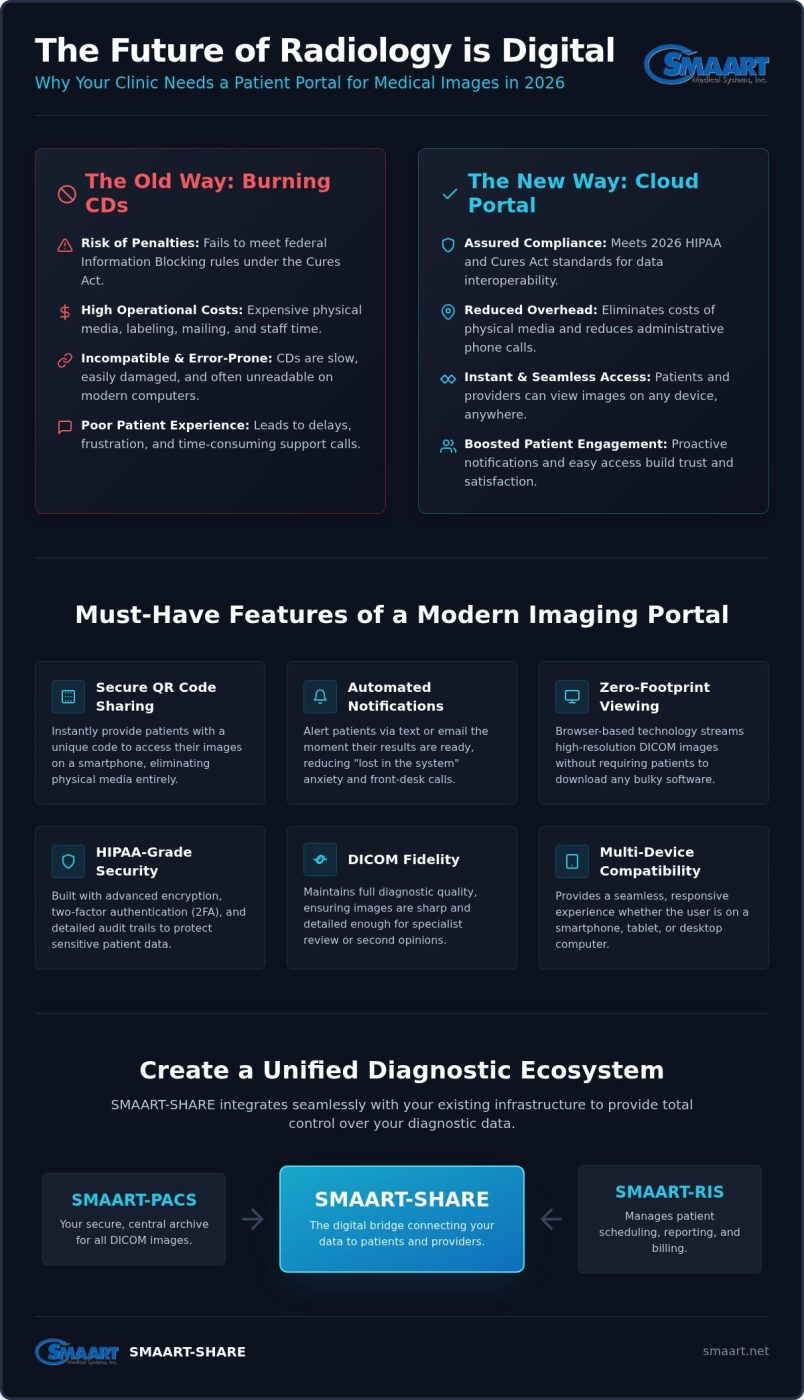
The best patient portal for medical images acts as a bridge, not a barrier. In 2026, patients expect the same speed and accessibility they get from their banking or retail apps. A modern portal should prioritize immediate utility by offering several high-impact features. Secure QR code sharing is a prime example. This allows a technician to provide a unique code immediately after an exam, giving the patient a direct path to their records on their own smartphone. It’s a simple, pragmatic solution that eliminates the need for physical media entirely.
Automated notifications are another essential component. These systems reduce the administrative burden on your staff by alerting patients via text or email the moment their results are released. This proactive communication eliminates the “lost in the system” anxiety that often leads to repeated, time-consuming phone calls to your front desk. When you combine this with multi-device compatibility, you ensure a seamless experience whether the user is on a tablet, a desktop, or a mobile phone. These features offer a level of relief to both the patient and the provider by streamlining the entire post-exam process.
Security and HIPAA Compliance Standards
Security remains the non-negotiable foundation of medical software. To Future-Proof Your Radiology Workflow, your portal must utilize advanced encryption protocols for data both in transit and at rest. Two-factor authentication (2FA) is now a baseline requirement to ensure that only authorized users can access sensitive DICOM data. Detailed audit trails provide another layer of protection by tracking exactly who viewed an image and when it happened. This transparency is vital for maintaining HIPAA compliance and building long-term trust with your patient base.
Zero-Footprint Viewing Technology
Traditional image sharing often forced patients to download bulky, third-party viewers that rarely worked on modern devices. Browser-based viewers, like those integrated into SMAART-PACS, eliminate this technical hurdle. They use server-side rendering to stream high-resolution images without taxing the user’s hardware. This isn’t just a convenience for patients; it’s a massive clinical advantage for referring physicians who need to see images instantly to make urgent treatment decisions. You can explore the technical benefits of this approach in our guide to the Zero Footprint PACS Viewer: The Guide to Browser-Based Diagnostic Viewing. Adopting these modern standards through SMAART-SHARE ensures your facility remains efficient and patient-focused.
The Business Case: Why Clinics are Switching to Cloud Portals
Switching to a digital-first approach isn’t just about following trends; it’s a pragmatic financial decision. Physical CDs represent a significant, recurring expense that many imaging centers simply ignore until they see the cumulative cost of hardware maintenance, blank media, and postage. Beyond the hard costs, the manual labor involved in managing physical records creates a massive administrative bottleneck. Transitioning to a patient portal for medical images allows your team to reclaim those lost hours and redirect them toward higher-value tasks. Industry analysts report that cloud-based sharing can reduce radiology overhead by up to 40% by eliminating physical media and manual distribution workflows.
Accelerating the referral cycle is another critical business advantage. When a specialist gets instant access to diagnostic data, patient outcomes improve and the clinic’s reputation grows. Waiting for a CD to arrive by courier is a liability in a modern healthcare environment. Digital sharing ensures that the right data reaches the right hands in seconds, not days. This speed translates into faster treatment plans and higher referral volumes from physicians who value efficiency.
Operational Efficiency and Staff Relief
SMAART-SHARE automates the distribution process, removing the need for manual intervention every time a record is requested. This directly reduces front-desk congestion, as patients no longer need to visit the clinic in person just to pick up a disc. Transitioning to a modern patient portal for medical images helps move record requests online, creating a more orderly and predictable environment for your employees. To see how this fits into a larger organizational strategy, read our guide on Modernizing Workflow with Integrated RIS PACS Solutions: A 2026 Strategic Guide.
Improving Patient Retention and Satisfaction
Providing instant access to images builds a deep level of trust. Patients feel a sense of relief when they can view their own scans immediately, reducing the anxiety that often accompanies a long wait for results. This transparency positions your clinic as a tech-forward leader in your community. It’s a powerful way to differentiate your services from competitors who still rely on outdated, paper-and-plastic methods. When patients feel empowered and informed, they’re far more likely to return for future imaging needs and recommend your facility to others.
How to Implement a Secure Medical Image Portal
Implementing a patient portal for medical images requires a methodical strategy to ensure both security and ease of use. Start by assessing your current PACS and RIS infrastructure for compatibility. You need to determine if your existing systems can communicate with a web-based interface or if they require a modern bridge like SMAART-SHARE. The choice between on-premise hosting and a cloud-based SaaS model is a major decision point. Cloud models generally offer faster deployment and lower maintenance burdens, providing immediate relief to your IT department.
The human side of implementation is just as important as the software. Comprehensive staff training ensures that technicians and administrative teams can assist patients with the portal without hesitation. We recommend a phased rollout rather than a “big bang” launch. Testing the system with a small, controlled group of patients allows you to identify and resolve any friction points in the user experience before the full launch. This methodical approach ensures a smooth transition and maintains high levels of patient satisfaction from the start.
EMR and PACS Integration Strategies
Seamless integration is critical for maintaining a unified patient record. When your portal connects directly to your EMR, it eliminates the need for manual data entry and prevents patient mismatching. SMAART-RIS facilitates this by managing the scheduling and automatically triggering portal access once results are verified. This creates a frictionless experience for both the provider and the patient. To learn more about refining these connections, explore our Hospital Imaging Workflow Optimization: A 2026 Strategy Guide.
Data Migration and Cloud Storage
Modernizing your facility often involves moving years of legacy data from physical archives to the cloud. This migration must be handled with precision to ensure long-term storage compliance with state and federal regulations. Cloud storage provides the scalability you need as your imaging volume increases, without the cost of physical server upgrades. For more on this shift, see our article on Enterprise PACS Solutions: The Shift to Cloud Based Medical Imaging Storage in 2026. If you’re ready to start your migration, schedule a demo of SMAART-SHARE today to see our integration in action.
Future-Proof Your Radiology Workflow with SMAART-SHARE
SMAART-SHARE is built for clinics that demand high-performance tools without the excessive overhead of legacy industry giants. While previous sections detailed the technical and financial benefits of a digital shift, this solution provides the specific infrastructure to make that transition permanent. By integrating SMAART-PACS, SMAART-RIS, and SMAART-SHARE, your facility achieves total control over the diagnostic lifecycle. This unified ecosystem ensures that data moves instantly from the modality to the patient’s device, eliminating the friction points found in fragmented systems.
Scalability remains a primary concern for growing imaging centers. SMAART-SHARE utilizes a cloud-native architecture that allows your portal to expand alongside your clinic. Whether you’re adding new modalities or opening secondary locations, the system adapts without requiring expensive hardware overhauls. This flexibility offers genuine relief to administrators who need to remain agile in an evolving healthcare market. You can scale your operations confidently, knowing your sharing platform won’t become a bottleneck as patient volumes increase.
The SMAART Advantage: Pragmatic Innovation
SMAART Medical Systems, Inc. focuses on delivering high-density information without the “industry giant” price tag. We understand that your priority is a reliable partner that supports your facility’s ongoing success, not just a one-time software vendor. Our commitment to pragmatic innovation means we prioritize the features that actually drive efficiency and patient satisfaction. For a broader look at the industry’s shift, see our guide on Patient Portal for Medical Images: The Evolution of Exam Sharing Solutions. We bridge the gap between complex IT requirements and your facility’s high-level administrative goals.
Next Steps for Your Facility
Moving toward a paperless, CD-less future is a practical necessity for maintaining a competitive edge in 2026. Evaluating the specific cost savings for your imaging volume is the first step toward reclaiming your budget and reducing staff burnout. We invite you to request a live demo of the SMAART-SHARE platform to see how a modern patient portal for medical images can transform your daily operations. Join the hundreds of clinics finding relief from operational strain by choosing a streamlined, integrated sharing ecosystem. Contact us today to see how we can support your facility’s modernization goals.
Embrace the Future of Digital Image Sharing
The transition from physical media to a cloud-native patient portal for medical images is a strategic pivot that yields immediate operational relief. By eliminating the high costs of burning and mailing CDs, your clinic can finally shed the administrative weight of legacy distribution. You’ve seen how modern tools like zero-footprint viewing and automated notifications don’t just satisfy regulatory requirements; they fundamentally improve the diagnostic journey for patients and referring physicians alike.
Modernizing your workflow shouldn’t be a source of financial strain. Our platform focuses on pragmatic innovation, providing high-level technical capabilities without the prohibitive costs of traditional industry giants. With SMAART-SHARE, you gain a reliable partner dedicated to your facility’s long-term growth and efficiency. It’s time to replace complexity with a system designed for the modern healthcare landscape.
Ready to see how our affordable subscription-based model and seamless EMR integration can transform your practice? Schedule a SMAART-SHARE Demo to Modernize Your Image Sharing and take the first step toward a paperless, efficient future. Your staff and your patients will thank you for the upgrade.
Frequently Asked Questions
Can patients download their actual DICOM files from the portal?
Yes, patients can export full DICOM files directly from the interface. This ensures they have access to the raw diagnostic data required for specialists or personal archives. While many users prefer the convenience of the built-in browser viewer, having the option to download original files is essential for comprehensive record portability. It empowers patients to maintain their own diagnostic history without the frustration of physical media or manual requests.
Is a patient portal for medical images HIPAA compliant?
A dedicated patient portal for medical images must adhere to strict federal regulations to protect sensitive health data. SMAART-SHARE utilizes advanced encryption for data at rest and in transit, multi-factor authentication, and detailed audit logs to maintain compliance. These security measures ensure that only authorized individuals can access the images. Using a compliant cloud-based platform provides peace of mind for both the clinic and the patient while meeting current standards.
How do I share my images with a specialist from the portal?
Sharing images with a specialist is typically done through a secure, time-limited link or an email invitation sent directly from the platform. The specialist can then view the studies in a browser-based viewer without needing to install proprietary software. This method is significantly faster and more secure than mailing physical discs. It allows for immediate collaboration between providers, which is vital for urgent treatment planning and improving overall patient outcomes.
What happens if a patient forgets their portal login credentials?
Most modern portals include a secure, self-service password reset feature to reduce the administrative burden on your front-desk staff. Patients can simply click a link to receive a reset code via their registered email or phone number. This automation provides immediate relief for the user and ensures they maintain access to their records without needing to call the clinic. It’s a pragmatic way to manage user access while maintaining high security standards.
Do patient portals work on mobile devices and tablets?
Yes, SMAART-SHARE is designed with a mobile-first approach that works across smartphones, tablets, and desktops. Because it uses zero-footprint viewing technology, there’s no need to download heavy apps or plugins to see high-resolution images. This accessibility allows patients to review their results or show them to a doctor during a consultation right from their own device. It ensures a consistent and high-quality experience regardless of the hardware being used by the patient.
Can I integrate a new portal with my existing PACS system?
Integration is a core feature of SMAART-SHARE, which is built to connect with your existing PACS or other standards-compliant systems. This connectivity ensures that once a radiologist finalizes a report, the images are automatically available in the portal. You don’t have to replace your entire infrastructure to gain the benefits of modern sharing. This streamlined approach reduces technical friction and allows your facility to modernize its workflow without a massive, costly overhaul.
How much does it cost for a clinic to implement a patient portal?
The cost of implementation depends on your facility’s specific study volume and existing infrastructure. SMAART Medical Systems, Inc. offers an affordable, subscription-based model that avoids the heavy upfront licensing fees associated with legacy industry giants. This pragmatic pricing structure allows clinics to scale their services as they grow. By switching to a digital model, most facilities realize significant savings by eliminating the recurring costs of physical media and manual labor.
Will patients still need a CD if they use a portal?
In almost every case, the portal entirely replaces the need for a physical CD. Patients can view, download, and share their images digitally, which is much more convenient and reliable than carrying a plastic disc. While some clinics keep a small supply of CDs for exceptionally rare circumstances, the vast majority of patients and specialists prefer the instant access provided by a digital platform. Moving to a CD-less workflow is a major step toward modern efficiency.