
Radiology Patient Tracking System: Optimizing the Scheduling Workflow in 2026
What if your scheduling workflow was the primary engine driving your practice’s financial growth rather than a source of constant administrative friction? You’re likely all too familiar with the frustration of watching expensive modalities sit idle while no-show rates climb. Manual data entry errors between your EMR and RIS don’t just waste time; they lead to patient dissatisfaction and clinician burnout. It’s a heavy burden to carry in an increasingly competitive imaging market, but it doesn’t have to be your daily reality.
We’re here to help you regain control. By implementing a sophisticated radiology patient tracking system, you can master the complexities of modern scheduling to eliminate bottlenecks and create a seamless clinical journey. This article provides a roadmap for optimizing your operations in 2026, focusing on how tools like SMAART-RIS can automate your most tedious tasks. We’ll examine the impact of new CMS regulations regarding virtual supervision, benchmarks for maintaining a denial rate below 5%, and strategies to improve referring physician satisfaction through better modality utilization. You’ll discover how to transform your administrative workflow into a streamlined, high-performance asset that supports both your staff and your patients.
Key Takeaways
- Understand how a modern radiology patient tracking system acts as a digital map for the entire diagnostic exam lifecycle, ensuring no stage of the patient journey is overlooked.
- Master the seven essential stages of an optimized workflow to capture accurate clinical data and improve patient throughput from order entry to archiving.
- Discover how integrating your RIS and PACS eliminates data silos, reducing the manual entry errors that lead to costly no-shows and idle modality time.
- Learn to track critical success metrics like Modality Utilization Rates and Turnaround Time to identify and resolve scheduling gaps in real-time.
- Explore how cloud-based solutions like SMAART-RIS and SMAART-SHARE replace outdated physical media with secure, instant data distribution for referring physicians.
What is a Radiology Patient Tracking System?
Think of a radiology patient tracking system as a digital roadmap for the entire diagnostic imaging lifecycle. It isn’t just a calendar; it’s a dynamic tool that monitors a patient’s progress from the moment a referral arrives to the final archiving of their report. In a busy clinical setting, scheduling acts as the gatekeeper for both modality utilization and clinic revenue. If an MRI machine sits idle for thirty minutes because of a scheduling gap, that’s lost income that can’t be recovered. A modern radiology patient tracking system replaces these friction-heavy steps with automated, real-time visibility.
By 2026, the shift from manual, phone-based booking to digital, integrated systems has become a necessity rather than a luxury. New regulations, such as the CMS permanent virtual direct supervision rules for Level 2 diagnostic tests, require precise coordination that manual logs simply can’t handle. Interoperability is the foundation of this modernization. It allows different software platforms to communicate seamlessly, ensuring that patient data flows without manual intervention. This connectivity eliminates the bottlenecks that typically stall patient throughput and drain administrative resources.
The RIS as the Central Tracking Engine
The Radiology Information System (RIS) serves as the central nervous system of any imaging department. It centralizes patient demographics, order entries, and complex scheduling protocols into a single point of truth. To maintain data integrity, top-performing practices rely on integrated RIS PACS solutions. This integration ensures that the administrative data in the RIS matches the clinical images stored in the PACS, preventing identity errors and lost files. SMAART-RIS is purpose-built to act as this central engine, offering a streamlined approach to clinical scheduling management that focuses on practical utility over unnecessary complexity.
Why Digital Tracking Outperforms Manual Workflows
Manual workflows are inherently reactive and prone to human error. When staff rely on paper logs or disconnected spreadsheets, they lack the bird’s-eye view needed to optimize patient flow. Digital tracking provides real-time status updates, allowing staff to see exactly where a patient is in the process. This visibility offers significant relief to both staff and patients. It reduces lobby wait times and lowers patient anxiety by providing clear, consistent communication about their appointment status. From a business perspective, the transition to digital tracking cuts administrative friction and improves the bottom line. Clinics experience a refreshing boost in efficiency when they stop chasing paper and start following a clear, digital path.
The 7-Step Lifecycle of an Optimized Radiology Workflow
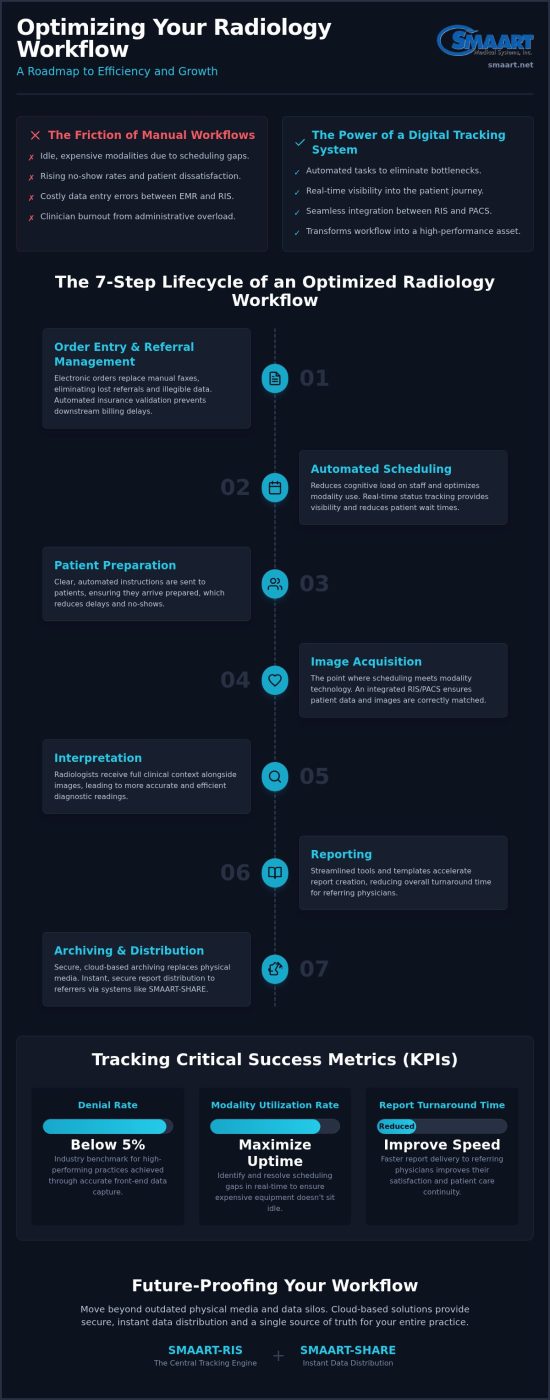
An optimized workflow is a sequence of seven interconnected stages: Order Entry, Scheduling, Preparation, Acquisition, Interpretation, Reporting, and Archiving. Each step must function perfectly to maintain a high-performing practice. A robust radiology patient tracking system ensures that no patient falls through the cracks during these transitions. Capturing accurate clinical indications at the very first step, order entry, is vital. It provides the diagnostic context necessary for accurate coding and helps keep denial rates below the 5% industry benchmark. Automated scheduling then takes the lead, significantly reducing the cognitive load on front-desk administrative staff. The Acquisition phase is the point where scheduling meets modality technology.
Order Entry and Referral Management
The transition from paper-based referrals to electronic orders is a game-changer for data integrity. When you move beyond manual faxing, you eliminate the risk of lost orders and illegible handwriting. By interfacing PACS with EMR systems, you ensure that radiologists receive the full clinical story alongside the images. This stage should also include automated validation of insurance and pre-authorizations. Handling these administrative hurdles upfront prevents downstream billing delays and improves your first-pass resolution rate. It’s a refreshing change for staff who no longer have to spend hours on the phone verifying coverage.
Real-Time Status Tracking During Acquisition
Once a patient is scheduled, that data should flow directly into the technologist’s worklist at the modality. This seamless handoff ensures the right patient receives the right exam at the right time. During the scan, technologists can use the SMAART-PACS zero footprint PACS viewer to perform immediate quality checks without leaving the patient’s side. This real-time visibility is a core benefit of a modern radiology patient tracking system. It allows the team to monitor patient progress and adjust for any delays instantly. Moving from acquisition to interpretation, structured reporting then reduces turnaround times, ensuring referring physicians get the answers they need faster. Finally, archiving ensures that every study is securely stored and easily retrievable. If you’re looking to modernize your facility, you can explore how SMAART-RIS simplifies these complex handoffs.
Overcoming Scheduling Bottlenecks with Integrated RIS and PACS
The biggest hurdle in modern imaging isn’t the technology itself; it’s the fragmented communication between systems. When data sits in isolated silos across the EMR, RIS, and PACS, your staff spends more time hunting for information than caring for patients. A fragmented radiology patient tracking system is often the root cause of these operational delays. This lack of integration creates a massive bottleneck that ripples through the entire facility, affecting everything from machine uptime to final reimbursement. It’s a frustrating cycle that drains resources and slows down clinical progress.
Consider the impact of the no-show epidemic. For high-value modalities like MRI and CT, even a single missed appointment represents a significant loss in potential revenue. When these machines sit idle, the clinic’s fiscal health suffers immediately. Beyond the financial hit, information gaps put clinical quality at risk. If a technologist doesn’t have clear access to patient preparation details because that data is stuck in a separate system, the exam might be cancelled or performed incorrectly. Manual data entry further compounds these issues. Redundant typing between systems is an invitation for human error, which frequently leads to billing discrepancies and rejected insurance claims.
Reducing No-Shows Through Automated Communication
Modernizing your outreach is the most effective way to protect your modality uptime. Automated SMS and email reminders have become the gold standard for reducing cancellations in 2026. These touchpoints do more than just remind patients of the time; they provide a platform to deliver digital preparation instructions. When patients know exactly how to prepare for their contrast study or fasting requirement, the likelihood of a last-minute cancellation drops. SMAART-RIS automates these communications, relieving your front-desk team from the burden of manual confirmation calls. This proactive approach ensures your schedule remains full and your staff stays focused on high-value tasks.
Eliminating Data Silos and Manual Entry Errors
Achieving a Single Source of Truth is the ultimate goal of hospital imaging workflow optimization. By leveraging HL7 and DICOM standards, you can create a seamless, vendor-neutral environment where data flows freely between platforms. An integrated RIS/PACS setup eliminates the need for redundant data entry, ensuring that patient demographics and clinical context are consistent across the board. This modernization reduces the risk of human error and ensures that billing codes match the performed procedures perfectly. It’s a pragmatic solution that offers immediate relief from administrative strain while securing your practice’s financial future. Moving away from manual logs isn’t just about speed; it’s about building a reliable foundation for patient care.
Key Performance Indicators (KPIs) for Radiology Workflow Success
Data without direction is just noise. In a modern diagnostic environment, your radiology patient tracking system should serve as a dashboard for both clinical and financial health. By tracking specific Key Performance Indicators (KPIs), you can identify exactly where your workflow thrives and where it falters. High-performing radiology groups aim for a net collection rate of 95% to 99%; achieving this requires a surgical focus on the metrics that drive throughput and minimize waste.
To evaluate your department’s efficiency, focus on these four core metrics:
- Modality Utilization Rate: Measures the percentage of time your MRI, CT, and X-ray machines are actively scanning versus sitting idle.
- Turnaround Time (TAT): Tracks the total duration from the initial order entry to the final report delivery.
- Patient Wait Time: Monitors how long patients stay in the lobby after their scheduled appointment time, a key driver of satisfaction.
- No-Show Percentage: Evaluates the effectiveness of your reminder system and the reliability of your patient tracking.
Measuring Turnaround Time (TAT) and Throughput
To find real solutions, you must break TAT into granular segments. Order-to-Exam TAT highlights administrative bottlenecks, such as slow insurance authorizations or scheduling gaps. Exam-to-Report TAT measures clinical efficiency and radiologist workload. SMAART-RIS identifies these specific delays in the patient journey, allowing you to reallocate resources where they are needed most. Once the report is ready, the speed of distribution is just as critical. Using SMAART-SHARE for cloud-based results distribution eliminates the delays associated with physical media, ensuring referring physicians get answers immediately. This seamless flow reduces the typical friction that stalls patient care.
Modality Efficiency and ROI
The opportunity cost of an idle MRI suite is staggering. Every fifteen-minute gap in the schedule represents lost revenue that your practice can never recover. Intelligent scheduling maximizes daily exam volume without overworking your technologists. It’s about finding the balance between a full calendar and a manageable pace. Choosing affordable, high-performance software is a matter of fiscal responsibility. SMAART provides the tools you need to protect your clinical margins without the bloated costs of traditional industry giants. By reducing administrative burdens and optimizing machine uptime, you create a more sustainable business model. If you are ready to see these metrics in action, request a demo of SMAART-RIS today to start optimizing your department’s ROI.
Future-Proofing Your Workflow with SMAART-RIS and SMAART-SHARE
The healthcare landscape in 2026 demands more than just basic scheduling. It requires a radiology patient tracking system that evolves alongside regulatory shifts and rising patient expectations. Future-proofing your facility means moving away from the complex, high-cost software giants of the past. SMAART-RIS provides a refreshing alternative. It’s a full-feature solution that offers operational relief without the enterprise-level price tag. By choosing a partner invested in your long-term success, you ensure that your workflow remains agile and your clinical margins stay protected from administrative bloat.
Achieving Enterprise-Grade Efficiency on a Clinic Budget
Modernizing your storage and scheduling shouldn’t require a total infrastructure overhaul. SMAART-RIS is purpose-built for plug-and-play interoperability, connecting naturally with your existing HIS or EMR. This connectivity ensures that patient data flows effortlessly across your entire network. When you combine this with SMAART-PACS, you gain a unified enterprise PACS solution that scales with your practice. You don’t need a massive IT department to manage these integrations. The zero-footprint viewing advantage allows your team to read and collaborate from any browser, supporting the real-time supervision requirements mandated by CMS. It’s high-level technology grounded in practical utility.
Replacing Physical Media with SMAART-SHARE
The era of physical CDs is over. Handing a patient a disc is a relic of a slower, more fragmented time that creates unnecessary friction for everyone involved. SMAART-SHARE transforms this final step of the clinical journey into a modern, digital experience. Instead of physical media, patients and referring physicians receive digital access to images via secure, encrypted links. This shift doesn’t just save on hardware costs; it drastically improves the patient experience. Collaborative viewing becomes instant. A specialist can review a study the moment it’s uploaded, significantly reducing the time to treatment and improving referring physician satisfaction.
This transition offers a sense of relief that manual processes simply can’t match. You’re no longer managing hardware; you’re managing care. SMAART stands as a bold innovator in a traditional field, offering the technical authority you need and the warmth of a true professional partnership. It’s time to eliminate the bottlenecks that have held your department back. A modern radiology patient tracking system is the foundation for a more efficient, fiscally responsible future. We invite you to modernize your facility through SMAART’s integrated platform and experience the difference of a workflow designed for the realities of 2026.
Empower Your Practice with Modernized Workflow Control
Mastering the complexities of radiology scheduling isn’t just about filling a calendar; it’s about building a strategic engine that drives clinical throughput and secures your financial future. By implementing a robust radiology patient tracking system, you eliminate the data silos that cause costly bottlenecks and no-shows. Tracking critical KPIs like modality utilization and turnaround time transforms your operations from reactive to proactive. The shift toward digital, cloud-based solutions ensures your practice stays compliant with 2026 regulations while providing the operational relief your staff deserves.
The path to a more efficient department starts with choosing a partner that understands the specific pressures of modern healthcare. You can streamline your radiology workflow with SMAART Medical Systems, Inc. solutions. Our platform offers affordable, full-feature PACS and RIS with seamless EMR and HIS integration. Cloud-based SMAART-SHARE provides instant image distribution, finally replacing physical media for good. Take the first step toward a more integrated, fiscally responsible future today. Your patients and your bottom line will thank you for the modern, professional experience.
Frequently Asked Questions
What is the difference between RIS and PACS in a scheduling workflow?
The RIS manages administrative data while the PACS manages clinical images. In a scheduling workflow, the RIS acts as the command center for a radiology patient tracking system, handling demographics and appointment times. Once the exam is complete, the images are sent to the PACS for storage and interpretation. Integrating these two systems ensures that clinical images are always linked to the correct patient record, preventing data silos and identity errors.
How does an integrated radiology patient tracking system reduce no-show rates?
An integrated radiology patient tracking system reduces no-shows by automating patient outreach and providing clear preparation instructions. Automated SMS and email reminders keep appointments top-of-mind for patients, while digital prep guides ensure they arrive ready for their specific modality. This proactive communication significantly lowers the rate of last-minute cancellations and exam failures, which protects your modality uptime and ensures that expensive machines like MRI suites don’t sit idle.
Can SMAART-RIS integrate with my existing EMR or HIS system?
SMAART-RIS is purpose-built to integrate seamlessly with your existing EMR and HIS platforms through standard HL7 and DICOM protocols. This interoperability allows patient data to flow bidirectionally, eliminating the need for manual data entry between systems. By serving as a bridge between your main hospital records and your imaging department, SMAART-RIS ensures data integrity and reduces the administrative burden on your front-desk staff, providing a unified view of the patient journey.
Why should we replace radiology CDs with cloud-based exam sharing?
Replacing CDs with cloud-based sharing through SMAART-SHARE eliminates the logistical friction and hardware costs associated with physical media. CDs are often lost, damaged, or unreadable, leading to delayed treatments and patient frustration. Cloud-based distribution provides instant, secure access to images via a browser-based viewer. This allows specialists to review studies immediately and enables patients to access their records digitally, which is a refreshing and modern alternative to traditional methods.
What are the most important metrics to track in a radiology department?
The most critical metrics for department health include Modality Utilization Rate, Turnaround Time (TAT), and No-Show Percentage. Tracking the time from order entry to final report helps identify bottlenecks in your administrative or clinical phases. High-performing practices also monitor their net collection rate, aiming for 95% to 99%. By analyzing these data points, you can make informed decisions about resource allocation and modality scheduling to protect your clinical margins.
How does automated scheduling impact radiologist and staff burnout?
Automated scheduling reduces burnout by eliminating the repetitive, manual tasks that drain staff energy. When you remove the need for constant phone tag and redundant data entry, your administrative team can focus on patient interaction. For radiologists, a streamlined workflow ensures they receive complete clinical context with every study. This operational relief creates a more sustainable work environment, allowing your team to practice at the top of their licenses without being bogged down by paperwork.
Is cloud-based radiology software secure and HIPAA compliant for tracking?
Cloud-based solutions like SMAART-SHARE are designed with robust encryption and security protocols to ensure full HIPAA compliance. Data is encrypted both in transit and at rest, protecting sensitive patient information from unauthorized access. These platforms provide a secure environment for collaborative viewing and results distribution. By moving to a secure cloud infrastructure, you gain the benefit of automatic backups and disaster recovery, which provides significant relief compared to managing on-premise server security.
How can smaller clinics afford enterprise-grade radiology software?
Smaller clinics can access enterprise-grade tools by choosing modular, affordable software providers like SMAART Medical Systems. We challenge industry norms regarding cost and complexity by offering full-feature PACS and RIS solutions that don’t require massive upfront hardware investments. Our subscription-based models allow independent facilities to benefit from the same level of integration and efficiency as large hospital networks. This pragmatic approach ensures that high-quality patient tracking and image management remain accessible to all practices.