
Radiology Workflow Management Software: The 2026 Efficiency Guide
How much revenue is your facility losing to the hidden “CD-ROM tax” and the constant maintenance of aging, on-premise servers? In 2026, the cost of clinging to legacy systems is no longer just a line item. It’s a direct barrier to quality care. Implementing the right radiology workflow management software is the most effective way to stop the bleed of high operational overhead. You likely already feel the frustration of fragmented data sitting in silos between your RIS and PACS. This friction slows down report turnaround times and complicates every physician referral.
We believe you deserve a system that works as hard as your clinical team without the complexity of traditional industry giants. This guide explores how modern tools like SMAART-PACS and SMAART-RIS eliminate operational friction and integrate diagnostic imaging into the heart of patient care. You’ll learn how cloud-based platforms like SMAART-SHARE replace physical media with secure, instant access for everyone involved. We will show you how to achieve faster turnarounds and lower costs through seamless, modern interoperability.
Key Takeaways
- Modern radiology workflow management software isn’t just about storage. It’s the digital orchestration of imaging data, patient scheduling, and reporting.
- Unifying your RIS and PACS ensures data integrity. It eliminates the double-entry errors that often delay billing and frustrate administrative staff.
- Transitioning to cloud-based SaaS models replaces high upfront capital costs with predictable monthly expenses. This provides radiologists with secure access from anywhere.
- Follow a structured five-step digital audit to identify specific operational bottlenecks. This process helps you optimize your facility’s imaging throughput and patient care.
- Scalable solutions like SMAART-PACS provide a reliable foundation that grows with your clinic. They help reduce technical burdens and financial strain through modern integration.
What is Radiology Workflow Management Software?
Radiology workflow management software is the digital orchestration of every step in the imaging lifecycle. It manages the entire journey from initial patient scheduling to the final diagnostic report distribution. Historically, facilities relied on siloed systems where data lived in isolated pockets. This created friction and slowed down patient care. Modern software replaces those barriers with a unified digital environment that connects every stakeholder in real-time. In 2026, the industry has shifted decisively toward cloud-based medical imaging storage. This transition allows for seamless collaboration and secure data access without the weight of local servers. The primary goal is simple: reduce the time between the imaging procedure and the final diagnostic report. When you cut out manual steps, you improve both patient outcomes and clinic profitability.
The Core Components of a Modern System
A high-performing environment relies on three critical elements working in perfect harmony. First, the Radiology Information System (RIS) acts as the administrative engine. It handles patient registration, tracking, and the complex logistics of scheduling. Second, the PACS (Picture Archiving and Communication System) serves as the digital library for storing and retrieving high-resolution images. Finally, the role of a zero footprint PACS viewer is essential for remote diagnostics. This browser-based tool lets radiologists review studies from any device without installing heavy software or plugins. This flexibility is a game-changer for modern clinical teams that need to work across multiple locations or from home offices.
Why Traditional Workflows Fail in 2026
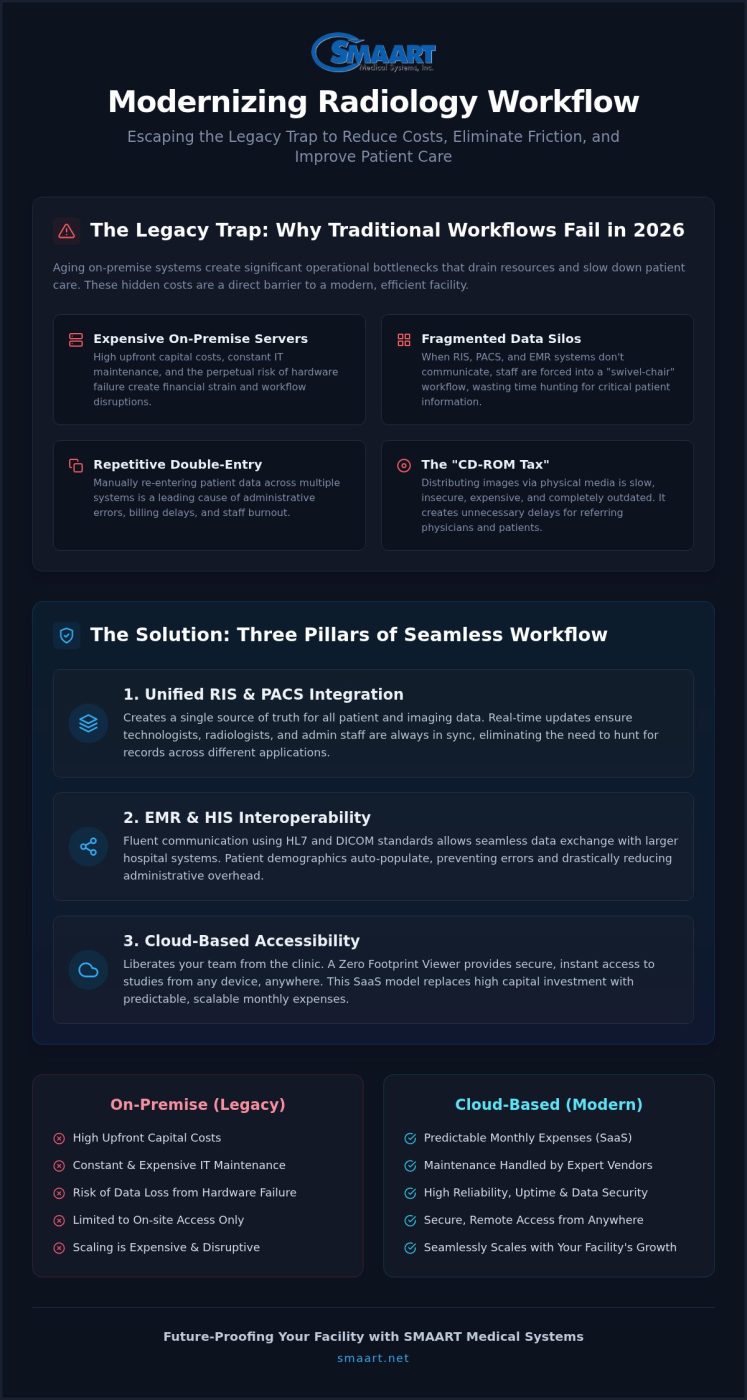
Many facilities are caught in the “Legacy Trap.” Relying on on-premise hardware creates significant bottlenecks, especially for multi-site clinics. Maintaining physical servers is expensive, risky, and requires constant IT attention. When hardware fails or requires updates, the entire workflow grinds to a halt. Data fragmentation is another major issue. When EMRs and imaging systems don’t talk to each other, staff must manually bridge the gap through repetitive data entry. This leads to avoidable errors and staff burnout. There is also the hidden drain of physical media. Distributing images on CDs is slow, insecure, and costly. Modern radiology workflow management software eliminates these outdated practices. It provides immediate relief to overstretched administrative and clinical staff by automating the most tedious parts of the diagnostic journey.
The Three Pillars of Seamless Workflow Management
Achieving peak efficiency in a modern imaging facility requires more than just faster hardware. It demands a foundation built on three specific pillars: integration, interoperability, and cloud-based accessibility. You can’t reach 2026 standards by patching together legacy systems that don’t talk to each other. Instead, the focus must be on creating a unified ecosystem where data flows without manual intervention. This approach is the only way to eliminate the friction that currently drains your staff’s energy and your facility’s budget.
Unified RIS and PACS Integration
The first pillar of modern efficiency is the tight synchronization of your administrative and clinical data. Many facilities still struggle with the “swivel-chair” effect. This happens when staff must jump between disconnected applications to find patient history or update study statuses. Implementing integrated RIS PACS solutions solves this by creating a single source of truth. SMAART-RIS and SMAART-PACS work together to ensure that when a patient checks in, the technologist sees that update immediately on their worklist. This real-time synchronization is a core requirement for any high-performing radiology workflow management software. It allows your team to focus on patients rather than hunting for records.
EMR and HIS Interoperability
Interoperability is the second pillar. Your software must speak HL7 and DICOM fluently to communicate with larger hospital systems. This prevents the nightmare of double-entry errors. When demographics auto-populate from the EMR into the imaging system, administrative overhead drops significantly. This isn’t just about convenience; it’s about streamlining equipment usability to maximize your facility’s daily capacity. This is also where the relief of automated scheduling and patient preparation reminders comes into play. Sending automated instructions ensures patients arrive prepared, which reduces no-shows and late starts. Once the radiologist signs the report, it flows back into the patient record instantly, allowing for faster billing and reimbursement cycles.
Cloud-Based Image Distribution
The final pillar is secure, cloud-based image distribution. Moving beyond internal storage allows for collaborative viewing without the need for expensive, proprietary hardware. SMAART-SHARE enables referring physicians to view diagnostic-grade images from any standard web browser. This eliminates the frustration of physical media and improves the referral experience. Additionally, providing a patient portal for medical images empowers patients to take ownership of their health records. By centralizing these functions, you create a seamless loop that benefits everyone from the front desk to the patient. If you’re ready to modernize your foundation, exploring the options at SMAART Medical Systems is an excellent starting point.
Cloud vs. On-Premise: Evaluating Workflow Efficiency and Cost
Choosing between on-premise hardware and cloud-native radiology workflow management software is often the most consequential financial decision a facility makes in 2026. Traditional on-premise systems require a massive upfront capital expenditure (CAPEX) for servers, networking, and dedicated cooling rooms. In contrast, cloud models shift these costs to a predictable monthly operational expense (OPEX). This shift provides immediate relief for small and midsize clinics that lack the budget for large infrastructure projects. Beyond the balance sheet, the cloud offers a level of professional security and data redundancy that local servers simply cannot match. Professional data centers use advanced encryption and multiple backup sites to ensure your patient data is never at risk from a single hardware failure.
Scalability is where the cloud truly shines for growing practices. Transitioning to enterprise PACS solutions allows your facility to add storage capacity or new users instantly as your caseload increases. You aren’t limited by the physical space in your server closet or the processing power of aging hardware. This flexibility ensures your workflow remains fast and responsive, regardless of how many studies you perform each day.
The Financial Impact of Cloud Migration
Moving to a cloud environment eliminates several hidden costs that plague traditional facilities. You no longer need to pay for constant hardware maintenance, expensive server upgrades, or the specialized IT staffing required to manage on-site imaging databases. Cloud-based systems also protect your revenue by reducing the risk of downtime. If a local computer fails, your data remains safe and accessible in the cloud. For facilities looking to test the waters of modernization, SMAART-SHARE serves as an affordable entry point. It allows for secure, cloud-based image exchange without requiring a total overhaul of your existing infrastructure.
Remote Reading and Teleradiology Support
The ability to access studies from any location is a vital component of enhancing the efficiency of radiology workflow and supporting a modern clinical team. Remote reading allows radiologists to interpret studies from home or satellite clinics without the frustration of latency or slow image loading. High-quality, web-based viewers ensure that diagnostic standards are maintained even on mobile devices. This “anywhere access” is a powerful tool for reducing physician burnout. It provides the flexibility needed to manage heavy caseloads without being tethered to a specific workstation. By enabling a more agile workforce, you improve turnaround times and ensure that referring physicians get the answers they need faster.
How to Perform a Radiology Workflow Digital Audit
Before investing in new radiology workflow management software, you must identify where your current process is failing. A digital audit isn’t just a technical review; it’s a pragmatic look at how data moves through your facility. By measuring specific KPIs like “clicks-to-view” and “time-to-report,” you can pinpoint exactly where operational friction occurs. Your goal is to identify and eliminate every manual step that slows down the diagnostic cycle. If your staff is still faxing reports or burning CDs, you have identified immediate opportunities for automation and cost savings.
Use this hospital imaging workflow optimization checklist to guide your internal review. Focus on these three critical steps to uncover the hidden burdens on your clinical team.
Step 1: Mapping the Patient Journey
Track a single patient from the moment their referral arrives until their study is archived. Look for “data islands” where information must be manually re-entered from one system to another. Pay close attention to any point where physical media like CDs or paper files are introduced. A bottleneck is any manual interruption or system delay that extends the interval between an exam’s completion and the radiologist’s final signature. Mapping this journey often reveals that the longest delays aren’t in the imaging itself, but in the administrative hand-offs between departments.
Step 2: Assessing Interoperability Gaps
Test whether images are instantly viewable across all clinical departments without specialized workstations. You should also verify that data flows seamlessly between your RIS and your billing software. If your billing team has to wait for a manual notification to process a claim, you’re losing revenue to simple timing gaps. Evaluate the security of your current image-sharing methods as well. If you’re relying on unsecured portals or physical transport, you’re exposing the facility to unnecessary compliance risks that modern radiology workflow management software is designed to prevent.
Step 3: Quantifying Operational Overhead
Calculate the total cost of CD burning, mailing, and maintaining local storage hardware. Don’t forget to include the “hidden cost” of staff time spent on manual scheduling and answering phone calls from referring physicians looking for results. When you quantify these expenses, the financial relief of moving to a cloud-based model becomes clear. Using the SMAART-SHARE model as a benchmark, many clinics find they can save thousands of dollars annually by simply digitizing their image distribution. If you’re ready to see how these savings apply to your facility, contact SMAART Medical Systems for a personalized workflow assessment.
Future-Proofing Your Facility with SMAART Medical Systems
Choosing the right radiology workflow management software is about more than solving today’s bottlenecks. It’s about ensuring your facility remains competitive and compliant as healthcare technology continues to evolve. SMAART Medical Systems positions itself as a refreshing alternative to the overly complex, expensive giants that dominate the field. We provide the technical authority you need with a client-focused warmth that larger vendors often lack. By choosing SMAART-PACS and SMAART-RIS, you’re investing in a scalable foundation that adapts to your specific clinical needs. You don’t have to settle for a rigid, one-size-fits-all enterprise system that strains your budget and complicates your daily operations.
The deployment of our cloud platforms, such as SMAART-SHARE, is designed for immediate impact. You can modernize your image distribution without the traditional “enterprise” price tag or a massive overhaul of your current IT setup. This approach provides instant relief from the financial and operational burdens of maintaining legacy hardware. It allows your clinical team to focus on what matters most: delivering high-quality patient care in a streamlined, modern environment.
Scalability for Growing Clinics
Your software should grow with your patient volume, not act as a ceiling to your success. SMAART software is built to handle increasing caseloads effortlessly. Whether you’re adding a new modality or expanding to a second site, our systems support multi-site operations without requiring new local infrastructure. We take a “pragmatic innovator” approach to software updates. This means we focus on functional advantages that improve your daily work rather than chasing every technical trend. You get a system that stays current with 2026 standards for HL7 and DICOM interoperability without the stress of constant, disruptive changes.
A Partnership Beyond the Software
We see ourselves as a reliable partner rather than just a software vendor. Our commitment to your success extends far beyond the initial installation. We provide ongoing support that’s both elite in its expertise and humble in its service. You’ll find that our technical assistance carries a supportive, accessible tone that makes resolving issues fast and straightforward. This partnership provides the peace of mind that comes from knowing an expert team is deeply invested in your facility’s efficiency. If you’re ready to eliminate friction and lower your overhead, we invite you to schedule a comprehensive workflow consultation. Let’s work together to build a more efficient future for your imaging department.
Modernizing Your Imaging Future
The transition to a unified, cloud-native environment is no longer optional for facilities that want to thrive in 2026. By integrating your RIS and PACS, you remove the friction that slows down diagnostic reporting and frustrates your clinical team. A digital audit often reveals that the biggest drains on your budget are manual processes and aging, on-premise hardware. Modern radiology workflow management software provides the scalability and security needed to eliminate these operational burdens once and for all.
You don’t have to navigate this transition alone. SMAART Medical Systems offers a refreshing alternative to traditional software giants, focusing on practical utility and fiscal responsibility. Our SMAART-PACS provides diagnostic-grade viewing from any browser, while SMAART-SHARE enables instant, cloud-based image exchange without the need for physical media. With seamless HIS and EMR integration, you can significantly reduce administrative overhead and focus on patient care. Streamline your imaging facility with SMAART Medical Systems. We are ready to help you build a faster, more efficient future.
Frequently Asked Questions
What is the difference between RIS and PACS in radiology workflow?
The Radiology Information System (RIS) manages administrative data like scheduling and billing, while the Picture Archiving and Communication System (PACS) stores and distributes clinical images. Modern radiology workflow management software integrates these two functions to create a single source of truth. When SMAART-RIS and SMAART-PACS work together, they eliminate the need for staff to jump between different applications. This synchronization ensures that patient records and imaging studies are always perfectly aligned.
Can radiology workflow software integrate with any EMR?
Most modern systems integrate with major EMR and HIS platforms using industry standards like HL7 and DICOM. This connectivity ensures that patient demographics flow directly from the primary record into the imaging worklist. SMAART-RIS and SMAART-PACS are specifically designed for seamless EMR integration. This prevents double-entry errors and ensures that final diagnostic reports are immediately available to the referring physician. It streamlines the entire diagnostic cycle from the initial order to final billing.
How much does radiology workflow management software cost?
The cost of a system is highly variable and depends on your facility’s specific volume, storage needs, and user count. Most vendors have shifted to subscription-based SaaS models. This approach replaces high upfront capital costs with predictable monthly fees. This model typically includes automatic security updates and ongoing support. You should evaluate the total cost of ownership over five years, including implementation and training, to determine the best financial fit for your imaging facility’s budget.
Is cloud-based radiology software secure enough for HIPAA compliance?
Cloud-based systems often provide superior security compared to local servers. In 2026, HIPAA mandates AES-256 encryption for data at rest and TLS 1.2 or higher for data in transit. Professional data centers offer redundant backups and advanced threat monitoring that small clinics usually can’t maintain on-site. SMAART-SHARE and SMAART-PACS utilize these high-level security protocols to ensure all patient data remains protected and compliant with all current federal regulations regarding medical data privacy.
How do I replace radiology CDs with cloud sharing?
You can replace physical media by implementing a cloud-based sharing platform like SMAART-SHARE. Instead of burning a CD, you send a secure link to the referring physician or patient. This allows for instant viewing on any device without proprietary hardware. This transition eliminates the overhead costs of postage and physical supplies. It also provides a faster, more modern experience for everyone involved in the patient care cycle while improving overall diagnostic turnaround times.
What are the key features to look for in a zero-footprint PACS viewer?
A high-quality zero-footprint viewer must offer diagnostic-grade tools directly within a standard web browser without requiring plugins or local installations. Look for features like multi-planar reconstruction, window/leveling, and measurement tools. It’s essential that the viewer works seamlessly on mobile devices to support remote reading. SMAART-PACS includes a zero-footprint viewer that maintains high performance even on standard internet connections. This ensures radiologists can perform accurate interpretations from any location without specialized hardware or software.
How long does it take to implement a new RIS/PACS system?
Implementation timelines vary based on the complexity of your current infrastructure and data migration requirements. A standard cloud-based deployment can often be completed in weeks rather than months. The process includes system configuration, EMR integration, and staff training. Choosing a partner like SMAART Medical Systems ensures a more streamlined transition. Our software is designed for rapid deployment and minimal disruption to your existing clinical operations, allowing your team to realize the benefits of modernization quickly.
Can modern workflow software help reduce radiologist burnout?
Modern radiology workflow management software addresses burnout by automating tedious administrative tasks. Features like unified worklists and automated report drafting reduce the cognitive load on clinical staff. By providing “anywhere access” through cloud platforms, radiologists gain the flexibility to read studies from home or satellite offices. This reduction in operational friction allows physicians to focus more on diagnostic accuracy and less on navigating fragmented software interfaces. It creates a more sustainable and efficient work environment.