
Scalable PACS for Growing Clinics: 2026 Strategic Guide
Why invest up to $80,000 in on-premise server hardware that might be obsolete before your clinic even reaches its next growth milestone? For many practice managers, the dream of expansion often turns into a nightmare of system lag and the looming threat of massive data migration costs. You shouldn’t have to choose between financial stability and the high-performance imaging your patients deserve. Finding scalable PACS solutions for growing clinics that actually keep pace with increasing study volumes is often a struggle, especially when traditional systems demand a total infrastructure overhaul every few years.
This 2026 strategic guide reveals how to implement a modular, cloud-native approach that allows your infrastructure to expand study-by-study. We’ll show you how to ensure you only pay for what you use, transforming your imaging department into a streamlined operation. You’ll discover how to achieve predictable monthly SaaS pricing while providing your team with zero-footprint accessibility for seamless remote reading. We’re diving into the technical and financial shifts that make modern imaging a growth engine rather than a capital drain.
Key Takeaways
- Identify why modular architecture is essential to bypass the “growth plateau” often triggered when clinics exceed 10,000 annual studies.
- Understand why zero-footprint, browser-based viewing has become the 2026 standard for maintaining diagnostic accuracy across remote locations.
- Compare pure cloud and hybrid deployment models to determine which structure best supports your clinic’s multi-site expansion goals.
- Discover how scalable PACS solutions for growing clinics eliminate prohibitive upfront hardware costs in favor of predictable, study-based pricing.
- Learn a five-step transition strategy for integrating new imaging workflows with your existing EMR/HIS platforms without operational downtime.
Why Scalability is the Critical Metric for Expanding Clinics
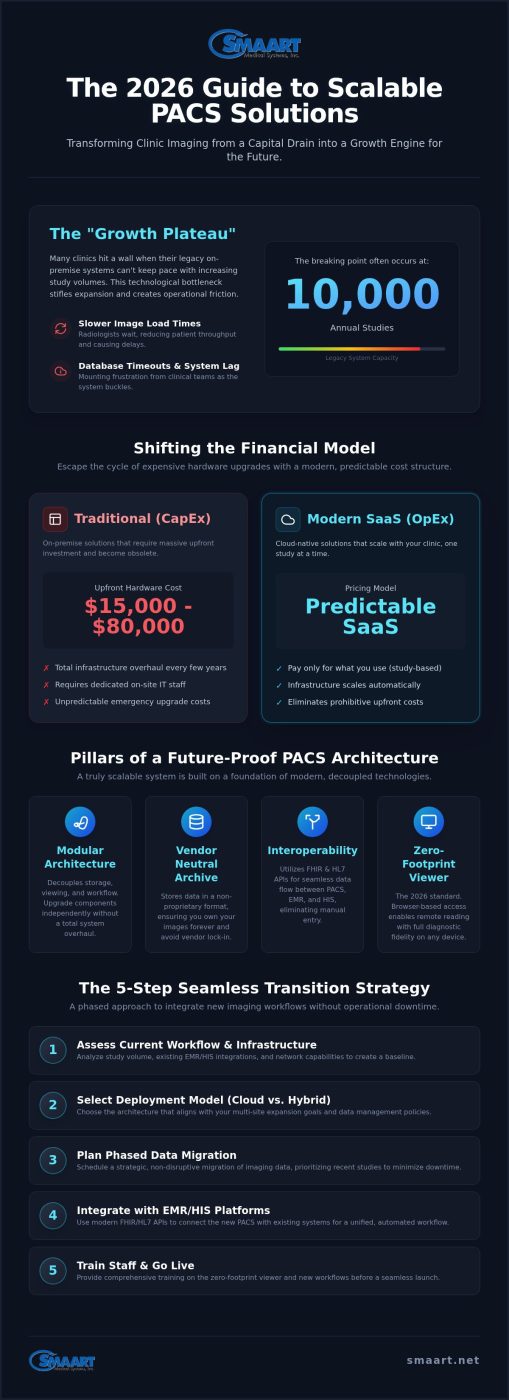
Many clinics reach a point where their initial technology investment begins to push back. This “Growth Plateau” often occurs when a facility hits approximately 10,000 studies annually. At this volume, legacy systems that worked for a single-modality office start to buckle. You’ll notice the signs: slower image load times, database timeouts, and mounting frustration from your clinical team. A traditional Picture archiving and communication system (PACS) wasn’t built for the elastic demands of 2026. Instead of a monolithic software package that requires a total replacement every five years, modern clinics need scalable PACS solutions for growing clinics that function as modular ecosystems.
When scalability is ignored, the hidden costs accumulate quickly. These aren’t just software license fees; they’re the expenses of emergency server upgrades and the lost revenue from physicians who can’t read studies efficiently. High-caliber radiologists now prioritize facilities with modern, responsive interfaces. If your system lags, you’ll struggle with physician recruitment and teleradiology partnerships, as external readers won’t tolerate clunky, non-responsive workflows. Moving to a modular architecture ensures that your tech stack remains an asset rather than a bottleneck.
The Financial Impact of Scalable Architecture
The most immediate relief comes from shifting your financial strategy. Transitioning from a heavy Capital Expenditure (CapEx) model to an Operational Expenditure (OpEx) SaaS model removes the $15,000 to $80,000 upfront hardware burden typical of older systems. This predictable monthly pricing ensures your ROI remains stable even as your imaging volumes fluctuate. Cloud-native tools also reduce your reliance on specialized on-site IT staffing. You don’t need a dedicated server room or a full-time technician to manage updates; the infrastructure scales automatically in the background, allowing your team to focus on patient care.
Operational Efficiency and Patient Throughput
System lag during peak hours is more than a technical nuisance; it’s a patient satisfaction issue. When a radiologist waits thirty seconds for a series to load, the entire diagnostic loop slows down. This delay ripples through your clinic, pushing back appointment times and reducing daily throughput. Implementing integrated RIS PACS solutions allows for automated image routing across multi-site clinics. This ensures that the right study reaches the right specialist instantly, regardless of where the patient was scanned. By decoupling storage from viewing, you maintain high-speed performance even as your database grows into the terabytes.
Technical Pillars of a Future-Proof PACS Architecture
A truly scalable PACS isn’t just a larger hard drive. It’s a modular framework that separates storage, viewing, and workflow management. This decoupling allows you to upgrade one component without breaking the others. For clinics, this means you can add new imaging sites or teleradiology partners without a total system overhaul. While traditional systems often lock you into proprietary silos, modern scalable PACS solutions for growing clinics prioritize Vendor Neutral Archive (VNA) technology. A VNA stores data in a non-proprietary format, ensuring you own your images forever, regardless of which software you use to view them.
Interoperability serves as the backbone of this architecture. As of January 1, 2026, certified EHRs must support FHIR APIs to improve the exchange of imaging and administrative records. This standard, along with HL7, ensures your data flows seamlessly between systems. It eliminates the manual entry errors and data silos that often plague growing practices during expansion.
Zero-Footprint Diagnostic Viewing
Browser-based access has moved from a convenience to a requirement. In 2026, zero-footprint viewing is the standard for diagnostic accuracy. It eliminates the need for expensive, proprietary workstation hardware. Radiologists can now review studies with full fidelity on any high-resolution monitor using standard web browsers. The July 2026 release of the DICOM 2026c standard significantly improved this experience by offering greater efficiency for streaming large datasets across networks. You can explore the technical requirements for this in our guide to the zero footprint PACS viewer.
Modular Cloud-Native Storage
Elastic storage is the financial engine of a growing clinic. Instead of buying servers for “future” capacity, you pay only for the DICOM data you actually generate. Current storage rates range from $0.01 to $0.08 per gigabyte per month, allowing for precise budget forecasting. This distributed cloud environment also provides built-in redundancy. Your data isn’t just on one drive; it’s replicated across secure nodes to ensure instant disaster recovery and 99.9% uptime.
Security remains a top priority for any expanding infrastructure. Recent updates to the HIPAA Security Rule emphasize mandatory AES-256 encryption for ePHI both at rest and in transit. Modern systems also require multi-factor authentication (MFA) to protect against evolving cybersecurity threats. If you’re looking for a partner to simplify this transition, consider exploring the specialized tools available at smaart.net to secure your clinical data and maintain compliance effortlessly.
Comparing Deployment Models: Cloud vs. Hybrid PACS for Growth
Legacy on-premise hardware is no longer a viable path for clinics eyeing expansion. These monolithic systems act as a growth bottleneck, tethering your practice to a physical server room and demanding expensive hardware refreshes every few years. In contrast, modern scalable PACS solutions for growing clinics offer deployment models that adapt to your specific operational needs. Choosing between a pure cloud or a hybrid model depends on three primary factors: your available bandwidth, the complexity of your imaging modalities, and your long-term total cost of ownership goals.
A pure cloud deployment removes the burden of local maintenance. It’s the fastest way to scale across multiple locations because it bypasses the need for site-specific hardware installations. This model excels in remote reading environments, providing radiologists with the same high-speed access whether they are in the clinic or at home. For administrators, the shift from a hardware-heavy budget to a predictable subscription model provides the financial clarity needed to plan for future growth without the fear of hidden upgrade costs.
When to Choose Pure Cloud Solutions
Pure cloud systems are the gold standard for clinics without dedicated IT departments or server infrastructure. These platforms handle all software updates, security patches, and database optimizations automatically in the background. This ensures your system is always running the latest version without manual intervention or downtime. By adopting enterprise PACS solutions, growing networks can centralize their management. This allows a single administrator to oversee imaging workflows across dozens of sites from one dashboard, ensuring consistency and compliance across the entire organization.
The Case for Hybrid Scalability
While cloud is the future, some clinics benefit from a hybrid approach to manage high-volume modalities. Large datasets from 3D Mammography or Cardiac CT can occasionally strain standard internet connections during peak hours. A hybrid model places a local cache server on-site to provide immediate image rendering for the reading radiologist. This setup ensures that high-resolution studies load instantly, regardless of external network traffic.
Hybrid scalability also serves as a critical fail-safe for business continuity. If a local internet outage occurs, the local cache allows your clinical team to continue scanning and reading studies without interruption. Once the connection is restored, the system automatically syncs the new data to the secure cloud archive. This strategy is particularly effective for clinics in areas with inconsistent bandwidth or those processing exceptionally high daily study volumes that require zero-latency performance.
5 Steps to Transition Your Imaging Workflow Without Downtime
Transitioning to scalable PACS solutions for growing clinics doesn’t have to disrupt patient care or freeze your clinical operations. Success starts with a comprehensive digital audit of your current imaging volumes and storage requirements. You need a clear picture of your data footprint and modality performance before moving a single byte. Once the audit is complete, select a platform that prioritizes seamless, bi-directional integration with your existing Electronic Medical Record (EMR) and Hospital Information System (HIS). This ensures that your technology stack works as a unified whole rather than a collection of disconnected silos.
Planning your data migration requires choosing between a “Big Bang” transition or a phased approach. For most expanding clinics, a phased migration offers the lowest risk. You can prioritize current and recent studies for immediate cloud access while migrating historical archives in the background. This strategy ensures your radiologists have the data they need for today’s appointments without overwhelming your local bandwidth. Finally, establish a feedback loop with your clinical staff. Regular check-ins during the first 90 days allow you to fine-tune automated workflows and resolve bottlenecks before they impact patient throughput.
EMR and RIS Integration Strategy
Modern efficiency relies on a seamless data flow between your imaging platform and patient records. When your systems communicate effectively, you eliminate the need for manual data entry. This reduces clinical errors and accelerates the entire diagnostic timeline. SMAART-RIS plays a central role in this ecosystem by managing clinical scheduling and patient data management. By unifying your RIS and PACS, you ensure that every exam is correctly linked to the patient’s history from the moment they check in, providing a smoother experience for both staff and patients.
Managing the Human Element of Growth
Technology is only as effective as the people using it. Onboarding your radiologists to browser-based, zero-footprint diagnostic tools requires clear training on remote reading capabilities. These tools allow your team to provide high-quality care from any location, which is a significant advantage for practices expanding into new regions. You should also empower your patients by setting up digital access points. Explore the patient portal for medical images to see how digital sharing improves engagement and reduces the administrative burden of physical media.
If you’re ready to modernize your clinic’s infrastructure without the typical growing pains, you can consult with our experts at smaart.net to begin your transition today.
Scaling Smarter with SMAART-PACS and SMAART-SHARE
Growth shouldn’t come with a side of technical debt. SMAART Medical Systems, Inc. understands that clinic administrators need high-performance tools that don’t require a total budget overhaul. SMAART-PACS provides a full-feature radiology management environment at a price point that respects your clinic’s revenue cycle. It’s designed to function as your practice’s growth engine, offering the same elite capabilities as enterprise-level systems without the unnecessary complexity. Choosing scalable PACS solutions for growing clinics requires a partner that values your bottom line as much as your diagnostic accuracy; SMAART-PACS delivers on both fronts.
Our commitment to your success extends beyond software installation. We provide national US support and professional partnership to ensure your imaging infrastructure remains a reliable asset for years. By prioritizing seamless integration with your existing EMR and HIS platforms, we remove the friction often associated with system upgrades. You get a modern, streamlined workflow that allows your clinical team to focus on patient outcomes rather than troubleshooting software conflicts.
Affordable Growth with SMAART-SHARE
One of the most immediate ways to reduce operational overhead is by replacing costly, outdated CDs with SMAART-SHARE. This zero-hardware solution enables secure, cloud-based image distribution and collaboration with a few clicks. Referring physicians gain instant access to studies through a zero-footprint viewer, eliminating the need for them to install proprietary software. This doesn’t just save money on physical media; it significantly improves the referring physician experience, making your clinic the preferred partner for local medical communities.
Future-Proofing with SMAART Medical Systems, Inc.
The healthcare landscape changes fast. Our scalable licensing models are built to adapt as your study volumes increase, ensuring you never pay for capacity you don’t use. We provide continuous software updates to meet evolving 2026 standards, including the latest cybersecurity protocols and interoperability mandates. This proactive approach protects your investment and keeps your clinic at the forefront of medical technology. You can take the next step in hospital imaging workflow optimization by partnering with a team that understands the specific pressures of modern clinic management. We’re here to help you build a resilient, efficient, and profitable imaging department that’s ready for whatever comes next.
Secure Your Clinic’s Future with Modular Imaging Architecture
Choosing scalable PACS solutions for growing clinics is no longer just an IT decision; it’s a strategic move to protect your revenue and operational flow. By shifting from high-cost hardware to modular, cloud-native architecture, you eliminate the technical bottlenecks that often stall expansion. The transition toward a flexible, interoperable imaging ecosystem marks the end of prohibitive upfront costs and the start of sustainable growth. Implementing a system that decouples storage from viewing allows you to scale study-by-study, ensuring you only pay for the capacity you use. This approach provides the relief of predictable monthly SaaS pricing while empowering your radiologists with the freedom of remote reading.
With full-feature PACS, RIS, and SHARE integration, you’re equipped to handle the demands of 2026 and beyond. Ready to eliminate hardware burdens and modernize your workflow? Request a SMAART-PACS Demo and Scalability Assessment to see how we can support your clinic’s expansion. Your path to a more efficient, future-proof practice starts with a partner who understands your unique pressures. We’re here to help you build an imaging department that grows as fast as your vision.
Frequently Asked Questions
What makes a PACS solution ‘scalable’ for a growing medical clinic?
Scalability is defined by a modular architecture that decouples storage, viewing, and workflow management. It allows your system to expand as study volumes increase without requiring a total infrastructure replacement. For many, this means adopting scalable PACS solutions for growing clinics that utilize cloud-native storage. This model lets you add new modalities or locations instantly, ensuring your tech stack remains an asset rather than a bottleneck as you hit growth milestones.
How much does a scalable cloud PACS cost compared to on-premise systems?
While on-premise hardware can cost between $15,000 and $80,000 upfront, cloud systems typically operate on a subscription model. Industry data suggests cloud PACS subscriptions for small to mid-size clinics generally range from $150 to $2,000 per month. This shift from capital expenditure to operational expenditure provides financial relief. It allows clinics to align their technology costs with actual patient volume, making it much easier to manage cash flow during expansion periods.
Can I integrate a new PACS with my clinic’s existing EMR system?
Yes, modern systems are designed for seamless EMR and HIS integration. As of January 1, 2026, certified EHRs are required to support FHIR APIs, which significantly improves interoperability between imaging and administrative records. SMAART-PACS is built to communicate directly with these platforms, ensuring a bi-directional data flow. This integration reduces manual data entry and minimizes clinical errors, allowing your staff to focus on patient care instead of managing disconnected software silos.
What is a zero-footprint PACS viewer and why is it important for growth?
A zero-footprint viewer is a browser-based diagnostic tool that requires no software installation on the local device. It’s critical for growth because it eliminates the need for expensive, proprietary workstation hardware. Radiologists can securely access and read studies from any high-resolution monitor using a standard web browser. This flexibility supports remote reading environments and multi-site expansion, ensuring that your diagnostic capabilities aren’t limited by your physical office space or hardware inventory.
How long does it take to migrate data to a new scalable PACS solution?
Migration timelines vary based on the size of your existing archive, but most clinics opt for a phased approach to avoid downtime. Initial setup and configuration typically take a few weeks. Moving existing image archives to the cloud can range from a few days for smaller practices to several months for larger operations. By prioritizing current studies for immediate access, you can maintain your clinical workflow while historical data migrates in the background.
Does a cloud-based PACS meet HIPAA security standards in 2026?
Yes, cloud-native solutions are built to meet and exceed current HIPAA mandates. In 2026, security protocols emphasize mandatory AES-256 encryption for ePHI both at rest and in transit. Modern platforms also implement multi-factor authentication and robust audit trails to protect patient data. These built-in security features provide a higher level of protection than many traditional on-site servers, which often lack the specialized cybersecurity resources found in distributed cloud environments.
What happens to my imaging workflow if the internet goes down?
Most scalable PACS solutions for growing clinics utilize a hybrid model or local caching to ensure business continuity. If your internet connection fails, a local cache server allows your team to continue scanning and reading studies without interruption. Once connectivity is restored, the system automatically synchronizes the new data with the secure cloud archive. This fail-safe mechanism ensures that your diagnostic loop remains active even during temporary network outages.
Is SMAART-PACS compatible with all imaging modalities (MRI, CT, X-ray)?
SMAART-PACS is fully compatible with all standard DICOM modalities, including MRI, CT, X-ray, and Ultrasound. It’s designed as a comprehensive Picture Archiving and Communication System that integrates with your existing hospital or clinic infrastructure. Whether you’re managing high-volume CT datasets or standard digital radiography, the system provides a full-feature radiology workflow. This broad compatibility ensures that you can centralize all your imaging data within a single, streamlined management environment.